Quick Answer
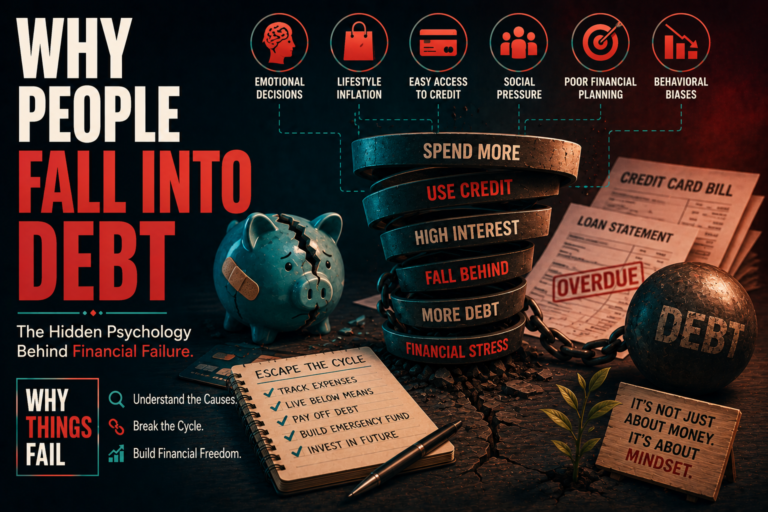
People rarely fall into debt because of a single financial mistake. Debt usually develops through a combination of emotional decision making, lifestyle inflation, poor financial planning, easy access to credit, social pressure and behavioural biases. Debt is often the visible result of deeper psychological and financial patterns that build over time.
Introduction
Debt has become one of the defining financial challenges of modern life.
Across every income level, millions of people struggle with credit card balances, personal loans, mortgages, student loans and other financial obligations. Some fall into debt because of unexpected emergencies, while others gradually accumulate liabilities despite earning stable incomes.
At first glance, debt appears to be a mathematical problem.
People spend more than they earn.
Yet this explanation barely scratches the surface.
If debt were simply about arithmetic, financial failure would be easy to avoid. People would borrow only when necessary, repay loans on time and carefully manage their expenses.
Reality is far more complicated.
Many individuals understand that excessive borrowing is risky, yet continue making financial decisions that increase their obligations. Others promise themselves they will repay debt quickly, only to find balances growing faster than expected. Some escape debt temporarily before falling back into the same pattern a few years later.
This raises a deeper question.
Why do intelligent and hardworking people repeatedly fall into debt despite understanding its consequences?
The answer lies beyond income, interest rates and monthly payments.
Debt is often the result of predictable patterns in human behaviour, financial psychology and the incentives built into modern consumer economies. Understanding these forces reveals why debt is rarely caused by one poor decision. Instead, it emerges from many small decisions that appear harmless in isolation but become financially destructive when repeated over time.
What Is Debt?
Debt is money borrowed with the expectation that it will be repaid in the future, usually with interest.
Borrowing itself is not a financial failure.
Businesses borrow to expand operations.
Governments borrow to finance infrastructure.
Families borrow to purchase homes.
Students borrow to invest in education.
In many situations, debt can support long term financial growth when it is carefully managed and matched with future earning potential.
Financial failure begins when debt consistently grows faster than a person’s ability to repay it.
At this point, debt stops serving future opportunities and begins restricting financial freedom.
Monthly repayments consume increasing portions of income.
Savings become more difficult.
Unexpected expenses create additional borrowing.
Eventually, debt becomes self reinforcing, making financial recovery progressively harder.
The problem is therefore not borrowing alone.
It is losing control of the relationship between borrowing, income and future obligations.
The Biggest Myth
One of the most common beliefs about debt is that it only affects people who are irresponsible with money.
This assumption is both inaccurate and misleading.
People from every income group experience financial difficulties. High earners, professionals, entrepreneurs and business owners can accumulate significant debt despite earning substantial incomes.
Behavioural economists have consistently found that financial decisions are influenced by psychological biases rather than intelligence alone.
People often make decisions based on optimism, immediate rewards and emotional comfort rather than long term financial outcomes.
Easy access to credit further reinforces this behaviour.
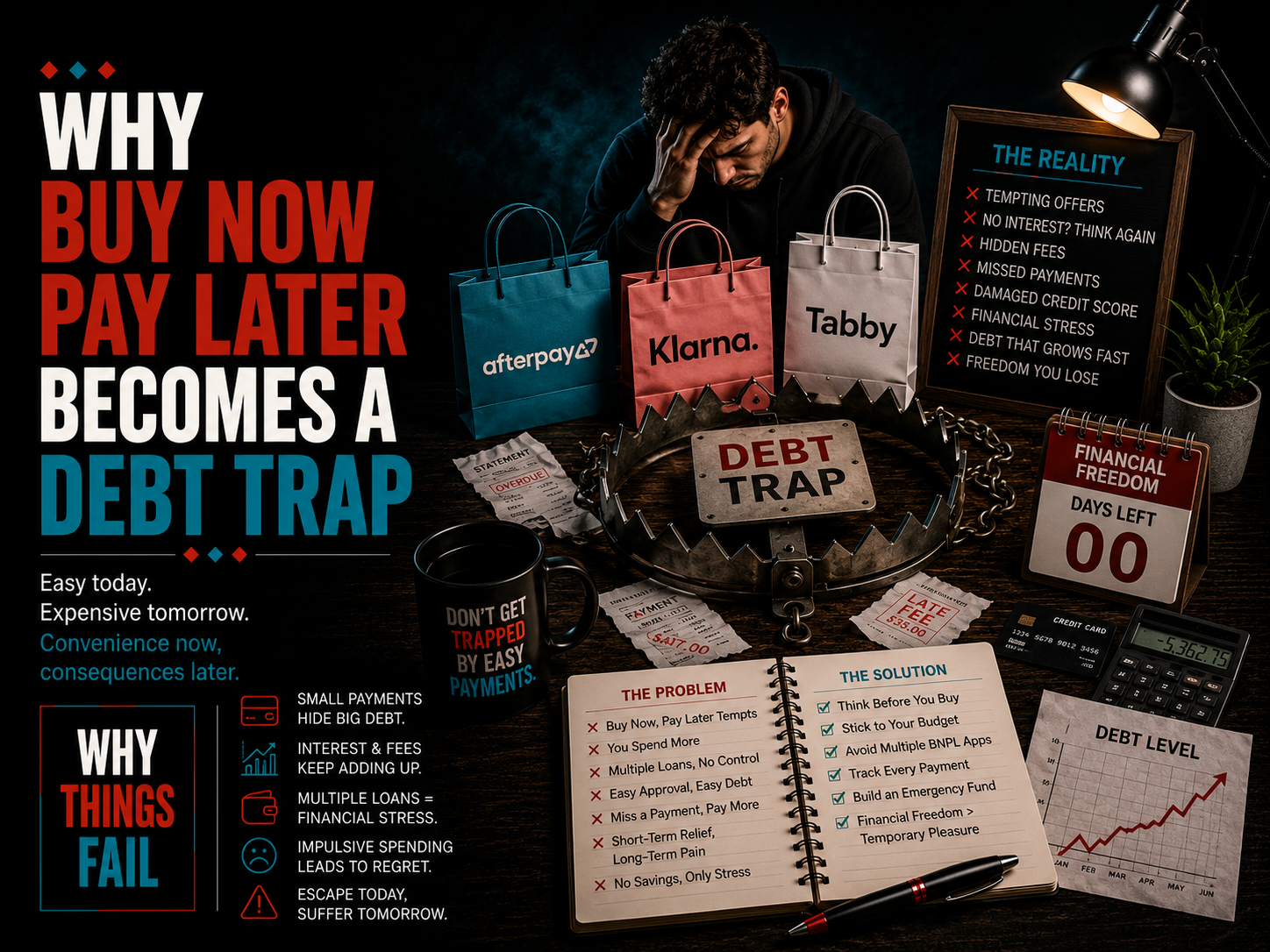
Credit cards, buy now pay later services and personal loans reduce the immediate pain of spending. Consumers receive the benefit today while postponing the financial cost until later.
This separation between consumption and payment weakens natural spending discipline.
The result is that debt often develops gradually, not because people lack intelligence, but because the financial system encourages decisions that prioritise present satisfaction over future stability.
What Usually Happens?
Debt rarely appears overnight.
It usually follows a predictable progression.
Spending begins to increase.
Credit provides temporary flexibility.
Repayments remain manageable.
Confidence grows.
Borrowing becomes normal.
Unexpected expenses appear.
Income struggles to keep pace with financial commitments.
Minimum repayments replace full repayments.
Interest charges accumulate.
New borrowing is used to repay existing borrowing.
Over time, financial pressure increases while flexibility disappears.
Although the circumstances vary between individuals, the underlying pattern remains remarkably similar.
Debt grows quietly long before it becomes a visible financial crisis.
Why Do People Fall Into Debt?
The most important question is not why people borrow.
The more revealing question is why borrowing gradually becomes unsustainable.
Financial markets have offered credit for centuries, yet modern debt levels continue rising in many economies.
The explanation extends beyond personal responsibility.
It involves psychology, incentives, consumer culture and decision making under uncertainty.
Present Bias Encourages Immediate Rewards
Behavioural economists describe present bias as the tendency to value immediate rewards more highly than future consequences.
This bias affects almost every financial decision.
Buying a product today produces immediate satisfaction.
Paying for it months later feels distant and abstract.
The human brain naturally gives greater importance to present emotions than future obligations.
Credit products take advantage of this tendency.
Consumers experience the pleasure of ownership immediately while postponing the discomfort of payment.
Because future costs feel psychologically smaller than present benefits, borrowing becomes easier than delaying gratification.
Over time, repeated decisions based on present bias gradually increase financial commitments without creating the feeling that significant debt is accumulating.
Lifestyle Inflation Quietly Expands Financial Commitments
One of the strongest predictors of long term debt is lifestyle inflation.
As income increases, spending often increases at a similar or even faster rate.
Higher earnings create expectations of a better lifestyle.
Larger homes.
New vehicles.
Luxury holidays.
Premium subscriptions.
Frequent dining out.
These expenses may appear affordable individually.
Collectively, they reduce financial flexibility.
The problem is not necessarily luxury itself.
The problem is allowing permanent spending to rise every time income rises.
Eventually, people become financially dependent on maintaining a lifestyle that requires continued borrowing whenever unexpected expenses occur.
Lifestyle inflation therefore reduces resilience.
Instead of increasing financial security, higher income simply supports higher obligations.
Social Comparison Changes Spending Behaviour
Humans naturally compare themselves with others.
Behavioural psychology shows that satisfaction often depends less on absolute wealth and more on perceived social position.
This creates powerful financial incentives.
Social media constantly exposes people to expensive lifestyles, luxury purchases and apparent financial success.
Friends purchase larger homes.
Colleagues upgrade their cars.
Influencers display designer brands and luxury holidays.
Although these images rarely reveal underlying debt, they shape expectations about what appears normal.
People begin spending to maintain social identity rather than genuine financial need.
Consumer behaviour becomes influenced by status instead of long term affordability.
Debt gradually becomes the hidden cost of trying to match lifestyles that may themselves be financed through borrowing.
Financial Education Often Focuses On Numbers Rather Than Behaviour
Many people understand interest rates, monthly repayments and budgeting.
Yet they continue making decisions that increase debt.
Why?
Because financial behaviour depends on psychology as much as mathematics.
Knowing how compound interest works does not automatically reduce emotional spending.
Understanding budgeting does not eliminate impulsive purchases.
The gap between knowledge and behaviour explains why financial education alone often produces limited results.
People rarely fall into debt because they cannot calculate repayments.
They fall into debt because emotions frequently override calculations during everyday financial decisions.
The challenge is therefore behavioural rather than purely educational.
Easy Credit Reduces The Feeling Of Financial Risk
Modern financial systems have made borrowing remarkably convenient.
Credit approvals take minutes.
Digital payments require little thought.
Installment plans reduce the visible cost of expensive purchases.
Each innovation improves convenience.
At the same time, it weakens the psychological connection between spending and payment.
Consumers no longer experience the immediate loss associated with handing over physical money.
Instead, spending becomes almost frictionless.
This reduction in financial friction encourages more frequent borrowing and higher overall consumption.
The consequences appear much later when repayments begin competing with future income.
By then, many of the decisions responsible for the debt have already become habits rather than isolated purchases.
Warning Signs
People rarely wake up one morning overwhelmed by debt. Financial pressure usually builds slowly through a series of warning signs that appear manageable in isolation.
One of the earliest indicators is relying on credit for everyday living expenses rather than unexpected emergencies. When groceries, utility bills or routine purchases are regularly financed through borrowing, debt is beginning to replace income as the primary source of financial support.
Another warning sign is making only minimum repayments. Although this provides temporary relief, it often allows interest charges to grow faster than the outstanding balance declines. Progress appears to be happening, yet the underlying financial position changes very little.
Lifestyle commitments that cannot easily be reduced also signal increasing financial vulnerability. Monthly payments for expensive vehicles, luxury subscriptions or frequent discretionary spending reduce flexibility when income falls or unexpected expenses arise.
Avoiding financial statements is another behavioural warning sign. Many people stop checking balances because doing so creates anxiety. Ignoring the numbers provides temporary emotional comfort while allowing the financial problem to grow unnoticed.
Perhaps the strongest warning sign is believing that future income will solve today’s borrowing. Promotions, bonuses or business growth may eventually occur, but building financial decisions around uncertain future earnings often leads to greater debt rather than financial stability.
These warning signs are frequently ignored because debt usually grows gradually. Small increases in borrowing feel insignificant until accumulated obligations become difficult to manage.
What Could Have Prevented It?
Preventing excessive debt is less about perfect budgeting and more about improving financial decision making before borrowing becomes habitual.
One important safeguard is recognising the difference between temporary financial pressure and permanent lifestyle commitments. Borrowing for a short term emergency may be manageable. Borrowing to maintain an unaffordable standard of living often creates ongoing financial strain.
Building financial flexibility is equally important. Savings provide options during unexpected events, reducing the need to rely on expensive credit products when income is disrupted or emergency expenses arise.
Consumers also benefit from introducing friction into spending decisions. Delaying significant purchases by even a few days creates time for rational evaluation instead of emotional impulse. Behavioural research consistently shows that reducing impulsive decisions leads to better financial outcomes.
Financial planning should extend beyond monthly budgeting. Understanding future obligations, expected income changes and potential financial risks creates a more realistic picture of long term affordability.
Finally, improving financial systems matters as much as improving individual behaviour. Transparent lending practices, clearer disclosure of borrowing costs and responsible credit assessments help reduce the likelihood that consumers accumulate debt beyond their repayment capacity.
Debt prevention is therefore not simply an individual responsibility. It is also influenced by the design of financial products and the incentives within the wider economy.
Lessons
The investigation into debt reveals lessons that extend far beyond personal finance.
The first lesson is that financial failure is rarely caused by one dramatic mistake. It usually develops through small decisions repeated consistently over months or years. These decisions appear harmless individually but become significant when combined.
The second lesson is that emotions influence spending more than logic. Purchases often satisfy psychological needs such as status, comfort, convenience or belonging rather than genuine necessity. Understanding these motivations explains why debt frequently persists despite good intentions.
Another lesson is that financial resilience depends on flexibility. Individuals who maintain lower fixed commitments and preserve financial reserves are better equipped to absorb unexpected shocks without relying heavily on borrowing.
Perhaps the most important lesson is that modern financial systems reward consumption today while delaying the financial consequences until tomorrow. Recognising this structure allows people to understand that debt is often encouraged by incentives as much as individual choices.
Failure Pattern
The dominant pattern behind excessive debt is Lifestyle Inflation combined with Short Term Thinking and Emotional Decision Making.
As income grows, spending grows alongside it. Easy access to credit removes the immediate pain of payment. Social comparison encourages higher consumption, while present bias places greater value on today’s satisfaction than tomorrow’s financial obligations.
Over time these behaviours become normal.
Borrowing no longer feels exceptional.
It becomes part of everyday financial management.
The same pattern appears in households, businesses and even governments. When current consumption consistently receives greater priority than future financial stability, debt gradually expands until flexibility disappears.
The financial outcome changes from one situation to another.
The behavioural pattern remains remarkably consistent.
Hidden Lesson
Debt is rarely the original problem.
It is usually the visible symptom of deeper behavioural and structural forces.
People often believe debt begins with borrowing.
In reality, it often begins much earlier with repeated decisions that prioritise immediate comfort over future resilience.
Financial systems make borrowing increasingly convenient because lending generates economic activity and commercial profit. Human psychology makes delayed consequences easier to ignore than immediate rewards.
Debt therefore emerges where these two forces meet.
The deeper lesson is that financial failure is often created long before the first missed payment. It begins when repeated behavioural choices gradually weaken the ability to absorb uncertainty.
Failure Scorecard
| Area | Score | Explanation |
| Financial Discipline | 4/10 | Spending frequently grows alongside income while borrowing becomes increasingly normal. |
| Decision Making | 5/10 | Many borrowing decisions prioritise immediate needs over future affordability. |
| Risk Management | 4/10 | Unexpected financial shocks often expose limited emergency preparation. |
| Long Term Thinking | 4/10 | Present rewards commonly outweigh consideration of future financial obligations. |
| Financial Knowledge | 6/10 | Many people understand borrowing but underestimate its behavioural impact. |
| Emotional Control | 4/10 | Emotional spending and social comparison strongly influence consumption. |
| Planning | 5/10 | Long term financial planning is often replaced by short term budgeting. |
| Adaptability | 6/10 | Financial recovery is possible, but many continue following established spending patterns despite growing debt. |
Key Takeaways
- People usually fall into debt through repeated behavioural decisions rather than one major financial mistake.
- Present bias encourages spending today while ignoring future repayment obligations.
- Lifestyle inflation often increases financial commitments as income rises.
- Social comparison can influence spending more than genuine financial need.
- Easy access to credit weakens the psychological connection between spending and payment.
- Financial knowledge alone does not prevent debt if behaviour remains unchanged.
- Financial flexibility is one of the strongest protections against excessive borrowing.
- Debt reflects the interaction between human psychology and the incentives created by modern financial systems.
Frequently Asked Questions
Why do people fall into debt even with a good income?
High income does not guarantee financial stability. Lifestyle inflation, emotional spending and increasing financial commitments can cause debt to grow faster than earnings.
What is the biggest psychological reason people fall into debt?
Present bias is one of the strongest behavioural drivers. People naturally value immediate rewards more highly than future financial costs, making borrowing feel easier than delaying consumption.
Is all debt considered bad?
No. Debt can support education, home ownership or business growth when it is affordable and aligned with long term financial objectives. Financial failure occurs when debt grows faster than repayment capacity.
How does social pressure contribute to debt?
People often compare their lifestyles with those of friends, colleagues or social media personalities. This comparison encourages higher spending, even when those purchases require borrowing.
Why is debt difficult to escape?
Debt often becomes self reinforcing. Interest charges reduce available income, making additional borrowing more likely when unexpected expenses occur. Without addressing the underlying behavioural patterns, the cycle can continue.
Conclusion
People rarely fall into debt because they suddenly become financially irresponsible. Debt usually develops through predictable interactions between human psychology, consumer incentives and gradual behavioural change. Each borrowing decision may appear reasonable in isolation, yet together they create a financial system that becomes increasingly difficult to escape.
Understanding why people fall into debt changes the conversation from blaming individual choices to recognising the deeper patterns that make financial failure predictable. Debt is often not the beginning of the problem. It is the final expression of decisions, behaviours and incentives that have been shaping financial outcomes long before the first payment was missed.