
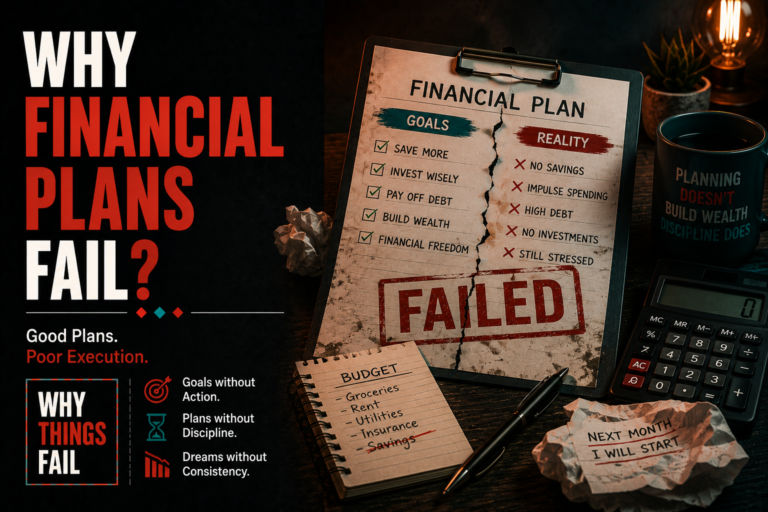
Quick Answer
Financial plans usually fail not because the numbers are wrong, but because human behaviour changes over time. Emotional spending, lifestyle inflation, short term thinking, poor risk management and unrealistic assumptions gradually weaken even well designed plans. The real challenge is not creating a financial plan. It is consistently following one through changing circumstances and emotions.
Introduction
Most people have some form of financial plan.
They may want to save for a home, eliminate debt, build an investment portfolio, fund their children’s education or retire comfortably. Businesses create budgets and forecasts. Investors design long term strategies. Governments publish economic plans.
Yet many of these plans fail.
Savings targets are missed. Debt grows faster than expected. Investments are abandoned during market downturns. Businesses overspend. Retirement goals become increasingly distant.
This failure is surprisingly common because financial planning appears straightforward. The mathematics is often simple. Income is estimated, expenses are projected and future goals are calculated.
What is difficult is predicting human behaviour.
People change careers. Families grow. Markets fluctuate. Priorities shift. Emotions intervene. Unexpected events occur. Most importantly, the person who creates the plan is rarely the same person who must follow it years later.
Understanding why financial plans fail therefore requires looking beyond spreadsheets and budgets. It requires examining psychology, incentives, risk perception and the systems that shape financial decisions over time.
What Is Financial Plan Failure?
Financial plan failure does not simply mean becoming bankrupt.
More often, it means gradually drifting away from intended financial outcomes.
A household may save far less than planned. An investor may abandon a long term strategy during a market decline. A business may consistently exceed its budget. A professional may delay retirement because earlier savings goals were not achieved.
The common feature is not a single catastrophic event.
It is the growing gap between planned behaviour and actual behaviour.
That gap is where most financial plans begin to fail.
The Biggest Myth
The biggest myth is that financial plans fail because people lack financial knowledge.
Knowledge matters, but it is rarely the primary problem.
Many people understand that saving regularly is beneficial. They know excessive debt is risky. They recognise the importance of investing for the long term.
Yet understanding and doing are very different things.
Behavioural economists have repeatedly found that people often make decisions that conflict with their stated goals. The challenge is not merely knowing what is sensible. The challenge is acting sensibly when emotions, social pressures and short term incentives point in another direction.
Financial planning is therefore less a mathematics problem and more a behaviour problem.
What Usually Happens?
Most financial plans fail through a predictable progression.
- A plan is created with optimism.
- Initial progress is encouraging.
- Life becomes busier.
- Unexpected expenses appear.
- Small exceptions are made.
- Goals are postponed.
- Spending gradually rises.
- Reviews become less frequent.
- The plan quietly loses relevance.
- Years later, the intended outcome is no longer achievable without significant changes.
The failure rarely feels dramatic in real time.
That is precisely why it is so dangerous.
Why Does It Happen?
This is the most important question.
Financial plans fail because they are created by one version of ourselves and executed by another.
The planner is usually rational, optimistic and future focused.
The executor is dealing with real bills, real temptations, real stress and real uncertainty.
That difference creates a behavioural conflict that many plans never overcome.
Present Bias Makes The Future Feel Less Important
One of the strongest forces in behavioural economics is present bias, the tendency to value immediate rewards more highly than future benefits.
Saving for retirement provides a benefit decades away.
Buying something enjoyable provides a benefit today.
Even when people genuinely want long term financial security, the immediate reward often feels more compelling.
This is why many financial plans begin with good intentions but gradually lose momentum.
The future remains important in theory, while the present becomes more persuasive in practice.
Lifestyle Inflation Quietly Consumes Progress
Few forces undermine financial plans more consistently than lifestyle inflation.
When income rises, spending often rises with it.
A larger home feels reasonable.
A better car feels deserved.
More frequent holidays feel affordable.
Each decision appears manageable on its own.
Together, they create a permanent increase in financial obligations.
The problem is not occasional spending.
It is converting temporary income growth into permanent lifestyle costs.
Many financial plans fail not because income was insufficient, but because rising income never translated into rising financial capacity.
Overconfidence Creates Unrealistic Assumptions
People tend to be overly optimistic about future earnings, investment returns and self discipline.
They assume promotions will arrive, businesses will grow, investments will perform well and saving habits will remain consistent.
This overconfidence bias leads to financial plans built on favourable assumptions rather than resilient assumptions.
When reality turns out to be less generous than expected, the plan becomes increasingly difficult to maintain.
Emotional Spending Overrides Rational Planning
Financial plans are usually created during calm moments.
Spending decisions are often made during emotional moments.
Stress, boredom, celebration, anxiety and social comparison all influence purchasing behaviour.
People rarely say, “I am abandoning my financial plan today.”
Instead, they make a series of emotionally justified exceptions that gradually weaken the plan’s foundation.
Social Pressure Changes Financial Priorities
Humans are social creatures.
We compare our homes, holidays, schools, cars and lifestyles with those around us.
Financial plans that look sensible in isolation may feel restrictive when peers appear to be spending more freely.
This creates a powerful incentive to prioritise visible consumption over invisible financial progress.
The pressure is often subtle, but its long term effects can be significant.
Plans Ignore Uncertainty
Many financial plans are built as if life will unfold smoothly.
In reality, careers change, health issues arise, families evolve, markets fluctuate and economic conditions shift.
A plan that works only under ideal conditions is often fragile.
Resilient plans require flexibility, buffers and the recognition that uncertainty is normal rather than exceptional.
Delayed Consequences Hide The Damage
Perhaps the most important reason financial plans fail is that poor decisions are rarely punished immediately.
Skipping one investment contribution feels harmless.
Adding a small monthly expense feels manageable.
Taking on slightly more debt seems affordable.
The consequences emerge slowly.
Years later, the cumulative effect becomes obvious.
Behavioural economists call this delayed feedback. When the cost of a decision is postponed, people consistently underestimate its importance.
Financial plans often fail not because of one disastrous mistake, but because hundreds of small decisions accumulate quietly over time.
By the time the gap becomes visible, reversing it is far more difficult than it would have been earlier.
Warning Signs
Financial plans rarely fail without warning.
The difficulty is that the warning signs often appear ordinary. They develop slowly, making them easy to justify and even easier to ignore.
One of the earliest indicators is regularly spending more than originally planned while promising to compensate later. Individuals convince themselves that future income will solve today’s financial imbalance. Over time, these temporary exceptions become permanent habits.
Another warning sign is stopping regular financial reviews. A financial plan is not a document that should remain untouched for years. It is a decision making framework that requires continual adjustment as income, expenses, family responsibilities and economic conditions change. When people stop reviewing their finances, small problems grow unnoticed.
Lifestyle inflation is another clear signal. A salary increase should strengthen financial security, yet many people immediately increase their standard of living. Larger financial commitments leave less room for saving, investing and managing unexpected events.
Growing dependence on debt should also raise concern. Credit cards, personal loans and financing arrangements often create the illusion that financial goals remain achievable, even when spending consistently exceeds available resources. Debt temporarily hides financial pressure instead of solving it.
Perhaps the most overlooked warning sign is losing sight of the original purpose behind the financial plan. When daily financial decisions become disconnected from long term objectives, the plan gradually becomes irrelevant. Without a meaningful objective, discipline becomes increasingly difficult to maintain.
These warning signs are frequently ignored because they rarely create immediate consequences. Financial deterioration usually occurs quietly, allowing behavioural mistakes to become deeply established before their true cost becomes visible.
What Could Have Prevented It?
Most financial plans fail because they are designed for ideal circumstances instead of real life.
A more resilient approach begins by recognising that uncertainty is inevitable rather than exceptional.
Successful financial planning depends on building systems rather than relying on motivation. Automated saving, scheduled financial reviews, realistic spending limits and emergency reserves reduce the need for constant willpower. Systems create consistency even when emotions fluctuate.
Flexibility is equally important. Financial plans should adapt to changing careers, family responsibilities, inflation, interest rates and unexpected events. A rigid plan often collapses when reality differs from original assumptions.
Another essential safeguard is conservative planning. Assuming continuous salary growth, exceptional investment returns or perfect financial discipline creates fragile expectations. Plans built around realistic assumptions remain effective even when conditions become difficult.
Behavioural awareness also improves financial outcomes. Understanding present bias, loss aversion, overconfidence and social comparison enables individuals to recognise when emotions are influencing decisions. Awareness cannot eliminate psychological biases, but it can reduce their impact.
Most importantly, financial planning should be viewed as an ongoing process rather than a one time event. Reviewing progress regularly allows small adjustments before they develop into major financial setbacks.
Lessons
The investigation into why financial plans fail reveals lessons that extend well beyond personal finance.
The first lesson is that behaviour consistently outweighs intention. Creating an excellent financial plan requires only a few hours. Following it successfully requires years of disciplined decisions.
The second lesson is that financial success depends more on consistency than intensity. Small, repeated actions often produce greater long term results than occasional periods of exceptional discipline followed by neglect.
Another lesson is that uncertainty should be expected rather than feared. Plans built around perfect conditions usually fail because real life rarely follows predictable patterns. Financial resilience comes from preparing for change rather than assuming stability.
Perhaps the most valuable lesson is that financial planning is fundamentally a behavioural exercise. Income, investments and budgets matter, but they are ultimately shaped by daily decisions, emotional control and long term thinking.
Failure Pattern
The dominant pattern behind financial plan failure is Poor Planning reinforced by Short Term Thinking and Lifestyle Inflation.
This pattern repeats because people naturally respond to immediate needs more strongly than distant rewards. As income increases, spending expands. As financial pressure rises, saving becomes easier to postpone. Each decision appears insignificant on its own, yet together they gradually weaken the entire financial plan.
The same behavioural pattern appears in households, businesses and investment portfolios. Organisations frequently exceed budgets after periods of growth. Entrepreneurs overestimate future revenue. Investors abandon carefully designed strategies during uncertain markets.
The underlying problem is rarely a lack of intelligence.
It is the tendency to prioritise immediate comfort over long term financial resilience.
Hidden Lesson
The greatest weakness in most financial plans is not the spreadsheet.
It is the assumption that future behaviour will remain perfectly consistent.
Financial planning often treats people as rational decision makers who will always follow predetermined rules. Human behaviour tells a different story.
Emotions change. Circumstances change. Priorities evolve.
The deeper lesson is that financial plans succeed only when they are designed around human behaviour rather than ideal behaviour. The strongest plans recognise psychological limitations instead of assuming they do not exist.
Failure Scorecard
| Area | Score | Explanation |
| Financial Discipline | 5/10 | Many plans fail because consistent financial habits gradually weaken over time. |
| Decision Making | 5/10 | Emotional spending and short term priorities frequently replace objective financial decisions. |
| Risk Management | 6/10 | Many plans overlook unexpected events, inflation and economic uncertainty. |
| Long Term Thinking | 4/10 | Immediate financial needs often take priority over future objectives. |
| Financial Knowledge | 6/10 | Most people understand basic financial principles but struggle to apply them consistently. |
| Emotional Control | 4/10 | Stress, social comparison and lifestyle expectations often influence spending behaviour. |
| Planning | 5/10 | Plans are commonly created without regular reviews or realistic contingency measures. |
| Adaptability | 5/10 | Many financial plans remain unchanged despite significant changes in personal or economic circumstances. |
Key Takeaways
- Financial plans usually fail because behaviour changes while the plan remains static.
- Present bias encourages immediate spending at the expense of future financial security.
- Lifestyle inflation quietly reduces long term wealth even as income grows.
- Small financial decisions create significant consequences when repeated over many years.
- Systems and routines are more reliable than motivation alone.
- Conservative assumptions produce stronger financial plans than optimistic projections.
- Regular financial reviews identify problems before they become difficult to reverse.
- Financial resilience depends on adapting to uncertainty rather than attempting to eliminate it.
Frequently Asked Questions
Why do financial plans fail even when they are well designed?
Well designed financial plans often fail because they assume consistent behaviour. Emotional decisions, changing priorities, unexpected expenses and lifestyle inflation gradually move people away from their original plan.
What is the biggest reason financial plans fail?
The biggest reason is the gap between intention and behaviour. People generally know what they should do financially, but maintaining those decisions over many years is far more difficult than creating the plan itself.
Can a financial plan survive unexpected life changes?
Yes, provided it is flexible. Financial plans that include emergency savings, realistic assumptions and regular reviews are more likely to adapt successfully to changing circumstances.
How does lifestyle inflation affect a financial plan?
Lifestyle inflation increases spending as income grows. While each new expense may appear affordable, the combined effect reduces savings, investment capacity and financial flexibility.
Why is reviewing a financial plan important?
Regular reviews ensure that financial goals, spending patterns and investment strategies remain aligned with changing personal circumstances and economic conditions. Without reviews, small deviations can become significant financial problems.
Conclusion
Financial plans rarely fail because the calculations were inaccurate. They fail because they underestimate the complexity of human behaviour. Every financial decision reflects emotions, incentives, habits and changing circumstances that no spreadsheet can fully predict.
Understanding why financial plans fail transforms the way financial success is viewed. The strongest plans are not those built on perfect forecasts, but those designed to withstand imperfect human behaviour. That distinction explains why lasting financial success depends less on creating an impressive plan and more on building a system capable of surviving reality.
1. Why Financial Plans Fail concept illustration with broken budget and rising expenses
2. Why Financial Plans Fail due to lifestyle inflation and emotional spending
3. Why Financial Plans Fail because of poor planning and delayed financial consequences