Quick Answer
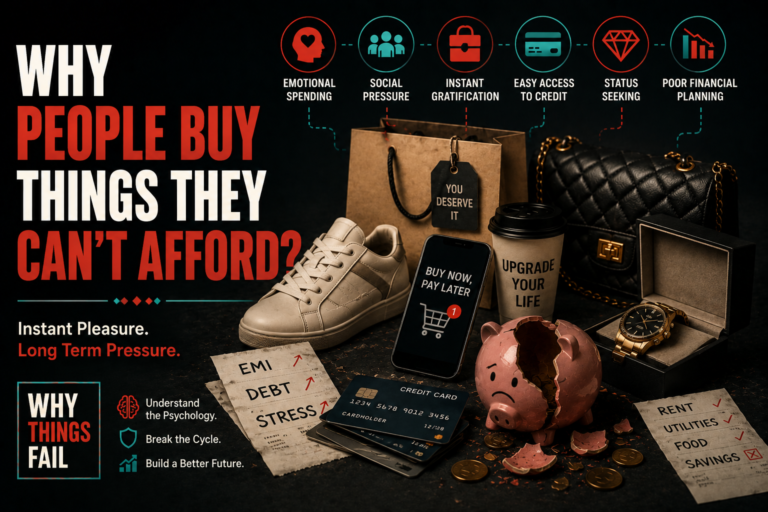
People buy things they cannot afford because spending is often driven by emotion rather than logic. Social pressure, instant gratification, status seeking, behavioural biases, easy access to credit and poor financial planning combine to create spending decisions that feel rewarding today but create financial stress tomorrow.
Introduction
Every day, millions of people make purchases they know they cannot comfortably afford.
Some finance luxury cars while struggling to pay monthly bills. Others buy expensive designer clothing using credit cards that already carry large balances. Many upgrade smartphones every year despite having functioning devices. Some purchase larger homes, lavish holidays or premium lifestyles that exceed their financial capacity.
This behaviour is surprisingly common.
It affects people with low incomes, middle incomes and even high incomes. Increased earnings do not always eliminate financial pressure because spending often rises alongside income.
The question is not whether people understand the price of what they are buying.
Most do.
The more important question is why intelligent and financially responsible individuals repeatedly make purchasing decisions that create long term financial strain.
The answer extends far beyond mathematics.
Buying decisions are shaped by psychology, social expectations, behavioural economics and modern consumer culture. Financial choices are rarely made in isolation. They are influenced by emotions, identity, advertising, digital technology, peer behaviour and the desire to feel successful.
Understanding why people buy things they cannot afford requires looking beyond budgets and bank accounts.
It requires understanding the hidden forces that influence human decision making long before money changes hands.
What Is Financial Overspending?
Financial overspending is not simply purchasing expensive products.
It occurs when spending consistently exceeds what an individual can comfortably support without harming future financial stability.
Someone earning a high income may still overspend if their lifestyle depends entirely on debt or leaves little room for savings, emergencies or unexpected expenses.
Conversely, a modest purchase can represent financial overspending if it creates unnecessary financial pressure.
The problem is therefore not the product itself.
The problem is the gap between immediate desires and long term financial capacity.
Overspending becomes financial failure when repeated purchasing decisions gradually reduce financial flexibility, increase debt and limit future opportunities.
The consequences often develop slowly, making the behaviour appear harmless until financial stress becomes unavoidable.
The Biggest Myth
The most common belief is that people buy things they cannot afford because they lack financial intelligence.
This explanation is appealing because it appears simple.
Unfortunately, it is also incomplete.
Many people who overspend understand budgeting, interest rates and debt. Some are accountants, business owners or experienced professionals who fully understand financial concepts.
Knowledge alone does not guarantee disciplined behaviour.
Behavioural economists have repeatedly demonstrated that people frequently make decisions that conflict with their long term interests.
The reason is that human beings do not make financial decisions through logic alone.
Emotions, habits, identity and social influences often become stronger than rational calculation.
Financial failure therefore reflects a behavioural challenge as much as a mathematical one.
Understanding this distinction changes how we interpret overspending.
Instead of asking why people ignore financial facts, a better question becomes why emotional rewards consistently outweigh future financial consequences.
What Usually Happens?
The pattern is remarkably consistent.
An individual experiences a desire for something that represents comfort, status, convenience or personal success.
The purchase appears manageable because financing options, credit cards or instalment plans reduce the immediate financial impact.
The emotional reward arrives instantly.
The financial cost arrives gradually.
Monthly payments accumulate.
Savings decline.
Unexpected expenses become more difficult to manage.
New purchases replace old ones.
Lifestyle expectations increase.
Eventually, financial obligations consume a growing share of income.
Rather than solving dissatisfaction, increased spending often creates additional financial pressure, encouraging further emotional spending.
The cycle quietly repeats itself.
Financial problems rarely begin with one extravagant purchase.
They emerge through hundreds of ordinary decisions that individually appear reasonable but collectively become unsustainable.
Why Does It Happen?
The reasons people buy things they cannot afford extend far beyond income.
They are rooted in psychology, behavioural economics and the incentives that shape modern consumer societies.
People rarely purchase products simply because they need them.
More often, they purchase what those products appear to represent.
Security.
Recognition.
Status.
Achievement.
Belonging.
Hope.
These emotional motivations explain why spending behaviour often remains unchanged even after financial difficulties become obvious.
The purchase satisfies a psychological need.
The financial consequences remain distant and abstract.
This imbalance creates predictable patterns of financial failure.
Immediate Rewards Defeat Future Consequences
One of the strongest findings in behavioural economics is that people naturally value immediate rewards more highly than future benefits.
Psychologists describe this tendency as present bias.
Receiving pleasure today feels more meaningful than avoiding financial stress months from now.
Buying a luxury handbag, premium watch or expensive holiday creates immediate emotional satisfaction.
Saving that same money produces no comparable emotional reward in the present moment.
The future benefit exists intellectually but not emotionally.
Because the human brain responds more strongly to immediate experiences than distant outcomes, spending often wins against saving even when people understand the long term consequences.
This explains why financial goals frequently lose to short term desires.
The decision is rarely irrational from an emotional perspective.
It simply prioritises present satisfaction over future security.
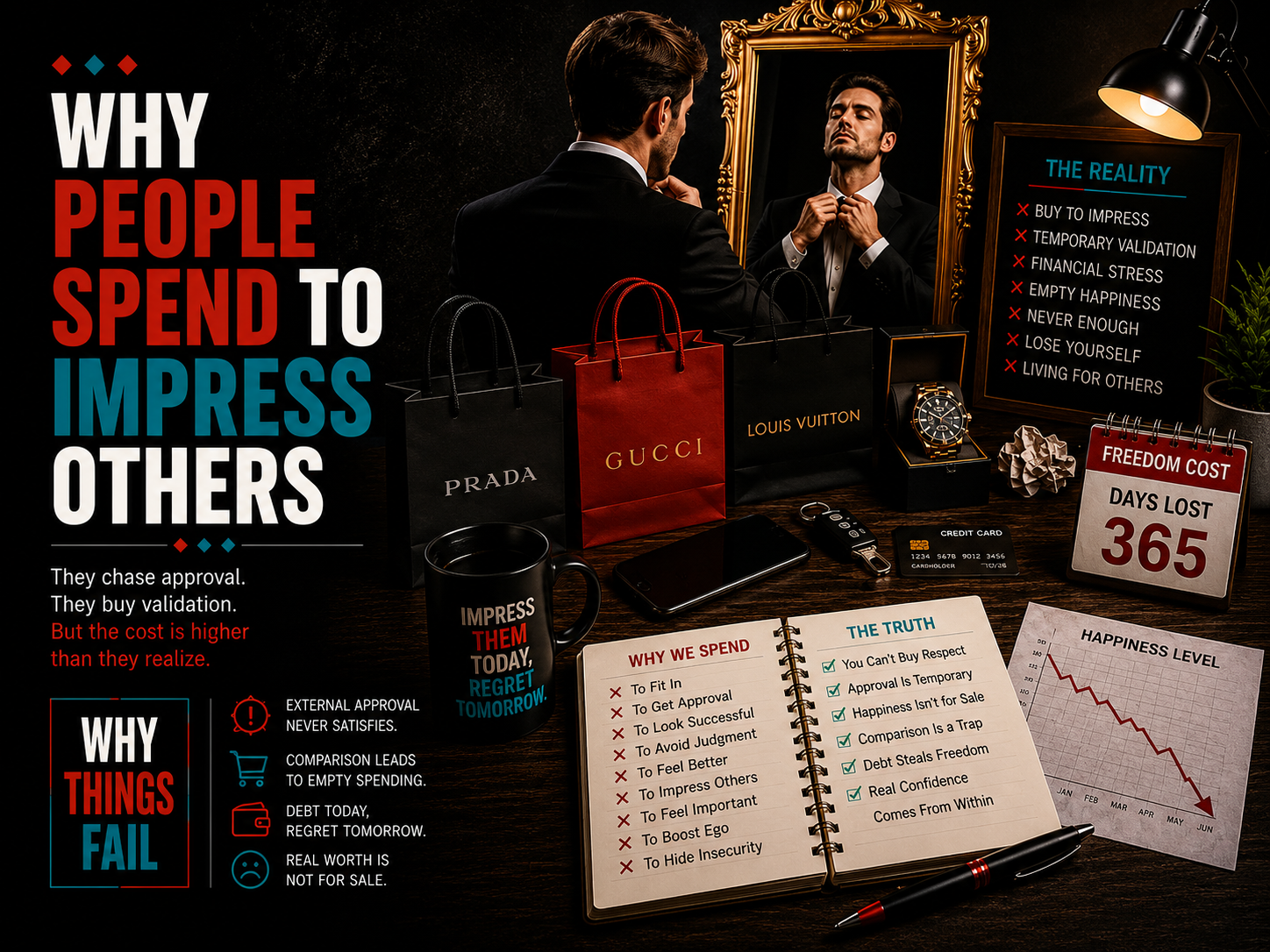
Status Consumption Shapes Financial Decisions
Human beings are deeply influenced by social comparison.
People naturally evaluate their success by comparing themselves with colleagues, neighbours, friends and increasingly, strangers on social media.
This tendency creates status consumption.
Certain products become symbols rather than practical purchases.
Luxury cars signal achievement.
Designer fashion communicates success.
Premium technology represents modernity.
Expensive homes reflect social position.
The purchase is therefore not always about owning the product.
It is about owning the identity associated with the product.
Behavioural researchers have shown that visible products often attract higher spending because they communicate social signals.
Unfortunately, financial obligations remain private while material possessions remain public.
People see the lifestyle.
They rarely see the debt supporting it.
Lifestyle Inflation Happens Quietly
Few people dramatically transform their spending overnight.
Lifestyle inflation develops gradually.
Income increases.
Spending increases alongside it.
A larger salary leads to a larger home.
A promotion encourages a more expensive car.
Higher earnings justify premium holidays, dining experiences and luxury purchases.
Each decision appears affordable in isolation.
Together they create a financial structure where expenses expand as quickly as income.
Instead of increasing financial security, higher earnings simply support higher living costs.
This explains why individuals earning substantial incomes may still experience financial stress.
The problem is not insufficient earnings.
It is that rising income changes spending expectations faster than financial priorities.
Marketing Exploits Emotional Decision Making
Modern marketing rarely focuses only on product features.
Instead, it sells emotions, identity and aspiration.
Advertisements promise confidence, happiness, success and belonging rather than simply promoting products.
Digital platforms strengthen this effect through personalised advertising, behavioural targeting and continuous exposure to carefully curated lifestyles.
Consumers are therefore making decisions inside environments specifically designed to influence attention, emotions and purchasing behaviour.
This does not remove personal responsibility.
It does explain why resisting unnecessary spending requires far more psychological effort than many people realise.
The modern consumer economy rewards spending, encourages convenience and celebrates visible success.
Within such a system, buying beyond one’s financial capacity becomes easier than exercising restraint.
Why Does It Happen? Continued
Easy Credit Makes Expensive Decisions Feel Affordable
Modern financial systems have transformed how people experience spending.
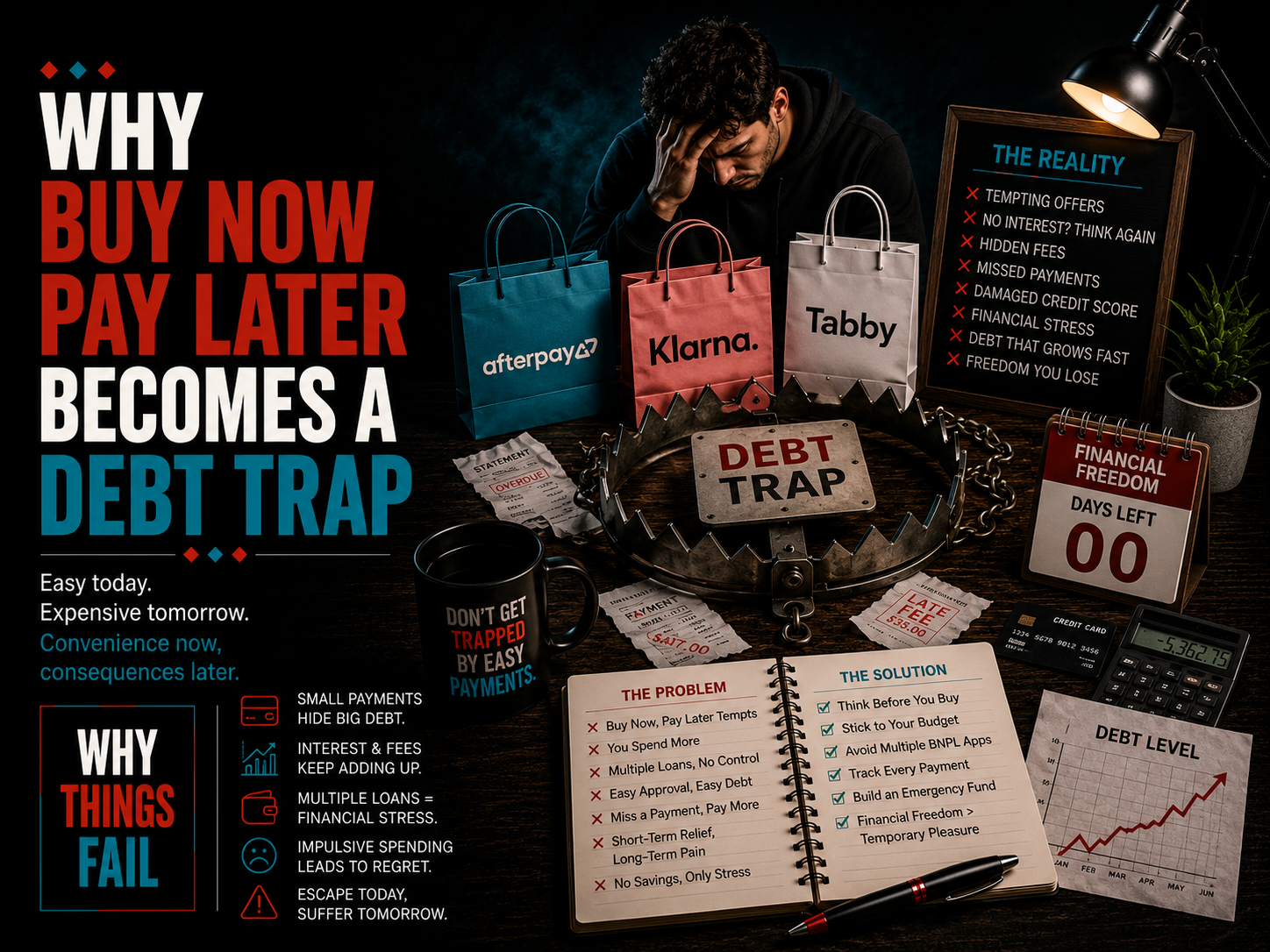
In the past, purchasing something expensive usually required saving first. Today, credit cards, personal loans and buy now pay later services separate the pleasure of buying from the pain of paying.
Behavioural economists describe this as reducing the pain of payment.
When money leaves a bank account immediately, people naturally become more cautious. When payment is divided into small monthly instalments, the purchase appears less expensive even though the total financial commitment remains the same.
This psychological separation encourages larger purchases because consumers focus on the monthly payment rather than the overall cost.
The danger is that multiple small obligations eventually become one significant financial burden.
The purchase feels affordable.
The accumulated commitments do not.
Emotional Spending Becomes A Coping Mechanism
Many purchases have little to do with practical need.
They are responses to emotional discomfort.
Stress after work.
Loneliness.
Anxiety.
Disappointment.
Boredom.
Celebration.
Shopping provides immediate emotional relief because purchasing activates the brain’s reward system. The anticipation of owning something new often produces as much satisfaction as the product itself.
The difficulty is that emotional relief is temporary.
When the positive feeling fades, the financial obligation remains.
If spending repeatedly becomes a method of managing emotions, financial problems gradually become psychological problems as well.
The person is no longer buying products.
They are buying temporary emotional comfort.
Financial Education Often Ignores Human Behaviour
Traditional financial education focuses on budgeting, saving, interest rates and debt management.
These subjects are important.
Yet they rarely explain why intelligent people continue making poor financial decisions despite understanding these concepts.
Knowing what to do and consistently doing it are entirely different challenges.
Behavioural finance demonstrates that knowledge competes with powerful psychological forces including optimism bias, social comparison, present bias and emotional decision making.
Without understanding these influences, financial knowledge alone often proves insufficient.
This explains why many high income professionals still experience persistent financial stress.
The problem is not always a lack of information.
It is the absence of behavioural awareness.
Warning Signs
Financial failure caused by overspending rarely begins with bankruptcy or overwhelming debt.
It begins with subtle behavioural changes that gradually become normal.
One warning sign is justifying purchases based on monthly instalments instead of total cost. This shifts attention away from the long term financial commitment.
Another warning sign is regularly using credit to maintain an existing lifestyle rather than to manage genuine emergencies. Borrowing gradually changes from an exception into a habit.
Frequently comparing possessions with other people is another indicator. When purchasing decisions become influenced by social approval rather than personal priorities, financial discipline often weakens.
Lifestyle inflation is equally important. Every increase in income quickly leads to higher spending, leaving little improvement in long term financial security despite earning more.
Perhaps the clearest warning sign is feeling temporary excitement after every purchase followed by financial regret shortly afterwards.
This emotional cycle often repeats long before serious financial consequences become visible.
What Could Have Prevented It?
Preventing financial overspending is not simply about spending less.
It requires changing the decision making process that occurs before money is spent.
One effective approach is creating deliberate pauses before significant purchases. Time reduces emotional intensity and allows logical evaluation to replace impulse.
Separating needs from emotional wants also improves financial judgement. Products that promise identity, status or happiness deserve greater scrutiny because their value often depends on emotion rather than practical usefulness.
Building financial flexibility is equally important. Savings reduce dependence on credit while creating confidence during unexpected events.
Consumers also benefit from recognising how advertising, social media and digital platforms shape purchasing behaviour. Awareness does not eliminate influence, but it reduces automatic responses.
Most importantly, financial success depends on designing habits that make thoughtful decisions easier than impulsive ones.
Behaviour changes more effectively through systems than through willpower alone.
Lessons
The reasons people buy things they cannot afford reveal important lessons that extend far beyond personal spending.
The first lesson is that financial decisions are emotional before they become mathematical. People usually justify purchases logically after deciding emotionally.
The second lesson is that higher income does not automatically create financial security. Without disciplined decision making, greater earnings often support greater consumption rather than greater wealth.
Another lesson is that consumer culture rewards visible success while ignoring invisible financial stability. Society often celebrates expensive lifestyles without recognising the debt or financial pressure supporting them.
Perhaps the most important lesson is that wealth is influenced not only by income but also by behaviour. Small purchasing decisions repeated consistently shape financial outcomes far more than occasional major purchases.
Failure Pattern
The dominant pattern behind this financial failure is Consumerism combined with Lifestyle Inflation and Emotional Decision Making.
People naturally seek comfort, recognition and belonging. Modern consumer markets transform these emotional needs into purchasing opportunities.
As income increases, expectations increase alongside it. Social comparison encourages spending. Easy credit removes immediate financial barriers. Emotional rewards reinforce the behaviour.
Eventually spending becomes part of personal identity rather than a financial decision.
The same pattern appears in households, entrepreneurs and businesses that continually expand expenses without strengthening financial resilience.
The underlying cause is rarely insufficient income.
It is allowing emotional rewards to dominate long term financial thinking.
Hidden Lesson
People rarely buy products because they truly need them.
They buy the future they imagine those products will create.
A luxury car appears to promise success.
Designer clothing appears to promise confidence.
A larger home appears to promise achievement.
The purchase becomes a symbol of identity rather than a practical financial decision.
The deeper lesson is that financial failure often begins when people use consumption to solve emotional needs that money alone cannot satisfy.
Failure Scorecard
| Area | Score | Explanation |
| Financial Discipline | 4/10 | Spending habits frequently outweigh long term financial priorities. |
| Decision Making | 5/10 | Purchases are often influenced by emotion rather than objective evaluation. |
| Risk Management | 4/10 | Heavy reliance on credit increases financial vulnerability. |
| Long Term Thinking | 3/10 | Immediate satisfaction regularly takes priority over future financial security. |
| Financial Knowledge | 6/10 | Many consumers understand basic finance but struggle to apply it consistently. |
| Emotional Control | 4/10 | Stress, excitement and social comparison strongly influence spending decisions. |
| Planning | 5/10 | Long term financial planning often gives way to short term lifestyle choices. |
| Adaptability | 6/10 | Consumers can improve financial habits when behavioural patterns are recognised early. |
Key Takeaways
- People buy things they cannot afford because emotions often influence spending more than logic.
- Present bias encourages immediate satisfaction while ignoring future financial consequences.
- Social comparison increases spending even when financial circumstances do not improve.
- Easy access to credit reduces the psychological pain of spending.
- Lifestyle inflation quietly absorbs income growth and limits wealth creation.
- Emotional spending often provides temporary relief but creates lasting financial obligations.
- Financial success depends on behavioural discipline as much as income.
- Long term wealth is built through consistent financial decisions rather than visible consumption.
Frequently Asked Questions
Why do people buy things they cannot afford?
People often overspend because emotional rewards, social pressure, present bias and easy access to credit outweigh long term financial thinking.
Is overspending always caused by low income?
No. Many high income earners experience financial stress because lifestyle inflation and consumer behaviour increase spending as income grows.
What role does social media play in overspending?
Social media encourages constant comparison with carefully selected lifestyles, increasing the desire for status driven purchases and unnecessary consumption.
Why does credit encourage overspending?
Credit separates the enjoyment of buying from the financial cost of paying, making expensive purchases appear more affordable than they truly are.
Can financial knowledge alone prevent overspending?
No. Financial knowledge is valuable, but lasting improvement also requires understanding behavioural biases, emotional spending patterns and decision making psychology.
Conclusion
People buy things they cannot afford not because they consistently misunderstand money, but because modern consumer environments are designed to reward immediate satisfaction while delaying financial consequences. Every purchase reflects a decision shaped by psychology, incentives and social influence as much as by income.
Understanding this changes the conversation from blaming individuals to recognising predictable behavioural patterns. Financial failure is rarely created by one expensive purchase. It develops through repeated decisions where emotional rewards quietly outweigh long term financial resilience.