Quick Answer
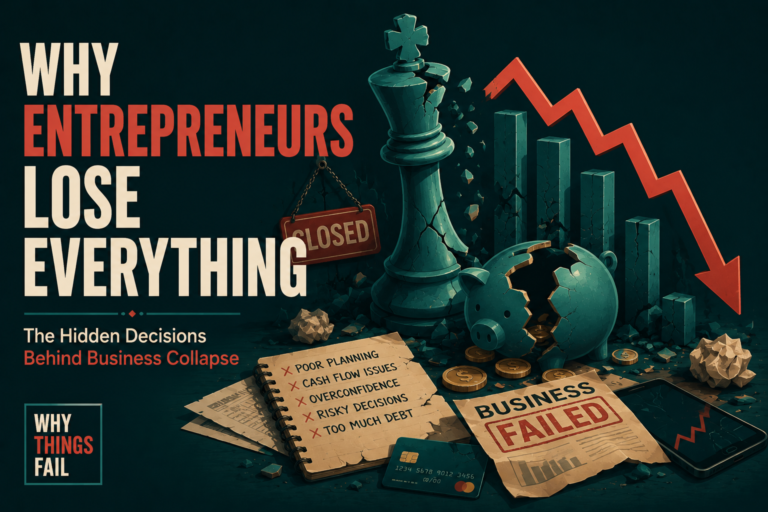
Entrepreneurs rarely lose everything because of one bad decision or an unpredictable economy. Most business collapses result from a series of behavioural mistakes, poor financial discipline, weak cash flow management, overconfidence and emotional decision making. Financial failure is usually gradual long before it becomes visible.
Introduction
Every year thousands of entrepreneurs build businesses with ambitious goals.
Some create innovative products.
Others identify gaps in the market that established companies have ignored.
Many experience rapid growth, increasing revenue and expanding customer demand.
Yet despite early success, a surprising number eventually lose everything.
Some are forced into bankruptcy.
Some sell profitable assets simply to pay creditors.
Others lose their savings, homes, business reputation and years of hard work.
This raises an important question.
Why do entrepreneurs who appear intelligent, hardworking and determined suffer complete financial collapse?
The obvious explanation is often market competition or economic conditions.
These factors certainly matter.
However, they rarely tell the complete story.
Many businesses survive recessions, rising costs and changing consumer demand.
Others fail during periods of economic growth.
The difference often lies beneath financial statements.
Entrepreneurial failure is usually shaped by human behaviour, decision making, incentives and systems that quietly weaken a business long before customers notice anything is wrong.
Understanding why entrepreneurs lose everything requires looking beyond failed businesses.
It requires understanding why successful people repeatedly make decisions that gradually increase financial risk while reducing resilience.
What Is Entrepreneurial Failure?
Entrepreneurial failure is often misunderstood.
Many people believe closing a business automatically means failure.
That assumption is too simplistic.
Businesses sometimes close because founders pursue better opportunities, merge with competitors or change industries.
Losing everything is different.
It occurs when business failure extends beyond the company itself and destroys personal wealth, financial security and future opportunities.
This often happens because entrepreneurs personally guarantee loans, invest their savings, borrow against their homes or reinvest every available resource into continued expansion.
The business becomes inseparable from personal finances.
When the company collapses, personal wealth collapses with it.
Entrepreneurial failure therefore reflects more than declining sales.
It represents a breakdown in financial judgement, risk management and strategic decision making.
The Biggest Myth
The most common belief about entrepreneurship is simple.
Businesses fail because entrepreneurs lack good ideas.
Reality suggests otherwise.
Many failed businesses offered excellent products, loyal customers and growing demand.
Some even generated healthy revenue before collapsing.
The problem was rarely creativity.
More often, it was execution.
Business history repeatedly demonstrates that companies rarely fail because they cannot generate income.
They fail because they cannot manage cash flow, control risk, adapt to changing conditions or make disciplined financial decisions.
A brilliant business idea cannot compensate for poor financial systems.
Nor can rapid growth guarantee long term survival.
The businesses that endure are often those that manage uncertainty better than their competitors rather than those with the most innovative products.
What Usually Happens?
The pattern is remarkably consistent.
An entrepreneur launches a promising business.
Customers respond positively.
Revenue grows.
Confidence increases.
Expansion begins.
New employees are hired.
Larger premises are secured.
Marketing spending rises.
Personal income increases alongside business income.
Then conditions change.
Costs increase faster than revenue.
Cash flow becomes unpredictable.
Debt grows.
Financial pressure intensifies.
Instead of slowing down, many entrepreneurs attempt to solve financial problems through even faster growth.
Risk increases.
Liquidity declines.
Eventually one unexpected setback exposes weaknesses that have been developing for months or even years.
From the outside, the collapse appears sudden.
Inside the business, the warning signs were present long before failure became visible.
Why Do Entrepreneurs Lose Everything?
Most business failures begin long before the first missed payment or declining sales report.
They begin with decisions.
Each decision may appear reasonable on its own.
Together they create a fragile business that cannot withstand uncertainty.
Entrepreneurship rewards optimism.
Without optimism, few people would accept the uncertainty of building a business.
The same optimism that encourages innovation, however, can gradually distort judgement when it is no longer balanced by disciplined risk management.
The challenge is not ambition.
The challenge is knowing when confidence becomes overconfidence.
Overconfidence Creates Dangerous Blind Spots
Success changes the way entrepreneurs interpret information.
A growing business reinforces existing decisions.
Positive customer feedback increases confidence.
Revenue growth encourages expansion.
Investors, employees and family members praise the entrepreneur’s judgement.
Over time, confidence begins replacing critical thinking.
Warning signs receive less attention.
Alternative viewpoints are dismissed.
The entrepreneur increasingly believes future success is inevitable because past decisions proved successful.
Behavioural economists describe this as overconfidence bias.
Previous success creates the illusion that future outcomes can also be controlled.
Markets, however, constantly change.
Customer behaviour changes.
Competition changes.
Technology changes.
Businesses that stop questioning their assumptions often continue making decisions based on yesterday’s conditions instead of today’s realities.
The greatest danger is not confidence.
It is believing success makes failure unlikely.
Cash Flow Problems Destroy Healthy Businesses
Revenue attracts attention.
Cash flow determines survival.
Many entrepreneurs mistakenly assume increasing sales automatically improve financial health.
In reality, businesses frequently collapse despite generating impressive revenue.
The reason is simple.
Revenue measures sales.
Cash flow measures available money.
A business may sell thousands of products while waiting months for customer payments.
Operating expenses, employee salaries, suppliers, taxes and loan repayments cannot wait.
As cash reserves decline, entrepreneurs increasingly rely on borrowing.
Debt temporarily solves liquidity problems while quietly increasing financial vulnerability.
Eventually the business reaches a point where even profitable months cannot restore financial stability because existing obligations consume available cash.
Many entrepreneurs lose everything not because customers disappear but because liquidity disappears.
Emotional Attachment Replaces Objective Thinking
Entrepreneurs often develop a powerful emotional connection with their businesses.
Years of sacrifice create personal identity around the company.
The business no longer feels like an investment.
It feels like part of the entrepreneur.
This emotional attachment creates one of the most dangerous psychological traps.
Entrepreneurs begin defending the business instead of objectively evaluating it.
Declining performance is explained away as temporary.
Negative customer feedback is ignored.
Financial losses are viewed as short term setbacks rather than evidence requiring strategic change.
Psychologists refer to this as the sunk cost effect.
The more time, money and effort invested, the harder it becomes to accept that previous decisions may have been wrong.
Instead of reducing losses, entrepreneurs often commit even more resources to justify earlier choices.
Small financial problems gradually become existential threats.
Growth Without Systems Creates Fragility
Growth is widely celebrated in entrepreneurship.
Few people ask whether growth is sustainable.
Expanding too quickly often places enormous pressure on operations, hiring, inventory management and customer service.
Without strong financial systems, rapid growth creates increasing complexity.
The entrepreneur spends more time solving immediate problems and less time making strategic decisions.
Operational weaknesses remain hidden while demand remains strong.
When economic conditions change or customer demand slows, those weaknesses become impossible to ignore.
Growth therefore becomes a paradox.
The very success entrepreneurs celebrate may quietly increase the probability of future failure if systems fail to grow alongside revenue.
Fear Delays Difficult Decisions
Fear influences entrepreneurs differently from employees or investors.
Closing an unsuccessful project may feel like admitting personal failure.
Reducing staff may feel like betraying loyal employees.
Selling assets may feel like abandoning years of work.
As a result, many entrepreneurs postpone decisions they already know are necessary.
Unprofitable products remain available.
Loss making locations continue operating.
Borrowing replaces restructuring.
Optimism replaces evidence.
Delayed decisions rarely eliminate problems.
They usually increase their cost.
By the time reality forces action, available options have often become far more limited.
Confirmation Bias Reinforces Poor Decisions
Successful entrepreneurs are often decisive.
This quality becomes a weakness when they stop seeking opposing viewpoints.
Once a strategic direction has been chosen, many founders naturally search for information confirming that decision.
Positive customer reviews receive attention.
Negative financial indicators receive less attention.
Supportive advice is welcomed.
Critical feedback is dismissed.
Confirmation bias gradually reduces organisational learning.
The business adapts more slowly because leadership becomes increasingly convinced its existing strategy remains correct.
Markets reward adaptation.
Businesses that stop learning usually stop growing shortly afterwards.
Warning Signs
Entrepreneurial collapse rarely begins with bankruptcy.
It usually begins with behavioural changes that appear reasonable in the moment but gradually weaken the business.
One warning sign is treating rising revenue as proof of financial strength while ignoring cash flow. Entrepreneurs celebrate increasing sales but overlook declining liquidity, growing accounts payable and shrinking cash reserves.
Another warning sign is making important decisions without reliable financial data. When founders rely on instinct instead of financial reporting, they lose the ability to recognise emerging risks before they become crises.
Borrowing to solve operational problems is another indicator. Debt can support productive investment, but repeatedly using loans to pay salaries, suppliers or everyday expenses often signals deeper structural weaknesses.
Ignoring constructive criticism is equally dangerous. Entrepreneurs surrounded by employees, advisers or family members who hesitate to challenge decisions gradually lose access to objective feedback. Confidence slowly becomes isolation.
Perhaps the most overlooked warning sign is believing that working harder will solve every problem. Many founders respond to declining performance by increasing effort instead of questioning whether the business model, pricing strategy or cost structure requires fundamental change.
These warning signs are often ignored because they develop during periods when entrepreneurs remain optimistic about future growth. Unfortunately, optimism without evidence frequently delays necessary decisions until available options become limited.
What Could Have Prevented It?
Entrepreneurs rarely lose everything because one unpredictable event occurs.
They lose everything because their businesses become too fragile to absorb unexpected events.
The strongest protection is disciplined financial planning.
Healthy businesses monitor cash flow as carefully as revenue. They build financial reserves during profitable periods instead of assuming favourable conditions will continue indefinitely.
Risk management also requires separating personal wealth from business risk whenever possible. Entrepreneurs who invest every available resource into one business increase the consequences of failure. Diversification creates resilience by ensuring one setback does not destroy every source of financial security.
Another safeguard is creating systems that challenge leadership decisions. Independent advisers, experienced accountants and financially informed board members reduce the likelihood of confirmation bias by introducing objective perspectives.
Businesses also benefit from regularly reviewing assumptions. Customer behaviour changes. Competition evolves. Economic conditions fluctuate. Entrepreneurs who continuously test their business model adapt more effectively than those who assume previous success guarantees future results.
Perhaps the most important protection is recognising that resilience often matters more than rapid growth. Sustainable businesses preserve flexibility, maintain healthy liquidity and make decisions that improve long term survival rather than short term expansion.
Lessons
The reasons entrepreneurs lose everything reveal lessons that extend well beyond business ownership.
The first lesson is that growth and financial health are not the same. A business can expand rapidly while becoming increasingly vulnerable because cash flow, debt and operational complexity are growing even faster.
The second lesson is that confidence requires balance. Optimism encourages innovation, but optimism without disciplined analysis gradually weakens judgement. Successful entrepreneurs remain confident enough to pursue opportunities while remaining humble enough to question their assumptions.
Another lesson is that systems outperform individual effort. Businesses built around one person’s energy often struggle as complexity increases. Strong financial controls, reliable reporting and effective delegation create organisations capable of adapting to uncertainty.
Finally, lasting success depends less on avoiding every mistake and more on recognising problems early enough to respond before they threaten the survival of the entire business.
Failure Pattern
The dominant pattern behind entrepreneurial collapse is Overconfidence combined with Weak Cash Flow Management and Poor Risk Management.
The pattern repeats because success changes behaviour.
Growing revenue increases confidence.
Confidence encourages expansion.
Expansion increases financial commitments.
Financial commitments reduce flexibility.
When market conditions change, businesses with limited liquidity and excessive obligations struggle to adapt.
The same pattern appears across different industries because it reflects predictable human behaviour rather than unique business circumstances.
Investors become overconfident during rising markets.
Traders increase risk after profitable periods.
Families increase spending after higher incomes.
Businesses expand after strong sales.
In each case, favourable conditions reduce caution until uncertainty exposes hidden weaknesses.
Hidden Lesson
Entrepreneurs rarely lose everything because one decision destroys their business.
They lose everything because many small decisions quietly reduce resilience over time.
Markets, competitors and economic downturns do not create fragile businesses.
They reveal businesses that have gradually become fragile through weak financial discipline, delayed decisions and excessive confidence.
The deepest lesson is that entrepreneurial success is not measured only by growth.
It is measured by the ability to survive periods when growth becomes impossible.
Failure Scorecard
| Area | Score | Explanation |
| Financial Discipline | 4/10 | Many entrepreneurs prioritise expansion before building financial resilience. |
| Decision Making | 5/10 | Confidence often influences decisions more than objective financial evidence. |
| Risk Management | 3/10 | Personal guarantees, excessive debt and limited diversification increase financial vulnerability. |
| Long Term Thinking | 5/10 | Short term growth frequently receives greater attention than sustainable resilience. |
| Financial Knowledge | 6/10 | Many founders understand their product better than financial management. |
| Emotional Control | 4/10 | Personal attachment to the business often delays difficult but necessary decisions. |
| Planning | 5/10 | Strategic planning is common, but contingency planning is frequently overlooked. |
| Adaptability | 6/10 | Successful entrepreneurs adapt quickly, while struggling businesses often resist changing direction. |
Key Takeaways
- Entrepreneurs usually lose everything through a series of small financial decisions rather than one catastrophic mistake.
- Strong revenue cannot compensate for weak cash flow.
- Overconfidence often prevents leaders from recognising emerging risks.
- Emotional attachment makes objective decision making more difficult.
- Sustainable growth depends on strong financial systems rather than constant expansion.
- Risk management protects businesses during periods of uncertainty.
- Independent advice improves decision quality by challenging assumptions.
- Long term business survival depends on resilience as much as innovation.
Frequently Asked Questions
Why do entrepreneurs lose everything?
Most entrepreneurs lose everything because poor cash flow management, excessive debt, emotional decision making and weak risk management gradually make their businesses financially fragile. A single economic shock often exposes problems that have been developing for years.
Is lack of funding the main reason businesses fail?
Not always. Many businesses fail despite generating revenue or raising investment. Cash flow management, financial discipline and strategic decision making often have a greater influence on long term survival than funding alone.
Why do successful entrepreneurs sometimes make poor decisions?
Previous success can create overconfidence. Entrepreneurs may begin believing that strategies which worked in the past will continue working despite changing markets, customer behaviour and competitive conditions.
How important is cash flow compared with profit?
Cash flow determines whether a business can meet its financial obligations. A profitable business can still fail if it cannot generate enough available cash to pay employees, suppliers, taxes and creditors on time.
Can business failure be prevented completely?
No. Every business operates under uncertainty. However, disciplined financial planning, effective risk management, healthy cash reserves and objective decision making significantly improve the ability to survive unexpected challenges.
Conclusion
Entrepreneurs rarely lose everything because they lack ambition, intelligence or determination. More often, they lose everything because success gradually changes the way they assess risk, interpret information and make financial decisions.
Understanding this transforms entrepreneurial failure from a story of bad luck into a study of human behaviour. Business collapse becomes less about unpredictable markets and more about recognising that lasting success depends on disciplined decisions made long before adversity arrives.