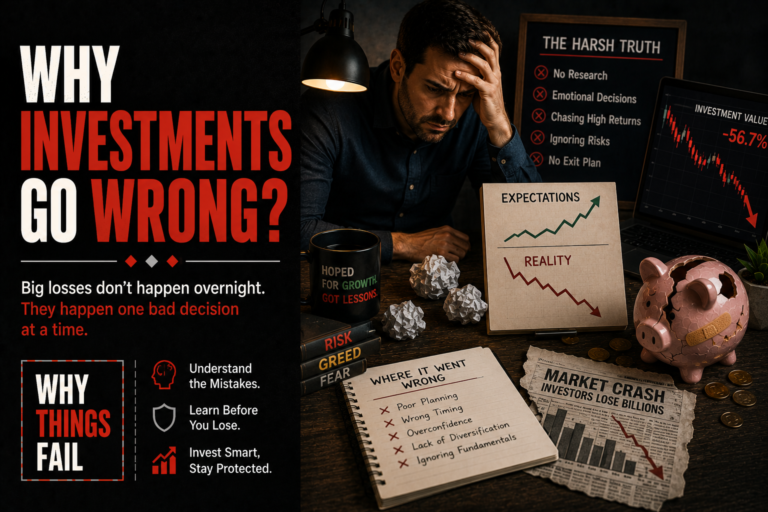
Investments rarely go wrong because markets are unpredictable alone. Most failures result from emotional decision making, poor risk management, overconfidence, weak planning and behavioural biases that cause investors to make predictable mistakes. Understanding these hidden patterns is the first step towards understanding why financial failure occurs.
Introduction
Every successful investment begins with optimism.
An investor identifies an opportunity, commits capital and expects future growth. Some investments generate exceptional returns, while others produce disappointing losses. Although financial markets have created enormous wealth throughout history, they have also destroyed billions in personal savings, retirement funds and business capital.
This contradiction raises an important question.
Why do investments go wrong even when investors have access to more information, better technology and greater financial education than ever before?
Many people assume poor investments fail because of unexpected economic events or bad luck. Others blame market volatility, political uncertainty or changing interest rates.
These explanations only describe what happened.
They rarely explain why similar investment failures occur repeatedly across different markets, different generations and different economic conditions.
The deeper truth is that investment failure usually begins long before money is lost.
It begins with human behaviour.
Behavioural economists have spent decades studying why intelligent people continue making financial decisions that reduce long term wealth. Their research consistently shows that markets do not simply reward knowledge. They reward disciplined behaviour, rational judgement and effective risk management.
Understanding why investments go wrong is therefore not simply about analysing financial assets.
It is about understanding how people respond to uncertainty, opportunity and emotion when money is involved.
What Is Investment Failure?
Investment failure is often viewed too narrowly.
Many people believe an investment has failed only when it loses money.
In reality, temporary losses are a normal feature of investing.
Financial failure occurs when decisions consistently reduce the ability to build sustainable wealth over time.
An investor who repeatedly buys overpriced assets because they fear missing out may experience financial failure even before markets decline.
Another investor may refuse to diversify because previous success creates excessive confidence.
Others avoid investing altogether because fear of losing money prevents them from participating in long term wealth creation.
Investment failure is therefore not defined by one unsuccessful asset.
It reflects a pattern of decisions that gradually weaken financial resilience and increase exposure to avoidable risk.
The Biggest Myth
The biggest misconception about investing is simple.
Good investments always produce good results.
This belief sounds logical but ignores one important reality.
Every investment exists within an uncertain environment.
Excellent businesses can experience temporary declines.
Strong economies can enter recessions.
Unexpected events can influence even carefully selected investments.
The quality of an investment should therefore not be judged solely by its short term outcome.
Likewise, poor decisions sometimes produce profitable results during favourable market conditions.
This creates a dangerous illusion.
Investors begin believing success reflects skill rather than circumstance.
Behavioural finance demonstrates that outcomes alone cannot measure decision quality.
A disciplined investment process can occasionally produce losses.
An undisciplined process can occasionally produce gains.
Over time, however, disciplined decision making consistently outperforms emotional decision making because it manages uncertainty instead of attempting to eliminate it.
The objective is not to avoid every loss.
It is to avoid predictable mistakes that repeatedly destroy wealth.
What Usually Happens?
Most investment failures develop gradually rather than suddenly.
An investor begins with a sensible objective.
Early success increases confidence.
Confidence encourages larger investments.
Risk management receives less attention.
Diversification weakens.
Expectations become unrealistic.
When markets eventually change direction, losses begin appearing.
Instead of reviewing the original investment thesis, many investors become emotionally attached to previous decisions.
Some refuse to sell because they hope prices will recover.
Others panic and sell quality assets after significant declines.
Some continue investing additional money into failing opportunities because admitting a mistake feels more painful than accepting further risk.
Although individual circumstances differ, the underlying pattern remains remarkably consistent.
Financial losses usually reflect behavioural decisions that accumulated long before market prices declined.
Why Do Investments Go Wrong?
Understanding investment failure requires looking beyond financial statements and market performance.
Most unsuccessful investments do not begin with poor assets.
They begin with predictable patterns of human behaviour.
Markets expose psychological weaknesses because every investment decision involves uncertainty. People naturally seek certainty, yet investing can never provide complete certainty.
This conflict creates the conditions where behavioural biases gradually replace objective judgement.
Overconfidence Creates Invisible Risk
One of the most powerful behavioural biases in investing is overconfidence.
After several successful investments, many people begin believing their judgement is consistently superior to the market.
This belief encourages increasingly risky behaviour.
Investors allocate larger amounts of capital to fewer opportunities.
They ignore diversification because previous concentration appeared successful.
They become less interested in evaluating risk and more interested in confirming existing beliefs.
This psychological shift often develops slowly.
Confidence feels justified because previous decisions produced positive outcomes.
However, favourable market conditions frequently disguise weak decision making.
When economic conditions eventually change, the hidden risks become visible.
Losses that appear sudden are often the result of decisions made months or even years earlier.
The greatest danger is not confidence itself.
It is the belief that previous success guarantees future success.
Fear Changes Rational Decisions
Fear influences investment behaviour just as strongly as confidence.
Behavioural economists describe loss aversion as one of the most powerful forces affecting financial decisions.
People experience the pain of financial loss far more intensely than the satisfaction of an equivalent gain.
This psychological tendency explains why investors often react emotionally during market declines.
Temporary losses begin feeling permanent.
Long term strategies suddenly appear unreliable.
Short term uncertainty receives greater attention than long term fundamentals.
As fear increases, rational analysis decreases.
Investors focus on escaping discomfort rather than evaluating whether underlying businesses or assets remain fundamentally valuable.
This often results in selling quality investments precisely when prices already reflect widespread pessimism.
Fear rarely asks whether an investment still has long term potential.
It simply seeks immediate emotional relief.
Herd Behaviour Replaces Independent Thinking
Human beings naturally look to others when uncertainty increases.
Financial markets amplify this instinct.
During rising markets, widespread optimism creates social pressure to invest in popular assets.
News coverage celebrates exceptional returns.
Friends discuss profitable investments.
Social media reinforces stories of rapid wealth creation.
The growing popularity of an investment creates the impression that it has become safer.
The reality is often the opposite.
High demand frequently pushes prices beyond reasonable valuations.
Investors purchase assets because other people appear confident rather than because careful analysis supports the decision.
The same behaviour appears during market downturns.
Fear spreads rapidly.
Selling becomes socially acceptable.
Independent analysis disappears beneath collective anxiety.
Markets repeatedly demonstrate that following the crowd often feels emotionally comfortable but financially costly.
Confirmation Bias Protects Beliefs Instead Of Capital
Once investors become convinced an investment will succeed, they begin searching for information that supports their existing opinion.
Evidence that challenges their assumptions receives less attention.
Psychologists describe this tendency as confirmation bias.
Instead of asking whether market conditions have changed, investors focus on proving themselves correct.
Economic reports, company announcements and financial news are interpreted selectively.
This reduces adaptability.
Rather than responding objectively to new information, investors defend previous decisions because admitting mistakes feels psychologically uncomfortable.
The investment gradually becomes connected to personal identity rather than objective analysis.
This makes rational decision making increasingly difficult.
Short Term Thinking Destroys Long Term Wealth
Modern financial markets provide constant information.
Prices update every second.
News appears every minute.
This continuous flow encourages investors to focus on immediate performance rather than long term value creation.
Short term thinking changes expectations.
Normal market volatility begins appearing abnormal.
Temporary declines feel like permanent failures.
Investors start measuring success over weeks instead of years.
This creates unnecessary trading, emotional decision making and poor capital allocation.
Markets have historically rewarded patience.
Human psychology frequently rewards immediate gratification instead.
The conflict between these two forces explains why many investors understand long term investing in theory but struggle to practise it consistently.
Poor Risk Management Makes Failure Predictable
Risk is an unavoidable part of investing.
Poor risk management is not.
Many investors devote enormous effort to identifying profitable opportunities while spending very little time evaluating what could go wrong.
They underestimate uncertainty.
They overestimate their ability to predict outcomes.
They ignore the possibility that favourable market conditions may eventually reverse.
This imbalance creates fragile investment portfolios.
When unexpected events occur, investors discover that their greatest weakness was never investment selection.
It was the absence of a disciplined framework for managing uncertainty.
Financial failure therefore becomes predictable long before market losses appear.
It develops through small behavioural compromises that gradually weaken resilience until changing market conditions expose the accumulated consequences.
Warning Signs
Investment failure rarely arrives without warning. The challenge is that warning signs usually appear during periods of optimism, when confidence is high and caution begins to fade.
One of the earliest indicators is believing that recent success proves exceptional investment skill. Investors become convinced they have developed an ability to identify winning opportunities, even though favourable market conditions may have contributed significantly to previous returns.
Another warning sign is gradually abandoning diversification. A portfolio that once balanced risk across different asset classes becomes increasingly concentrated in one company, one industry or one investment theme. Concentration may increase potential returns, but it also increases exposure to unexpected events.
Emotional attachment to investments is another common signal. Investors begin defending previous decisions instead of evaluating current evidence. They refuse to sell declining assets because accepting a loss feels like admitting personal failure.
Excessive confidence during bull markets also deserves attention. Rising prices create the impression that risk has disappeared. Investors begin borrowing money, increasing position sizes or chasing speculative opportunities because recent gains appear to validate increasingly aggressive decisions.
Perhaps the most overlooked warning sign is the absence of a clear investment framework. Investors who cannot explain why they purchased an asset, under what conditions they would sell it or how it contributes to their broader financial objectives are often reacting emotionally rather than following a disciplined process.
These warning signs are frequently ignored because they develop gradually. By the time financial losses become visible, the behavioural decisions responsible for them have usually been repeated many times.
What Could Have Prevented It?
Investment failure cannot be eliminated because uncertainty can never be removed from financial markets.
However, many costly mistakes can be prevented through better decision making systems rather than better predictions.
The first safeguard is recognising that investing is an exercise in probability rather than certainty. Investors who accept uncertainty become less dependent on perfect forecasts and more focused on making consistently rational decisions.
Risk management should also become a permanent part of every investment decision. Diversification, thoughtful capital allocation and realistic expectations reduce vulnerability when market conditions change unexpectedly.
A structured investment process creates another layer of protection. Investors who define clear objectives, review assumptions regularly and evaluate investments according to evidence rather than emotion are less likely to react impulsively during periods of volatility.
Behavioural awareness is equally important. Understanding biases such as overconfidence, confirmation bias, herd behaviour and loss aversion allows investors to recognise psychological traps before they influence financial decisions.
Perhaps the most effective prevention is separating personal identity from investment outcomes. A declining investment is not a reflection of personal worth. Investors who remain intellectually flexible can acknowledge mistakes, adjust their strategy and preserve capital before temporary setbacks become permanent losses.
The purpose is not to avoid every mistake.
It is to avoid making the same behavioural mistakes repeatedly.
Lessons
Investment failure offers lessons that extend far beyond financial markets.
The first lesson is that successful investing depends as much on behaviour as knowledge. Understanding valuation, portfolio construction and economic cycles provides little advantage if emotions consistently override disciplined judgement.
The second lesson is that protecting capital deserves as much attention as growing it. Investors naturally focus on potential returns because gains are exciting. Long term wealth, however, is usually built by avoiding decisions that create irreversible losses.
Another lesson is that financial markets reward patience more consistently than prediction. Many investors spend years searching for the perfect investment opportunity while overlooking the importance of remaining disciplined through changing market conditions.
Investment failure also demonstrates that incentives shape behaviour. Financial media rewards exciting predictions. Social media rewards extraordinary success stories. Friends often discuss profitable investments rather than disciplined risk management. These incentives encourage short term thinking even though wealth is generally created through long term consistency.
Perhaps the most valuable lesson is that every investment decision reflects a broader decision making process. Improving that process often produces greater long term benefits than searching endlessly for the next successful asset.
Failure Pattern
The dominant pattern behind investment failure is Emotional Decision Making combined with Overconfidence and Poor Risk Management.
This pattern appears repeatedly because investors naturally seek certainty in environments that cannot provide it.
Periods of success increase confidence.
Confidence reduces caution.
Reduced caution increases risk.
Higher risk remains hidden while markets continue rising.
Eventually market conditions change.
Losses reveal behavioural weaknesses that were previously disguised by favourable circumstances.
This cycle extends far beyond investing.
Entrepreneurs overestimate demand after rapid growth.
Businesses expand too aggressively during economic booms.
Property investors become convinced prices can only rise.
Families increase spending after temporary income growth.
The underlying pattern remains remarkably consistent because it reflects human psychology rather than financial markets alone.
Hidden Lesson
The greatest investment risk is rarely hidden inside the market.
It is hidden inside the investor.
Markets do not create fear, greed or overconfidence. They reveal them.
Every investment decision reflects how individuals respond to uncertainty, incomplete information and emotional pressure.
The deeper truth is that investments rarely fail without behavioural warning signs appearing first.
Financial loss is often the final consequence of psychological decisions made long before prices begin to fall.
Understanding this changes the entire perspective on investing.
Success becomes less about discovering perfect opportunities and more about consistently avoiding predictable behavioural mistakes.
Failure Scorecard
| Area | Score | Explanation |
| Financial Discipline | 5/10 | Many investors begin with discipline but gradually abandon it after periods of success or prolonged market optimism. |
| Decision Making | 5/10 | Behavioural biases frequently influence investment choices more than objective analysis. |
| Risk Management | 4/10 | Poor diversification and excessive confidence often increase exposure to avoidable losses. |
| Long Term Thinking | 5/10 | Investors understand long term investing but frequently react to short term market movements. |
| Financial Knowledge | 6/10 | Information is widely available, yet behavioural understanding often remains limited. |
| Emotional Control | 4/10 | Fear and greed continue influencing investment decisions during periods of uncertainty. |
| Planning | 5/10 | Many investment decisions lack clearly defined objectives, review criteria and exit strategies. |
| Adaptability | 6/10 | Successful investors adapt to changing evidence, while unsuccessful investors defend outdated assumptions. |
Key Takeaways
- Investments usually go wrong because behavioural mistakes accumulate over time rather than because markets suddenly become unpredictable.
- Overconfidence often increases financial risk without investors recognising the danger.
- Fear and loss aversion encourage decisions that prioritise emotional comfort over rational analysis.
- Diversification remains one of the most effective ways to manage uncertainty.
- A disciplined investment process consistently outperforms emotional decision making over the long term.
- Confirmation bias prevents investors from recognising changing market conditions.
- Protecting capital is just as important as pursuing growth.
- Long term wealth is created through consistent judgement rather than occasional exceptional decisions.
Frequently Asked Questions
Why do investments go wrong?
Investments usually go wrong because emotional decision making, poor risk management, overconfidence and behavioural biases gradually replace disciplined analysis. Market conditions contribute to outcomes, but human behaviour often determines whether losses become permanent.
What is the biggest reason investors make poor investment decisions?
The biggest reason is allowing emotions to influence judgement. Fear, greed, confirmation bias and herd behaviour frequently cause investors to ignore evidence and make decisions that conflict with their long term objectives.
Can a good investment still lose money?
Yes. Even high quality investments experience periods of decline because markets respond to economic conditions, interest rates, investor sentiment and unexpected events. Temporary losses do not necessarily indicate poor decision making.
Why is diversification important?
Diversification reduces dependence on the performance of any single investment. It strengthens portfolio resilience and helps investors manage uncertainty without exposing excessive amounts of capital to one source of risk.
How can investors avoid repeating the same mistakes?
Investors reduce repeated mistakes by following a structured investment process, reviewing decisions objectively, managing risk consistently and recognising behavioural biases before they influence financial judgement.
Conclusion
Investments rarely go wrong because of one unexpected event. More often, they fail through a sequence of behavioural decisions that gradually replace discipline with emotion, planning with optimism and evidence with certainty.
Understanding why investments go wrong reveals a broader truth about financial success. Markets reward those who manage uncertainty with patience, discipline and sound judgement. They expose those who believe confidence alone can overcome risk. The real investigation therefore is not into the investment itself, but into the decisions that shaped it long before the outcome became visible.