
Quick Answer
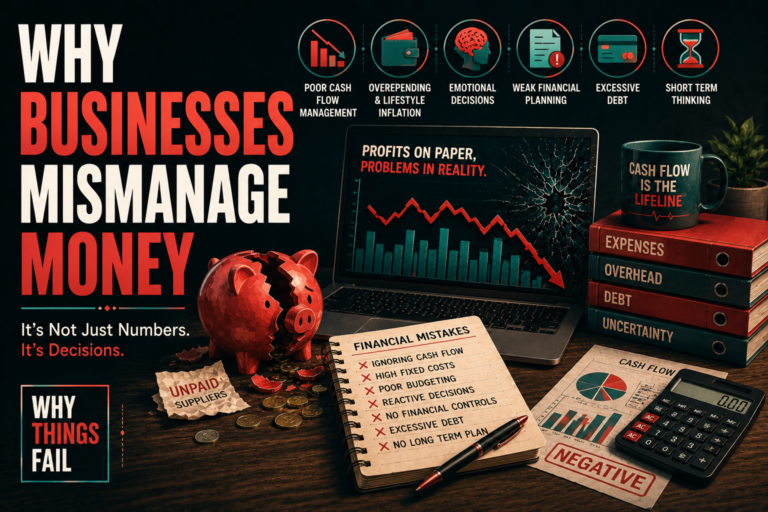
Businesses rarely fail because they cannot generate revenue. They fail because they mismanage money through poor decision making, weak financial discipline, emotional leadership, ineffective cash flow management and short term thinking. Financial mismanagement is usually a gradual process driven by behavioural patterns rather than a single mistake.
Introduction
Every year, thousands of businesses close their doors despite having customers, capable employees and products that people genuinely want to buy.
Some businesses experience rapid sales growth yet run out of cash. Others receive substantial investment but still collapse within a few years. Even well established companies with recognised brands sometimes enter financial distress because they fail to manage their money effectively.
This creates an important question.
If businesses understand their products, markets and customers, why do so many struggle with financial management?
The obvious explanation is declining sales or difficult economic conditions.
The deeper explanation is far more revealing.
Businesses rarely mismanage money because owners cannot perform basic calculations. They mismanage money because financial decisions are influenced by human behaviour, organisational culture, incentives and psychological biases that develop over time.
Money management is therefore not simply an accounting function.
It is a reflection of how leaders think, how organisations make decisions and how they respond to uncertainty.
Understanding why businesses mismanage money requires looking beyond financial statements. It requires investigating the behavioural and structural patterns that quietly transform profitable companies into financially fragile organisations.
What Is Business Financial Mismanagement?
Business financial mismanagement is the repeated failure to allocate, protect and monitor financial resources in a way that supports long term sustainability.
It extends far beyond bookkeeping errors.
A company can produce accurate financial reports while still making poor financial decisions.
For example, a business may expand too quickly without sufficient cash reserves. Another may generate strong sales but fail to control operating expenses. Some companies borrow excessively because debt appears cheaper than improving operational efficiency. Others invest heavily in growth while ignoring liquidity.
These decisions often appear reasonable when viewed individually.
Collectively, however, they weaken the financial stability of the organisation.
Business failure therefore begins long before insolvency.
It begins when financial discipline gradually gives way to emotional judgement and reactive decision making.
The Biggest Myth
The most common belief is simple.
Businesses fail because they do not earn enough revenue.
Revenue certainly matters.
However, history repeatedly demonstrates that high revenue alone does not guarantee financial stability.
Many businesses with impressive sales figures have entered bankruptcy because cash left the business faster than it entered.
Revenue measures activity.
Cash flow measures survival.
Profit measures accounting performance.
Financial management determines whether those profits can actually sustain the organisation.
This distinction explains why rapidly growing companies sometimes collapse while smaller competitors continue operating successfully for decades.
The problem is rarely earning money.
The problem is managing money once it arrives.
What Usually Happens?
Business financial mismanagement follows a familiar pattern.
The company begins with careful spending and close monitoring of cash.
As revenue increases, confidence grows.
Expenses gradually increase.
New employees are hired.
Larger offices are leased.
Marketing budgets expand.
Debt becomes easier to justify.
Financial controls become less rigorous because previous growth creates confidence that future income will solve current financial pressures.
When economic conditions change or sales slow, weaknesses that remained hidden during periods of growth become impossible to ignore.
Cash reserves disappear.
Suppliers demand payment.
Loan obligations increase.
Management responds by making reactive decisions rather than strategic ones.
Although every business experiences unique circumstances, the underlying behavioural pattern changes remarkably little.
Financial collapse rarely begins with one poor decision.
It usually develops through hundreds of small financial choices that slowly reduce resilience.
Why Do Businesses Mismanage Money?
Leaders Often Confuse Revenue With Financial Health
One of the most damaging assumptions in business is that increasing revenue automatically creates a stronger company.
This belief encourages leaders to focus primarily on sales while paying less attention to profitability, liquidity and cash flow.
A company may celebrate record monthly revenue while simultaneously experiencing declining operating margins and increasing debt.
Because revenue is highly visible, it often becomes the primary measure of success.
Cash flow receives far less attention until financial pressure becomes unavoidable.
Behavioural economists describe this as a measurement bias.
People naturally focus on indicators that are visible, celebrated and easy to understand.
Financial sustainability depends on indicators that often receive far less attention.
Overconfidence Reduces Financial Discipline
Business success creates confidence.
Confidence encourages expansion.
Expansion increases financial commitments.
The danger emerges when leaders begin believing previous success guarantees future success.
This form of overconfidence gradually weakens financial discipline.
Budgets become more flexible.
Investment decisions become less rigorous.
Financial forecasts become increasingly optimistic.
Potential risks receive less discussion because recent success creates the impression that the organisation can overcome almost any challenge.
Overconfidence rarely appears reckless.
It usually develops quietly after repeated success.
This makes it particularly dangerous because few leaders recognise it while it is happening.
Cash Flow Problems Are Often Ignored Until They Become Critical
Cash flow represents the movement of money into and out of a business.
Without sufficient cash, profitable businesses can still fail.
Many organisations focus heavily on profit while overlooking liquidity.
Invoices remain unpaid.
Inventory grows faster than sales.
Operating expenses increase each month.
Loan repayments consume increasing amounts of available cash.
None of these issues appear catastrophic individually.
Together, they gradually weaken financial flexibility.
By the time management recognises the seriousness of the situation, available options have often become limited.
Cash flow problems therefore develop silently.
They become visible only after months of declining financial resilience.
Short Term Thinking Creates Long Term Weakness
Managers frequently face pressure from shareholders, investors or owners to produce immediate financial results.
This pressure encourages decisions that improve short term performance while weakening future stability.
Maintenance budgets are reduced.
Employee development is postponed.
Research spending declines.
Essential technology investments are delayed.
These decisions improve short term financial reports but gradually reduce the organisation’s ability to compete effectively.
Psychologists refer to this tendency as present bias.
Immediate rewards receive greater attention than future consequences.
Businesses experiencing constant short term pressure often sacrifice resilience for temporary financial improvement.
Emotional Decision Making Replaces Objective Analysis
Financial decisions are often presented as rational calculations.
In reality, they are heavily influenced by emotion.
Leaders become emotionally attached to expansion plans.
Founders hesitate to close unprofitable divisions because of personal commitment.
Executives continue funding unsuccessful projects because admitting failure feels more painful than accepting additional financial losses.
This behaviour reflects the sunk cost effect.
Previous investments influence future decisions even when those investments cannot be recovered.
Instead of asking what decision creates the greatest future value, leaders focus on justifying previous choices.
The result is continued spending on activities that no longer contribute to sustainable growth.
Poor Incentives Encourage Poor Financial Decisions
Financial behaviour inside organisations is strongly influenced by incentives.
Sales teams rewarded only for revenue may ignore profitability.
Managers rewarded for rapid expansion may underestimate operational risks.
Executives receiving bonuses based on annual performance may prioritise immediate financial results instead of long term sustainability.
These incentive structures create predictable behaviour.
People optimise for the outcomes they are rewarded to achieve.
If organisational incentives reward growth more than financial discipline, excessive spending and weak cost control become logical responses rather than accidental mistakes.
Financial mismanagement therefore becomes a system problem rather than an individual problem.
Weak Financial Education At Leadership Level
Not every business owner begins with a background in finance.
Many entrepreneurs excel at product development, marketing or customer service but have limited understanding of budgeting, financial forecasting, working capital and capital allocation.
This knowledge gap often remains hidden while revenue continues growing.
As the organisation becomes more complex, however, financial decisions require greater analytical capability.
Without strong financial literacy, leaders rely increasingly on instinct instead of evidence.
Important decisions become reactive rather than strategic.
The business may continue generating sales, yet its financial foundation becomes progressively weaker.
Financial mismanagement is therefore rarely caused by a lack of ambition.
More often, it results from behavioural biases, organisational incentives and decision making systems that quietly reward short term success while undermining long term financial stability.
Warning Signs
Business financial mismanagement rarely appears overnight. It develops through a series of warning signs that often seem insignificant while revenue remains strong. By the time these signals become impossible to ignore, financial flexibility has usually disappeared.
One of the earliest warning signs is declining cash reserves despite increasing sales. This suggests the business is generating activity but not preserving liquidity. Leaders often dismiss this problem because revenue continues to grow, believing future sales will solve current cash shortages.
Another warning sign is consistently relying on debt to finance routine operating expenses. Borrowing can support productive investments, but using loans to cover everyday costs usually indicates that the business is spending more than it can sustainably afford.
Rapid increases in overhead costs also deserve attention. Hiring employees, leasing larger premises and expanding operations may appear to reflect success. However, when fixed expenses grow faster than reliable cash flow, the organisation becomes increasingly vulnerable to economic uncertainty.
Delaying supplier payments is another indicator of financial stress. Businesses often justify these delays as temporary cash management. In reality, they frequently reveal deeper liquidity problems that continue worsening beneath the surface.
Perhaps the most dangerous warning sign is when management stops discussing financial risks openly. Excessive optimism replaces objective analysis. Critical questions become uncomfortable conversations. Instead of examining financial weaknesses, leaders focus only on growth opportunities.
These warning signs are ignored because they emerge gradually. Success creates confidence, and confidence often discourages difficult financial conversations until the consequences become unavoidable.
What Could Have Prevented It?
Business financial failure is rarely prevented through perfect forecasting.
Markets remain uncertain. Consumer demand changes. Economic conditions evolve.
The objective is not to eliminate uncertainty but to strengthen financial resilience.
One effective safeguard is separating growth decisions from emotional enthusiasm. Expansion should be supported by realistic cash flow projections rather than optimistic assumptions. Every significant financial commitment should be evaluated against multiple scenarios rather than only the most favourable outcome.
Strong cash flow management also provides protection against uncertainty. Businesses that regularly monitor liquidity, working capital and operating cash flow identify financial pressure before it develops into a crisis.
Independent financial oversight improves decision quality as well. External advisers, experienced finance professionals and objective board members challenge assumptions that internal leadership may overlook. This reduces the influence of confirmation bias and emotional attachment.
Building financial reserves is equally important. Cash reserves provide flexibility during unexpected market disruptions, allowing businesses to respond strategically instead of reactively.
Finally, organisations should reward sustainable financial performance rather than growth alone. Incentives that balance profitability, cash flow, operational efficiency and long term value creation encourage healthier financial behaviour throughout the business.
Financial resilience is not created during periods of crisis.
It is built through disciplined decisions made long before uncertainty arrives.
Lessons
Business financial failure reveals lessons that extend beyond accounting and corporate finance.
The first lesson is that revenue does not equal financial strength. Sustainable businesses manage liquidity, expenses and capital allocation with the same discipline used to generate sales.
The second lesson is that behavioural biases influence organisations just as they influence individuals. Overconfidence, optimism and emotional attachment can distort corporate decisions regardless of experience or company size.
Another lesson is that financial systems matter more than individual talent. Exceptional leaders operating within weak financial processes often produce inconsistent results, while disciplined systems frequently outperform charismatic leadership.
Perhaps the most important lesson is that resilience depends on preparation rather than prediction. Businesses that survive economic uncertainty usually do so because they created financial flexibility before conditions became difficult.
Failure Pattern
The dominant pattern behind business financial mismanagement is Poor Financial Discipline reinforced by Overconfidence and Short Term Thinking.
This pattern appears repeatedly because organisations naturally celebrate growth while paying less attention to financial resilience. Revenue creates optimism. Optimism encourages expansion. Expansion increases fixed costs and financial commitments.
When economic conditions remain favourable, these decisions appear successful.
When conditions change, the accumulated consequences become visible.
The same behavioural pattern appears in family finances, investment decisions and entrepreneurial ventures. Human beings consistently underestimate long term risks while overestimating their ability to manage future uncertainty.
Financial failure therefore reflects predictable behavioural tendencies rather than isolated mistakes.
Hidden Lesson
Businesses rarely collapse because they suddenly forget how to generate revenue.
They collapse because financial discipline gradually weakens while success creates the illusion that previous achievements guarantee future stability.
The deeper lesson is that money does not disappear because of one disastrous decision.
It disappears through hundreds of decisions that individually appear reasonable but collectively reduce resilience, flexibility and sound judgement.
Financial failure is therefore less an event than the final outcome of a behavioural process that began long before financial distress became visible.
Failure Scorecard
| Area | Score | Explanation |
| Financial Discipline | 4/10 | Spending frequently grows faster than sustainable financial capacity. |
| Decision Making | 5/10 | Optimism and emotional judgement often outweigh objective financial analysis. |
| Risk Management | 4/10 | Many businesses underestimate liquidity risk and external uncertainty. |
| Long Term Thinking | 4/10 | Immediate growth often receives greater attention than lasting financial stability. |
| Financial Knowledge | 6/10 | Many leaders understand operations better than financial management. |
| Emotional Control | 5/10 | Personal attachment and overconfidence influence major financial decisions. |
| Planning | 5/10 | Strategic planning exists, but financial contingency planning is frequently inadequate. |
| Adaptability | 6/10 | Successful businesses adjust early, while struggling organisations react after problems become severe. |
Key Takeaways
- Businesses usually fail because of poor financial decisions rather than poor products.
- Revenue growth cannot compensate for weak cash flow management.
- Overconfidence often weakens financial discipline after periods of success.
- Organisational incentives strongly influence financial behaviour.
- Cash reserves provide resilience during periods of uncertainty.
- Financial systems are more reliable than intuition.
- Small financial decisions accumulate into major organisational outcomes.
- Long term sustainability depends on disciplined capital allocation rather than rapid expansion alone.
Frequently Asked Questions
Why do businesses mismanage money?
Businesses mismanage money because behavioural biases, weak financial discipline, poor cash flow management and short term thinking gradually replace objective financial decision making.
Can a profitable business still fail financially?
Yes. A profitable business can fail if it lacks sufficient cash flow to meet operating expenses, repay debt or manage unexpected financial pressures.
What is the biggest financial mistake businesses make?
One of the biggest mistakes is confusing revenue growth with financial health. High sales do not guarantee liquidity, profitability or long term sustainability.
Why is cash flow more important than revenue?
Revenue measures how much money a business earns through sales. Cash flow measures whether enough money is available to pay employees, suppliers, lenders and operating expenses. Without healthy cash flow, profitable businesses can still become insolvent.
How can businesses improve financial decision making?
Businesses improve financial decision making by strengthening financial controls, monitoring cash flow regularly, aligning incentives with sustainable performance, challenging assumptions objectively and planning for multiple economic scenarios.
Conclusion
Businesses rarely mismanage money because they lack ambition or opportunity. More often, they mismanage money because human behaviour, organisational incentives and short term pressures quietly weaken financial discipline while success creates the illusion of control.
Understanding this changes the conversation about business failure. Financial mismanagement is not simply an accounting problem. It is a predictable consequence of decisions, behaviours and systems that shape how organisations think about money long before financial statements reveal the damage.