Introduction
Financial emergencies are not rare events.
Unexpected medical bills, job losses, home repairs, car breakdowns and family emergencies occur throughout life. While the timing of these events is uncertain, their existence is almost guaranteed.
Yet millions of people face these situations without any financial cushion.
The immediate explanation appears straightforward. People simply do not save enough money.
However, this explanation overlooks a much deeper reality.
The absence of an emergency fund is rarely caused by one poor financial decision. Instead, it develops gradually through behavioural patterns, psychological biases, financial incentives and everyday choices that seem harmless when viewed individually.
This is why people from different income levels often experience the same financial vulnerability. Some earn modest incomes and struggle to save, while others earn comfortable salaries yet still live from one pay cheque to the next.
The common factor is not always income.
More often, it is behaviour.
Understanding why people have no emergency funds requires looking beyond budgeting advice and examining the hidden decisions that make financial insecurity predictable.
What Is An Emergency Fund?
An emergency fund is money reserved specifically for unexpected expenses rather than planned purchases or everyday living costs.
Its purpose is not to generate investment returns or increase wealth.
Its purpose is to provide financial resilience during periods of uncertainty.
Whether someone loses a job, faces an unexpected medical expense or needs urgent home repairs, an emergency fund reduces the need to rely on credit cards, personal loans or expensive borrowing.
The absence of an emergency fund therefore represents more than a savings problem.
It represents a lack of financial flexibility.
Without accessible cash reserves, even relatively small financial shocks can develop into long term financial difficulties.
The Biggest Myth
The most common belief is that people have no emergency fund because they earn too little.
Income certainly influences saving capacity.
However, income alone does not explain the problem.
Many high income households also have little or no emergency savings despite earning significantly more than average.
Conversely, many families with modest incomes successfully build financial reserves through consistent habits and disciplined decision making.
This suggests that financial resilience depends on more than earnings.
It depends on how individuals perceive risk, prioritise future needs and manage present day financial decisions.
Money creates opportunities.
Behaviour determines whether those opportunities become lasting financial security.
What Usually Happens?
Most people do not consciously decide to avoid building an emergency fund.
The process develops gradually.
Income arrives.
Regular expenses consume most of it.
The remaining money is often spent on discretionary purchases, debt repayments or lifestyle improvements.
Saving becomes something planned for the future rather than completed today.
When an unexpected expense eventually appears, there is no financial reserve available.
Credit cards, personal loans or borrowed money become the immediate solution.
Once debt increases, future income is used to repay previous emergencies rather than preparing for the next one.
The cycle repeats.
Over time, financial insecurity becomes normal rather than temporary.
Why Do People Have No Emergency Funds?
The absence of emergency savings is often described as a budgeting problem.
Behavioural economics suggests something far more complex.
Saving for emergencies requires people to sacrifice immediate satisfaction for protection against an uncertain future.
The human brain is naturally inclined to do the opposite.
This creates a predictable conflict between psychology and financial security.
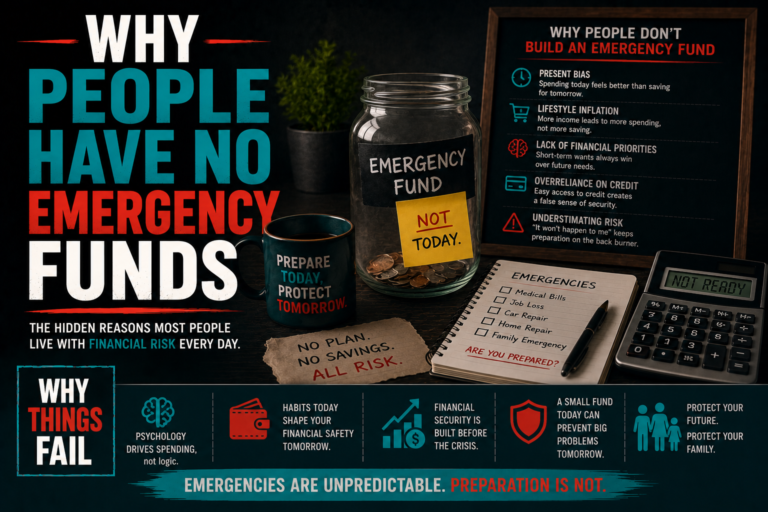
Present Bias Encourages Immediate Spending
One of the strongest behavioural forces affecting financial decisions is present bias.
People naturally place greater value on rewards they can enjoy today than benefits they may need months or years later.
A holiday creates immediate happiness.
A new phone provides instant satisfaction.
Dining out offers a tangible experience.
An emergency fund offers none of these emotional rewards.
Its value only becomes visible when something goes wrong.
Because emergencies feel distant and uncertain, saving for them often feels less important than spending money on something enjoyable today.
This explains why many people fully understand the importance of emergency savings while consistently postponing them.
The problem is rarely knowledge.
It is the way the human brain values immediate gratification over future protection.
Lifestyle Inflation Quietly Consumes Higher Income
Many people expect saving to become easier as income increases.
In reality, higher earnings often lead to higher spending.
Behavioural economists describe this as lifestyle inflation.
A salary increase creates opportunities to upgrade housing, purchase newer vehicles, travel more frequently and spend more freely on entertainment.
Each improvement appears reasonable in isolation.
Together, they increase recurring monthly expenses.
As fixed financial commitments expand, the ability to save remains limited despite rising income.
This explains why some households earning substantial salaries still struggle to build emergency reserves.
Income has grown.
Financial flexibility has not.
People Underestimate Everyday Financial Risk
Human beings generally struggle to evaluate low probability events.
Most people acknowledge that job loss, illness or unexpected repairs happen to others.
Few genuinely believe these events will affect them in the near future.
Psychologists refer to this as optimism bias.
Individuals naturally believe negative outcomes are less likely to happen to them than to other people.
This reduces the perceived urgency of preparing for emergencies.
Saving money therefore becomes a future objective rather than an immediate priority.
Unfortunately, financial emergencies rarely provide advance notice.
By the time optimism is replaced by reality, opportunities to prepare have often disappeared.
Emotional Spending Replaces Rational Planning
Money is rarely spent for purely financial reasons.
Purchasing decisions frequently satisfy emotional needs.
People spend to celebrate success.
They spend to reduce stress.
They spend to reward themselves after difficult experiences.
Consumer behaviour research consistently shows that emotions strongly influence purchasing decisions, particularly during periods of fatigue, anxiety and social comparison.
These decisions rarely appear irresponsible.
Most are relatively small.
Coffee.
Streaming subscriptions.
Impulse purchases.
Frequent dining out.
Online shopping.
Individually they seem insignificant.
Collectively they reduce the surplus income required to build financial resilience.
The challenge is not one expensive purchase.
It is hundreds of small decisions that gradually replace saving with consumption.
Social Pressure Changes Financial Priorities
Financial decisions are rarely made in isolation.
Family expectations, friendship circles and social media all influence spending behaviour.
People compare lifestyles more frequently than they compare financial security.
A visible purchase receives immediate recognition.
An emergency fund receives almost none.
Behavioural economists describe this as a problem of incentives.
Society often rewards visible consumption while ignoring invisible financial resilience.
As a result, people naturally allocate more attention towards purchases that improve social status than savings that quietly improve financial stability.
The emergency fund loses because it provides psychological security rather than social recognition.
Poor Financial Education Explains Only Part Of The Problem
Financial literacy is important.
Understanding budgeting, cash flow and saving certainly improves financial decision making.
However, knowledge alone does not guarantee action.
Many people know they should build an emergency fund.
They simply delay doing so.
The gap between knowledge and behaviour is one of the most important findings in behavioural finance.
People frequently understand the correct decision while choosing differently because immediate emotions outweigh long term objectives.
This is why improving financial education alone cannot solve the emergency savings problem.
Behaviour must change alongside knowledge.
Delayed Consequences Make The Problem Invisible
Perhaps the most dangerous characteristic of having no emergency fund is that the consequences often remain hidden.
Nothing appears wrong for months or even years.
Bills are paid.
Income continues.
Life feels financially stable.
This creates the illusion that emergency savings are unnecessary.
Then circumstances change.
Employment ends unexpectedly.
A major medical expense appears.
Essential household repairs become unavoidable.
The financial system that once seemed stable is suddenly exposed as fragile.
The emergency did not create the problem.
It simply revealed vulnerabilities that had been developing long before the crisis appeared.
Warning Signs
Financial failure rarely begins with a crisis.
It usually begins with habits that appear harmless because their consequences are delayed.
One warning sign is consistently reaching the end of each month with nothing left to save despite stable income. This often indicates that spending has gradually expanded to match earnings rather than leaving room for financial resilience.
Another warning sign is relying on credit cards for unexpected expenses. When borrowing becomes the default response to routine emergencies, it suggests that financial flexibility has already disappeared.
Many people also postpone saving until they receive a salary increase, bonus or tax refund. While this sounds reasonable, it often becomes a permanent habit because higher income is frequently accompanied by higher spending.
Ignoring small financial setbacks is another indicator. If a minor car repair, medical bill or household expense creates significant financial stress, it usually reflects the absence of adequate cash reserves rather than the size of the expense itself.
Perhaps the clearest warning sign is believing that emergencies are unlikely to happen. This optimistic assumption reduces the urgency of preparing for uncertain events until reality proves otherwise.
People ignore these warning signs because nothing appears wrong in the present. Daily life continues normally, making financial vulnerability invisible until an unexpected event exposes it.
What Could Have Prevented It?
Building an emergency fund is not primarily about earning more money.
It is about creating systems that make saving automatic rather than optional.
One important safeguard is treating emergency savings as a fixed financial commitment instead of saving whatever remains at the end of the month. Behavioural research consistently shows that people are more likely to save when the decision is made before spending begins.
Clear financial planning also reduces uncertainty. Individuals who define savings goals, expected monthly expenses and potential financial risks are better prepared for unexpected events because they have already considered possible outcomes.
Reducing unnecessary lifestyle expansion is equally important. Higher income creates opportunities to improve living standards, but allowing every increase in earnings to become permanent spending leaves little room for financial resilience.
Better financial education can also improve decision making, particularly when it explains behavioural biases rather than focusing only on budgeting techniques. Understanding why people naturally delay saving helps individuals recognise the psychological barriers affecting their choices.
Finally, households benefit from viewing emergency savings as protection rather than unused money. This shift changes the purpose of saving from sacrificing present enjoyment to purchasing future stability.
Lessons
The absence of emergency savings reveals lessons that extend far beyond personal finance.
The first lesson is that financial security depends more on consistent behaviour than occasional financial success. A high income cannot compensate for habits that continually consume available resources.
The second lesson is that people rarely make poor financial decisions intentionally. Most financial vulnerability develops through repeated small choices that seem reasonable in isolation but become damaging when accumulated over time.
Another lesson is that uncertainty cannot be avoided, but it can be prepared for. Financial resilience comes from accepting that unexpected events are a normal part of life rather than rare exceptions.
Perhaps the most important lesson is that wealth is not measured only by income or assets. True financial strength includes the ability to absorb unexpected shocks without disrupting long term financial stability.
Failure Pattern
The dominant pattern behind this financial failure is Short Term Thinking combined with Poor Financial Discipline.
People naturally prioritise immediate needs, visible rewards and present satisfaction over uncertain future events. Every small spending decision appears reasonable, but together they gradually eliminate the capacity to save.
Lifestyle inflation strengthens this pattern. As income increases, expectations also increase. Spending adjusts upward while savings remain unchanged.
Social comparison reinforces the behaviour because visible consumption receives immediate recognition while financial preparedness remains invisible.
The same pattern appears across households, businesses and even governments. Immediate rewards often receive greater attention than preparing for future uncertainty. Financial crises simply expose weaknesses that have existed for years.
Hidden Lesson
The absence of an emergency fund is rarely caused by one financial mistake.
It is the result of repeatedly choosing certainty today over protection tomorrow.
The deeper truth is that financial resilience is built long before an emergency occurs. When a crisis exposes the absence of savings, the real failure is not the emergency itself. It is the gradual pattern of decisions that made the household financially fragile long before the unexpected event arrived.
Failure Scorecard
| Area | Score | Explanation |
| Financial Discipline | 4/10 | Spending habits often take priority over consistent saving. |
| Decision Making | 5/10 | Present needs frequently outweigh preparation for future uncertainty. |
| Risk Management | 3/10 | Many households underestimate financial risks and remain unprepared for emergencies. |
| Long Term Thinking | 4/10 | Short term satisfaction often replaces long term financial resilience. |
| Financial Knowledge | 6/10 | Many understand the value of emergency savings but fail to act consistently. |
| Emotional Control | 5/10 | Emotional spending and optimism bias frequently influence financial behaviour. |
| Planning | 4/10 | Emergency savings are often postponed instead of being incorporated into financial planning. |
| Adaptability | 6/10 | Households often adapt after financial setbacks, but preparation usually begins too late. |
Key Takeaways
- People often have no emergency funds because behavioural biases outweigh financial knowledge.
- Present bias encourages spending today while delaying preparation for tomorrow.
- Lifestyle inflation can prevent saving even when income increases.
- Emotional spending gradually reduces financial resilience.
- Optimism bias causes people to underestimate everyday financial risks.
- Emergency funds protect against uncertainty rather than generating returns.
- Financial security depends on consistent habits more than income alone.
- Small behavioural changes repeated over time create either financial stability or financial vulnerability.
Frequently Asked Questions
Why do people have no emergency funds?
Most people have no emergency funds because immediate spending, lifestyle inflation, optimism bias and poor financial habits gradually replace consistent saving. The problem is usually behavioural rather than purely financial.
Is low income the main reason people cannot build an emergency fund?
Low income can make saving more difficult, but it is not the only explanation. Behavioural research shows that households across different income levels often struggle with emergency savings due to spending habits, financial priorities and psychological biases.
Why do people delay building an emergency fund?
People delay because emergencies feel uncertain while spending provides immediate satisfaction. Present bias encourages prioritising today’s rewards over future financial protection.
How does lifestyle inflation affect emergency savings?
As income rises, many people increase their spending rather than their savings. This leaves little additional money available for emergency reserves despite earning more.
Why is an emergency fund important?
An emergency fund provides financial flexibility during unexpected events such as job loss, medical expenses or urgent repairs. It reduces reliance on debt and helps households manage financial shocks without disrupting long term financial stability.
Conclusion
People rarely lack emergency funds because they ignore financial reality. They lack them because human behaviour naturally favours immediate rewards over uncertain future risks. Financial emergencies simply reveal the consequences of choices that accumulated quietly over time.
Understanding this changes the conversation from blaming income alone to recognising the deeper behavioural, psychological and systemic patterns that shape financial resilience. An emergency fund is therefore not simply a savings account. It is evidence of decisions that consistently placed future stability ahead of present comfort.