Quick Answer
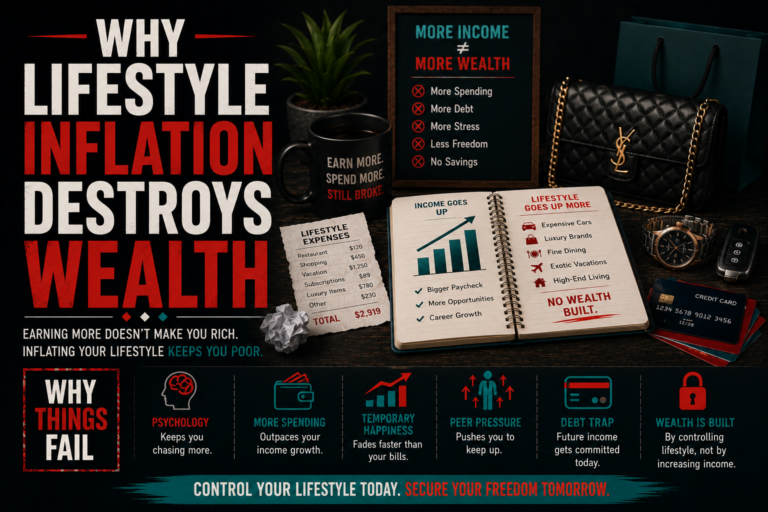
Lifestyle inflation destroys wealth because spending often rises alongside income. Instead of increasing savings, investments and financial resilience, people gradually adopt more expensive lifestyles. Over time, higher fixed expenses reduce cash flow, limit wealth accumulation and make financial independence increasingly difficult.
Introduction
Most people believe earning more money naturally leads to becoming wealthier.
It sounds logical.
A higher salary should create greater financial security, larger investment portfolios and more opportunities to build long term wealth.
Yet many high income earners continue living from one pay cheque to the next. Some earn six figure salaries while carrying significant debt. Others receive regular promotions but still feel financially stretched.
This contradiction raises an important question.
If income continues to increase, why does financial security often remain out of reach?
The answer lies in a behavioural pattern that receives far less attention than investing, budgeting or saving.
It is known as lifestyle inflation.
Unlike sudden financial crises, lifestyle inflation rarely creates immediate hardship. It develops quietly through hundreds of small decisions that individually appear reasonable but collectively transform higher earnings into higher spending.
Understanding why lifestyle inflation destroys wealth is not simply about controlling expenses.
It is about understanding how human behaviour adapts to success, how social expectations influence financial choices and why more income does not automatically create more wealth.
What Is Lifestyle Inflation?
Lifestyle inflation occurs when spending increases as income grows.
Rather than using additional earnings to strengthen financial security, people gradually upgrade their standard of living.
A modest apartment becomes a larger home.
A reliable family car becomes a luxury vehicle.
Occasional restaurant meals become everyday habits.
Premium subscriptions replace basic services.
Holidays become increasingly expensive.
Individually, none of these decisions appear irresponsible.
Collectively, they create permanent financial commitments that consume future income before it has even been earned.
The result is that income rises while financial freedom remains largely unchanged.
Lifestyle inflation therefore represents a failure to convert higher earnings into lasting wealth.
The Biggest Myth
The most common belief is that spending more is the natural reward for earning more.
Many people assume financial success should always be visible.
A higher salary is expected to produce a bigger house, newer car, designer clothing and a more luxurious lifestyle.
This belief confuses income with wealth.
Income measures how much money enters your bank account.
Wealth measures how much financial security remains after spending.
Someone earning a modest salary while consistently investing and building assets may accumulate greater long term wealth than someone earning several times more but continually increasing their expenses.
The visible signs of financial success often reveal very little about actual financial strength.
In many cases, they reveal the opposite.
What Usually Happens?
Lifestyle inflation follows a remarkably predictable pattern.
Income increases.
Spending increases shortly afterwards.
The new lifestyle quickly becomes normal.
Satisfaction fades.
Another increase in income leads to another increase in spending.
Savings remain relatively unchanged.
Financial commitments continue growing.
Eventually, a person earning substantially more than before experiences the same financial pressure they felt at a much lower income.
The cycle repeats because expectations rise almost as quickly as earnings.
The problem is rarely insufficient income.
It is the inability to separate improved earning power from continuously expanding consumption.
Why Does Lifestyle Inflation Destroy Wealth?
This is where the deeper investigation begins.
Lifestyle inflation is rarely driven by mathematics alone.
It is driven by psychology.
Money changes behaviour long before it changes financial security.
Every increase in income creates new choices.
Those choices are influenced by emotion, social expectations and behavioural biases rather than objective financial analysis.
Understanding these hidden forces explains why lifestyle inflation appears so consistently across different income levels, professions and cultures.
Hedonic Adaptation Changes The Definition Of Enough
One of the strongest explanations comes from behavioural psychology.
Humans rapidly adapt to improved circumstances.
Psychologists describe this as hedonic adaptation.
A salary increase creates excitement.
A new home feels luxurious.
A premium car feels rewarding.
Yet these emotional benefits rarely last.
After several months, yesterday’s luxury becomes today’s normal routine.
The brain adjusts its expectations.
What once felt exceptional soon feels ordinary.
This creates an endless cycle of upgrading because satisfaction gradually fades while expectations continue increasing.
Lifestyle inflation therefore has less to do with financial necessity than with changing psychological standards.
People do not simply earn more.
They redefine what they believe they need.
Social Comparison Quietly Shapes Financial Decisions
Financial decisions are rarely made in isolation.
People constantly compare themselves with colleagues, neighbours, relatives and friends.
Behavioural economists refer to this as social comparison.
As income increases, the comparison group often changes.
Instead of comparing themselves with people earning similar salaries, individuals begin comparing themselves with higher income households.
New benchmarks emerge.
A larger house appears reasonable because successful colleagues own one.
Luxury holidays seem normal because friends regularly post photographs online.
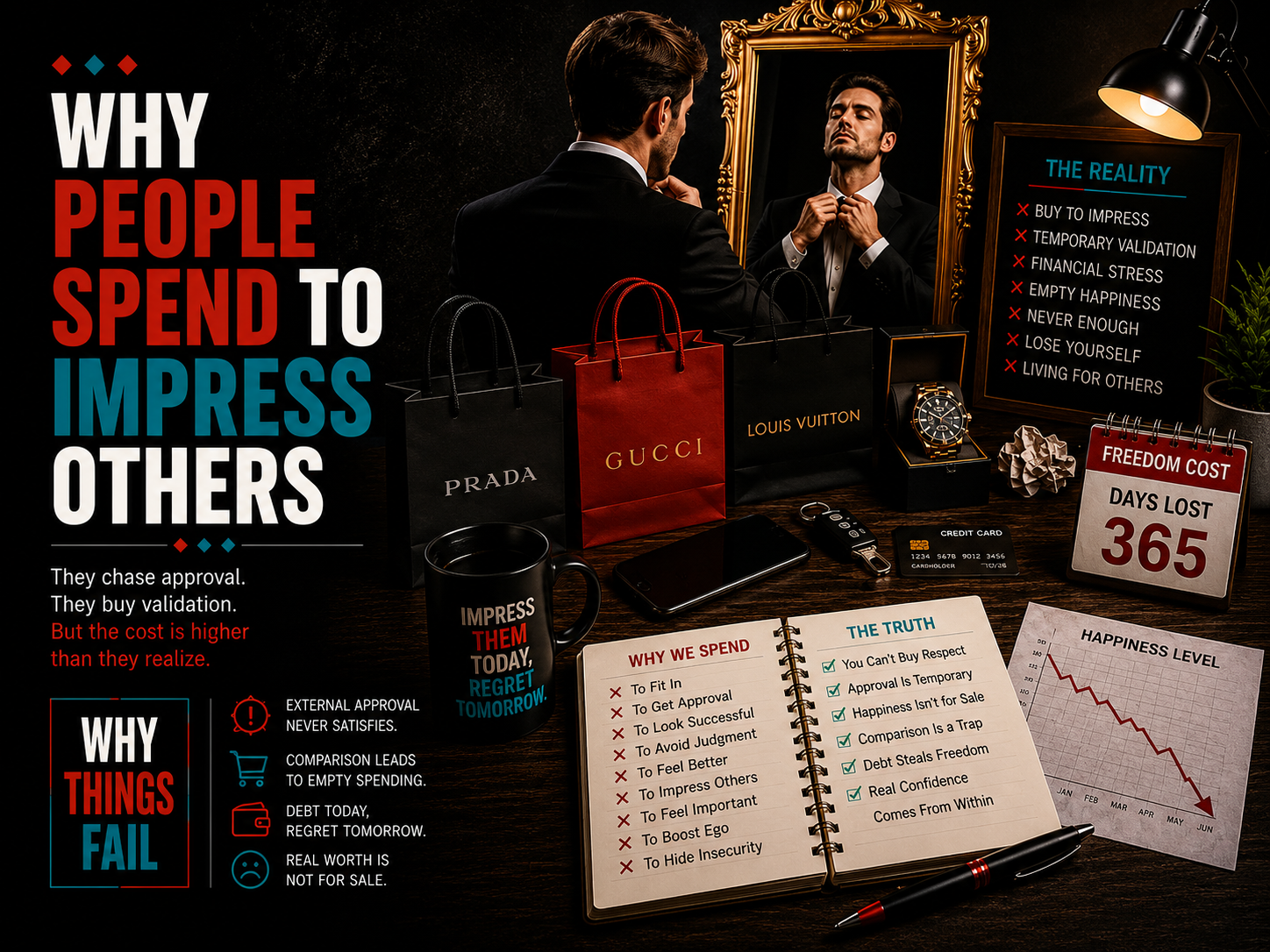
Expensive schools, premium memberships and designer products gradually become symbols of belonging rather than personal preference.
The desire for social acceptance quietly influences spending decisions that appear entirely rational on the surface.
Lifestyle inflation is therefore partly driven by external expectations rather than internal financial goals.
Emotional Spending Creates Temporary Satisfaction
Many purchases associated with lifestyle inflation are not made because they solve practical problems.
They are made because they satisfy emotional needs.
Recognition.
Achievement.
Status.
Comfort.
Identity.
Consumer psychology shows that spending often functions as emotional reinforcement.
After working harder and earning more, people naturally seek rewards.
The problem is that emotional rewards are temporary.
The satisfaction of buying a luxury watch, renovating a home or upgrading a vehicle gradually disappears.
The financial commitment, however, remains.
This imbalance creates a situation where temporary emotional satisfaction produces permanent financial obligations.
Over time, recurring expenses reduce cash flow and limit opportunities to build investments, emergency savings and long term wealth.
Lifestyle Inflation Reduces Future Financial Flexibility
Perhaps the greatest hidden cost is not higher spending itself.
It is reduced flexibility.
Higher fixed expenses create dependence on maintaining the same level of income.
Career changes become more difficult.
Starting a business becomes riskier.
Taking time away from work becomes financially stressful.
Unexpected economic downturns become harder to absorb.
What initially appeared to be a reward for financial success gradually becomes a system that demands continued high earnings simply to maintain an established lifestyle.
The paradox is striking.
More income was supposed to increase freedom.
Instead, unmanaged lifestyle inflation often reduces it.
Behavioural Biases Reinforce The Cycle
Lifestyle inflation persists because several behavioural biases operate simultaneously.
Present bias encourages immediate enjoyment over future financial security.
Optimism bias creates confidence that future income will continue growing indefinitely.
Overconfidence reduces concern about economic uncertainty or unexpected expenses.
Mental accounting allows people to justify expensive purchases because they have recently received bonuses, promotions or salary increases.
Each bias appears relatively harmless on its own.
Together, they create a powerful system that gradually shifts money away from wealth building and towards higher consumption without attracting immediate attention.
Unlike sudden financial crises, lifestyle inflation rarely announces itself.
It quietly reshapes financial behaviour until wealth accumulation slows, financial resilience weakens and earning more no longer translates into becoming wealthier.
Warning Signs
Lifestyle inflation rarely begins with one extravagant purchase. It develops through a series of small financial decisions that gradually become permanent obligations.
One of the earliest warning signs is that every salary increase is immediately followed by higher spending. Instead of strengthening savings or investments, additional income is quickly absorbed by lifestyle upgrades.
Another warning sign is treating luxury as necessity. Expenses that once felt optional gradually become non negotiable. Premium services, expensive holidays and larger homes begin to feel like basic requirements rather than personal choices.
A growing dependence on future income is another important signal. Financial commitments are made based on expected promotions, bonuses or future salary increases rather than current financial capacity.
Perhaps the most overlooked warning sign is that net worth grows far more slowly than income. A person may earn significantly more than five years ago, yet their savings, investments and financial resilience remain almost unchanged.
These warning signs are often ignored because there is no immediate financial crisis. Bills continue to be paid, credit remains available and income continues arriving. The long term consequences remain hidden until a job loss, economic downturn or unexpected expense exposes how little financial flexibility actually exists.
What Could Have Prevented It?
Lifestyle inflation is not prevented by avoiding success or refusing to enjoy higher earnings.
It is prevented by creating systems that separate increased income from increased consumption.
The most effective approach is deciding in advance how additional income will be allocated. When salary increases automatically contribute towards investments, emergency savings or wealth building assets before lifestyle upgrades occur, financial progress becomes intentional rather than accidental.
Another important safeguard is recognising the difference between improving quality of life and increasing the cost of living. Some spending genuinely enhances wellbeing, health or productivity. Other spending simply reflects social comparison or temporary emotional satisfaction. Understanding this distinction leads to better financial decisions.
Maintaining modest fixed expenses also preserves flexibility. Lower financial commitments create greater freedom to change careers, start a business, reduce working hours or navigate economic uncertainty without immediate financial pressure.
Regularly measuring net worth rather than income provides another valuable perspective. Income reflects earning ability. Net worth reflects the financial results of decisions made over many years. Focusing on assets instead of lifestyle encourages long term thinking.
Most importantly, understanding behavioural psychology helps people recognise when spending decisions are driven by identity, status or social expectations rather than genuine personal value.
Lessons
Lifestyle inflation teaches that earning more money and building wealth are fundamentally different objectives.
Higher income creates opportunity, but behaviour determines whether that opportunity becomes financial security or higher consumption.
Another lesson is that financial success is often invisible. Wealth grows quietly through disciplined decisions that receive little public attention, while expensive lifestyles are highly visible despite sometimes resting on weak financial foundations.
The investigation also shows that satisfaction cannot be permanently purchased. Human expectations naturally adjust to improved circumstances, making continuous lifestyle upgrades an ineffective strategy for achieving lasting fulfilment.
Perhaps the most important lesson is that financial freedom depends less on how much people earn and more on how much flexibility they preserve. The ability to make independent life decisions often matters more than maintaining an increasingly expensive lifestyle.
Failure Pattern
The dominant pattern behind lifestyle inflation is Lifestyle Inflation reinforced by Consumerism, Social Comparison and Short Term Thinking.
The cycle begins with increased income.
Higher income creates confidence and expands spending choices.
Consumer behaviour encourages treating every financial milestone as a reason to upgrade lifestyle.
As spending increases, fixed financial commitments grow.
Growing commitments reduce savings, investments and financial flexibility.
Eventually, individuals discover that earning substantially more has not produced proportional increases in wealth.
This pattern appears repeatedly among employees, entrepreneurs, professional athletes, business owners and lottery winners because it reflects predictable human behaviour rather than income level.
The financial outcome changes very little.
Higher earnings become higher expenses instead of greater financial security.
Hidden Lesson
Lifestyle inflation does not destroy wealth because people spend more.
It destroys wealth because every unnecessary financial commitment quietly claims future income before it has been earned.
The deeper truth is that wealth is created by preserving future choices.
Every recurring expense reduces those choices.
Every unnecessary obligation limits flexibility.
Every lifestyle upgrade that becomes permanent quietly transfers future earning power into present consumption.
Financial freedom is therefore determined less by income than by the ability to control commitments that compete for future cash flow.
Failure Scorecard
| Area | Score | Explanation |
| Financial Discipline | 4/10 | Rising income frequently leads to higher consumption rather than greater saving and investing. |
| Decision Making | 5/10 | Spending decisions are often influenced by emotion and social expectations instead of long term financial goals. |
| Risk Management | 5/10 | High fixed expenses reduce resilience during economic uncertainty and unexpected life events. |
| Long Term Thinking | 4/10 | Immediate lifestyle improvements commonly take priority over future financial independence. |
| Financial Knowledge | 6/10 | Many people understand the value of saving but underestimate the cumulative effect of lifestyle inflation. |
| Emotional Control | 4/10 | Emotional rewards and status driven purchases often override rational financial judgement. |
| Planning | 5/10 | Income usually increases faster than long term financial planning evolves. |
| Adaptability | 6/10 | Lower financial commitments allow adaptation, while expensive lifestyles reduce flexibility. |
Key Takeaways
- Lifestyle inflation quietly reduces wealth by increasing spending as income grows.
- Higher income does not automatically create financial security.
- Hedonic adaptation continually raises expectations, making satisfaction temporary.
- Social comparison encourages unnecessary lifestyle upgrades.
- Wealth is determined by assets and financial flexibility rather than visible consumption.
- High fixed expenses reduce resilience during financial uncertainty.
- Behavioural biases often influence spending more than practical needs.
- Long term wealth grows when increased income strengthens investments instead of recurring expenses.
Frequently Asked Questions
Why does lifestyle inflation destroy wealth?
Lifestyle inflation destroys wealth because additional income is gradually consumed by higher spending instead of increasing savings, investments and financial assets. Over time this limits wealth accumulation despite higher earnings.
Is lifestyle inflation always bad?
No. Improving quality of life is not the problem. Lifestyle inflation becomes harmful when spending grows faster than wealth, creating permanent financial commitments that reduce future flexibility.
What causes lifestyle inflation?
The primary causes include hedonic adaptation, social comparison, consumer behaviour, present bias, emotional spending and the belief that higher income should always lead to a more expensive lifestyle.
Can high income earners still experience lifestyle inflation?
Yes. Lifestyle inflation affects people across all income levels. In many cases, higher earners experience greater pressure to maintain increasingly expensive lifestyles, making wealth accumulation more difficult than expected.
How is lifestyle inflation different from inflation?
Economic inflation refers to rising prices across the economy. Lifestyle inflation refers to voluntarily increasing personal spending as income grows, regardless of changes in the cost of living.
Conclusion
Lifestyle inflation rarely appears as a financial mistake because every individual decision seems reasonable at the time. The danger lies in the cumulative effect. Small lifestyle upgrades gradually become permanent financial obligations that consume future income and reduce financial flexibility.
Understanding this pattern reveals that wealth is not determined by how much money flows into a person’s life, but by how much of that money remains available to create future opportunities. The greatest cost of lifestyle inflation is not higher spending today. It is the quiet erosion of financial freedom tomorrow.