Quick Answer
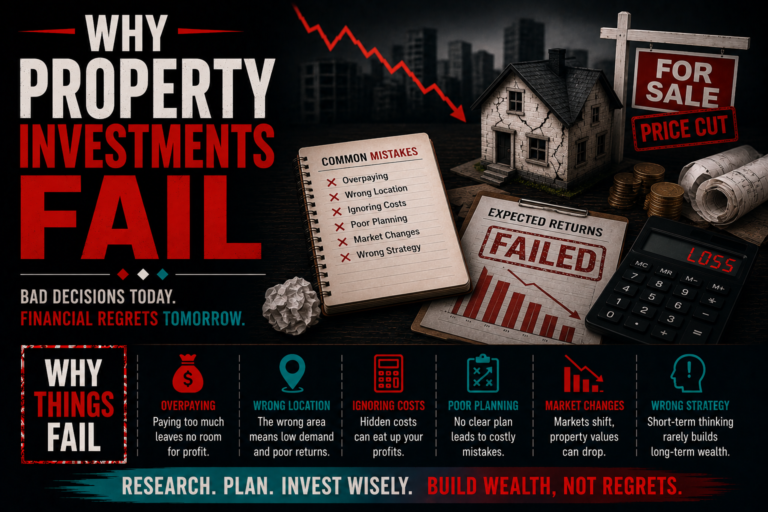
Property investments fail because investors often underestimate risk while overestimating returns. Emotional decision making, poor financial planning, excessive borrowing, weak cash flow management and unrealistic expectations gradually turn promising investments into financial liabilities. In most cases, the property itself is not the problem. The decisions surrounding it are.
Introduction
Property has long been viewed as one of the safest ways to build wealth.
For generations, owning real estate has symbolised financial security, stability and long term prosperity. Stories of rising house prices and successful property investors have reinforced the belief that property rarely loses value and that anyone who buys at the right time will eventually profit.
Yet the reality is far more complex.
Every year, countless investors experience financial losses despite purchasing assets that appeared to have strong potential. Some struggle with rising mortgage payments. Others face prolonged vacancies, unexpected maintenance costs or declining property values. Many eventually sell at a loss, while others remain trapped in investments that continually drain their finances.
These outcomes are often blamed on economic downturns or unfavourable market conditions.
Those explanations only reveal part of the story.
Property investment failure rarely begins when prices fall. It usually begins much earlier through a series of decisions that gradually increase financial vulnerability while creating the illusion of security.
Understanding why property investments fail is therefore not simply about analysing real estate markets.
It is about understanding how psychology, incentives, financial systems and human behaviour influence investment decisions long before problems become visible.
What Is Property Investment Failure?
Property investment failure is not defined by temporary declines in property prices.
Real estate markets naturally move through periods of growth, stability and correction. Short term fluctuations are part of every investment cycle.
Failure occurs when an investment no longer supports long term financial objectives because poor decisions have weakened its ability to generate sustainable value.
A property may produce insufficient rental income to cover expenses.
An investor may accumulate excessive debt that becomes difficult to manage when interest rates rise.
Unexpected repair costs, prolonged vacancies or declining local demand may reduce cash flow until the investment becomes financially unsustainable.
In many cases, the property itself remains valuable.
The failure lies in the financial structure, planning and decision making surrounding the investment.
The Biggest Myth
The most common belief in property investing is remarkably simple.
Property always increases in value.
This assumption has encouraged millions of people to enter the housing market believing that time alone guarantees profit.
History tells a different story.
Property markets experience cycles influenced by interest rates, employment, population growth, housing supply, government policy, inflation and economic confidence.
Some properties appreciate significantly.
Others remain stagnant for years.
Some decline in value for prolonged periods due to changing economic conditions or local market dynamics.
The belief that every property automatically becomes a successful investment encourages investors to ignore essential questions.
Can the property generate positive cash flow?
Is the purchase price supported by local demand?
Can the investor manage higher borrowing costs?
What happens if rental income falls?
The myth shifts attention away from analysing risk and towards assuming success.
That assumption often becomes the first step towards financial failure.
What Usually Happens?
Most unsuccessful property investments follow a predictable sequence.
An investor identifies a property that appears attractive.
Optimism encourages quick decision making.
Borrowing increases to maximise purchasing power.
Initial market conditions remain favourable.
Property values rise or rental demand appears strong.
Confidence grows.
As confidence increases, financial discipline often weakens.
Investors purchase additional properties without fully considering debt levels, cash flow or changing economic conditions.
Unexpected expenses begin appearing.
Interest rates rise.
Vacancy periods become longer.
Maintenance costs increase.
Rental income no longer covers total expenses.
Financial pressure gradually replaces optimism.
By the time serious problems emerge, many of the decisions responsible were made years earlier during periods of confidence.
Why Property Investments Fail?
Property investment failure is rarely caused by one unexpected event.
It usually develops through the interaction of psychology, financial incentives and structural weaknesses that remain hidden while market conditions appear favourable.
The market simply exposes risks that already existed.
Overconfidence Encourages Excessive Borrowing
One of the strongest behavioural biases affecting property investors is overconfidence.
After purchasing one successful property, many investors begin believing they understand the market exceptionally well.
They become increasingly comfortable taking on larger mortgages and expanding their portfolios.
Borrowing itself is not necessarily dangerous.
The danger emerges when confidence exceeds financial resilience.
During periods of low interest rates and rising property prices, larger loans appear manageable. Monthly repayments remain affordable and increasing equity creates the impression that risk is declining.
In reality, financial exposure is increasing.
The investor becomes increasingly dependent on favourable market conditions continuing indefinitely.
When borrowing costs rise or rental income declines, highly leveraged portfolios become fragile.
The problem is not debt alone.
It is assuming future conditions will always resemble the present.
Emotional Decision Making Replaces Objective Analysis
Property purchases often involve more emotion than other investments.
People imagine future lifestyles, neighbourhood prestige and long term security.
These emotional associations influence judgement even when the property is intended purely as an investment.
Behavioural economists have shown that emotional attachment frequently distorts financial decisions.
Investors become willing to pay more than objective valuations justify because they fear missing an opportunity.
This behaviour is reinforced by competitive property markets where buyers feel pressure to make immediate decisions.
Instead of evaluating expected rental yields, operating costs and long term cash flow, attention shifts towards securing ownership before someone else does.
Fear of missing out gradually replaces disciplined investment analysis.
Cash Flow Is Frequently Ignored
Many investors focus almost entirely on future capital appreciation.
They assume rising property values will compensate for weak financial performance today.
This assumption overlooks one of the most important principles in real estate investing.
A property survives through cash flow.
Mortgage repayments, insurance, maintenance, property taxes and unexpected repairs continue regardless of whether property prices increase.
If rental income consistently fails to cover these obligations, investors become dependent on personal savings or additional borrowing.
This weakens financial resilience and reduces flexibility during economic downturns.
Strong property values cannot compensate indefinitely for weak cash flow.
Eventually, liquidity problems force difficult decisions.
Greed Gradually Changes Investment Behaviour
Property markets often create the illusion that wealth can be built quickly.
As prices rise, investors become increasingly optimistic.
Stories of rapid capital gains encourage others to purchase additional properties using maximum available borrowing.
Behavioural finance describes this as reward reinforcement.
Each successful investment increases confidence and encourages greater risk taking.
Investors who originally planned to purchase one carefully researched property may eventually own several highly leveraged assets.
The objective quietly changes.
Preserving wealth becomes less important than expanding wealth.
The pursuit of rapid growth often replaces careful financial planning.
Short Term Thinking Weakens Long Term Decisions
Successful property investing requires patience.
Many investors, however, judge success through short term price movements.
When prices rise rapidly, they become convinced that purchasing decisions were correct.
When prices stagnate, anxiety increases.
This creates unnecessary buying and selling based on market sentiment rather than long term fundamentals.
Economic cycles rarely move according to investor expectations.
Interest rates change.
Employment patterns evolve.
Infrastructure projects reshape local demand.
Demographic trends influence housing markets over decades rather than months.
Short term thinking encourages reactions to temporary market conditions instead of thoughtful analysis of sustainable value.
Poor Financial Education Creates Hidden Risk
Many first time property investors understand how to purchase a property.
Far fewer understand how to evaluate investment risk comprehensively.
They may underestimate vacancy risk, maintenance expenses, refinancing costs, taxation, insurance requirements or changing lending conditions.
These overlooked factors rarely create immediate problems.
Instead, they accumulate gradually until multiple pressures occur simultaneously.
By then, financial flexibility has often disappeared.
The investment appears to have failed suddenly.
In reality, the failure developed through years of underestimated risk, optimistic assumptions and incomplete financial planning.
Warning Signs
Property investment failure rarely arrives without warning. Most investors receive numerous signals that risk is increasing, yet they often dismiss them because recent success creates confidence.
One warning sign is relying entirely on rising property prices to justify the investment. When appreciation becomes the primary source of expected returns, investors pay less attention to rental income, operating expenses and long term affordability.
Another warning sign is purchasing additional properties before the first investment has demonstrated sustainable cash flow. Expanding rapidly increases financial commitments while reducing flexibility if market conditions change.
Declining liquidity is equally important. When mortgage payments, maintenance costs and unexpected repairs consume an increasing proportion of monthly income, the investment becomes financially fragile. Even a short vacancy period can create significant pressure.
Ignoring changing economic conditions is another common mistake. Rising interest rates, weaker employment, declining population growth or oversupply in the local housing market all affect future property performance. Investors who assume yesterday’s conditions will continue indefinitely often underestimate these risks.
Perhaps the clearest warning sign is making investment decisions based on optimism rather than evidence. Purchasing because everyone else is buying, believing property prices cannot fall or assuming refinancing will always remain available reflects emotional confidence rather than objective analysis.
These warning signs are frequently ignored because they appear during periods of market strength. Success creates reassurance, making caution seem unnecessary until financial pressure becomes unavoidable.
What Could Have Prevented It?
Most unsuccessful property investments could not have been prevented by predicting the perfect time to buy or sell.
They could have been reduced through stronger decision making and better financial systems.
The first safeguard is recognising that property should be evaluated as a business rather than an emotional purchase. Every investment should be capable of generating sustainable cash flow while remaining resilient under less favourable economic conditions.
Conservative borrowing also strengthens long term resilience. Investors who maintain manageable debt levels are better positioned to absorb rising interest rates, temporary vacancies and unexpected maintenance costs without being forced into distressed sales.
Scenario planning provides another important defence. Considering how the investment would perform if rental income declined, borrowing costs increased or local demand weakened encourages more balanced decisions before financial commitments are made.
Regular financial reviews are equally valuable. Property markets evolve over time, and assumptions made during purchase may no longer remain valid several years later. Reviewing cash flow, operating costs and local market conditions helps investors identify problems before they become critical.
Finally, separating emotion from investment decisions improves judgement. Attractive architecture, prestigious locations and optimistic market sentiment should never replace careful analysis of affordability, cash flow and long term sustainability.
Lessons
Property investment reveals an important truth about financial success.
Assets rarely fail on their own.
Poor decisions surrounding those assets create failure.
One important lesson is that leverage magnifies both opportunity and risk. Borrowed money can accelerate wealth creation during favourable conditions, but it can equally accelerate financial decline when circumstances change.
Another lesson is that cash flow deserves greater attention than property prices. Rising valuations create paper wealth, but consistent cash flow determines whether an investment remains financially sustainable.
Property investing also demonstrates that patience is different from passivity. Long term investors benefit from allowing quality assets time to appreciate, yet they must continue monitoring financial performance rather than assuming success is inevitable.
Perhaps the most enduring lesson is that disciplined planning consistently outperforms optimistic assumptions. Financial resilience depends less on predicting favourable markets and more on preparing for unfavourable ones.
Failure Pattern
The dominant pattern behind property investment failure is Overconfidence combined with Poor Risk Management and Weak Cash Flow Management.
The sequence is remarkably consistent.
Initial success encourages confidence.
Confidence encourages larger borrowing.
Larger borrowing reduces financial flexibility.
Unexpected economic changes expose underlying weaknesses.
Financial pressure replaces optimism.
This pattern extends beyond property markets.
Businesses expand too quickly after periods of growth.
Investors concentrate wealth into fashionable assets.
Families increase spending after temporary income increases.
In every case, favourable conditions encourage behaviour that becomes unsustainable when circumstances change.
The failure is therefore behavioural before it becomes financial.
Hidden Lesson
The greatest risk in property investing is not market volatility.
It is believing that owning property automatically creates wealth.
Real estate is simply an asset.
Its success depends on the quality of the financial decisions supporting it.
Markets rarely create financial weakness.
They reveal weaknesses that already exist through excessive borrowing, poor planning, unrealistic expectations and insufficient cash flow.
By the time a property investment fails, the decisions responsible were usually made years earlier when confidence was highest and perceived risk was lowest.
Failure Scorecard
| Area | Score | Explanation |
| Financial Discipline | 5/10 | Many investors allow optimism to influence borrowing and spending decisions. |
| Decision Making | 5/10 | Emotional judgement often outweighs objective financial analysis. |
| Risk Management | 4/10 | Excessive leverage and inadequate contingency planning increase financial vulnerability. |
| Long Term Thinking | 6/10 | Investors generally recognise the importance of time but often underestimate changing market conditions. |
| Financial Knowledge | 6/10 | Basic property knowledge is common, but understanding of investment risk is frequently incomplete. |
| Emotional Control | 5/10 | Fear of missing opportunities and overconfidence regularly influence purchasing decisions. |
| Planning | 5/10 | Many investments begin without realistic stress testing or long term cash flow analysis. |
| Adaptability | 6/10 | Successful investors adjust to economic changes, while unsuccessful investors remain committed to outdated assumptions. |
Key Takeaways
- Property investments fail because of decisions more often than market conditions.
- Overconfidence frequently leads investors to borrow beyond sustainable levels.
- Positive cash flow is more important than relying solely on future price appreciation.
- Emotional purchasing decisions weaken objective investment analysis.
- Conservative borrowing improves resilience during economic downturns.
- Property markets move through cycles rather than permanent growth.
- Strong financial planning protects investors from unexpected events.
- Long term wealth depends on disciplined decision making rather than optimistic assumptions.
Frequently Asked Questions
Why do property investments fail?
Property investments usually fail because of excessive borrowing, weak cash flow, emotional decision making and poor risk management rather than the property itself.
Is buying property always a good investment?
No. Property can be a valuable long term asset, but investment success depends on purchase price, cash flow, financing, market conditions and disciplined financial planning.
What is the biggest mistake property investors make?
One of the biggest mistakes is assuming future property price growth will solve weak financial performance instead of ensuring the investment is sustainable through rental income and cash flow.
Why is cash flow more important than property appreciation?
Cash flow allows an investment to remain financially sustainable by covering ongoing expenses. Property appreciation creates value over time, but it does not pay monthly obligations.
Can experienced property investors still fail?
Yes. Experience does not eliminate behavioural biases. Even experienced investors can become overconfident, underestimate risk or ignore changing economic conditions.
Conclusion
Property investment failure is rarely the result of one unfortunate event. It is the cumulative outcome of decisions shaped by optimism, overconfidence, weak planning and an underestimation of financial risk. Market downturns do not usually create these weaknesses. They simply expose them.
Understanding why property investments fail shifts attention away from blaming economic conditions alone. It reveals that lasting success in real estate depends not only on choosing the right property but also on building financial systems that remain resilient when conditions inevitably change.