Introduction
Many people believe that profit is the ultimate measure of business success.
If a company earns money, attracts customers and reports healthy financial results, it should continue growing for years. Yet business history repeatedly tells a different story. Numerous companies have generated millions in revenue, reported impressive profits and still collapsed within a surprisingly short period.
This raises an important question.
How can a profitable business fail?
The answer reveals one of the biggest misconceptions in business.
Profit measures performance over a period of time. Survival depends on something much deeper. A profitable business can still fail if it makes poor decisions, ignores changing market conditions, weakens its financial position or loses the ability to adapt.
Understanding why profitable businesses still fail is important because failure rarely begins when profits disappear. It usually begins while financial performance still appears strong. By the time declining sales or cash shortages become visible, the underlying problems have often existed for months or even years.
Looking beneath the financial statements reveals that business failure is rarely caused by a single event. Instead, it develops through a combination of leadership decisions, behavioural biases, operational weaknesses and changing incentives that gradually undermine long term resilience.
What Is Business Failure?
Business failure is often associated with bankruptcy, insolvency or permanent closure.
These are only the final outcomes.
True business failure begins much earlier.
It occurs when decisions consistently weaken a company’s ability to create sustainable value, manage risk and respond to change.
A profitable company can still experience business failure if its strategy creates long term vulnerabilities.
Strong revenue does not guarantee strong cash flow.
Growing sales do not guarantee healthy operations.
High profits do not guarantee survival.
Many businesses appear financially successful while hidden weaknesses quietly accumulate beneath the surface.
The financial statements show today’s performance.
Business failure reflects tomorrow’s consequences.
The Biggest Myth
The most common belief is simple.
Profitable businesses do not fail.
This assumption seems logical.
If customers continue buying products and the company earns money, failure appears unlikely.
However, profit represents only one part of business health.
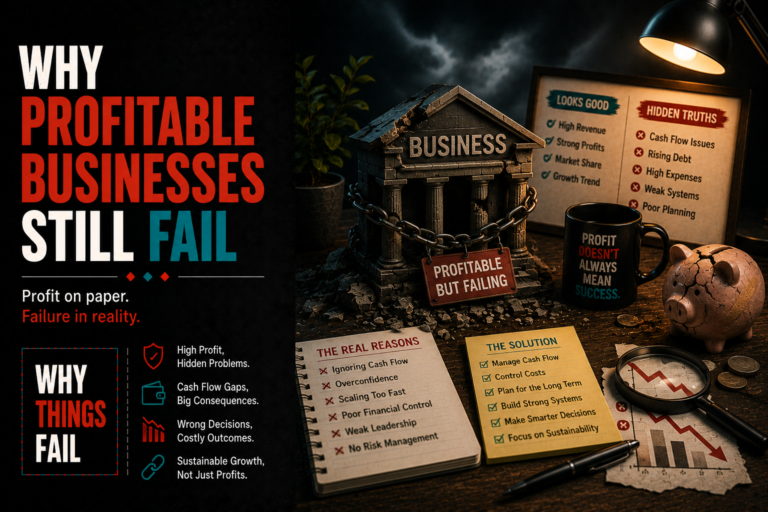
A company can report accounting profits while struggling with cash flow, excessive debt, operational inefficiencies, poor leadership or declining competitiveness.
History offers many examples of businesses that looked financially strong shortly before experiencing serious difficulties.
The mistake is assuming that profit automatically reflects resilience.
In reality, profit measures past performance.
Long term survival depends upon decision making, adaptability, financial discipline and effective leadership.
The most dangerous period for many businesses is not when performance is weak.
It is when performance is strong enough to create overconfidence.
What Usually Happens?
The pattern behind profitable business failure is remarkably consistent.
The business grows steadily.
Revenue increases.
Profits improve.
Management becomes increasingly confident.
Expansion accelerates.
Costs begin rising faster than operational discipline.
Customer expectations change.
Competition becomes stronger.
Cash flow becomes more constrained.
Small operational problems receive less attention because profits continue masking deeper weaknesses.
Eventually one unexpected event exposes vulnerabilities that have accumulated over time.
The event may be an economic slowdown, rising interest rates, supply chain disruption, changing consumer behaviour or increased competition.
The crisis itself rarely creates failure.
It simply reveals weaknesses that already existed.
Why Do Profitable Businesses Still Fail?
Understanding profitable business failure requires looking beyond financial reports.
Businesses are managed by people.
People make decisions.
Those decisions are influenced by incentives, psychology, confidence, organisational culture and imperfect information.
The financial outcome therefore reflects human behaviour as much as market conditions.
Overconfidence Often Follows Success
One of the strongest behavioural patterns in business is overconfidence.
Success naturally increases confidence.
Confidence encourages larger ambitions.
Leaders begin believing previous success guarantees future success.
Expansion plans become increasingly aggressive.
Risk appears smaller because recent decisions produced positive results.
Behavioural economists have repeatedly shown that successful outcomes often strengthen confidence faster than they improve judgement.
Leaders gradually become less likely to question assumptions or challenge existing strategies.
Alternative viewpoints receive less attention.
Warning signs are interpreted as temporary problems rather than structural risks.
This creates a dangerous feedback loop.
Success reduces caution.
Reduced caution increases risk.
Greater risk remains hidden while conditions remain favourable.
When market conditions eventually change, the accumulated weaknesses become impossible to ignore.
Cash Flow Matters More Than Profit
One of the least understood reasons profitable businesses fail is the difference between profit and cash flow.
Profit measures financial performance according to accounting principles.
Cash flow measures the movement of actual money into and out of the business.
A company may report healthy profits while struggling to pay suppliers, employees or lenders because cash has not yet been received from customers.
Rapid business growth often makes this problem worse.
Larger orders require more inventory.
More employees increase payroll expenses.
Longer customer payment terms delay incoming cash.
Operating expenses continue increasing while available cash becomes increasingly limited.
Without effective cash flow management, profitable businesses may experience severe financial pressure despite appearing successful on paper.
This isn’t a small factor research from a U.S. Bank study, widely cited by SCORE and the U.S. Chamber of Commerce, found that poor cash flow management or understanding contributed to roughly 82% of small business failures. It’s worth being precise about what that means: it’s a contributing-factor figure, not proof that cash flow was the sole cause but it confirms what this article argues. Many of the businesses in that data were genuinely profitable on paper. They simply ran out of liquid cash while waiting for revenue to arrive.
Growth Can Become A Hidden Risk
Growth is widely celebrated in business.
Investors reward it.
Customers notice it.
Employees often welcome it.
Yet rapid growth introduces complexity that many organisations underestimate.
Expanding into new markets, launching additional products or hiring large numbers of employees increases operational demands.
Management systems that worked for a smaller organisation may no longer support a larger one.
Communication becomes slower.
Decision making becomes fragmented.
Quality control becomes more difficult.
Leadership spends more time reacting to operational challenges than thinking strategically.
Growth therefore creates new risks alongside new opportunities.
When organisations focus only on expansion, they often overlook the systems required to sustain that expansion.
Short Term Success Can Weaken Long Term Thinking
Public companies frequently face pressure to deliver quarterly financial results.
Private businesses may experience similar pressure from investors, lenders or ambitious owners.
This encourages decisions that improve immediate performance while reducing future resilience.
Maintenance is delayed.
Employee development receives less investment.
Innovation slows.
Research budgets shrink.
Customer relationships receive less attention.
These decisions may temporarily improve profitability.
However, they gradually weaken the competitive advantages that originally created success.
Delayed consequences make these choices particularly dangerous because the financial impact often appears years after the original decision.
Businesses rarely fail because of one poor quarter.
They fail because repeated short term decisions gradually reduce their ability to compete, adapt and survive.
Warning Signs
Profitable businesses rarely collapse without warning. The problem is that early warning signs often appear while revenue and profits continue growing. Strong financial performance creates confidence, making leaders less likely to question existing decisions.
One important warning sign is declining cash flow despite increasing profits. When customers take longer to pay, inventory continues rising or operating expenses grow faster than available cash, financial pressure quietly builds beneath healthy income statements.
Another warning sign is leadership becoming resistant to criticism. Successful organisations sometimes begin believing that previous achievements prove future decisions will also be correct. Alternative opinions receive less attention, reducing the quality of strategic decision making.
Rapid expansion without strengthening internal systems is another common indicator. Hiring employees, entering new markets and increasing production all require stronger operational processes. When growth outpaces management capability, complexity begins weakening efficiency.
Customer behaviour also provides valuable warning signals. Falling customer satisfaction, increasing complaints and declining loyalty often appear before revenue begins falling. Businesses frequently ignore these indicators because current sales remain strong.
Excessive dependence on one product, one customer or one source of revenue creates another hidden vulnerability. During stable conditions this concentration appears profitable. When market conditions change, the business suddenly discovers that its financial strength depended upon a single variable.
Perhaps the most dangerous warning sign is believing that current success makes future success inevitable. History repeatedly shows that confidence often reaches its highest point immediately before serious business difficulties emerge.
What Could Have Prevented It?
Most profitable businesses do not fail because external events are impossible to predict. They fail because internal systems are not designed to withstand uncertainty.
One of the most effective safeguards is separating profit from financial health. Leaders who regularly monitor cash flow, working capital, liquidity and debt obligations gain a more accurate understanding of business resilience than those focusing only on profit.
Strong governance also improves decision quality. Encouraging constructive disagreement, challenging strategic assumptions and regularly reviewing business risks reduce the likelihood of overconfidence influencing leadership decisions.
Investment in systems is equally important. Growth should be supported by stronger operational processes, financial controls, technology and management capability. Expanding without strengthening these foundations creates instability rather than sustainable success.
Long term thinking also protects profitable businesses. Organisations that continue investing in innovation, employee development, customer relationships and operational improvement remain better prepared for changing market conditions.
Most importantly, successful businesses continuously ask one question.
“What could cause our current success to disappear?”
Organisations willing to examine their own weaknesses before competitors expose them usually develop greater resilience over time.
Lessons
Profitable businesses fail because success often changes behaviour before it changes financial results.
One lesson is that financial performance should never replace critical thinking. Strong profits do not eliminate strategic risk. They sometimes hide it.
Another lesson is that leadership quality matters as much as financial performance. Businesses succeed through decisions, not simply through products or revenue. Poor judgement repeated consistently eventually outweighs temporary financial success.
Business history also demonstrates that adaptability creates competitive advantage. Markets evolve, customer expectations change and technology transforms industries. Organisations that stop learning because they believe they have already succeeded often lose the ability to respond effectively.
Perhaps the most enduring lesson is that resilience matters more than short term profitability. Businesses capable of surviving uncertainty usually outperform those focused only on maximising immediate financial results.
Failure Pattern
The dominant pattern behind profitable business failure is Overconfidence combined with Short Term Thinking and Weak Risk Management.
This pattern appears repeatedly because success changes incentives.
Strong financial results reduce the perceived need for caution.
Leaders approve increasingly ambitious expansion.
Operational discipline gradually weakens.
Cash flow receives less attention than revenue.
Constructive criticism becomes less welcome.
Small problems remain unresolved because profits continue masking their impact.
Eventually changing market conditions expose weaknesses that accumulated during periods of success.
The same behavioural pattern appears across family businesses, multinational corporations, start up companies and entrepreneurial ventures because it reflects human psychology rather than industry specific conditions.
Hidden Lesson
The greatest threat to a profitable business is rarely declining profit.
It is the belief that current success proves future security.
Financial statements measure past performance.
They cannot measure leadership quality, organisational culture, strategic adaptability or future resilience.
Businesses rarely collapse because one unexpected event suddenly destroys them.
They collapse because repeated decisions quietly reduce their ability to respond when unexpected events eventually occur.
The market simply reveals weaknesses that success had previously concealed.
Failure Scorecard
| Area | Score | Explanation |
| Financial Discipline | 6/10 | Profit is often managed effectively, but cash flow and capital allocation may receive insufficient attention. |
| Decision Making | 5/10 | Confidence following success can reduce objective strategic judgement. |
| Risk Management | 4/10 | Growing businesses frequently underestimate operational and financial risks. |
| Long Term Thinking | 5/10 | Immediate growth objectives sometimes replace sustainable strategic planning. |
| Financial Knowledge | 7/10 | Leaders often understand financial reporting but overlook behavioural and systemic risks. |
| Emotional Control | 5/10 | Success may encourage optimism that weakens critical evaluation. |
| Planning | 6/10 | Expansion plans are common, but contingency planning is often inadequate. |
| Adaptability | 5/10 | Businesses that resist change become increasingly vulnerable as markets evolve. |
Key Takeaways
- Profit does not guarantee long term business survival.
- Cash flow often determines whether profitable businesses remain operational.
- Success can create overconfidence that weakens strategic decision making.
- Sustainable growth requires stronger systems as well as higher revenue.
- Leadership decisions shape business resilience more than financial results alone.
- Ignoring small operational weaknesses allows larger structural problems to develop.
- Long term competitiveness depends upon continuous adaptation.
- The strongest businesses regularly challenge their own assumptions before the market does.
Frequently Asked Questions
Why do profitable businesses still fail?
Profitable businesses fail because profit measures past performance rather than future resilience. Weak cash flow, poor leadership decisions, excessive debt, rapid expansion and failure to adapt can undermine an otherwise profitable company.
Can a company be profitable and still run out of cash?
Yes. A company may report accounting profits while lacking sufficient cash to pay suppliers, employees or lenders. This is one of the most common reasons profitable businesses experience financial distress.
What is the biggest reason profitable businesses collapse?
The biggest reason is usually a combination of overconfidence, weak risk management and poor strategic decision making. Success often encourages behaviours that gradually increase vulnerability.
Why is cash flow more important than profit?
Profit shows whether a business is earning money over time, while cash flow determines whether it can meet daily financial obligations. Without adequate cash flow, even profitable businesses can fail.
How can profitable businesses reduce the risk of failure?
They can strengthen cash flow management, improve governance, encourage critical thinking, invest in operational systems, monitor changing customer behaviour and maintain a long term strategic perspective.
Conclusion
Profitable businesses do not fail because profit suddenly disappears. They fail because success often changes behaviour before it changes financial results. Overconfidence replaces curiosity, growth outpaces capability and short term achievements begin masking long term vulnerabilities.
Understanding this shifts the conversation from financial performance to decision quality. Business failure becomes easier to explain when viewed through the lens of psychology, incentives and systems. Profit may indicate where a business stands today, but the choices made during periods of success determine whether that business is still standing tomorrow.