Introduction: Why This Failure Matters
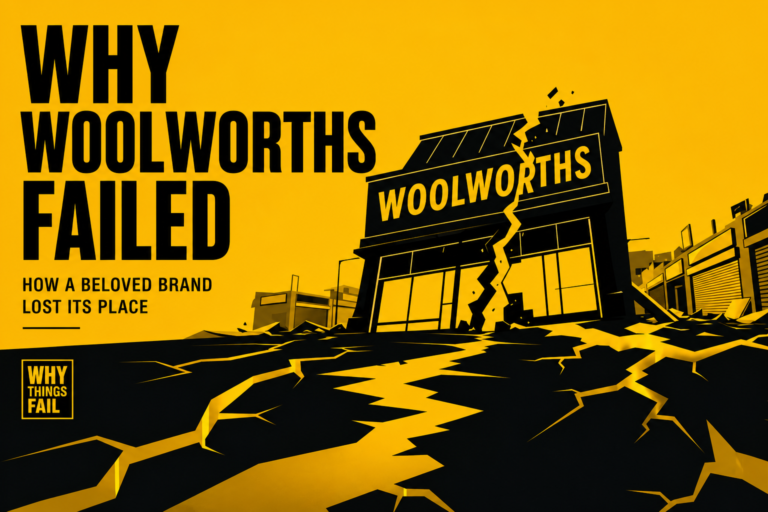
Woolworths was not just a shop. For generations of British customers, it was part of everyday life.
It sold toys, sweets, stationery, music, household items, children’s clothing, seasonal products, and small everyday goods. It was familiar, trusted, affordable, and present on high streets across the UK.
That is what makes its failure important.
Woolworths did not fail because people suddenly stopped knowing the brand. It did not fail because nobody liked it. It did not fail because one competitor destroyed it overnight.
Woolworths failed because familiarity became a substitute for strategy.
The company had history, recognition, store locations, customer memories, and national scale. But those strengths were not enough. In fact, some of them became weaknesses. The business became too broad, too unclear, too exposed to changing shopping habits, and too financially fragile.
The deeper lesson is simple: a loved brand can still become a weak business.
That is why Woolworths still matters today. Many businesses assume that recognition protects them. They believe customers will return because they always have. But markets do not reward nostalgia forever. Customers may love a brand emotionally while abandoning it practically.
Woolworths is a powerful case study in what happens when a company is known by everyone but clearly needed by fewer and fewer people.
Who Was Woolworths?
Woolworths was one of Britain’s most famous high street retailers.
It began in the UK in 1909 and became known as a variety store: a place where customers could buy many different everyday items under one roof.
At different times, Woolworths was associated with:
- Pick ’n’ mix sweets
- Toys
- Children’s clothes
- Music, DVDs, and entertainment
- Stationery
- Homeware
- Seasonal products
- General household goods
By the 2000s, Woolworths still had hundreds of stores across the UK. It remained a familiar name, especially in town centres and smaller communities.
But familiarity hid a serious problem.
Woolworths was famous, but it was no longer clearly positioned.
Customers knew Woolworths existed. The harder question was: why should they choose it?
Common Myth: “Woolworths Failed Because of the 2008 Financial Crisis”
The common explanation is simple: Woolworths failed because the financial crisis happened.
There is some truth in that. The 2008 credit crunch made trading harder, reduced consumer confidence, tightened lending, and put pressure on retailers.
But the financial crisis was not the root cause.
It was the final pressure on a business that was already weak.
The deeper reality is this: Woolworths failed because it had lost strategic clarity long before the crisis arrived.
The company was caught between different retail models. It was not the cheapest. It was not the most convenient. It was not the strongest specialist. It was not the best online retailer. It was not the most exciting destination.
It had many products, but no sharp reason to exist.
The financial crisis exposed the weakness. It did not create it.
1. What Happened?
Woolworths grew into one of the most recognisable names on the British high street. For decades, its broad product range made sense. In an earlier retail world, customers valued a shop where they could buy a little bit of everything.
But the retail environment changed.
Supermarkets expanded into toys, clothing, stationery, music, and homeware. Discount retailers became more aggressive. Specialist chains offered deeper product ranges. Online shopping changed customer expectations. Music and DVD sales came under pressure from digital formats and supermarkets selling entertainment products at low margins.
Woolworths was squeezed from every direction.
By the 2000s, the business was struggling to define its role. It tried to focus on children, celebrations, toys, sweets, and entertainment, but the model remained confused. Some stores felt dated. The product mix lacked discipline. The brand carried emotional memory, but emotional memory was not enough to drive profitable footfall.
In 2008, the situation became critical. Woolworths faced heavy financial pressure, weakening sales, lender concerns, and failed rescue attempts. The retail business entered administration in November 2008. Soon after, the stores began closing. By early January 2009, the Woolworths high street chain had disappeared.
A British retail institution was gone.
But the collapse did not happen in one moment. It was the outcome of years of strategic drift.
2. Why Did Woolworths Fail?
1. Woolworths Lost Its Clear Purpose
The biggest problem was not just debt, competition, or the recession.
The biggest problem was that Woolworths no longer had a clear answer to a basic retail question: Why should customers come here?
In its strongest years, Woolworths had a purpose. It was the convenient variety store. It offered affordable everyday goods in accessible locations.
But over time, that position became weaker.
Customers could buy toys from toy specialists or supermarkets. They could buy sweets and snacks from supermarkets or convenience stores. They could buy music from supermarkets, online sellers, or digital platforms. They could buy stationery from supermarkets, discount stores, or specialist shops.
Woolworths was still selling many things, but fewer of those things were uniquely associated with Woolworths.
This is dangerous because retail depends on habit. Customers need a reason to include a shop in their routine.
When a retailer becomes “somewhere you might go” rather than “somewhere you need to go,” decline begins.
Woolworths became optional.
That was fatal.
2. The Business Was Stuck in the Middle
Woolworths suffered from one of the most dangerous strategic positions: being stuck in the middle.
It was not a premium retailer. It was not a pure discount retailer. It was not a specialist. It was not a convenience leader. It was not an online leader.
It tried to compete across too many categories without dominating enough of them.
This creates a silent problem. Customers compare each category separately.
For toys, they compare you with toy shops, supermarkets, and later online retailers.
For music and DVDs, they compare you with supermarkets, Amazon, digital downloads, and specialist entertainment retailers.
For household basics, they compare you with discount chains.
For children’s clothes, they compare you with supermarkets, Primark, Matalan, and other value retailers.
Woolworths was fighting many different battles at once.
That meant management attention, buying power, store space, marketing, and customer perception were all spread thinly.
A business can sell many things if it has a strong system behind it. Amazon can sell everything because its system is convenience, search, delivery, price comparison, and scale. A supermarket can sell many things because customers are already visiting weekly for food.
Woolworths did not have that same advantage.
It had stores. It had history. But it did not have a modern strategic engine.
3. Nostalgia Hid Commercial Weakness
Woolworths was loved. But love and loyalty are not the same thing.
Many people had warm memories of Woolworths. They remembered buying sweets, toys, school items, or Christmas gifts there. But memory does not automatically convert into regular spending.
This is one of the most misunderstood parts of business failure.
A brand can be emotionally strong and commercially weak at the same time.
People may say they love a business, but still spend their money elsewhere. They may feel sad when it disappears, but not have visited often enough to keep it alive.
Woolworths had a powerful place in British culture. But culture is not cash flow.
The company may have been misled by its own familiarity. When a brand is known by everyone, leaders can confuse awareness with relevance.
Awareness means people recognise you.
Relevance means people choose you.
Woolworths had awareness. It was losing relevance.
4. Competition Attacked From Every Direction
Woolworths did not face one enemy. It faced many.
Supermarkets became much more powerful. Tesco, Asda, Sainsbury’s, and others expanded beyond food into toys, entertainment, clothing, homeware, and seasonal goods. They had stronger buying power, higher customer frequency, and bigger baskets.
Discount retailers also became stronger. Poundland, Wilko, B&M, Home Bargains, and similar value-led retailers gave customers a clearer reason to visit: low prices and everyday bargains.
Online retail added another threat. Amazon and other online sellers offered wider choice, price comparison, reviews, and home delivery.
Digital disruption hit entertainment. CDs and DVDs, once important parts of Woolworths’ business, became more vulnerable as music downloads, online entertainment, and supermarket discounting changed the economics.
This created a strategic squeeze.
Woolworths was too general to beat specialists, too expensive to beat discounters, too physical to beat online players, and too low-frequency to beat supermarkets.
That is a very dangerous position.
5. Store Scale Became a Burden
A large store estate can be a strength when shops are productive.
But when customer demand weakens, store scale becomes a fixed-cost trap.
Rent, wages, utilities, logistics, stock, maintenance, and management overheads continue even when sales weaken. The more stores a retailer has, the harder it becomes to move quickly.
Woolworths had hundreds of stores. That gave it national presence, but also created structural pressure. Many stores were in town centres, where footfall was changing. Some were not modern enough. Some were too small or awkwardly configured. Some were in locations where competitors had become stronger.
A large physical estate also slows down transformation. Closing stores is painful. Refitting stores is expensive. Changing stock ranges across hundreds of branches is complex.
This is why retailers often decline slowly before collapsing suddenly.
The visible collapse happens at the end. The real damage happens earlier, when weak stores keep draining cash and management hopes the next season will improve things.
6. The Product Mix Became Confused
Woolworths had too many categories without enough authority in each one.
The variety store model once worked because customers had fewer alternatives. But in the modern retail environment, broad variety is not enough. Customers expect either:
- Very low prices
- Very strong convenience
- Specialist expertise
- A trusted destination experience
- Online ease
- Clear identity
Woolworths did not fully own any of these.
Its product range created confusion. Was Woolworths a toy shop? A music shop? A children’s retailer? A discount store? A seasonal gift shop? A general store?
The answer was: a bit of everything.
That sounds useful, but in strategy it can be dangerous. “A bit of everything” can easily become “not the best at anything.”
The company needed sharper choices. It needed to decide what it would stop doing, not just what it would continue selling.
Failure often comes from refusing to choose.
7. Leadership Faced a Legacy Problem
It is easy to blame individual leaders after a company fails. But Woolworths’ problem was deeper than one CEO.
The company had a legacy model that was hard to fix.
Any leader trying to save Woolworths faced difficult constraints:
- A large store estate
- A broad product range
- Weakening customer relevance
- Competitive pressure
- Financial limitations
- A changing high street
- Dependence on seasonal trading
- Pressure from lenders and shareholders
Turning around such a business requires time, capital, focus, and courage.
Woolworths did not have enough of those.
The company needed radical simplification years before the collapse. By the time emergency decisions were being considered, the room for manoeuvre was much smaller.
This is an important lesson: turnarounds usually fail when they begin too late.
A business cannot wait until crisis to make strategic decisions that should have been made during comfort.
8. Financial Fragility Removed Strategic Freedom
Debt and financial pressure matter because they reduce options.
A healthy company can experiment, close weak units, invest online, modernise stores, rebuild the brand, renegotiate leases, and absorb short-term pain.
A financially fragile company cannot.
Once lenders lose confidence, management no longer controls the timeline. Decisions become urgent. Rescue talks become compressed. Buyers can wait. Suppliers become nervous. Customers notice closing-down rumours. Staff morale drops.
Woolworths had potentially valuable parts, including distribution and entertainment-related assets. But the group structure and debt position made rescue complicated.
This is a common failure pattern. Businesses often contain pieces that still have value, but the overall structure becomes too weak to protect them.
Financial pressure turns strategic problems into survival problems.
Once that happens, leaders stop asking, “What is the best future for the business?”
They start asking, “How do we get through the next week?”
That is when decline accelerates.
9. The Company Was Too Slow to Adapt to Digital Change
Woolworths was not destroyed only by the internet. But digital change exposed its weaknesses.
Entertainment was a key area. CDs, DVDs, games, and related products were vulnerable to online competition, price transparency, and later streaming and downloads.
Physical retailers could still compete, but they needed a reason: exclusive ranges, expert service, strong online integration, loyalty, convenience, or experience.
Woolworths did not build a strong enough digital identity early enough.
The deeper issue was not simply “it failed to go online.” Many companies go online badly.
The real issue was that Woolworths did not redefine its customer relationship for a new era. It continued to depend heavily on store visits while customers were developing new buying habits.
Digital disruption punishes vague retailers first.
If customers already see you as optional, the internet makes it easier for them to forget you.
3. What Warning Signs Existed?
Falling Customer Relevance
The strongest warning sign was that customers were finding alternatives.
They did not need to reject Woolworths publicly. They simply needed to visit less often.
This is one of the quietest warning signs in retail. Customers do not hold a meeting and announce they are leaving. They drift.
They buy toys during the supermarket shop. They buy DVDs online. They buy stationery at a discount store. They buy sweets from a convenience shop.
Each decision looks small. Together, they destroy a business.
Lack of Category Ownership
Woolworths no longer clearly owned a category in the customer’s mind.
Strong retailers usually own something:
- Aldi owns value grocery.
- Primark owns low-cost fashion.
- IKEA owns flat-pack home furnishing.
- Amazon owns convenience and range.
- B&M owns bargain-led variety.
- John Lewis owns trust and service.
What did Woolworths own by the end?
The answer was unclear.
That was a warning sign.
Dependence on Seasonal Peaks
Woolworths had strong seasonal associations, especially around Christmas, toys, sweets, and gifts.
Seasonal strength can be useful, but it can also hide weakness.
A retailer that depends too heavily on peak seasons may appear healthier than it is during the year. Good Christmas trading can delay difficult decisions. Management may hope that one strong season will solve deeper problems.
But seasonal sales cannot fix a broken strategy.
They only buy time.
Store Estate Pressure
A large store network should have raised hard questions earlier.
Which stores were genuinely profitable?
Which locations still had a future?
Which shops were being kept open because closing them was emotionally or politically difficult?
Which leases reduced flexibility?
Retail failure often begins when companies protect the appearance of scale instead of the quality of scale.
Bigger is not always stronger. Sometimes bigger just means more expensive to fix.
Competitors Had Clearer Propositions
The rise of supermarkets, online retailers, and discounters was not hidden. The warning signs were visible.
Competitors were giving customers clearer reasons to choose them.
Woolworths should have treated that as a strategic emergency, not just normal competition.
When competitors are clearer than you, they do not need to be perfect. They only need to be easier to understand.
4. What Could Have Prevented It?
A Sharper Strategic Focus
Woolworths needed to become less broad and more meaningful.
It could have chosen a smaller number of categories and built real authority around them. For example, it might have focused strongly on children, family essentials, toys, sweets, school supplies, and celebrations.
But focus only works if it is serious.
That would have required cutting weaker categories, redesigning stores, improving buying, building stronger private-label products, and creating a clearer brand promise.
The company needed to become known for something again.
Earlier Store Rationalisation
Woolworths likely needed to close or resize weaker stores earlier, before crisis removed control.
This would have been painful, but delay made the eventual outcome worse.
A controlled restructuring is usually better than an emergency collapse.
Earlier action could have freed capital, reduced losses, improved management focus, and allowed investment in stronger locations.
The lesson is not that companies should close stores quickly.
The lesson is that companies must be honest about underperforming assets before lenders force the issue.
Stronger Online Integration
Woolworths needed more than a website. It needed an integrated customer strategy.
It could have used its brand recognition, family appeal, and store network to create a stronger online-offline model: reserve online, collect in store, seasonal toy catalogues, family deals, school essentials, loyalty offers, and community-focused retail.
But this required early investment and clear positioning.
Digital transformation is not about copying technology. It is about redesigning how customers buy from you.
Better Financial Risk Management
The company needed a balance sheet that gave it room to change.
When a business is already strategically weak, financial fragility becomes extremely dangerous. It removes patience from the system.
Better risk management would have meant reducing debt exposure, simplifying the group, selling or restructuring non-core assets earlier, and not waiting until lenders had the power to dictate the future.
Businesses fail when strategic risk and financial risk arrive together.
Woolworths had both.
A More Honest View of Brand Strength
Management needed to separate brand affection from buying behaviour.
The key question should not have been: “Do people know and like Woolworths?”
The better question was: “What do customers still rely on Woolworths for?”
That question would have revealed the danger earlier.
A brand is not strong because people remember it. A brand is strong when people continue to choose it.
5. What Can Readers Learn?
1. Being Famous Is Not the Same as Being Needed
Woolworths was famous. But fame did not save it.
In business, the strongest position is not being known. It is being necessary.
If customers can easily replace you, your brand is weaker than it looks.
2. Broad Businesses Need a Clear Core
Selling many products is not automatically a strategy.
A broad business still needs a clear reason to exist.
Without that, every category becomes vulnerable to a stronger competitor.
3. Nostalgia Can Become a Trap
Customers may love the memory of a business more than the current business.
Leaders must be careful when customers say, “I love this brand.”
The better question is, “When did you last buy from us, and why?”
4. Decline Often Looks Like Normal Trading
Woolworths did not collapse because of one bad day.
The decline happened through small losses of relevance, category by category, customer by customer, year by year.
That is why decline is hard to see from inside.
5. Turnarounds Need Time
By the time a business is in crisis, many good options are already gone.
The best turnarounds start before everyone agrees there is a crisis.
6. A Large Footprint Can Become a Liability
Scale is only powerful when it is productive.
Unproductive scale becomes a burden. It creates costs, complexity, and emotional resistance to change.
7. Customers Do Not Owe Loyalty to History
A business may have served customers for decades, but customers still make present-day choices.
History can earn attention. It cannot guarantee survival.
6. Failure Pattern: Loss of Relevance
The primary failure pattern in Woolworths was loss of relevance.
This pattern appears when a company remains visible but becomes less essential.
The business may still have customers. It may still have brand recognition. It may still have stores, staff, suppliers, and history. But its role in the customer’s life becomes weaker.
This is a dangerous pattern because it creates false comfort.
The company does not disappear immediately. It slowly becomes less important.
Then, when a shock arrives — recession, debt pressure, new competition, technology, supplier problems — the weakness becomes impossible to hide.
Loss of relevance is especially dangerous for legacy businesses because they often confuse their past role with their current role.
Woolworths had once been a natural part of British shopping life.
By the end, it was no longer clear what job it performed better than anyone else.
That is the heart of the failure.
7. The Hidden Lesson
The hidden lesson of Woolworths is this: A brand can survive in people’s memories long after it has stopped surviving in their habits.
That is the uncomfortable truth.
People missed Woolworths when it disappeared. Many felt sadness when the stores closed. But sadness after closure is not the same as loyalty before closure.
Businesses do not fail when people stop remembering them. They fail when people stop depending on them.
Woolworths was remembered. It was recognised. It was emotionally familiar.
But it had become commercially replaceable.
That is why the failure matters.
The real enemy was not only the financial crisis, supermarkets, online shopping, or debt.
The real enemy was replaceability.
Once a business becomes easy to replace, it becomes fragile — even if everybody knows its name.
Failure Scorecard
- Leadership: 5/10 Leadership faced a difficult legacy problem, but the business did not make bold enough strategic choices early enough. The issue was not one bad leader. It was years of insufficient clarity and delayed restructuring.
- Strategy: 3/10 The strategy was too broad and unclear. Woolworths tried to remain a general variety retailer in a market where customers increasingly preferred specialists, supermarkets, discounters, or online convenience.
- Adaptability: 3/10 The company adapted too slowly to changing shopping habits, digital retail, and stronger competitors. It recognised problems, but recognition came too late to create a controlled transformation.
- Innovation: 4/10 Woolworths had brand assets and category strengths it could have developed, especially around children, family shopping, celebrations, and seasonal retail. But it did not turn those into a distinctive modern model.
- Financial Management: 3/10 Financial pressure severely limited options. Once lenders lost confidence, the business had little room to manoeuvre. Strategic weakness became a financial emergency.
- Customer Understanding: 4/10 Woolworths understood that customers had affection for the brand, but it failed to fully respond to how customer behaviour was changing. Emotional connection was mistaken for durable demand.
- Long-Term Thinking: 3/10 The company needed earlier, more painful decisions: fewer categories, fewer weak stores, stronger digital integration, and clearer positioning. Those decisions were delayed until the business had too little time left.
Key Takeaways
- A famous brand can still become commercially weak.
- Customers may remember you without relying on you.
- Broad product ranges need a clear strategic core.
- Nostalgia cannot replace customer relevance.
- Scale becomes dangerous when stores stop producing enough value.
- Competitors with clearer propositions slowly drain vague businesses.
- Financial fragility turns strategic problems into survival problems.
- Turnarounds must begin before crisis removes your options.
- A business must know what customers choose it for.
- Replaceability is one of the clearest signs of future failure.
Failure Timeline
- 1909 → Woolworths opens in the UK.
- 1920s–1930s → The chain expands and becomes a major name on the British high street.
- Late 20th century → Woolworths remains familiar but faces increasing competition from supermarkets, specialists, and discount retailers.
- Early 2000s → Customer habits shift further towards supermarkets, online shopping, and stronger value retailers.
- 2008 → Financial pressure intensifies during the credit crunch.
- November 2008 → Woolworths enters administration.
- December 2008 → Store closure plans are announced.
- January 2009 → The final UK Woolworths stores close.
Conclusion: Why Woolworths Really Failed
Woolworths failed because it became unclear.
It was still known, but no longer essential. It was still loved, but not visited enough. It still had scale, but that scale became expensive. It still had products, but too few categories where it truly dominated. It still had history, but history could not solve its future.
The financial crisis pushed Woolworths over the edge, but the deeper failure was strategic drift.
The company lost the discipline to define what it was, who it served, and why customers should choose it in a changing retail world.
That is the lesson.
Businesses do not only fail when people dislike them. Sometimes they fail when people like them, remember them, and still choose somewhere else.
Woolworths did not disappear because Britain forgot it.
It disappeared because Britain no longer needed it enough.