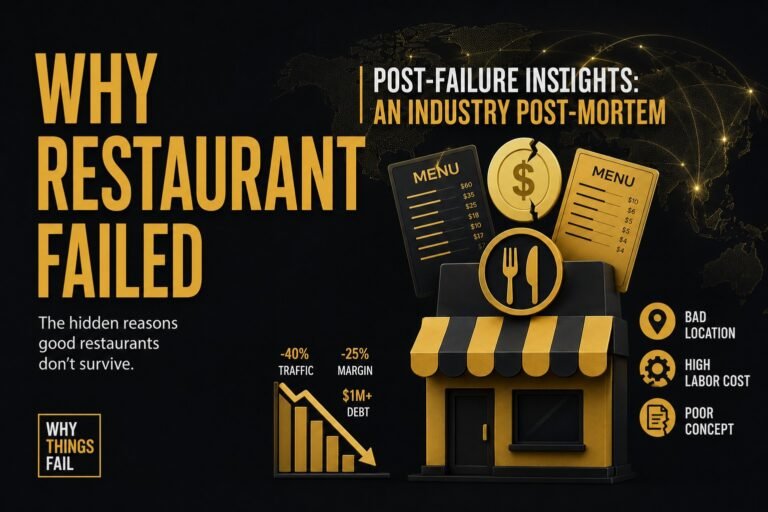
Introduction: Why Restaurant Failure Matters
Restaurants do not usually fail because the food is bad. That is the comforting explanation. It makes failure feel simple. If a restaurant closes, people assume the chef was not talented enough, the location was wrong, the reviews were poor, or customers simply preferred somewhere else.
But restaurant failure is rarely that simple.
Many restaurants fail while serving good food. Some fail with loyal customers. Some fail after busy weekends. Some fail even when the dining room looks full. The real problem is that restaurants are emotionally visible but financially fragile. Customers see the meal, the atmosphere, the service, and the brand. Owners must survive the rent, wages, food costs, utilities, tax, wastage, debt, repairs, marketing, delivery commissions, staff turnover, seasonality, and constant operational pressure.
A restaurant is not just a place that sells food. It is a live operating system where every mistake becomes expensive quickly.
That is why restaurant failure matters. It reveals one of the most important truths in business: demand is not the same as profit. Popularity is not the same as sustainability. Passion is not the same as management.
Restaurants continue to fail because people underestimate the gap between creating a product people enjoy and building a business that can survive.
Who Failed?
This article is not about one restaurant. It is about restaurants as a failure category.
Restaurants can include:
- Independent cafés
- Family-owned takeaways
- Fine dining venues
- Casual dining chains
- Street food operators
- Dark kitchens
- Franchise outlets
- Pub restaurants
- High-street chains
The names change, but the pattern is often similar: strong ambition, heavy upfront costs, thin margins, unpredictable demand, rising expenses, operational stress, and weak financial control.
Some restaurants close quietly. Some enter administration. Some sell to new owners. Some rebrand. Some survive for years but never become truly profitable.
The failure is not always dramatic. Sometimes the restaurant does not collapse suddenly. It slowly runs out of oxygen.
Common Myth
Common Myth: “Restaurants fail because people do not like the food.”
Reality: Food matters, but it is rarely the whole story.
Restaurants fail because the business model underneath the food does not work. A restaurant can have good food and still lose money. It can have a full dining room and still have weak cash flow. It can have a beautiful brand and still be destroyed by rent, wages, poor pricing, waste, debt, or inconsistent management.
The deeper failure is not usually culinary. It is operational, financial, strategic, and psychological.
The restaurant owner often asks: “Do people like what we serve?”
But the more important question is: “Can this business make enough profit, consistently, after every cost has been paid?”
Many restaurants never answer that question honestly.
There’s a widely repeated statistic that makes this feel even more dramatic than it is: the claim that “90% of restaurants fail in their first year.” It isn’t true. That figure traces back to a 2003 American Express commercial with no research behind it. Real data from Ohio State University and the Bureau of Labor Statistics puts the actual first-year failure rate at 14–17%, with around half of restaurants surviving past five years comparable to most other small business sectors. Restaurants aren’t uniquely cursed. They’re uniquely visible; when one closes, everyone notices.
1. What Happened?
The restaurant business has always attracted entrepreneurs because it appears accessible. Unlike industries that require patents, complex technology, or specialist regulation, restaurants feel understandable. People eat every day. Food is emotional. A good meal creates loyalty. A strong concept can spread quickly.
This makes the industry attractive. It also makes it dangerous.
Many restaurants begin with a strong idea: a family recipe, a gap in the local market, a chef’s ambition, a street food concept, a premium dining experience, or a desire to escape employment and build something independent.
The early phase is often full of energy. The founder focuses on the menu, name, branding, décor, social media, opening night, and customer experience. There is visible progress. A lease is signed. Equipment is bought. Staff are hired. Suppliers are arranged. Friends and family are excited.
Then reality arrives.
The restaurant opens, and every day becomes a test.
Sales fluctuate. Staff call in sick. Food prices change. Customers complain. Equipment breaks. Deliveries arrive late. Quiet Mondays hurt cash flow. Busy Saturdays create service pressure. A mistake in ordering becomes waste. A mistake in pricing becomes lost margin. A mistake in staffing becomes either poor service or unnecessary labour cost.
At first, the owner absorbs the stress. They work longer hours. They cover shifts. They delay paying themselves. They negotiate with suppliers. They hope next month will be better.
Sometimes it is. Often, it is not enough.
The restaurant enters a dangerous middle stage: not failing visibly, but not succeeding financially. It has customers, but not enough margin. It has revenue, but not enough cash. It has activity, but not enough control.
Eventually, pressure builds. Supplier payments become difficult. Tax bills accumulate. Staff morale falls. Standards slip. Reviews decline. The owner becomes reactive. Decisions become short-term. Discounts are used to bring people in, but discounts weaken margins further. Marketing becomes desperate. The restaurant loses its original clarity.
Closure may look sudden from the outside. Internally, failure has usually been developing for months.
2. Why Did It Happen?
2.1 The First Root Cause: Confusing Passion With Business Skill
Many restaurants are opened by people who love food, hospitality, creativity, or independence.
That passion is valuable. Without it, the business would never start. But passion can also create blindness.
A person may understand flavour but not cash flow. They may understand customers but not labour scheduling. They may understand atmosphere but not contribution margin. They may understand social media but not lease obligations. They may understand cooking but not procurement, compliance, staff training, pricing psychology, or debt management.
This is one of the central reasons restaurants fail: the founder is emotionally ready before the business model is financially ready.
The assumption is: “If the food is good, people will come.”
But a better assumption would be: “If the unit economics work, the team performs consistently, the location has enough demand, the pricing protects margin, and the customer experience is repeatable, then the restaurant has a chance.”
Restaurants punish romantic thinking because the costs are immediate and unforgiving. Passion may open the doors. Systems keep them open.
2.2 The Second Root Cause: Thin Margins Leave No Room for Error
Restaurants operate with narrow financial margins. That means small mistakes can become serious quickly.
A small increase in food cost matters.
- A few extra staff hours matter.
- A quiet week matters.
- A broken fridge matters.
- A poor supplier deal matters.
- A rent increase matters.
- A bad menu price matters.
- A high delivery commission matters.
In many businesses, inefficiency can be hidden for a while. In restaurants, inefficiency appears quickly because costs repeat daily.
This is why restaurants can look busy but still be weak. A full restaurant does not automatically mean a profitable restaurant. If the best-selling dishes have poor margins, if staff costs are too high, if waste is unmanaged, or if rent is excessive, revenue becomes misleading.
The owner sees money coming in. But the business may still be losing money underneath.
This creates a psychological trap. Busy periods make the owner feel successful. Quiet periods are blamed on weather, seasonality, the economy, or temporary customer behaviour. But the deeper issue may be structural: the restaurant was never priced or designed to make enough profit.
The restaurant does not fail because nobody came. It fails because enough people came, but the business still could not keep enough money.
2.3 The Third Root Cause: Poor Cash Flow Management
Profit and cash are not the same.
A restaurant may appear profitable on paper but still struggle to pay bills. Food must be bought before it is sold. Staff must be paid regularly. Rent is fixed. VAT, tax, utilities, loan repayments, insurance, repairs, and supplier invoices arrive whether the restaurant had a good week or not.
Cash flow failure often begins quietly.
The owner delays one supplier payment. Then another. Then they use weekend takings to cover last month’s bills. Then they rely on a busy period to rescue a weak month. Then an unexpected cost arrives. The business becomes dependent on everything going right.
But restaurants are not stable enough for that.
The deeper failure is not just lack of money. It is lack of visibility. Many owners do not have clear weekly control over:
- Gross profit
- Food cost percentage
- Labour cost percentage
- Average spend per customer
- Waste
- Break-even sales
- Cash runway
- Supplier payment terms
- Menu profitability
- Sales by daypart
- Staff productivity
- Repeat customer rate
Without these numbers, the owner is driving in fog. They may feel the business is improving because the restaurant is busy. But without financial discipline, busyness can hide decline.
Cash flow is where optimism meets reality.
Experienced operators track a number called prime cost food cost plus labor cost combined, usually expressed as a percentage of sales because when it climbs too high, profit disappears even while the restaurant looks busy.
2.4 The Fourth Root Cause: The Menu Becomes Too Emotional
A restaurant menu is not just a creative document. It is a financial machine.
Every dish has a cost, a selling price, a preparation time, a waste risk, a skill requirement, and an impact on kitchen flow. A menu can either make the restaurant easier to operate or quietly destroy it.
Many restaurants fail because the menu is built around what the owner wants to serve, not what the business can profitably deliver.
Common menu problems include:
- Too many dishes
- Too many ingredients
- Poorly priced popular items
- High waste items
- Slow preparation dishes
- Inconsistent portion control
- Items that require specialist staff
- Poor supplier flexibility
- Low-margin “signature” dishes
A large menu feels attractive because it appears to offer more choice. In reality, it often creates more complexity, more waste, slower service, higher stockholding, and weaker consistency.
The customer sees variety. The business absorbs complexity.
Strong restaurants understand that menu discipline is strategic discipline. They know which dishes create profit, which dishes create reputation, and which dishes create operational drag.
Weak restaurants treat the menu as identity rather than economics. That is dangerous because owners often resist removing poor-performing dishes. They become attached to them. A dish may represent the founder’s story, family tradition, creativity, or pride. But sentiment does not pay suppliers.
A menu should express the brand. But it must also protect the business.
2.5 The Fifth Root Cause: Location Is Misunderstood
Location matters, but not in the simple way people think.
A busy street does not guarantee success. A beautiful building does not guarantee demand. A cheap lease is not always a bargain. A premium area does not automatically support premium pricing.
The real question is not “Is this a good location?”
The real question is: “Is this the right location for this concept, price point, customer behaviour, labour model, delivery radius, rent burden, and trading pattern?”
Many restaurants fail because they sign leases based on hope. The rent may be too high for the expected turnover. The footfall may not match the target customer. The area may be busy at the wrong time of day. Parking may be weak. Nearby competitors may already own the customer habit. The local population may like the concept but not visit often enough.
A restaurant needs repeated behaviour, not occasional curiosity.
Opening week can deceive owners. People try new places. Friends visit. Social media creates a temporary lift. But the real test is month six, month twelve, and month eighteen. Does the local market return regularly? Does the restaurant become part of people’s routines?
If not, the location may have produced interest but not habit. Restaurants survive on habit.
2.6 The Sixth Root Cause: Labour Is Treated as a Cost, Not a System
Staffing can make or break a restaurant.
Restaurants depend on human performance under pressure. A good team can rescue a difficult night. A weak team can damage the brand in one service.
Yet many restaurants underinvest in recruitment, training, scheduling, leadership, and culture. They treat labour mainly as a cost to reduce. That creates a cycle:
- Low pay or poor conditions attract unstable staff.
- Unstable staff require constant replacement.
- Constant replacement weakens service.
- Weak service damages reviews.
- Poor reviews reduce sales.
- Lower sales create more pressure to cut labour.
The cycle repeats.
Restaurants are especially vulnerable because the customer experience is delivered live. There is no second chance during a bad service. If a customer waits too long, receives the wrong dish, senses staff stress, or feels ignored, the brand promise breaks immediately.
Good restaurants build repeatable service systems. Weak restaurants rely on heroic individuals. That is risky because heroic individuals burn out, leave, or become inconsistent. A restaurant cannot depend on the owner personally fixing every problem forever.
When the owner is the system, the system is fragile.
2.7 The Seventh Root Cause: Owners Underestimate Burnout
Restaurant failure is not only financial. It is psychological.
Owners often work long hours, sacrifice family time, manage constant complaints, cover staff shortages, deal with suppliers, solve emergencies, and carry financial anxiety privately. The restaurant becomes not just a business but an identity.
That makes decision-making harder.
A tired owner becomes reactive. They delay hard decisions. They avoid looking at numbers. They tolerate weak staff because hiring feels exhausting. They keep a failing concept alive because closing feels like personal humiliation. They discount aggressively because they need immediate cash. They confuse effort with progress.
Burnout narrows thinking. When survival pressure rises, owners stop thinking strategically. They focus only on today’s problem: tonight’s shift, tomorrow’s payment, this week’s review, next weekend’s bookings.
The restaurant may need a redesign, repositioning, menu reduction, rent renegotiation, leadership change, or controlled closure. But the owner has no mental space left to make those decisions properly.
This is one of the hidden reasons restaurants fail. The business drains the person who is supposed to save it.
2.8 The Eighth Root Cause: Customer Understanding Is Too Shallow
Many restaurants know what customers say they like. Fewer understand what customers repeatedly choose, pay for, recommend, and return for.
There is a major difference.
Customers may praise a dish but not order it often. They may like the concept but only visit once. They may say prices are fair but reduce visits when money is tight. They may enjoy the atmosphere but choose a competitor because parking is easier. They may love the food but avoid the restaurant because service is slow.
Restaurants fail when they listen only to compliments. Compliments are not the same as commercial proof.
The strongest signal is repeat behaviour. Do customers come back without being pushed? Do they bring others? Do they order profitable items? Do they visit on quiet days? Do they choose the restaurant when they have many alternatives?
Weak restaurants often mistake attention for loyalty. Opening buzz, influencer visits, and social media likes can create a false sense of demand. But sustainable restaurants need repeat customers, not just first-time curiosity.
A restaurant does not need everyone to like it. It needs enough of the right customers to return often enough at the right margin.
2.9 The Ninth Root Cause: Delivery Apps Changed the Economics
Delivery platforms gave restaurants access to more customers, but they also changed the economics of food service.
For some restaurants, delivery is a growth channel. For others, it becomes a margin trap.
The danger is that delivery orders can increase revenue while reducing profitability. Packaging costs, platform commissions, discounts, refunds, lower control over customer experience, and kitchen disruption can weaken the core business.
The restaurant feels busier. But the business may become less profitable.
Delivery also changes customer loyalty. On an app, the restaurant is placed beside dozens of alternatives. The brand becomes a thumbnail. Customers compare price, rating, delivery time, and offers. Loyalty becomes weaker. Discounting becomes normal.
Restaurants that succeed with delivery design for it intentionally. They create menus that travel well, price correctly, control packaging costs, and protect kitchen flow.
Restaurants that fail with delivery simply add it on top of an already fragile operation. They gain orders but lose control.
2.10 The Tenth Root Cause: Expansion Happens Before Control
Some restaurants fail not because the first site failed, but because the second site exposed weaknesses the first site was hiding.
A founder-led restaurant can work because the owner is always present. They know regular customers. They control quality. They solve problems instantly. They notice small details.
But when the business expands, personal control no longer works. The restaurant now needs systems: training manuals, supplier controls, financial dashboards, leadership structure, brand standards, hiring processes, quality checks, and cash discipline.
Many restaurant owners expand because the first site appears successful. But the first site may not be a scalable business. It may be a founder-dependent business.
Expansion adds rent, debt, staff, complexity, management distance, and operational risk. If the original model was not stable, expansion multiplies the weakness.
Growth does not fix a weak restaurant. It exposes it.
3. What Warning Signs Existed?
Restaurant failure usually gives warnings before collapse.
- The first warning sign is inconsistent cash flow. If the business needs a strong weekend to survive every week, it is already vulnerable.
- The second warning sign is poor visibility. If the owner cannot quickly explain food cost, labour cost, break-even sales, gross margin, and cash runway, the restaurant is not being controlled properly.
- The third warning sign is supplier pressure. Late payments, reduced credit terms, or strained supplier relationships often reveal deeper financial weakness.
- The fourth warning sign is owner exhaustion. When the owner is constantly covering shifts, solving basic problems, and avoiding strategic work, the business has become too dependent on one person.
- The fifth warning sign is menu complexity. If the kitchen struggles with consistency, stock is regularly wasted, and popular dishes are not profitable, the menu is damaging the business.
- The sixth warning sign is discount dependency. Promotions can help attract new customers, but if the restaurant needs constant discounts to maintain demand, the value proposition is weak.
- The seventh warning sign is staff turnover. High turnover damages service, increases training costs, and often signals cultural or leadership problems.
- The eighth warning sign is weak repeat trade. A restaurant with many first-time customers but few returning customers has a demand problem, even if reviews look positive.
- The ninth warning sign is emotional decision-making. When decisions are made to protect pride rather than profitability, the restaurant is in danger.
- The tenth warning sign is delayed reality. Owners often know something is wrong before they admit it. The numbers show it. The stress shows it. The staff sense it. The suppliers feel it. But admitting the truth means confronting painful choices.
Warning signs are ignored because hope is easier than restructuring.
4. What Could Have Prevented It?
Restaurant failure cannot always be prevented. Some costs rise unexpectedly. Some locations change. Some consumer habits shift. Some shocks are outside the owner’s control.
But many failures could be reduced through better discipline before and after opening.
4.1 A Stronger Business Model Before Launch
Before opening, the owner should test the concept financially, not just creatively.
The key questions are:
- What is the break-even sales level?
- How many customers are needed per day?
- What average spend is required?
- What is the food cost per dish?
- What labour model is affordable?
- How much cash runway exists?
- What happens if sales are 20% lower than expected?
- What happens if food costs rise?
- What happens if the first six months are slow?
A restaurant should not open because the idea is exciting. It should open because the numbers survive stress.
4.2 Better Menu Engineering
The menu should be designed around both customer desire and operational control. That means fewer unnecessary items, clear margin analysis, strong portion control, supplier flexibility, dishes that can be prepared consistently, and regular review of what actually sells.
A good menu is not the biggest menu. It is the most disciplined one.
4.3 Tighter Financial Controls
Restaurants need weekly financial management, not occasional accounting. Owners should know the numbers before the accountant produces year-end accounts. By then, it may be too late.
Useful controls include:
- Weekly cash flow review
- Daily sales tracking
- Food cost monitoring
- Labour cost monitoring
- Waste reporting
- Menu profitability review
- Supplier price checks
- Break-even tracking
- Forecasting by season
- Separate tax reserves
The goal is not bureaucracy. The goal is early warning.
4.4 More Realistic Staffing Systems
Restaurants need training systems, not just experienced people. They need clear roles, service standards, onboarding, rota discipline, and leadership accountability.
A restaurant should not depend entirely on the owner’s presence. If standards collapse when the owner leaves the building, the business is not yet stable.
4.5 Controlled Growth
Expansion should happen only after the first site works without constant founder intervention. Before opening another location, the owner should prove that the model is profitable, repeatable, documented, and manager-led.
Scaling chaos creates bigger chaos.
4.6 Earlier Strategic Honesty
The hardest prevention tool is honesty. Owners must be willing to ask:
- Is this concept working?
- Are we priced correctly?
- Is the location wrong?
- Is the menu too complex?
- Are we avoiding difficult staff decisions?
- Are we growing too early?
- Are we mistaking busyness for success?
- Are we keeping this alive because of pride?
Many restaurants do not fail because no solution existed. They fail because the solution required admitting the original plan was wrong.
5. What Can Readers Learn?
The failure of restaurants teaches principles that apply far beyond hospitality.
Principle 1: Revenue Is Not Proof of Success
Money coming in does not mean the business works. What matters is what remains after costs, waste, labour, rent, tax, and reinvestment. Many people celebrate sales too early. Profit is the real test.
Principle 2: Passion Must Be Converted Into Systems
Passion creates energy, but systems create consistency. A business cannot survive on enthusiasm alone. It needs controls, routines, standards, and numbers.
Principle 3: Complexity Is Expensive
Every extra menu item, supplier, process, shift pattern, and service channel adds complexity. Complexity feels like growth, but it often creates hidden cost. Simple businesses are not simple because they lack ambition. They are simple because they have discipline.
Principle 4: The Customer’s Behaviour Matters More Than Their Compliments
People may praise a restaurant and still not return. The strongest proof is repeat behaviour, not positive words.
Principle 5: Small Margins Require Fast Feedback
When margins are thin, slow learning is dangerous. Problems must be seen early. A restaurant that waits months to understand its numbers may already be in trouble.
Principle 6: Growth Before Control Is Risk
Expansion should multiply strength, not weakness. If the first operation depends on personal sacrifice, the second operation may multiply exhaustion.
Principle 7: Burnout Damages Judgment
Exhausted leaders make poorer decisions. They delay, react, avoid, and over-personalise problems. Protecting leadership capacity is not a luxury. It is risk management.
6. Failure Pattern
Primary Failure Pattern: Poor Financial Management Hidden by Passion
The most common restaurant failure pattern is not lack of talent. It is poor financial management hidden by passion.
This pattern appears repeatedly because restaurants attract emotionally committed founders. They care deeply about food, service, identity, independence, and customer experience. Those qualities are powerful, but they can also distract from the less romantic parts of the business.
- The owner wants to talk about the menu. The business needs to talk about margin.
- The owner wants to improve the décor. The business needs to improve cash flow.
- The owner wants more customers. The business needs more profitable customers.
- The owner wants to expand. The business needs control.
This pattern is dangerous because passion can make sacrifice feel noble. The owner works unpaid, covers shifts, delays holidays, absorbs stress, and tells themselves that hardship is part of the journey.
Sometimes it is. But sometimes hardship is evidence that the model is broken.
The tragedy of restaurant failure is that the owner may work incredibly hard and still fail because effort is being used to compensate for weak economics. Hard work cannot permanently rescue a bad model.
7. The Hidden Lesson
The hidden lesson of restaurant failure is this: A restaurant does not fail when people stop loving the food. It fails when the business underneath the food cannot survive reality.
That reality includes rent, wages, waste, tax, energy, repairs, competition, customer habits, staff turnover, supplier pressure, seasonality, and owner exhaustion.
Food is the visible product. The business model is the invisible structure. When the invisible structure is weak, the visible product cannot save it.
This is why restaurants are such powerful studies in failure. They show how human beings often judge success by what they can see: a full dining room, attractive branding, positive reviews, beautiful dishes, social media attention.
But survival depends on what is harder to see: cash discipline, margins, repeat behaviour, systems, leadership, and resilience.
The meal may be excellent. The business may still be failing.
Failure Scorecard
- Leadership: 6/10 Many restaurant founders show courage, work ethic, and commitment. The weakness is often not effort, but leadership structure. If the business depends too heavily on the owner, leadership is not scalable. Strong leadership requires delegation, training, accountability, and emotional discipline.
- Strategy: 5/10 Restaurant strategy is often underdeveloped. Many concepts begin with a food idea rather than a market position. A stronger strategy would define the target customer, price point, location logic, competitive difference, repeat visit reason, and margin structure before launch.
- Adaptability: 6/10 Restaurants often adapt tactically but not strategically. They change menu items, run offers, or post more on social media. But deeper adaptation, such as repositioning, simplifying the menu, renegotiating costs, or changing the operating model, is often delayed.
- Innovation: 5/10 Innovation is not always the issue. Many restaurants are creative. The problem is that creativity is often applied to food and branding rather than operations, pricing, staffing, and customer retention.
- Financial Management: 3/10 This is the weakest area. Many restaurant failures are rooted in poor cash flow control, weak cost monitoring, underpricing, over-ordering, lack of reserves, and slow reaction to financial warning signs.
- Customer Understanding: 6/10 Restaurants often understand customer taste but not customer behaviour. They may know what people enjoy, but not why they return, when they spend, what they compare against, or what makes them choose competitors.
- Long-Term Thinking: 4/10 Short-term pressure dominates restaurant life. Daily operations can consume all attention. Long-term planning, reserves, system building, leadership development, and risk management are often pushed aside until problems become urgent.
Key Takeaways
- Good food is not enough to save a weak business model.
- A full restaurant can still be unprofitable.
- Cash flow failure often begins before the public sees any problem.
- Menus should be designed for margin, consistency, and operational control.
- Passion is valuable, but systems are what protect survival.
- Customer compliments matter less than repeat customer behaviour.
- Delivery platforms can increase sales while weakening profit.
- Expansion before control multiplies weakness.
- Burnout is a business risk, not just a personal problem.
- Restaurants fail slowly internally before they close publicly.
Failure Timeline
- Concept Stage → Founder develops idea, menu, brand, and vision.
- Pre-Opening → Lease signed, equipment purchased, staff hired, suppliers arranged.
- Launch → Initial excitement, social media attention, friends, family, and first customers arrive.
- Early Trading → Sales fluctuate; operational problems begin appearing.
- Pressure Stage → Food costs, wages, rent, waste, and staffing issues reduce cash flow.
- Reaction Stage → Owner works longer hours, discounts more, delays payments, and hopes for stronger trade.
- Decline Stage → Standards slip, staff morale weakens, supplier pressure increases, and reviews may decline.
- Crisis Stage → Cash runs short; tax, rent, or supplier obligations become difficult to meet.
- Closure or Restructure → Restaurant closes, sells, rebrands, enters administration, or survives only after major change.
Frequently Asked Quetions
What percentage of restaurants actually fail?
Despite the popular “90% fail in year one” claim, real research shows only about 14–17% close in their first year, and roughly half survive past five years similar to most other small businesses.
What is the number one reason restaurants fail?
There’s rarely one single cause, but poor financial management weak cash flow control, underpricing, and not tracking food and labor costs is the most consistently cited root cause across studies.
How long does the average restaurant last?
Restaurants have a median lifespan of around 4.5 years, based on long-term industry data comparable to most other small business sectors, not uniquely short.
Can a restaurant fail even with good food and full tables?
Yes. A full dining room doesn’t guarantee profit if menu pricing, labor costs or rent eat into margins, a busy restaurant can still lose money every day it’s open.
Conclusion
Restaurants fail because they sit at the intersection of emotion and economics.
They are built on taste, hospitality, identity, culture, and experience. But they survive through pricing, margins, cash flow, systems, staff discipline, customer behaviour, and leadership judgment.
That tension is what makes restaurants so difficult. The public sees the romance of the restaurant. The owner lives the reality of the operating model.
When restaurants fail, it is tempting to blame the food, the economy, the location, or the competition. Sometimes those factors matter. But the deeper failure is usually the gap between what the restaurant promised emotionally and what the business could sustain financially.
The lesson is not that people should avoid opening restaurants. The lesson is that love for the product must never replace understanding of the system.
A restaurant is not successful because people enjoy eating there. It is successful only when the experience people love is supported by a business model strong enough to keep serving it.