Introduction: Great Products Are Not Supposed To Fail — But They Often Do
One of the most dangerous beliefs in business is that a great product is enough. It feels logical: if a product is useful, beautifully designed, or technically impressive, surely success should follow. But history shows that many great products fail some quietly, some after huge, well-funded launches.
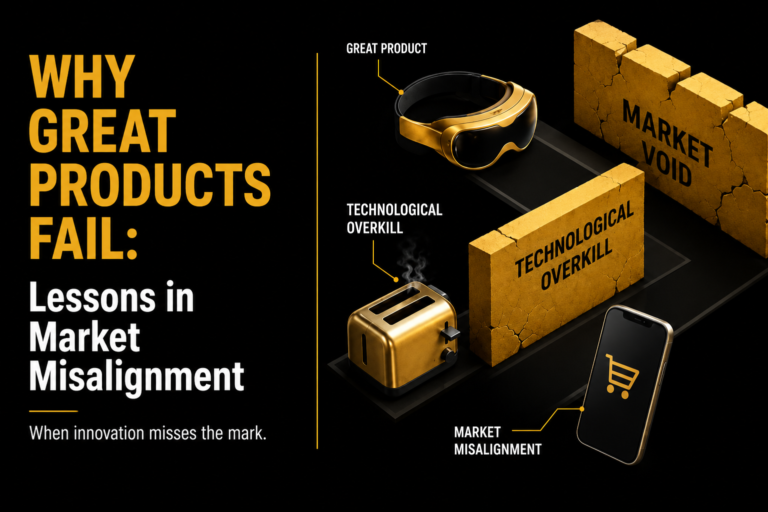
Product failure is frequently misunderstood. People often blame price, marketing, or competition, but those are rarely the full story. Great products fail because they do not exist in isolation. They live inside a complex system of markets, cultures, supply chains, and customer habits. A product can be technically brilliant but commercially fragile. The lesson is uncomfortable: quality is only one part of success. Great products fail when the market does not adopt them, the company cannot support them, the economics do not work, or the timing is wrong.
Who Failed?
This article analyzes a recurring failure pattern seen across many businesses. Examples include:
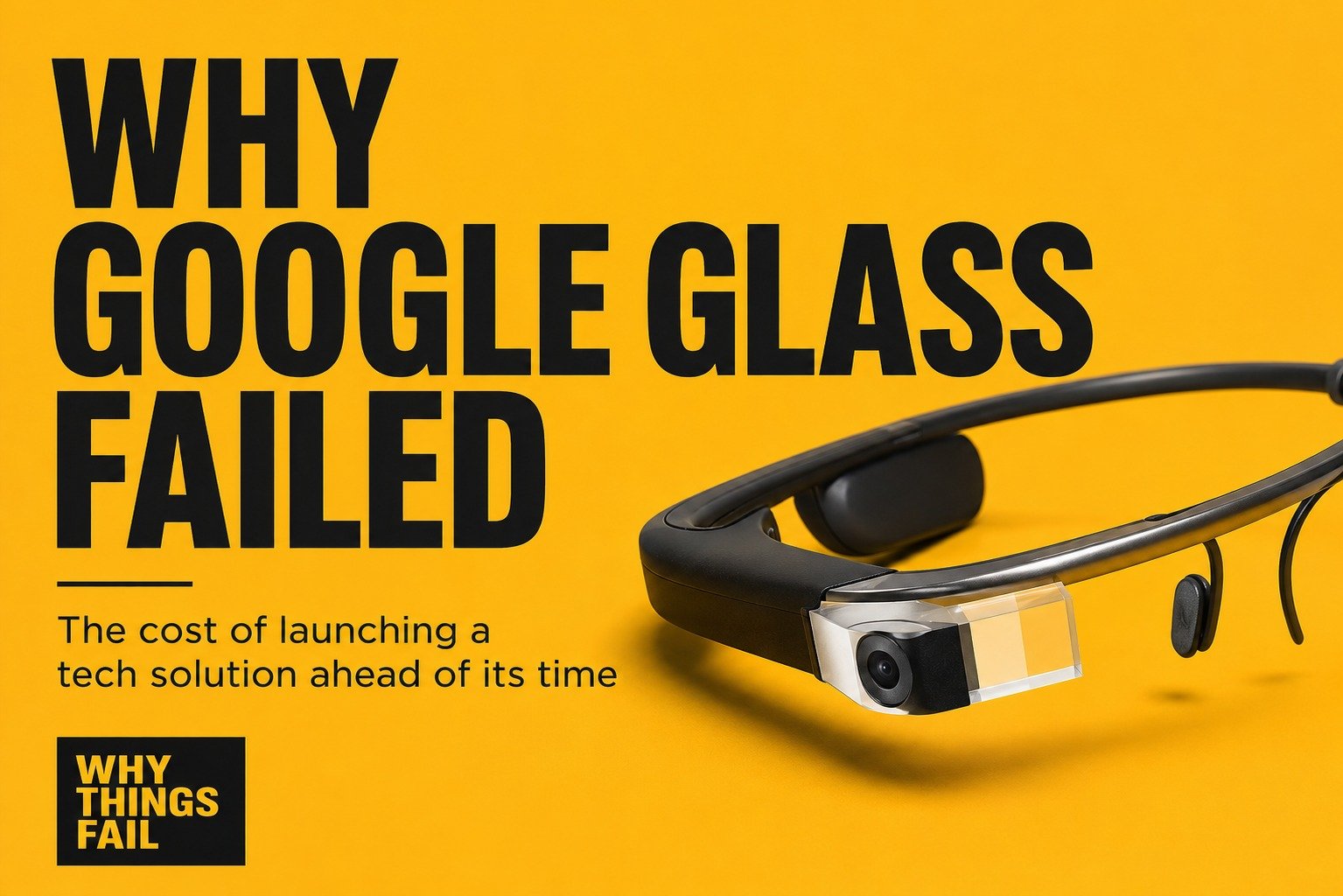
- Google Glass: Technologically ambitious but socially awkward and poorly positioned.
- Segway: Innovative engineering but unclear everyday use.
- Microsoft Zune: A competent product that suffered from weak ecosystem timing.
- Amazon Fire Phone: Backed by a powerful company but built around flawed customer assumptions.
- Quibi: Massive funding and premium talent, but hindered by poor timing and weak user demand.
- Windows Phone: An elegant interface that could not overcome the app ecosystem advantage of competitors.
- Juicero: Polished hardware solving a problem that did not require such complexity.
Common Myth
Common Myth: “Great products fail because people do not understand them.”
Reality: Sometimes people understand the product perfectly—they simply do not need it enough. A product can be clever and beautiful, but if customers do not feel a strong reason to change their behavior, spend money, or trust it, the product will struggle. Great products fail when creators confuse admiration with demand.
1. What Happened?
The modern business world produces many products that seem destined for success. They launch with media hype and serious investment, promising to disrupt industries. However, reality eventually sets in: sales lag, retention is weak, and adoption remains limited to a small group of enthusiasts. The product becomes expensive to market or too difficult to integrate into daily life, leading to a slow decline or a quiet disappearance. The visible story is product failure, but the deeper story is system failure.
2. Why Did It Happen?
The Product Was Great, But The Problem Was Not Urgent Enough
Many great products solve problems that are real but not painful. Customers may agree a product is smart, but they hesitate when it comes to switching costs, learning curves, or changing established routines. Customers choose the product that fits their habits with the least friction.
The Creators Confused Innovation With Adoption
Innovation is building something new; adoption is building trust, simplicity, and social acceptance. Google Glass was impressive, but it failed because it required a social shift—wearing a camera on one’s face—that mass society was not ready to accept.
The Product Was Built Around The Company’s Ambition, Not The Customer’s Reality
Many products are designed from the inside out to prove a company can build a technology or enter a market. Customers, however, do not care about a company’s strategic ambition—they only care about their own reality. If the answer to “Why should I care?” is not immediate, the product is vulnerable.
Timing Was Wrong
Being too early requires educating the market, while being too late means competitors have already formed loyal ecosystems. Great products fail when timing creates a structural disadvantage, such as Windows Phone entering a market where iOS and Android had already locked in developers and users.
Distribution Was Weak
The best product does not always win; the best-distributed product often does. Distribution creates visibility, which builds familiarity and trust. Without effective channels to reach customers, even the highest quality product remains invisible.
The Business Model Did Not Support The Product
A product may have high engagement but poor margins or high customer acquisition costs. A great product with poor economics is not a business; it is an expensive demonstration. Customer love does not automatically equal commercial viability.
Leadership Fell In Love With The Idea
The sunk cost trap occurs when a product becomes part of a leader’s identity. Criticism is dismissed as negativity, and evidence is ignored because stopping would mean admitting a mistake. Strong leadership requires loving the problem more than the solution.
The Product Was Too Difficult To Explain
If customers cannot explain what a product is, who it is for, and why it matters in a few seconds, adoption becomes difficult. Confused customers rarely buy. A weak message often masks a deeper lack of strategic clarity.
The Company Mistook Early Enthusiasm For Mainstream Demand
Early adopters love novelty and tolerate friction, whereas mainstream customers value reliability and ease. Many products fail to “cross the gap” because they cannot scale their appeal beyond the enthusiast niche.
3. What Warning Signs Existed?
- Customers Praised It But Did Not Buy It: Compliments are not demand; they are politeness. Real demand involves spending money and changing behavior.
- The Product Required Too Much Behaviour Change: When a product forces users to abandon too many habits at once, adoption friction becomes insurmountable.
- Competitors Controlled The Ecosystem: For platform products, failing to secure partners or integrations creates a structural weakness that features cannot fix.
- Heavy Marketing Was Needed to Explain Basic Value: If the value proposition isn’t self-evident, the cost of educating the market will eventually drain the company’s resources.
- Internal Doubts Were Suppressed: When teams see problems but are forced to prioritize “vision” over truth, the organization loses its ability to course-correct.
4. What Could Have Prevented It?
- Stronger Market Validation: Testing actual behavior (money and time spent) rather than just asking for opinions.
- Clearer Positioning: Defining exactly who the product is for and what painful problem it solves.
- Smaller Launches: Scaling slowly to learn from data rather than relying on massive, public launches.
- Better Internal Incentives: Rewarding teams for identifying failed assumptions early rather than just rewarding “bold” launches.
- Willingness to Pivot: Being prepared to reposition a product or change the business model if the original plan fails to gain traction.
5. What Can Readers Learn?
- Product Quality Does Not Guarantee Demand: Relevance beats technical excellence.
- Customers Buy Progress: Features are only tools to get a job done.
- Behaviour Change Is Expensive: The benefit must far outweigh the effort of switching.
- Distribution Is Strategy: Reach is just as important as the product itself.
- Leaders Must Stay Loyal To Evidence: Don’t fall in love with the solution; love the problem.
Failure Scorecard
| Metric | Score | Reason |
| Leadership | 6/10 | Vision is often present, but attachment leads to sunk cost fallacies. |
| Strategy | 5/10 | Internal logic is often strong, but external adoption routes are neglected. |
| Adaptability | 4/10 | Teams often defend the original concept instead of pivoting. |
| Innovation | 8/10 | Often the strongest suit, but innovation does not equal adoption. |
| Financials | 5/10 | Poor economics often follow failed market assumptions. |
| Customer Understanding | 4/10 | Companies mistake interest for intent. |
Key Takeaways
- A product is not great until it fits customer reality.
- Praise is not demand; always look at the purchase data.
- Distribution is part of the product—not an afterthought.
- Early fans are not representative of the mainstream market.
- Timing and ecosystem control are often more critical than features.
Failure Timeline
- Idea Stage: Identifying an opportunity.
- Development: Building based on ambition.
- Launch: Attracting initial attention.
- Early Adoption: Niche enthusiasts validate the concept.
- Warning: Mainstream demand fails to materialize.
- Defence: Doubling down on marketing or blame.
- Reality: Financial and competitive collapse.
- Failure: Shut down or quiet disappearance.
Idea Stage → Company identifies a product opportunity.
Development Stage → Product is built around technology, design, or strategic ambition.
Launch Stage → Product receives attention, praise, or curiosity.
Early Adoption Stage → Enthusiasts try it, but mainstream customers hesitate.
Warning Stage → Sales, retention, usage, or ecosystem support falls below expectations.
Defence Stage → Company increases marketing, explains harder, or blames timing.
Reality Stage → Economics, adoption, or competition becomes unsustainable.
Failure Stage → Product is shut down, repositioned, abandoned, or reduced to a niche.
Conclusion: Great Products Fail When They Are Great In The Wrong Way
Great products fail because product greatness is often misunderstood.
A product can be beautifully designed, technically advanced, widely discussed, and strategically ambitious. But if it does not fit customer behaviour, market timing, distribution reality, financial logic, and social context, it can still fail.
This is what makes great product failure so important to study. It proves that business success is not just about building something impressive. It is about building something that fits the world as it actually is.
The market does not reward products for being clever.
It rewards products for becoming necessary.
And that is the final lesson: a product fails when its creators confuse what is impressive with what is indispensable.