Introduction: Why This Failure Matters
Google Glass did not fail because the technology was useless.
It failed because the world was not ready for the way Google introduced it.
That difference matters.
Many failed products are not bad ideas. They are often good ideas launched with the wrong assumptions, wrong timing, wrong design choices, wrong social understanding, or wrong business model. Google Glass is one of the clearest examples of this.
It was bold, futuristic, and technically impressive. It promised a world where information would appear in front of your eyes without needing to pull out a phone. It suggested a future of hands-free computing, instant navigation, live translation, video recording, messaging, and digital assistance.
But instead of becoming the next iPhone, Google Glass became a warning.
It became a symbol of technology that moved faster than social acceptance.
It showed that innovation does not only need engineering. It also needs trust, etiquette, affordability, usefulness, and emotional permission from society.
Google Glass still matters today because the same questions have returned through smart glasses, AI assistants, wearable cameras, augmented reality headsets, and spatial computing.
The failure of Google Glass was not the failure of wearable computing.
It was the failure of launching a future-facing product before the human, social, and practical foundations were ready.
Who Failed?
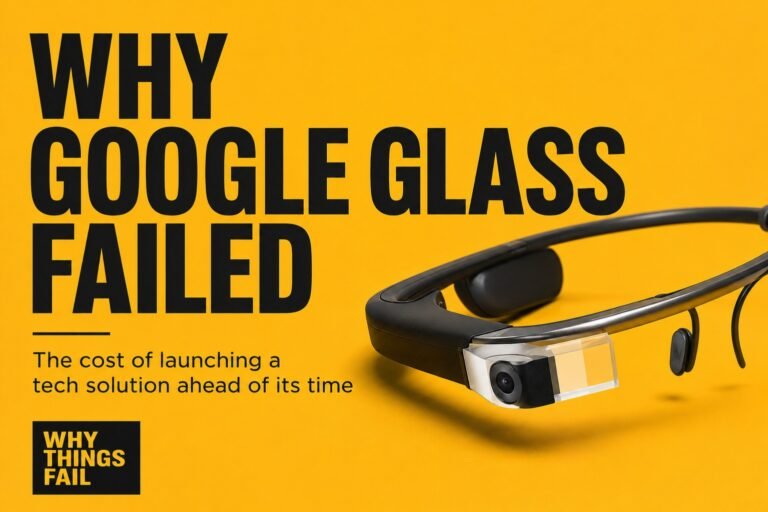
Google Glass was a smart glasses project developed by Google X, Google’s experimental innovation lab.
The device placed a small display above the user’s eye and allowed people to interact through voice commands, touch controls, and a built-in camera.
Key context:
- Announced publicly in 2012
- Released to early “Explorer” users in 2013
- Priced at around $1,500
- Marketed as a futuristic consumer wearable
- Faced major privacy and social backlash
- Consumer version was withdrawn in 2015
- Later repositioned for enterprise use
- Enterprise Edition was discontinued in 2023 Google Glass did not disappear because no one could imagine its use.It disappeared because Google tried to turn a powerful prototype into a public consumer symbol before it had earned public trust.
Common Myth
Common Myth:
“Google Glass failed because people were not ready for smart glasses.”
Reality:
People were not ready for Google Glass in the form Google presented it.
The deeper problem was not only timing. It was product positioning, social discomfort, weak everyday utility, privacy anxiety, high pricing, unclear use cases, and a launch strategy that made the product feel elitist rather than useful.
Google Glass did not simply fail because it was ahead of its time.
It failed because it was ahead of its social contract.
That is the real lesson.
Technology can be technically possible and commercially impossible at the same time.
1. What Happened?
Google Glass began as one of Google’s most ambitious moonshot projects.
The idea was simple but powerful: instead of constantly looking down at a smartphone, users could access information through a lightweight device worn on the face.
The product created huge excitement. It appeared futuristic. It generated media attention. It suggested a new computing platform after smartphones.
Google promoted Glass through dramatic demonstrations, early access campaigns, and carefully selected users. The Explorer Program gave developers, influencers, journalists, and enthusiasts the chance to buy and test the device.
But several problems appeared quickly.
The price was extremely high. The product looked unusual. The battery life was limited. The interface was interesting but not essential.
The camera raised privacy concerns. Many people disliked the idea of being around someone who might be recording them.
The term “Glasshole” entered public culture to describe users who wore Glass in socially awkward or intrusive ways.
Restaurants, cinemas, bars, and public spaces began questioning whether the device should be allowed. The conversation shifted from innovation to privacy, etiquette, surveillance, and arrogance.
By 2015, Google stopped selling the consumer Explorer version.
The product later found more practical use in enterprise environments such as manufacturing, logistics, healthcare, and field operations, where hands-free information had clearer value. But even that version eventually ended.
The important point is this:
Google Glass did not fail because the idea of smart glasses was worthless.
It failed because Google introduced a socially sensitive product without solving the social, emotional, and practical barriers that stood between curiosity and adoption.
2. Why Did It Happen?
2.1 Google Treated a Prototype Like a Cultural Product
One of the biggest mistakes was treating Google Glass as if public excitement could substitute for product readiness.
Glass was not a normal gadget.
A phone sits in your hand. A laptop sits on a desk. A watch sits on your wrist. But Glass sat on the face.
That made it different.
The face is socially sensitive. Eye contact, expression, attention, and trust all pass through the face. When technology sits there, it changes how people feel around the user.
Google underestimated this.
The company seemed to think the main challenge was technical: build a small display, voice interface, camera, and wearable computer.
But the real challenge was social: convince people that this device belonged in normal human interaction.
That required a very different launch strategy.
Google needed to answer questions like:
- Is this acceptable in public?
- Is the camera always recording?
- Can others know when it is recording?
- Is the wearer paying attention to me?
- Does this make the user look arrogant?
- Is this useful enough to justify the discomfort?
- What rules should exist around using it?Instead, the product entered society before those questions had been settled.This created resistance.Google was not only launching hardware.It was asking society to accept a new behaviour.That is much harder.
2.2 The Product Had No Clear Mass-Market Use Case
Successful consumer technology usually solves a frequent, painful, or emotionally valuable problem.
Google Glass struggled here.
It could show notifications. It could record video. It could give directions. It could take photos. It could respond to voice commands.
But for most ordinary users, these were not strong enough reasons to wear a computer on their face.
The smartphone already solved many of these problems well enough.
This created a value gap.
The question was not: “Can Google Glass do interesting things?”
The real question was: “Does it do something important enough that normal people will accept the cost, discomfort, attention, and social risk?”
For most consumers, the answer was no.
This is a common failure pattern in innovation. Companies become excited by what a product can do, but customers care about what problem it removes from their life.
Glass was impressive in demonstrations, but less compelling in daily life.
A product can be amazing for five minutes and unnecessary for five years.
That was one of Glass’s core problems.
2.3 The Price Created the Wrong Signal
Google Glass cost around $1,500 during the Explorer phase.
That price created two problems.
First, it made the product inaccessible to most people.
Second, it positioned Glass as a luxury symbol for tech insiders.
This mattered because the product already looked unusual.
When an unusual product is also expensive and worn publicly, it can create resentment rather than curiosity.
The device became associated with Silicon Valley elitism.
That damaged adoption.
Early adopters are important, but the wrong early adopters can damage a product’s reputation. If the first visible users appear arrogant, intrusive, or disconnected from normal social behaviour, the product inherits that image.
Google needed Glass to feel helpful.
Instead, it often felt performative.
That was not only a marketing problem. It was a trust problem.
2.4 Privacy Was Not a Feature Issue. It Was a Trust Issue
Google Glass had a camera.
Technically, smartphones also have cameras. Laptops have cameras. CCTV exists everywhere. So why did Glass create such strong concern?
Because Glass changed the visibility of recording.
A phone camera is obvious. Someone usually has to lift the phone, point it, and hold it. That action gives others a signal.
Glass made recording feel more invisible.
Even if the device had indicators, many people did not trust them. They did not know when they were being recorded. They did not know where the footage might go. They did not know whether facial recognition or data collection could be added later.
The issue was not only actual privacy invasion.
It was perceived privacy invasion.
Perception matters because trust is emotional before it is technical.
Google seemed to underestimate how uncomfortable people would feel around a wearable camera controlled by voice and worn near the eye.
The privacy concern became bigger than the product benefit.
Once that happened, Google lost control of the story.
Glass was no longer seen as a helpful assistant.
It was seen as a surveillance device.
2.5 The Design Made Users Socially Visible
For consumer products, design is not only appearance. It is social permission.
People wear products that help them express identity, confidence, status, beauty, usefulness, or belonging.
Google Glass struggled because it made users stand out in a way many people found awkward.
It looked futuristic, but not naturally fashionable. It looked technological, but not emotionally warm. It looked intelligent, but also intrusive.
This created a major barrier.
Wearable technology must pass a higher design test than handheld technology. A phone can be ugly and still succeed because it lives in your pocket. Glasses live on your face.
If a wearable changes how others judge you, its value must be extremely high.
For many people, Glass did not offer enough benefit to justify the social cost.
This is why the later enterprise version made more sense. In a factory, warehouse, hospital, or technical environment, social fashion matters less than productivity. Workers may accept a device if it helps them perform a task safely or efficiently.
In public consumer life, the rules are different.
Google designed a product for the future but launched it into the psychology of the present.
2.6 Google Confused Attention With Adoption
Google Glass received enormous media attention.
But attention is not the same as adoption.
This is a mistake many companies make.
A product can be famous without being wanted. It can be discussed without being trusted. It can be admired without being purchased.
Glass became one of the most talked-about products in technology. But much of that attention was anxiety, ridicule, or curiosity.
The hype cycle created a dangerous illusion.
From the outside, Glass looked like a major cultural moment.
But underneath, the product had not solved the basic adoption questions:
- Who exactly is this for?
- What daily pain does it solve?
- Why is it better than a phone?
- Why should strangers accept it?
- Why should users pay so much?
- Why should people wear it in public?These questions were never answered clearly enough.The result was a product that had visibility but not legitimacy.That distinction matters.Visibility can launch a product.Legitimacy sustains it.
2.7 The Launch Strategy Created Resistance
The Explorer Program gave early access to selected users who could afford the device and were willing to become public testers.
This created buzz, but it also created a social experiment in public spaces.
Google effectively asked ordinary people to interact with an unfinished product without their consent.
Someone could be sitting in a café, bar, meeting, or conversation and suddenly be faced with a person wearing a camera-computer on their face.
This created tension.
The public was not only observing the product. They were being affected by it.
That made Glass different from other early technology launches.
When someone tests a new phone, others are not deeply involved. When someone tests a face-mounted camera, everyone nearby becomes part of the test environment.
Google did not fully control that environment.
The result was predictable: social pushback.
The company should have introduced Glass first in controlled professional settings where the value was obvious and the privacy boundaries were clearer.
Instead, it allowed the product to become a public symbol before society understood its purpose.
2.8 The Product Was Too Early for the Ecosystem
Google Glass also faced ecosystem problems.
The technology around it was not mature enough. Battery life, display quality, voice interaction, mobile connectivity, app support, and contextual AI were all limited compared with what the product vision required.
The dream was effortless augmented computing.
The reality was a limited wearable display with a camera, notifications, and a small number of useful functions.
This gap between vision and reality hurt the product.
Consumers do not judge products against internal roadmaps.
They judge them against the promise they have been sold.
Google sold a vision of the future.
Users received an expensive early prototype.
That mismatch created disappointment.
Many breakthrough products need surrounding technologies to mature before they can succeed. For Glass, those surrounding technologies included:
- Better batteries
- Smaller components
- More natural voice interfaces
- Stronger AI assistants
- Better privacy indicators
- More useful apps
- Socially acceptable designs
- Clearer laws and etiquetteThe idea may have been early, but the launch was premature.
2.9 Google Did Not Create a Strong Enough Social Narrative
Every disruptive product needs a story that helps society understand why it belongs.
The iPhone was not just a touchscreen device. It was a phone, internet browser, and iPod in one.
The Apple Watch was not just a tiny computer. It became a health, fitness, notification, and lifestyle device.
Google Glass did not have an equally simple story.
Was it a camera? A phone replacement? A navigation device? A developer platform? An augmented reality product? A productivity tool? A fashion accessory? A medical device? A workplace tool?
Because the story was unclear, critics filled the gap.
And the story they created was simple:
“This is a creepy camera on your face.”
That story was damaging because it was easy to understand.
In communication, the clearest story often wins.
Google’s story was futuristic but vague. The public’s fear was immediate and specific.
Fear beat futurism.
3. What Warning Signs Existed?
3.1 Public Discomfort Appeared Early
One of the earliest warning signs was social discomfort.
People were not simply asking technical questions. They were asking whether the product should be allowed in public.
That should have been a major signal.
When a product creates questions about etiquette, privacy, and permission before it creates questions about features, adoption risk is high.
Google should have treated this as a strategic warning, not a public relations issue.
The problem was not that people misunderstood Glass.
The problem was that people understood enough to feel uncomfortable.
3.2 The “Glasshole” Label Was a Brand Emergency
The nickname “Glasshole” was more than a joke.
It was a sign that the product had become socially contaminated.
Once a device becomes associated with a negative identity, the adoption barrier rises sharply. People do not only ask, “Do I want this product?” They ask, “What will people think of me if I use it?”
For Glass, that question became dangerous.
Nobody wants to buy a product that makes them look rude, arrogant, or intrusive.
Google should have seen this as a brand-level crisis.
The product needed repositioning, redesign, and social education before broader exposure.
Instead, the label spread.
3.3 The Use Cases Were Stronger in Enterprise Than Consumer Life
Another warning sign was that the most convincing uses were not normal consumer scenarios.
Glass made much more sense for surgeons, warehouse workers, technicians, engineers, logistics teams, and field workers.
In those environments, hands-free information has clear value.
A worker repairing equipment may need instructions while keeping both hands free. A doctor may need access to information without turning away. A warehouse worker may need scanning and navigation support.
These are real problems.
But the consumer pitch was weaker.
For ordinary life, Glass often solved problems people did not urgently have.
This was a warning that the product should have started as an enterprise tool, not a mass consumer product.
Google eventually moved in that direction, but only after the consumer brand had already been damaged.
3.4 The Product Was Expensive but Not Essential
High price can work when a product feels essential, aspirational, or dramatically better than alternatives.
Glass was expensive, but not essential.
That was a major warning sign.
People may pay premium prices for a smartphone because it is used constantly. They may pay for a laptop because it enables work. They may pay for luxury fashion because it carries identity value.
Glass did not clearly fit any of these categories.
It was too experimental to be essential. Too awkward to be fashionable. Too limited to replace the phone. Too expensive to be casual.
That combination made mass adoption unlikely.
3.5 The Product Required Behaviour Change From Both Users and Non-Users
Many products require users to change behaviour.
Glass required everyone around the user to change behaviour too.
This is much harder.
A person wearing Glass changed the feeling of a room. Others had to think about recording, privacy, attention, and social boundaries.
That meant adoption depended not only on the buyer’s willingness but on public tolerance.
Google did not fully account for this.
A product that affects non-users must earn broader permission.
Glass did not.
4. What Could Have Prevented It?
4.1 Start With Enterprise, Not Consumers
The most realistic alternative would have been to launch Google Glass first as an enterprise product.
This would have allowed Google to prove practical value in controlled environments.
Factories, hospitals, logistics operations, aviation, engineering, and field services were better starting points because the use cases were clearer.
In those settings, people could understand the benefit:
- Faster training
- Hands-free instructions
- Remote expert support
- Documentation
- Safer workflows
- Reduced task switchingPrivacy concerns could also be managed through workplace policies.Had Google built credibility there first, Glass might later have entered consumer markets with a stronger reputation.Instead of being known as a creepy public camera, it could have been known as a serious productivity tool.
4.2 Make the Camera Less Central
The camera created much of the fear.
Google could have reduced the problem by making recording less central to the product identity.
Options included:
- Stronger visible recording indicators
- No camera in early consumer versions
- Physical camera cover
- Clear public recording signals
- Stronger privacy controls
- Strict app restrictions
- Privacy-first marketingThe goal should have been to make non-users feel safe.Google focused too much on what the wearer could do and not enough on what surrounding people needed to feel.That imbalance hurt the product.
4.3 Build Social Etiquette Before Mass Exposure
Google needed to create etiquette before creating hype.
This could have included clear public rules:
- Do not wear Glass in private conversations without permission
- Do not record in restaurants, bathrooms, schools, cinemas, or sensitive spaces
- Make recording obvious
- Remove the device during serious personal interactions
- Respect requests to take it offThese rules may sound simple, but they would have helped.New technology often needs new manners.When manners are missing, fear fills the gap.
4.4 Lower the Hype and Narrow the Promise
Google presented Glass as a glimpse of the future.
That created high expectations.
A better strategy would have been to position it as an experimental tool for specific professional tasks.
Less hype would have reduced backlash.
The product did not need to become a public symbol immediately. It needed time to mature.
Some products should not be launched as revolutions.
They should be introduced as tools.
Glass was treated like a revolution before it was ready to behave like one.
4.5 Improve Design Through Fashion Partnerships Earlier
Because Glass was worn on the face, design should have been treated as a central adoption issue.
The product needed to look natural, desirable, and socially acceptable.
That required deep involvement from eyewear designers, fashion brands, behavioural researchers, and ordinary users.
The device needed to feel like glasses first and technology second.
Instead, it felt like technology attached to glasses.
That difference mattered.
People do not want to feel like they are wearing a prototype.
They want to feel normal, confident, and understood.
4.6 Wait for AI and Voice Interfaces to Mature
Today, AI assistants make smart glasses easier to imagine.
A device that can understand context, answer questions, translate, identify objects, summarise information, and assist with tasks has a stronger reason to exist.
Google Glass arrived before that layer was mature.
Its interface was interesting, but not intelligent enough to justify constant wear.
Waiting may have improved the product’s value.
Sometimes the right idea fails because the surrounding technology is not ready to make it feel inevitable.
5. What Can Readers Learn?
5.1 Innovation Needs Permission
A product can be technically brilliant and socially rejected.
This is especially true when technology enters personal spaces: the face, home, body, workplace, relationships, money, children, or health.
Permission matters. Not legal permission only. Emotional permission. Social permission. Cultural permission.
Google Glass failed because it entered a sensitive space before earning trust.
5.2 A Product Must Solve a Stronger Problem Than the Problems It Creates
Every product creates some friction. It may cost money, require learning, change behaviour, or create social discomfort.
For adoption to happen, the benefit must be stronger than the friction.
Glass created major friction: high price, awkward appearance, privacy concerns, weak social acceptance, limited battery life, unclear use case.
The benefits were not strong enough for most consumers.
That imbalance killed adoption.
5.3 Early Adopters Shape Brand Meaning
The first users of a product are not just customers. They are public ambassadors.
If they represent the product badly, the product suffers.
Google Glass became associated with tech elites, public awkwardness, and intrusive behaviour.
That damaged its meaning.
Companies must carefully choose where and how early adoption happens.
A product’s first environment can define its future.
5.4 Being First Is Not the Same as Being Ready
Google was early. But being early is not automatically an advantage.
Sometimes being early means absorbing public fear, educating the market, making expensive mistakes, and damaging the category before it matures.
A later competitor can learn from the pioneer’s failure and launch with better timing, design, pricing, and social understanding.
First movers do not always win. Sometimes they clear the road for someone else.
5.5 The Human System Matters More Than the Technical System
Google solved many engineering problems. But it did not solve the human system around the product.
The human system included: trust, etiquette, identity, privacy, social judgement, public comfort, daily usefulness, emotional acceptance.
Ignoring these factors is dangerous.
Technology does not enter a vacuum. It enters human life.
6. Failure Pattern
Primary Failure Pattern: Innovation Without Social Acceptance
Google Glass is a classic case of innovation without social acceptance.
The company had a bold technological vision, but it underestimated the emotional and cultural work required to make that vision acceptable.
This pattern appears repeatedly in business.
Companies often ask: “Can we build this?”
They do not ask enough: “Will people accept this?” “Will non-users tolerate this?” “Does this fit existing behaviour?” “What fear does this create?” “What identity does this give the user?” “What social rule does this break?”
The failure pattern is not lack of innovation. It is incomplete innovation.
Complete innovation includes product, market, timing, culture, trust, behaviour, and business model.
Google Glass had product ambition. It lacked social readiness.
7. The Hidden Lesson
The hidden lesson of Google Glass is this:
The future does not fail because people hate technology.
It fails when technology asks for trust before it has earned it.
Google Glass showed people a possible future.
But it did not make that future feel safe, useful, normal, or desirable.
That is why the failure is so important.
Many companies think the hardest part of innovation is building the technology.
But often the harder part is helping humans accept what the technology changes.
Google Glass changed the meaning of eye contact. It changed the feeling of being recorded. It changed the social meaning of glasses. It changed the boundary between private and public life.
Those are not small changes.
Google treated Glass like a device.
Society experienced it like a disturbance.
That gap explains the failure.
Failure Scorecard
| Category | Score | Notes |
| Leadership | 6/10 | Bold vision, but weak social judgement. |
| Strategy | 5/10 | Ambitious but lacked clear focus/positioning. |
| Adaptability | 6/10 | Pivoted to enterprise too late. |
| Innovation | 8/10 | Concept was visionary and still relevant. |
| Financial Management | 5/10 | High price hurt adoption and perception. |
| Customer Understanding | 4/10 | Failed to understand the “non-user” experience. |
| Long-Term Thinking | 7/10 | Vision was correct, but sequence was wrong. |
Key Takeaways
- A product can be ahead of its time and still badly launched.
- Social acceptance is part of product-market fit.
- Privacy concerns are not only legal problems; they are trust problems.
- Early adopters can build or damage a product’s reputation.
- High price can create status, but it can also create resentment.
- Wearable technology must pass a social design test, not just a technical test.
- Products that affect non-users need broader permission.
- Hype cannot replace daily usefulness.
- A strong enterprise product is not always a strong consumer product.
- The future must feel normal before it becomes mainstream.
Failure Timeline
- 2010: Early prototypes developed inside Google X
- 2012: Google publicly reveals Project Glass
- 2013: Explorer Program begins
- 2014: Privacy backlash and “Glasshole” label grow
- 2015: Google ends consumer Explorer sales
- 2017: Glass repositioned for enterprise use
- 2019: Glass Enterprise Edition 2 introduced
- 2023: Support for Glass Enterprise ends
Conclusion
Google Glass failed because it misunderstood the distance between invention and adoption.
The product was not meaningless. It was not stupid. It was not simply too futuristic.
It failed because Google launched a socially disruptive device before solving the human questions around it.
The company built a wearable computer, but it did not build enough trust, etiquette, usefulness, or social permission around that computer.
That is why Google Glass remains one of the most valuable failure cases in modern technology.
It teaches that the future does not arrive just because engineers can build it.
The future arrives when people can live with it.
And Google Glass asked people to live with too much, too soon.