Quick Answer
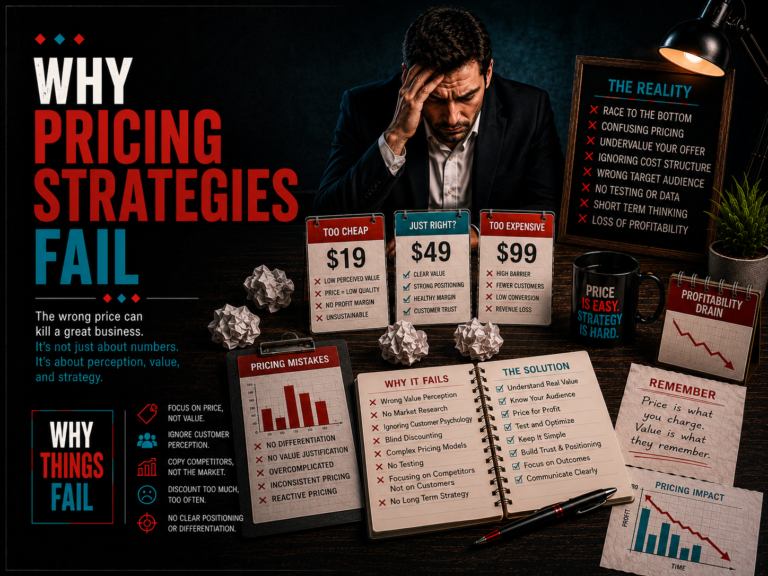
Pricing strategies fail because businesses often focus on costs and competitors instead of customer perception, value creation and behavioural psychology. Poor pricing decisions rarely result from mathematics alone. They usually reflect flawed assumptions, emotional decision making and weak strategic planning.
Introduction
Pricing is one of the most powerful decisions any business makes.
It determines profitability, customer perception, competitive position and long term sustainability. A small change in price can increase profits significantly or quietly destroy years of business growth.
Despite its importance, pricing remains one of the least understood aspects of business strategy.
Many companies invest heavily in product development, marketing and customer acquisition while treating pricing as a simple calculation based on production costs or competitor prices.
This assumption has caused countless businesses to struggle, even when they offer high quality products and excellent customer service.
The question is not simply why customers reject certain prices.
The deeper question is why intelligent business leaders repeatedly make pricing decisions that reduce profits, weaken their brand and create financial instability.
Understanding why pricing strategies fail requires looking beyond numbers.
It requires examining human behaviour, consumer psychology, organisational incentives and the hidden assumptions that shape pricing decisions long before products reach the market.
What Is Pricing Strategy Failure?
Pricing strategy failure occurs when a business sets prices that consistently reduce profitability, customer trust or long term competitiveness.
Failure does not always mean prices are too high.
Neither does it always mean prices are too low.
A pricing strategy fails whenever it prevents a business from capturing the true value it creates.
Some companies underprice excellent products because they fear losing customers.
Others overprice average products because they overestimate market demand.
Many businesses constantly change prices without understanding how customers interpret those changes.
In every case, the visible problem is price.
The deeper problem is decision making.
The Biggest Myth
The biggest myth is that lower prices always attract more customers and increase sales.
At first glance, this appears logical.
Lower prices make products more affordable.
More affordability should create greater demand.
However, consumer psychology tells a different story.
Customers rarely judge price in isolation.
They compare price with perceived value, brand reputation, product quality and available alternatives.
A product priced significantly below competitors may create doubt rather than confidence.
Customers begin asking whether quality has been sacrificed.
Similarly, premium prices often increase perceived quality when supported by strong branding and customer experience.
The relationship between price and demand is therefore shaped by perception rather than mathematics alone.
Businesses that compete only on price often discover that every discount reduces profit without creating lasting customer loyalty.
A famous real-world example shows exactly how this backfires. In 2012, JCPenney’s new CEO Ron Johnson eliminated the retailer’s constant coupons and sales in favor of simple, transparent “everyday low prices” a strategy that was mathematically fairer but ignored how customers actually perceived value. Sales dropped nearly 19% in the first quarter alone, the company lost roughly $4.3 billion in revenue that year, and Johnson was fired after just 17 months. The prices themselves weren’t the problem shoppers had simply learned to associate the thrill of a discount with getting a good deal, and removing that psychological anchor made the same items feel less valuable, even when the actual price was often lower.
What Usually Happens?
Most pricing failures follow a predictable sequence.
A business launches a product with optimism.
Sales grow slowly.
Management assumes the price is the problem.
Prices are reduced.
Sales increase temporarily.
Profit margins decline.
Competitors respond with similar discounts.
The market gradually expects lower prices.
The business now needs higher sales simply to maintain previous profits.
Eventually, price becomes the only competitive advantage remaining.
At this stage, the company has entered a race that becomes increasingly difficult to win.
The original pricing decision quietly transforms into a long term strategic weakness.
Why Do Pricing Strategies Fail?
Pricing failures rarely begin with incorrect calculations.
They begin with incorrect assumptions about customers, value and competition.
The visible outcome is declining profitability.
The invisible causes lie in psychology, organisational behaviour and strategic thinking.
Businesses Focus On Cost Instead Of Value
One of the most common pricing mistakes is cost based thinking.
Many businesses calculate production costs, add a desired profit margin and assume the resulting price is appropriate.
This approach appears rational.
Unfortunately, customers do not purchase products because they understand production costs.
They purchase products because they believe those products solve problems or improve their lives.
Value exists in the customer’s perception rather than the company’s accounting records.
A luxury watch and an inexpensive watch both tell time.
Yet customers willingly pay dramatically different prices because they perceive different levels of craftsmanship, exclusivity, status and emotional satisfaction.
Businesses that ignore perceived value often underprice products that customers would happily pay more for.
Others overprice products that customers see as ordinary.
The mistake is not mathematical.
It is psychological.
Fear Encourages Defensive Pricing
Fear quietly influences many pricing decisions.
Business owners fear losing customers.
Sales teams fear objections.
Managers fear declining revenue.
These concerns often encourage unnecessary discounts before customers even question the original price.
Behavioural economists describe this as loss aversion.
The possibility of losing a sale feels more painful than the possibility of earning greater profits from customers willing to pay full price.
As a result, businesses gradually train customers to expect discounts.
Price negotiations become normal.
Margins become smaller.
Long term profitability begins to weaken.
Ironically, attempts to protect revenue often reduce it.
Overconfidence Leads To Unrealistic Pricing
Fear pushes prices downward.
Overconfidence pushes them upward.
Some businesses believe their products deserve premium prices simply because they invested significant time or money creating them.
This assumption reflects the endowment effect, where people naturally overvalue what they own.
Customers evaluate products differently.
They compare alternatives.
They assess value.
They consider convenience, quality and trust.
Businesses that ignore customer perception frequently mistake internal enthusiasm for external demand.
The result is disappointing sales despite genuine confidence in the product.
Competitor Obsession Creates Strategic Blindness
Many companies monitor competitors more closely than customers.
Every pricing decision becomes a reaction.
If competitors reduce prices, they immediately respond.
If competitors increase prices, they follow.
This reactive behaviour creates a dangerous cycle.
The business gradually loses its own strategic identity.
Pricing becomes driven by competitors rather than customer value, brand positioning or long term objectives.
Eventually every business in the market begins competing on price while ignoring innovation, customer experience and product differentiation.
The competitive advantage disappears.
Only shrinking profit margins remain.
Consumer Psychology Is Frequently Ignored
Pricing is not purely economic.
It is behavioural.
Customers rarely evaluate prices objectively.
Instead, they rely on mental shortcuts known as cognitive biases.
Anchoring causes customers to compare current prices with previously observed prices.
Reference pricing encourages comparisons with competing products.
Scarcity increases perceived value.
Premium pricing can signal quality.
Price ending effects influence purchasing behaviour even when logical differences are minimal.
Businesses that ignore these behavioural principles often create pricing strategies that appear logical internally but fail in the marketplace.
Understanding consumer psychology does not manipulate customers.
It helps businesses communicate value more effectively while aligning pricing with genuine customer expectations.
Short Term Thinking Weakens Long Term Profitability
Many pricing decisions are driven by quarterly sales targets rather than sustainable business strategy.
Temporary discounts increase immediate revenue.
However, repeated discounting gradually changes customer expectations.
Customers begin delaying purchases until the next promotion.
The normal selling price loses credibility.
Profit margins become increasingly difficult to recover.
Behavioural incentives within organisations reinforce this pattern.
Sales teams may be rewarded for revenue growth rather than profitability.
Managers may prioritise short term performance to meet financial targets.
These incentives encourage pricing decisions that improve immediate results while quietly damaging long term business performance.
Pricing strategy therefore becomes less about customer value and more about satisfying short term organisational pressures.
This explains why pricing failures often continue long after warning signs become visible. The decisions appear successful in the present even though they steadily weaken the business for the future.
Warning Signs
Pricing strategies rarely fail overnight. They deteriorate gradually through a series of decisions that appear reasonable in isolation but become damaging when repeated over time.
One warning sign is constant discounting. A business that regularly reduces prices to stimulate demand often signals that customers do not clearly understand the product’s value. Instead of strengthening demand, repeated discounts train customers to wait for lower prices.
Another warning sign is declining profit margins despite increasing sales. Revenue may appear healthy, but profitability continues to weaken because pricing no longer reflects the value being delivered. Growth creates the illusion of success while financial resilience quietly declines.
Frequent price changes without a clear strategic reason are another indicator. Customers become uncertain about the true value of the product, while employees struggle to communicate consistent pricing. Trust begins to weaken because pricing appears reactive rather than deliberate.
Businesses should also pay attention when competitors become the primary influence behind pricing decisions. Once every price change is based on what competitors are doing, the business has stopped leading its own strategy.
Perhaps the most overlooked warning sign is customer confusion. If customers regularly ask why a product costs what it does, the business has not successfully communicated its value proposition. The problem is often not the price itself but the absence of a convincing value narrative.
These warning signs are frequently ignored because they rarely produce immediate financial pain. Sales may continue for months while profitability, brand perception and customer loyalty gradually deteriorate beneath the surface.
What Could Have Prevented It?
Most pricing failures could have been prevented through stronger strategic thinking rather than more complicated pricing formulas.
The first step is understanding that pricing is a reflection of value rather than cost. Businesses that invest time understanding customer expectations, perceived benefits and purchasing behaviour make pricing decisions with greater confidence.
Pricing should also be viewed as part of the overall business strategy. Product quality, customer experience, brand positioning and pricing must reinforce one another. When these elements remain aligned, customers are less likely to judge products purely on price.
Regular pricing reviews are equally important. Markets evolve, customer expectations change and economic conditions shift. A pricing strategy that worked three years ago may no longer reflect current realities. Continuous evaluation helps businesses adapt before problems become severe.
Organisations should also measure profitability alongside revenue. Focusing only on sales encourages decisions that increase turnover while quietly reducing financial strength. Profitability provides a more accurate measure of whether pricing supports long term success.
Most importantly, pricing decisions should be guided by evidence rather than emotion. Fear of losing customers and confidence unsupported by market research both lead to poor judgement. Objective analysis creates more sustainable outcomes than emotional reactions.
Lessons
Pricing reveals a broader lesson about business decision making.
Companies often assume financial success depends on selling more products. In reality, sustainable profitability depends on capturing an appropriate share of the value created.
Another lesson is that customer perception often matters more than internal assumptions. Businesses evaluate products based on effort and production costs, while customers evaluate outcomes, trust and perceived benefits. Successful pricing bridges this difference.
The investigation also demonstrates that incentives shape behaviour. Organisations rewarded for short term revenue frequently sacrifice long term profitability. Businesses rewarded for sustainable value creation make stronger pricing decisions because they consider future consequences rather than immediate results.
Perhaps the most important lesson is that pricing is fundamentally about human psychology. Every purchasing decision reflects perception, trust, comparison and emotion as much as numerical value.
Failure Pattern
The dominant pattern behind pricing failure is Short Term Thinking combined with Poor Strategic Positioning.
Businesses frequently react to immediate market pressures instead of protecting long term value. Fear encourages unnecessary discounts. Overconfidence encourages unrealistic pricing. Competitor obsession discourages independent thinking.
Each decision appears reasonable on its own.
Together they gradually weaken profitability, damage brand perception and reduce competitive advantage.
The same behavioural pattern appears across many forms of financial failure. Investors chase short term returns. Entrepreneurs pursue rapid expansion without sufficient planning. Companies sacrifice sustainable growth for immediate performance targets.
The underlying cause remains remarkably consistent.
Immediate rewards often receive greater attention than long term consequences.
Hidden Lesson
The greatest pricing mistake is believing that price determines value.
The opposite is usually true.
Perceived value determines whether a price feels justified.
Businesses that fail to communicate value eventually compete on price because customers have no other basis for comparison.
This explains why pricing failure often begins long before the first discount is offered. It starts when organisations stop investing in understanding customer psychology and begin treating pricing as a mathematical exercise rather than a strategic decision.
Failure Scorecard
| Area | Score | Explanation |
| Financial Discipline | 5/10 | Pricing decisions often prioritise revenue instead of sustainable profitability. |
| Decision Making | 4/10 | Emotional reactions to competitors and market pressure frequently replace objective analysis. |
| Risk Management | 5/10 | Many businesses underestimate the long term risks of repeated discounting and shrinking margins. |
| Long Term Thinking | 4/10 | Immediate sales targets often outweigh strategic pricing objectives. |
| Financial Knowledge | 6/10 | Businesses understand costs but frequently overlook behavioural pricing principles. |
| Emotional Control | 5/10 | Fear of losing customers and overconfidence both influence pricing decisions. |
| Planning | 5/10 | Pricing strategies are often revised reactively instead of following structured long term plans. |
| Adaptability | 7/10 | Successful businesses adapt pricing based on evidence rather than market panic. |
Key Takeaways
- Pricing failures are usually behavioural rather than mathematical.
- Customers purchase perceived value rather than production costs.
- Constant discounting weakens profitability and changes customer expectations.
- Competitor based pricing often destroys strategic differentiation.
- Behavioural economics explains why customers interpret prices differently from businesses.
- Sustainable pricing depends on long term positioning rather than short term sales targets.
- Strong pricing strategies combine customer psychology, market research and strategic planning.
- Profitable businesses compete through value before they compete through price.
Frequently Asked Questions
Why do pricing strategies fail?
Pricing strategies fail because businesses often focus on costs, competitors or short term sales instead of customer value, behavioural psychology and long term profitability.
Is lowering prices always a good strategy?
No. Lower prices may increase sales temporarily, but repeated discounting often reduces profit margins, weakens brand perception and trains customers to expect lower prices.
Why is customer perception important in pricing?
Customers decide whether a price is fair by comparing it with the value they believe they will receive. Perceived value often has a greater influence on purchasing decisions than the actual price.
How does behavioural economics affect pricing?
Behavioural economics explains how cognitive biases such as anchoring, reference pricing, scarcity and quality perception influence buying decisions. Understanding these behaviours helps businesses create pricing strategies that better reflect customer expectations.
What is the biggest pricing mistake businesses make?
The biggest mistake is treating pricing as a simple financial calculation instead of a strategic decision influenced by psychology, positioning, competition and customer perception.
Conclusion
Pricing strategies rarely fail because businesses cannot calculate costs. They fail because organisations underestimate the complexity of human behaviour and overestimate the power of numerical logic. Every price communicates value, quality and positioning long before a customer experiences the product.
Understanding pricing failure therefore changes the conversation. It reveals that sustainable profitability depends less on finding the perfect number and more on understanding the psychological, strategic and behavioural forces that determine whether customers believe that number is worth paying.