Quick Answer
Business expansion does not destroy companies because growth is inherently risky. It destroys businesses when leaders expand faster than their systems, finances and decision making can support. Poor cash flow management, overconfidence, weak operational control and short term thinking often turn ambitious growth into long term financial failure.
Introduction
Growth is widely celebrated in business.
Opening new locations, entering new markets, hiring more employees and increasing revenue are often seen as the clearest signs of success. Investors reward companies that expand. Customers associate larger businesses with credibility. Entrepreneurs frequently measure progress by the speed at which their organizations grow.
Yet business history tells a more complicated story.
Many successful companies fail not during periods of decline but during periods of rapid expansion. Businesses that once generated healthy profits suddenly experience cash flow shortages, operational failures, declining customer satisfaction and mounting debt. In many cases, the very strategy designed to strengthen the business becomes the reason it collapses.
This raises an important question.
Why does expansion destroy businesses that were previously successful?
The common explanation is that management simply grew too quickly.
While partly true, this answer only describes what happened.
It does not explain why experienced entrepreneurs, capable executives and profitable companies repeatedly make the same decisions despite decades of business evidence warning against uncontrolled growth.
Understanding why expansion destroys businesses requires looking beyond financial statements.
It requires examining how human psychology, organisational incentives and business systems interact when success creates pressure for even greater success.
What Is Business Expansion Failure?
Business expansion failure occurs when growth weakens a company’s financial health instead of strengthening it.
Expansion itself is not the problem.
Many businesses successfully increase revenue, open new locations, launch additional products and enter international markets while remaining financially strong.
Failure occurs when growth exceeds the organisation’s ability to manage it.
A company may double its sales while simultaneously reducing profitability.
Another business may open multiple branches only to discover that operating costs rise faster than revenue.
Some organisations become so focused on acquiring new customers that they neglect existing ones, damaging their reputation and long term competitiveness.
In each case, expansion creates complexity that the business is not prepared to manage.
The result is not sustainable growth but organisational strain.
The Biggest Myth
One of the most persistent myths in business is that faster growth always creates a stronger company.
This belief influences entrepreneurs, investors and even experienced executives.
Revenue increases are celebrated.
New branches generate media attention.
Larger workforces create the appearance of success.
Yet size and strength are not the same.
A business can grow rapidly while becoming financially weaker every month.
Higher sales often require additional inventory, more employees, larger facilities, increased marketing and greater working capital. These investments consume cash long before they generate reliable returns.
Many businesses mistake increasing revenue for increasing financial health.
In reality, sustainable businesses expand because strong systems support growth.
Unsuccessful businesses expect growth to solve weaknesses that already exist.
Expansion rarely fixes operational problems.
It usually magnifies them.
What Usually Happens?
The pattern is remarkably consistent.
A business achieves early success.
Customer demand increases.
Revenue grows steadily.
Management becomes confident that the current strategy will continue producing similar results.
The company opens additional locations, hires rapidly, increases inventory or enters new markets.
Initially, growth appears successful.
Sales continue increasing.
Soon afterwards, operating costs begin rising faster than expected.
Cash flow becomes constrained.
Management attention becomes divided.
Operational consistency declines.
Customer experience suffers.
Debt increases.
Eventually the business spends more time managing the consequences of expansion than serving customers.
Although every company faces different circumstances, the underlying progression changes very little.
Businesses rarely fail because they choose to grow.
They fail because growth outpaces their ability to manage complexity.
Why Does Expansion Destroy Businesses?
This is where the investigation begins.
Expansion is often described as a financial decision.
In reality, it is equally a psychological decision.
Growth changes how leaders think.
Success increases confidence.
Confidence changes risk perception.
Changing risk perception influences decision making.
Over time, these behavioural shifts gradually weaken the systems that originally made the business successful.
The financial collapse usually appears much later.
Success Creates Overconfidence
One of the strongest behavioural patterns behind expansion failure is overconfidence.
When a business experiences consistent success, leaders naturally begin believing their decisions are highly reliable.
Previous achievements create the impression that future growth will follow the same trajectory.
This confidence encourages larger investments, faster hiring and more ambitious expansion plans.
The danger lies in assuming that past success guarantees future success.
Business conditions constantly change.
Customer behaviour evolves.
Competition increases.
Operating costs fluctuate.
Strategies that performed exceptionally in one market may fail completely in another.
Overconfidence reduces the willingness to question assumptions.
Instead of asking whether the organisation is prepared for expansion, leaders begin asking how quickly expansion can occur.
This subtle shift transforms disciplined growth into unnecessary risk.
Cash Flow Becomes The Invisible Problem
Many expanding businesses report increasing revenue while simultaneously approaching financial distress.
At first glance this appears contradictory.
If sales are increasing, why does the business experience financial pressure?
The answer lies in cash flow rather than profit.
Expansion requires significant investment before additional revenue becomes reliable.
New premises require deposits.
Employees must be paid before sales are generated.
Inventory must be purchased months before customers make purchases.
Marketing expenses increase immediately while customer acquisition often develops gradually.
Revenue therefore creates optimism.
Cash flow determines survival.
Many business owners focus on income statements while underestimating the importance of liquidity.
Profitable businesses can still fail if they cannot meet short term financial obligations.
Expansion therefore creates a timing problem rather than simply a profitability problem.
Krispy Kreme is a well-documented example of this exact trap. After going public in 2000 at $37 a share, the company expanded aggressively including forcing franchisees to buy equipment and ingredients directly from headquarters at steep markups. When that unsustainable growth model collapsed in 2004, the company reported a $24.4 million quarterly loss, and its stock eventually fell from a high near $50 a share to around $4. The company hadn’t lost its product or its customers it had expanded faster than its financial structure could support.
Complexity Grows Faster Than Revenue
Growth increases more than sales.
It increases complexity.
One location becomes five.
Ten employees become one hundred.
One supplier becomes twenty.
Customer enquiries multiply.
Operational decisions become increasingly interconnected.
Processes that once relied on direct supervision now require formal systems, middle management and clear accountability.
Many entrepreneurs continue managing expanding organisations as though they were small businesses.
The informal communication that once worked effectively becomes inefficient.
Decision making slows.
Mistakes increase.
Departments begin operating independently rather than collaboratively.
The business becomes larger but less coordinated.
Complexity rarely destroys companies overnight.
Instead, it gradually weakens operational consistency until customers begin noticing declining quality, slower service and reduced reliability.
Growth Creates Incentives That Encourage More Growth
Expansion also changes incentives inside the organisation.
Executives may receive bonuses based on revenue growth.
Investors may demand continued expansion.
Competitors entering new markets create pressure to respond quickly.
Employees associate growth with career progression.
These incentives encourage leaders to prioritise expansion even when existing operations require greater attention.
The organisation begins rewarding visible growth instead of sustainable growth.
Over time, decisions become focused on opening the next branch, launching the next product or entering the next market rather than strengthening financial resilience.
This creates a dangerous feedback loop.
Growth generates praise.
Praise encourages further expansion.
Further expansion increases operational strain.
Instead of slowing down to strengthen internal systems, businesses accelerate towards greater complexity, believing that continued growth will eventually solve the pressures created by previous growth.
In many cases, it does exactly the opposite.
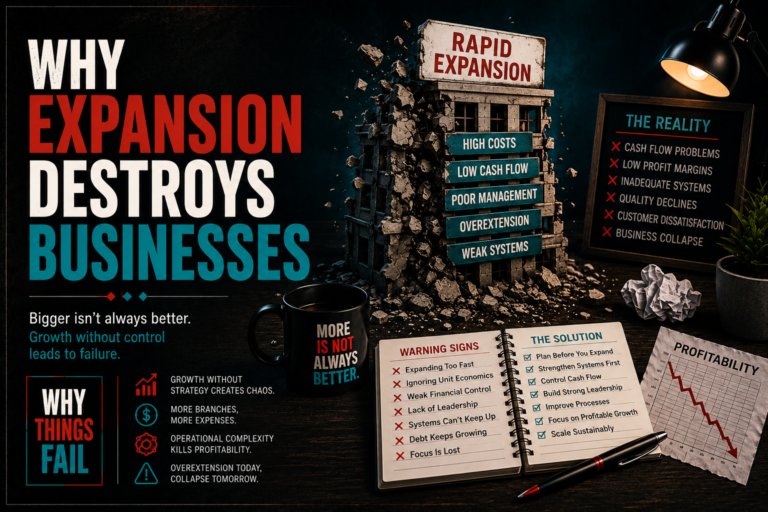
Warning Signs
Business expansion rarely fails without warning. The difficulty is that these warning signs often appear during periods of confidence, when leaders are least likely to recognise them.
One of the earliest signs is declining cash flow despite increasing revenue. Sales continue growing, yet the business constantly struggles to pay suppliers, employees and operating expenses. Many leaders dismiss this as a temporary consequence of growth rather than recognising it as a structural weakness.
Another warning sign is expanding before existing operations become consistently profitable. Instead of strengthening one successful location, product or market, businesses attempt to replicate a model that has not yet proved sustainable. Weaknesses that were manageable on a small scale become expensive across multiple locations.
Rapid hiring without developing management capability is another indicator. New employees join faster than organisational systems evolve. Communication becomes inconsistent, accountability weakens and decision making slows as leaders attempt to manage increasing complexity.
Customer complaints also provide valuable signals. Declining service quality, delayed deliveries, inconsistent products and slower response times often indicate that operational systems are struggling to support expansion.
Perhaps the most overlooked warning sign is leadership becoming consumed by growth targets instead of operational performance. When executives spend more time discussing expansion than improving existing processes, the organisation begins prioritising visibility over sustainability.
These warning signs are frequently ignored because revenue continues increasing. Growth creates optimism, making it difficult to recognise that financial resilience is gradually weakening beneath the surface.
What Could Have Prevented It?
Expansion becomes sustainable when businesses strengthen their foundations before increasing their size.
The first requirement is disciplined cash flow management. Expansion should be supported by sufficient working capital rather than optimistic revenue projections. Businesses survive through liquidity, not revenue alone.
Growth should also occur only after operational systems have demonstrated consistent performance. Standardised processes, reliable management structures and measurable performance indicators create stability before additional complexity is introduced.
Leaders must separate ambition from evidence. Every expansion decision should be tested against objective financial data, operational capacity and realistic demand rather than confidence generated by previous success.
Organisations also benefit from expanding gradually. Controlled growth allows management to identify weaknesses while they remain manageable. Problems discovered in one location or one market can be corrected before they spread throughout the organisation.
Finally, businesses should regularly evaluate incentives. Rewarding sustainable profitability, customer satisfaction and operational excellence often produces healthier long term outcomes than rewarding revenue growth alone.
Expansion succeeds when growth becomes the result of strong systems rather than the substitute for them.
Lessons
The failure of expanding businesses offers lessons that extend beyond entrepreneurship.
The first lesson is that growth does not solve organisational weaknesses. It magnifies them. Businesses with poor financial controls, inconsistent operations or weak leadership rarely become stronger through expansion.
Another lesson is that success changes decision making. Confidence developed through previous achievements often reduces caution and encourages assumptions that future markets will behave like past ones. Sustainable businesses continually challenge these assumptions instead of relying on them.
The investigation also demonstrates that financial strength depends on resilience rather than size. A smaller organisation with healthy cash flow, efficient operations and disciplined leadership may be significantly stronger than a much larger competitor experiencing operational strain.
Perhaps the most important lesson is that business success depends on systems rather than ambition. Vision creates opportunity, but systems determine whether that opportunity can be sustained over time.
Failure Pattern
The dominant pattern behind expansion failure is Overconfidence combined with Poor Planning and Weak Cash Flow Management.
Early success creates confidence.
Confidence encourages faster expansion.
Expansion increases operational complexity.
Complexity weakens financial control and decision making.
Management becomes increasingly focused on solving problems created by previous growth instead of strengthening the underlying business.
This pattern appears repeatedly across retail companies, restaurants, technology businesses, manufacturing firms, family businesses and international corporations.
The industry changes.
The products change.
The underlying behavioural pattern remains remarkably consistent because it reflects human psychology rather than business models.
Hidden Lesson
Businesses rarely fail because they become too large.
They fail because they expand faster than their ability to manage complexity.
Growth itself is not the hidden risk.
The hidden risk is believing that success automatically creates the capability to manage greater success.
In reality, expansion exposes weaknesses that already existed. Weak financial controls, poor communication, ineffective leadership and fragile operational systems remain hidden while businesses are small. Growth simply removes the conditions that once concealed them.
The collapse therefore begins long before financial distress becomes visible.
It begins the moment confidence grows faster than organisational capability.
Failure Scorecard
| Area | Score | Explanation |
| Financial Discipline | 4/10 | Rapid expansion often prioritises revenue over sustainable financial control. |
| Decision Making | 5/10 | Growth decisions frequently become influenced by confidence rather than objective analysis. |
| Risk Management | 3/10 | Operational and financial risks are commonly underestimated during expansion. |
| Long Term Thinking | 4/10 | Immediate growth targets often outweigh sustainable organisational development. |
| Financial Knowledge | 6/10 | Many leaders understand finance but underestimate the demands of scaling operations. |
| Emotional Control | 5/10 | Success can encourage overconfidence that weakens objective judgement. |
| Planning | 4/10 | Expansion plans frequently overlook operational capacity and cash flow requirements. |
| Adaptability | 6/10 | Businesses that recognise problems early adapt successfully, while others continue expanding despite warning signs. |
Key Takeaways
- Expansion does not guarantee stronger businesses.
- Revenue growth cannot compensate for weak cash flow management.
- Success often creates overconfidence that increases financial risk.
- Operational complexity grows faster than most leaders anticipate.
- Sustainable systems should be developed before aggressive expansion.
- Strong leadership requires questioning success as carefully as analysing failure.
- Growth should strengthen existing operations rather than distract from them.
- Long term resilience is more valuable than rapid expansion.
Frequently Asked Questions
Why does rapid expansion destroy businesses?
Rapid expansion increases costs, operational complexity and financial pressure before additional revenue becomes stable. Without strong systems and sufficient cash flow, growth can weaken the business instead of strengthening it.
Can profitable businesses fail because of expansion?
Yes. Profitability and liquidity are different. A profitable business can fail if expansion creates cash flow shortages that prevent it from meeting short term financial obligations.
What is the biggest mistake companies make during expansion?
The biggest mistake is assuming previous success guarantees future success. This often leads to overconfidence, weak planning and expanding beyond the organisation’s operational capacity.
Why is cash flow more important than revenue during expansion?
Revenue measures sales, while cash flow determines whether a business can pay employees, suppliers and operating expenses. Healthy revenue without sufficient liquidity can still lead to financial failure.
What makes business expansion sustainable?
Sustainable expansion is supported by disciplined financial management, strong operational systems, capable leadership, realistic planning and gradual implementation rather than rapid growth alone.
Conclusion
Business expansion does not destroy companies because growth is dangerous. It destroys businesses when confidence grows faster than capability, when ambition replaces discipline and when complexity outpaces the systems designed to manage it.
Understanding this changes the meaning of growth itself. Expansion is not the reward for success. It is the greatest test of whether a business has developed the financial discipline, operational resilience and leadership maturity required to survive the consequences of becoming larger.