Quick Answer
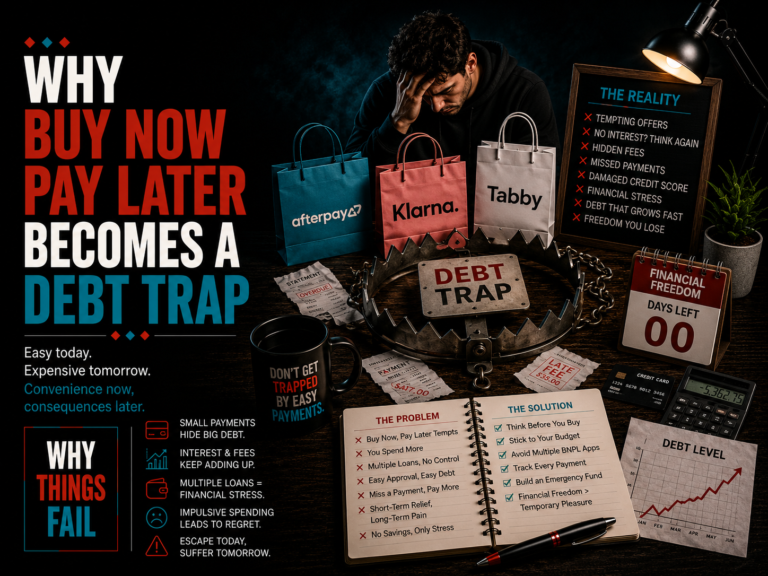
Buy Now Pay Later becomes a debt trap because it changes how people perceive spending. Instead of evaluating the full cost of a purchase, consumers focus on small instalments. This encourages impulse buying, repeated borrowing and poor budgeting, creating a cycle where multiple repayments become difficult to manage.
Introduction
Few financial products have changed consumer spending habits as quickly as Buy Now Pay Later.
What began as a convenient way to spread payments has become one of the fastest growing forms of consumer credit. Millions of people now use Buy Now Pay Later services to purchase everything from clothing and electronics to groceries, travel and household essentials.
The appeal is obvious.
There are no immediate large payments. The application process is simple. Approval often takes only a few seconds. Many providers advertise interest free instalments, making purchases appear affordable.
Yet behind this convenience lies an important question.
Why do so many consumers who intended to make budgeting easier eventually struggle with debt?
The answer is not simply that people borrow too much.
Nor is it because Buy Now Pay Later is inherently harmful.
The deeper explanation lies in the interaction between behavioural psychology, financial incentives and modern consumer culture. Buy Now Pay Later changes not only how people pay for products but also how they think about money, affordability and financial risk.
Understanding why Buy Now Pay Later becomes a debt trap requires looking beyond payment schedules. It requires examining the hidden behavioural patterns that gradually transform convenient borrowing into long term financial pressure.
What Is Buy Now Pay Later?
Buy Now Pay Later, often called BNPL, is a form of short term consumer credit that allows customers to receive goods immediately while paying for them through scheduled instalments.
Unlike traditional loans, the approval process is usually quick and requires limited documentation. Many providers advertise interest free payments provided repayments are made on time.
For retailers, Buy Now Pay Later increases sales by reducing the immediate financial barrier to purchasing.
For consumers, it creates the impression that expensive purchases have become easier to afford.
This convenience explains why services such as Klarna, Afterpay, Affirm and Zip have experienced rapid global growth.
However, affordability and payment flexibility are not always the same thing.
A product that can be divided into four instalments does not necessarily become financially affordable. It simply changes when payment is made.
Understanding this distinction is essential because financial failure often begins when delayed payments are mistaken for reduced costs.
The Biggest Myth
The most common belief is simple.
Buy Now Pay Later is safe because it is interest free.
This assumption influences millions of purchasing decisions every day.
Interest certainly matters.
However, behavioural economists argue that the greatest financial risk often appears before interest charges are even considered.
The real danger is psychological.
Breaking one large payment into several smaller payments changes how the human brain evaluates value.
A purchase costing five hundred pounds may appear expensive when paid immediately.
The same purchase divided into four monthly instalments suddenly feels manageable.
Nothing about the actual price has changed.
Only the perception has changed.
Behavioural researchers refer to this as payment framing.
Consumers evaluate the size of each payment rather than the total financial commitment.
This creates the illusion that spending has become more affordable when, in reality, only the timing has changed.
As a result, many consumers purchase products they would have rejected if immediate full payment had been required.
The debt trap therefore begins long before repayments become difficult.
It begins the moment affordability is judged by instalments instead of total cost.
What Usually Happens?
The pattern is remarkably consistent.
A consumer uses Buy Now Pay Later for a single purchase.
Repayments appear small and manageable.
Confidence grows.
Another purchase follows.
Then another.
Within a short period, several repayment schedules overlap.
Each individual instalment still appears affordable.
Collectively, however, they begin reducing monthly cash flow.
Unexpected expenses such as medical bills, vehicle repairs or reduced income create financial pressure.
Missed repayments lead to late fees, collection activity or additional borrowing to cover previous obligations.
What began as convenient payment flexibility gradually becomes a cycle of repayment management.
The financial difficulty rarely results from one expensive purchase.
It develops through multiple small decisions that appear harmless when viewed individually.
This isn’t theoretical CFPB research analyzing 145 million BNPL loan applications found that nearly two-thirds of US borrowers who use BNPL take out multiple loans simultaneously, and one-third borrow from more than one provider at once. The same research found BNPL borrowers carry meaningfully higher balances on other unsecured debt an average of $453 more in personal loans and $871 more in credit card debt than consumers with similar credit profiles who don’t use BNPL
Why Does Buy Now Pay Later Become A Debt Trap?
The answer extends far beyond consumer credit.
It begins with human behaviour.
Financial decisions are rarely made through perfect logic. They are influenced by emotion, cognitive shortcuts and immediate rewards.
Buy Now Pay Later systems are particularly effective because they align with several well documented behavioural biases.
Present Bias Prioritises Immediate Rewards
One of the strongest behavioural tendencies is present bias.
People naturally place greater value on immediate satisfaction than future consequences.
Receiving a product today creates an immediate emotional reward.
Paying for it over several months delays the financial discomfort.
The brain therefore gives greater attention to the pleasure of ownership than to future repayment obligations.
This explains why many consumers willingly commit future income before it has even been earned.
The future appears distant.
The purchase feels immediate.
As more purchases accumulate, future income becomes increasingly committed to past spending decisions.
Eventually, financial flexibility begins to disappear.
Payment Decoupling Reduces Spending Awareness
Traditional purchases create an immediate connection between buying and paying.
This psychological connection encourages consumers to consider whether a purchase is genuinely worthwhile.
Buy Now Pay Later weakens this connection.
Behavioural economists describe this as payment decoupling.
The emotional experience of purchasing becomes separated from the experience of paying.
Consumers enjoy the product immediately while repayments occur weeks or months later.
Without immediate financial discomfort, spending feels less significant.
Research consistently shows that consumers spend more freely when payment is delayed because the psychological cost becomes less visible.
The debt trap therefore develops gradually.
Not because consumers deliberately overspend.
Because delayed payments make overspending more difficult to recognise.
Lifestyle Inflation Quietly Changes Spending Habits
Most people associate lifestyle inflation with salary increases.
The same principle applies to easy credit.
When Buy Now Pay Later becomes available, products that once felt financially out of reach suddenly appear accessible.
Higher priced clothing becomes acceptable.
Premium electronics seem affordable.
Luxury furniture appears manageable.
Consumer expectations quietly rise.
Over time, the definition of normal spending changes.
The financial challenge is not the first purchase.
It is the gradual increase in everyday consumption.
As spending expectations rise, future income becomes increasingly allocated to maintaining a lifestyle that previously seemed unnecessary.
Impulse Buying Becomes Easier
Every financial decision contains a moment of hesitation.
Consumers naturally pause before making expensive purchases.
Buy Now Pay Later reduces that hesitation.
Instead of asking, “Can I afford five hundred pounds?”
Consumers begin asking, “Can I afford twenty five pounds this week?”
This subtle shift changes the entire purchasing decision.
Attention moves away from total cost towards immediate affordability.
Retailers understand this behavioural pattern well.
That is why Buy Now Pay Later options are frequently displayed beside the product price during checkout.
Reducing the perceived financial barrier increases the likelihood of completing the purchase.
The decision feels rational because each instalment appears small.
The cumulative financial commitment remains largely invisible until multiple repayment plans begin overlapping.
Overconfidence Creates Hidden Financial Risk
Many consumers believe they will easily manage future repayments because their current financial situation feels stable.
This reflects optimism bias and overconfidence.
People naturally assume future income will remain consistent.
Unexpected events are underestimated.
Job loss, illness, rising living costs or emergency expenses rarely form part of the purchasing decision.
When financial circumstances change, repayment commitments remain fixed.
What once appeared affordable becomes increasingly difficult to manage.
The problem was never the individual instalment.
It was the assumption that future financial conditions would remain unchanged.
This is why debt traps often emerge gradually rather than suddenly.
Every repayment appeared manageable when viewed in isolation.
Together, they quietly reduced financial resilience until an unexpected event exposed the underlying weakness.
Warning Signs
Financial failure caused by Buy Now Pay Later rarely begins with missed payments. It usually begins much earlier through subtle behavioural changes that appear harmless.
One of the first warning signs is judging affordability by the size of the monthly instalment instead of the total purchase price. Consumers gradually stop asking whether they need an item and begin asking whether they can manage another small payment.
Another warning sign is holding multiple Buy Now Pay Later agreements at the same time. Each repayment appears insignificant on its own, yet together they reduce available cash flow and increase financial pressure.
Impulse purchases also become more frequent. Products that would once have required careful consideration are bought within minutes because delayed payments reduce the psychological barrier to spending.
Consumers may also begin relying on future income to solve today’s financial commitments. This creates an assumption that next month’s salary will comfortably cover today’s borrowing. When unexpected expenses arise, that assumption quickly becomes fragile.
Perhaps the most overlooked warning sign is losing track of repayment schedules. Once consumers struggle to remember how many instalment plans they have active, financial commitments have often become more complex than they realise.
These warning signs are commonly ignored because they develop gradually. Each decision appears reasonable in isolation. The financial risk only becomes visible when the combined effect begins affecting everyday cash flow.
What Could Have Prevented It?
The debt trap associated with Buy Now Pay Later is rarely prevented through better products alone. It is prevented through better decision making and stronger financial systems.
The first safeguard is evaluating purchases by their full price rather than their instalment amount. This keeps attention focused on the true financial commitment instead of the immediate affordability.
Consumers also benefit from viewing Buy Now Pay Later as a form of borrowing rather than as a payment method. This simple change in perspective encourages more careful spending decisions because every instalment represents future income that has already been committed.
Maintaining a realistic household budget creates another layer of protection. When repayment obligations are clearly recorded alongside rent, utilities, food and savings, consumers gain a more accurate understanding of their available income.
Financial education also plays an important role. Understanding concepts such as cash flow management, consumer credit, debt accumulation and delayed gratification helps people recognise behavioural biases before they become financial problems.
Finally, stronger consumer protection can reduce systemic risk. Clear affordability assessments, transparent repayment information and responsible lending practices encourage sustainable borrowing rather than excessive consumption.
The objective is not to eliminate Buy Now Pay Later.
The objective is to ensure convenience does not quietly replace financial judgement.
Lessons
The rise of Buy Now Pay Later offers lessons that extend well beyond consumer credit.
The first lesson is that the way a payment is presented can influence spending more than the price itself. Human behaviour responds to perception as much as reality, making payment structure a powerful driver of financial decisions.
Another lesson is that convenience often carries hidden behavioural costs. Technology has made borrowing faster and easier, but it has also reduced the moments of reflection that once encouraged careful financial judgement.
The debt trap also demonstrates that financial problems rarely begin with one large mistake. They emerge through a series of small decisions that appear harmless when viewed individually but become damaging when repeated over time.
Perhaps the most important lesson is that sustainable financial health depends as much on understanding psychology as it does on understanding money. The greatest financial risks often begin in the mind long before they appear in a bank account.
Failure Pattern
The dominant pattern behind Buy Now Pay Later debt is Consumerism combined with Short Term Thinking and Poor Financial Discipline.
Consumers prioritise immediate satisfaction while postponing financial consequences. Every purchase feels affordable because repayments are divided into smaller amounts. As confidence grows, borrowing increases, spending habits change and repayment obligations accumulate.
This pattern extends beyond Buy Now Pay Later.
Credit card debt, personal loans, lifestyle inflation and business borrowing often follow the same behavioural sequence. Immediate rewards receive greater attention than future obligations, while optimism encourages the belief that future income will easily absorb today’s commitments.
The underlying failure is therefore not excessive borrowing alone.
It is consistently choosing immediate consumption over long term financial resilience.
Hidden Lesson
The greatest danger of Buy Now Pay Later is not that it encourages borrowing.
It is that it changes how people think about affordability.
Once consumers begin measuring purchases by monthly instalments instead of total cost, spending decisions become psychologically disconnected from financial reality.
The debt trap is therefore not created by one expensive purchase.
It is created by a gradual shift in perception where future income feels easier to spend than money already earned.
That subtle psychological change explains why financial pressure often develops without consumers recognising it until repayment obligations begin competing with everyday living expenses.
Failure Scorecard
| Area | Score | Explanation |
| Financial Discipline | 4/10 | Small repayments often encourage repeated borrowing instead of controlled spending. |
| Decision Making | 5/10 | Purchasing decisions are influenced more by instalment size than total affordability. |
| Risk Management | 4/10 | Future income is frequently committed without allowing for unexpected financial events. |
| Long Term Thinking | 3/10 | Immediate gratification often takes priority over future financial flexibility. |
| Financial Knowledge | 6/10 | Many consumers understand repayments but underestimate cumulative debt obligations. |
| Emotional Control | 5/10 | Convenience and impulse buying often outweigh careful financial judgement. |
| Planning | 4/10 | Multiple repayment plans are commonly accepted without a complete household budget. |
| Adaptability | 6/10 | Consumers can adjust spending, but many react only after financial pressure has already developed. |
Key Takeaways
- Buy Now Pay Later changes spending behaviour more than it changes affordability.
- Small instalments can disguise the true cost of a purchase.
- Present bias encourages immediate consumption while ignoring future obligations.
- Payment decoupling reduces awareness of how much money is actually being spent.
- Lifestyle inflation often begins through repeated access to easy credit.
- Multiple small repayments can quietly damage monthly cash flow.
- Financial resilience depends on evaluating total cost rather than monthly instalments.
- Behavioural psychology plays a greater role in debt accumulation than many consumers realise.
Frequently Asked Questions
Why does Buy Now Pay Later become a debt trap?
Buy Now Pay Later becomes a debt trap because consumers focus on small repayments instead of the total purchase price. As multiple instalment plans accumulate, monthly repayment obligations reduce available cash flow and increase financial pressure.
Is Buy Now Pay Later better than a credit card?
It can be less expensive when repayments are made on time, but both are forms of consumer credit. Financial outcomes depend more on borrowing behaviour and repayment discipline than on the payment product itself.
Can Buy Now Pay Later affect your financial health?
Yes. Managing several repayment plans at once can reduce financial flexibility, increase stress and make it more difficult to cover unexpected expenses or achieve long term financial goals.
Why do people overspend with Buy Now Pay Later?
Behavioural psychology explains that delayed payments reduce the immediate emotional impact of spending. Consumers therefore feel more comfortable making purchases they might have postponed if full payment had been required immediately.
How can consumers avoid a Buy Now Pay Later debt trap?
Consumers can reduce the risk by evaluating the full purchase price, limiting the number of active repayment plans, maintaining a realistic budget and treating Buy Now Pay Later as borrowing rather than free money.
Conclusion
Buy Now Pay Later does not create financial failure on its own. It succeeds because it aligns with predictable patterns of human behaviour, including present bias, optimism, impulse buying and the tendency to underestimate future obligations. The technology makes borrowing easier, but psychology determines whether that convenience becomes a useful financial tool or a persistent source of debt. Understanding this distinction reveals that the true debt trap is not hidden within the repayment schedule. It is hidden within the way the human mind perceives affordability.