Introduction: The Quiet Death of Competence
Skills rarely become irrelevant overnight. They fade slowly, quietly and often invisibly.
A person does not wake up one morning and suddenly discover they are useless. More often, they remain busy, experienced and respected while the world around them changes. Their work still gets done. Their title still looks credible. Their past achievements still feel real. Then, gradually, the market stops rewarding what they know.
This is one of the most uncomfortable failures in modern careers and organisations: people can be competent and still become outdated.
The danger is not that skills disappear. It is that their value changes. A skill that once made someone employable, respected or promotable can become ordinary, automated, outsourced or strategically unimportant. What was once rare becomes common. What was once technical becomes basic. What was once enough becomes the minimum requirement.
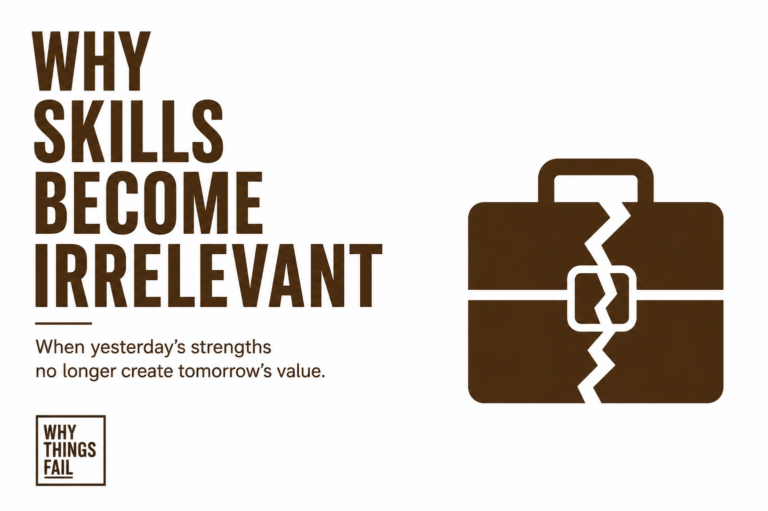
This is why skills become irrelevant: not because people lack talent, but because they confuse past usefulness with future value.
What Is It?
Skill irrelevance happens when a person’s abilities no longer match the needs of the market, organisation or role they occupy.
It does not always mean the skill is completely useless. Typing is still useful. Basic spreadsheet knowledge is still useful. Traditional sales calls still matter in some sectors. But usefulness is not the same as advantage.
A skill becomes irrelevant when it no longer creates meaningful value, differentiation or leverage.
This can happen because of technology, automation, artificial intelligence, regulation, changing customer behaviour, new business models, global competition or internal organisational change. Sometimes the skill remains valid, but the context around it changes so much that it loses power.
The person still knows something. The problem is that the world no longer needs it in the same way.
The Biggest Myth: “If You Are Good at Something, You Are Safe”
The biggest myth is that mastery protects people.
It does not.
Mastery protects people only when the thing being mastered continues to matter. History is full of skilled professionals who were excellent at work that became less valuable. Telephone operators, typesetters, travel agents, video rental managers, print advertising specialists and many clerical workers did not fail because they were lazy. Many failed because the system around their skills changed faster than they did.
The modern version is more subtle. A marketer who only understands traditional campaigns may struggle in an AI-driven, data-heavy environment. A manager who only knows command-and-control leadership may lose influence in hybrid teams. A designer who ignores automation tools may become slower than competitors. A finance professional who only reports numbers, but cannot interpret them strategically, may be replaced by dashboards and software.
The harsh truth is this: being good at yesterday’s work does not guarantee relevance tomorrow.
What Usually Happens?
The pattern is usually predictable.
First, a person builds competence. They learn a skill, become reliable and gain confidence. That skill brings promotion, income, status and identity.
Then the environment begins to shift. New tools appear. Younger colleagues bring different methods. Customers expect faster service. Leaders start asking different questions. The organisation changes priorities.
At first, the person dismisses the shift. They see it as hype, fashion or unnecessary complexity. Because their current skill still works, they assume it will continue to work.
Then performance begins to decline indirectly. They are not immediately bad at their job, but they become slower to adapt, less visible in new projects, less fluent in new language and less trusted with future-facing work.
Eventually, they face a painful discovery: their experience is respected, but no longer central.
That is when skill irrelevance becomes personal.
Why Does It Happen?
1. People Attach Their Identity to Their Existing Skills
Skills are not just tools. They become part of identity.
A chef is proud of technique. A salesperson is proud of persuasion. A manager is proud of judgement. A designer is proud of taste. A finance person is proud of accuracy. When the world says, “This skill is no longer enough,” people do not hear a neutral market signal. They hear an insult.
This is why people resist learning. Not because they cannot learn, but because learning threatens the story they have built about themselves.
To learn something new, a person must first admit that something old may no longer be enough. That admission is emotionally expensive.
The deeper failure is not technical. It is psychological. People protect their identity before they protect their relevance.
2. Organisations Reward Current Performance More Than Future Readiness
Most organisations say they value learning. Their systems often say the opposite.
They reward people for hitting today’s targets, solving today’s problems and maintaining today’s operations. Training is encouraged, but only after urgent work is complete. Development is praised, but delivery is measured. Innovation is discussed, but efficiency is rewarded.
This creates a hidden trap. Employees become excellent at what the organisation currently needs, while failing to prepare for what it will need next.
By the time the company changes direction, the same employees are blamed for being outdated.
In reality, many people become irrelevant inside organisations that quietly trained them to stay still.
3. Success Creates Complacency
Failure teaches loudly. Success whispers.
When a skill has produced results for years, people naturally trust it. They stop questioning it. They stop testing it against reality. They assume that because it worked before, it will work again.
This is especially dangerous for senior professionals and leaders. The longer someone has been rewarded for a particular way of working, the harder it becomes to abandon it.
A leader who built a career through personal authority may underestimate collaborative leadership. A professional who built expertise through technical knowledge may underestimate communication. A company that built advantage through scale may underestimate speed.
Success becomes a prison when it makes people loyal to the method rather than the outcome.
4. Technology Does Not Remove Skills; It Changes Their Value
Technology rarely destroys an entire profession at once. It changes the value of tasks inside that profession.
This distinction matters.
Artificial intelligence may not replace all marketers, lawyers, designers, analysts or administrators. But it can reduce the value of routine writing, basic research, simple reporting, repetitive design and predictable decision-making.
When technology absorbs the lower-value parts of a role, humans must move higher up the value chain. They must become better at judgement, interpretation, creativity, ethics, strategy, relationship-building and problem framing.
The mistake is believing that because a job still exists, the old skill mix is safe.
The job title may survive while the skills inside it are completely rearranged.
5. People Confuse Activity With Relevance
Busy people often assume they are valuable.
This is a dangerous assumption.
A person can be busy doing work that no longer matters. They can attend meetings, produce reports, answer emails and complete tasks while contributing little to future value. Activity creates the feeling of importance, but it can hide declining relevance.
This happens in organisations all the time. People protect processes because those processes justify their role. They defend old reports because they know how to produce them. They maintain routines because routines feel like control.
But relevance is not measured by effort. It is measured by usefulness in the current and emerging context.
A hard-working person can still become irrelevant if the work itself is losing importance.
6. Learning Becomes Too Passive
Many professionals think learning means waiting for training.
They expect the employer to provide courses, the manager to explain the future or the industry to give them clear signals. But by the time formal training arrives, the shift is often already obvious to everyone else.
Relevant people do not wait for permission to learn. They watch weak signals. They notice new tools. They ask younger colleagues what is changing. They study customer behaviour. They test new methods before they are forced to use them.
Passive learning is too slow for modern work.
The people who stay relevant are not always the smartest. They are often the most alert.
7. Leaders Fail to Translate Change Into Skills
Many organisations talk about transformation without explaining what it means for people’s daily work.
They announce AI strategies, digital transformation, automation, customer-centricity or agility. But they do not clearly define which skills must be built, which behaviours must change and which old habits must stop.
This creates confusion. Employees hear the language of change but receive no practical map. Some panic. Some ignore it. Some pretend to adapt by using new vocabulary while continuing old behaviour.
Leadership failure sits at the centre of many skill failures. People cannot prepare for a future that leaders describe only in slogans.
Good leadership does not simply say, “Change is coming.” It says, “Here is how your work is changing, here is what you need to learn, and here is how we will support you.”
8. People Underestimate the Speed of Normalisation
New skills feel optional at first. Then they become expected.
This is how many professionals get caught. At first, using data tools, AI tools, digital platforms or new communication methods feels like an advantage. Early adopters seem unusual. Then, suddenly, the skill becomes normal. What once made someone stand out becomes a basic requirement.
The danger is not only missing the future. It is joining too late, when the future has already become standard.
Professionals often say, “I will learn it when I need it.”
By then, others may already be fluent.
Warning Signs
Skill irrelevance usually sends signals before it becomes a crisis.
The first warning sign is repeated defensiveness. When someone reacts to new tools or methods with irritation rather than curiosity, they may be protecting comfort rather than judging quality.
The second warning sign is exclusion from future-facing conversations. If a person is still trusted with maintenance work but not invited into new projects, the organisation may already see them as operational rather than strategic.
The third warning sign is declining language fluency. Every field develops new vocabulary. When someone no longer understands the language being used around them, they are losing connection with the direction of the work.
The fourth warning sign is over-reliance on experience. Experience is valuable when it improves judgement. It becomes dangerous when it replaces learning.
The fifth warning sign is blaming the market. When people say, “This is just a trend,” “People are overcomplicating things,” or “The old way is better,” they may be right occasionally. But repeated dismissal is often fear disguised as wisdom.
These signs are ignored because they are uncomfortable. Nobody wants to admit that their professional value may be weakening. Managers avoid the conversation because it feels harsh. Employees avoid it because it feels threatening. Organisations avoid it because they benefit from current productivity until the gap becomes expensive.
What Could Have Prevented It?
Skill irrelevance cannot always be prevented, but it can be reduced.
The first prevention is honest skills diagnosis. People and organisations need to ask: which skills create value now, which are becoming basic, and which are likely to matter next? Without this clarity, learning becomes random.
The second prevention is regular reinvention, not emergency reskilling. Waiting until a role is threatened creates panic. Small, consistent learning prevents the shock.
The third prevention is better leadership communication. Leaders must explain change in practical terms. Employees need to know how technology, customers, competitors and strategy will affect their actual responsibilities.
The fourth prevention is psychological safety around not knowing. People hide skill gaps when ignorance is punished. If asking basic questions damages status, employees will pretend to understand until failure becomes visible.
The fifth prevention is skills-first career planning. People should not define themselves only by job titles. Titles change slowly; skills change quickly. A person who thinks in terms of transferable capabilities is more adaptable than one who thinks only in terms of position.
The sixth prevention is exposure. Professionals need contact with new ideas, different generations, different industries and different tools. Isolation accelerates irrelevance.
The realistic solution is not constant reinvention for its own sake. It is disciplined awareness of where value is moving.
Lessons
The first lesson is that skills have a shelf life. Some last decades. Others decline within years. The mistake is assuming all skills age at the same speed.
The second lesson is that relevance is relational. A skill is valuable only in relation to a problem, market or organisation. When the problem changes, the skill must change.
The third lesson is that confidence can become a liability. The more a person has succeeded with one skill set, the more carefully they must examine whether it still fits the future.
The fourth lesson is that learning is not a personality trait. It is a system. People learn better when time, incentives, leadership and culture support learning.
The fifth lesson is that organisations create the irrelevance they later criticise. If they reward only short-term delivery, they should not be surprised when people fail to prepare for long-term change.
The sixth lesson is that human skills become more important as technical tools become more powerful. Judgement, trust, communication, adaptability and ethical reasoning become more valuable when routine tasks are automated.
Failure Pattern: Failure to Learn
The dominant failure pattern is failure to learn.
But this does not mean people are stupid or lazy. It means the system around them makes learning easy to postpone and hard to prioritise.
People delay learning because they are busy. Leaders delay training because budgets are tight. Organisations delay change because current systems still function. Everyone waits until the cost of inaction becomes undeniable.
This pattern appears repeatedly because irrelevance is rarely urgent at the beginning. It feels manageable. The old skill still works. The customer has not fully left. The software has not fully replaced the task. The younger competitor has not yet taken the promotion.
Then the gap widens.
By the time people accept the need to learn, they are no longer catching up with the future. They are catching up with the present.
Hidden Lesson: Skills Do Not Fail — Assumptions Fail
The deeper truth is that skills themselves do not become irrelevant in isolation. The assumptions beneath them become outdated.
A person assumes customers will behave the same way. They assume employers will value the same expertise. They assume technology will support their role rather than reshape it. They assume experience will protect them. They assume learning can wait.
The visible failure is skill irrelevance. The hidden failure is an outdated mental model.
This is why some people remain relevant for decades. They are not constantly chasing every trend. They are constantly updating their understanding of reality.
They do not ask, “What skill do I have?”
They ask, “What problem is becoming more important, and what must I learn to solve it?”
That question keeps careers alive.
Failure Scorecard
Leadership: 6/10
Leadership often recognises change before employees do, but fails to translate it into practical skill development.
Self-awareness: 5/10
Many professionals notice discomfort before they notice irrelevance. They sense change, but explain it away.
Adaptability: 4/10
Adaptability fails when people protect identity, habits and status more than future usefulness.
Communication: 6/10
Organisations speak about transformation but often fail to explain what new skills are required.
Learning: 3/10
Learning is usually treated as an event rather than a continuous operating system.
Decision-making: 5/10
People delay decisions because the current skill still produces some results.
Emotional Intelligence: 6/10
The emotional difficulty of becoming a beginner again is underestimated.
Long-term Thinking: 4/10
Short-term productivity often wins over long-term employability.
Key Takeaways
- Skills become irrelevant when the problem they solve loses importance.
- Experience protects people only when it evolves into better judgement.
- Technology changes the value of tasks before it removes jobs.
- Busy work can hide declining relevance.
- Organisations often reward people for maintaining skills that are already ageing.
- The first sign of irrelevance is usually defensiveness, not incompetence.
- Learning must happen before the crisis, not after it.
- Job titles change slowly, but skill requirements change quickly.
- The most future-proof professionals are not those who know everything, but those who update quickly.
- The real failure is not losing a skill; it is refusing to question the assumptions behind it.
Frequently Asked Questions
How do I know if my skills are becoming obsolete?
Common signs: you’re excluded from new or future-facing projects, you don’t understand the terminology your industry now uses, and you rely more on past experience than current results to justify your value.
What is FOBO (fear of being obsolete)?
FOBO is the growing anxiety professionals feel as automation and AI change what’s valued at work it’s less about losing a job overnight and more about sensing your experience no longer carries the weight it used to.
Which skills are becoming obsolete because of AI?
Routine, repetitive tasks are most at risk basic data entry, simple reporting, and templated customer service. Judgment, strategic thinking, creativity and relationship-building are holding their value or rising in importance.
Can experienced professionals become irrelevant too?
Yes. Research shows even highly-skilled and experienced workers are affected experience protects relevance only when it keeps evolving into better judgment, not when it’s used to justify resisting change.
Conclusion: Relevance Is Not Owned, It Is Renewed
Skills become irrelevant because the world keeps moving while people mistake competence for permanence.
This failure is especially painful because it often happens to capable people. They worked hard. They learned their craft. They delivered results. But they failed to notice that the market had changed the meaning of value.
The lesson is not to chase every new trend. That creates noise, not wisdom. The lesson is to keep asking where value is moving, which problems are becoming more important and which old strengths are quietly losing power.
A career does not fail only when people lack ability. Sometimes it fails because ability remains fixed while reality moves on.
That is the uncomfortable truth behind skill irrelevance: the world does not retire our skills dramatically. It simply stops needing them as much as it once did.