Introduction
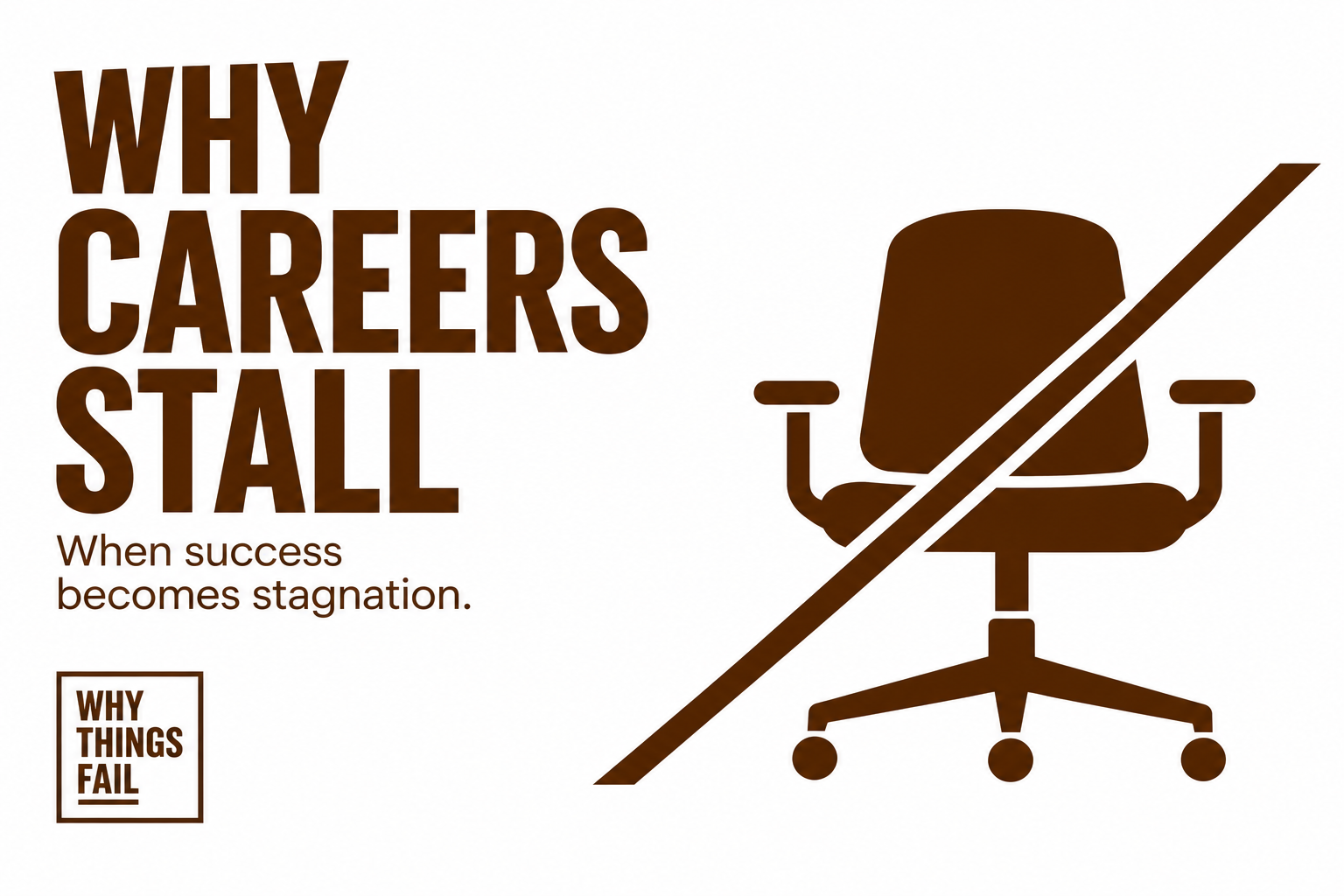
Career success is often treated as proof of ability. A promotion, a senior title, a strong reputation, a high salary or a visible leadership role can look like evidence that someone has “made it”. But careers do not fail only because people lack talent. Many fail after success has already arrived.
That is what makes this failure so difficult to understand. The person who once looked sharp, hungry and capable slowly becomes predictable, defensive or irrelevant. The skills that once created momentum stop creating advantage. The network that once opened doors begins to weaken. The judgement that once seemed confident starts to look rigid. From the outside, it appears sudden. In reality, it is usually gradual.
Career success does not last because the conditions that created it rarely stay the same.
What Is It?
Career success stops lasting when a person continues to rely on the same identity, skills, habits and reputation that produced earlier progress, even after the environment has changed.
This is not simply failure. It is a failure of renewal.
A successful person becomes attached to a version of themselves that once worked. They keep repeating old strengths in a new context. Over time, the market, organisation, technology, leadership expectations and workplace culture move on. The individual does not.
The Biggest Myth
The biggest myth is that career success lasts if you keep working hard.
Hard work matters, but it is not enough. Many people lose career momentum while working extremely hard. The problem is not effort. The problem is direction.
A person can be busy, loyal and experienced while becoming less valuable. They can work long hours while avoiding the uncomfortable learning that would keep them relevant. They can protect their reputation while quietly losing influence.
Success lasts only when people keep adapting the basis of their value.
What Usually Happens?
The pattern is familiar.
At first, someone builds success through competence. They solve problems, deliver results and gain trust. Their confidence grows. Their reputation improves. They receive more responsibility.
Then success changes the environment around them. Expectations rise. Their role becomes more political, strategic and visible. The skills required change. They are no longer judged only on personal output but on judgement, influence, adaptability and leadership.
Instead of changing with the role, many people repeat what made them successful before. They become busier, but not wiser. More senior, but less curious. More confident, but less open to feedback.
Eventually, their career plateaus. Sometimes it declines quietly. Sometimes it collapses after one visible mistake.
Why Does It Happen?
1. Success creates attachment to the past
Early success becomes part of identity. People do not simply think, “This method worked.” They begin to think, “This is who I am.”
That is dangerous. Once a behaviour becomes identity, changing it feels like personal defeat.
The technical expert struggles to become a leader. The high performer struggles to delegate. The loyal employee struggles to challenge the system. The confident manager struggles to admit uncertainty.
What once looked like strength becomes rigidity.
2. The workplace changes faster than self-image
Careers are built in moving systems. Industries change. Technology changes. Leadership standards change. Employees expect different communication. Organisations restructure. AI automates tasks. Younger colleagues bring new skills.
But people often update their CV faster than they update their thinking.
They still believe their old success gives them protection. It does not. Reputation can buy time, but it cannot permanently compensate for declining relevance.
3. Promotions change the job
Many careers stall after promotion because the person misunderstands what changed.
A promotion is not just more of the same work at a higher level. It often requires a different operating system.
The employee who was rewarded for execution must now prioritise judgement. The manager who was rewarded for control must now build trust. The specialist who was rewarded for answers must now ask better questions.
People fail when they treat a new level as a reward instead of a new test.
4. Feedback reduces as status increases
Successful people often receive less honest feedback.
Colleagues become careful. Juniors avoid disagreement. Leaders assume the person knows what they are doing. Poor decisions are softened, delayed or hidden.
This creates a dangerous silence around successful people. They hear applause longer than they should and warnings later than they need.
By the time the truth becomes visible, the behaviour has already hardened.
5. Ego disguises fear
Career stagnation is often presented as confidence, but underneath it is fear.
Fear of looking inexperienced. Fear of being replaced. Fear of losing authority. Fear of learning from younger colleagues. Fear of admitting that the old formula no longer works.
Ego protects the person from embarrassment in the short term, but it prevents learning in the long term.
This is why successful people sometimes reject the very advice that could save them.
6. Organisations reward yesterday’s results
Companies often help create the failure.
They promote people because of past performance, not future fit. They reward visible output more than learning. They tolerate poor leadership if targets are met. They celebrate experience without asking whether that experience is still useful.
This creates a culture where people are encouraged to defend their track record rather than update their capabilities.
The individual fails, but the system often trained them to fail.
7. Learning becomes optional
At the beginning of a career, learning is unavoidable. People know they are not finished. They ask questions, copy others, test ideas and accept correction.
Later, learning becomes optional. That is when danger begins.
Successful people can avoid discomfort. They can delegate unfamiliar work. They can dismiss new tools as trends. They can surround themselves with people who confirm their views.
The decline begins when learning stops feeling necessary.
Warning Signs
The warning signs are usually visible before the failure becomes obvious.
A person starts relying on phrases such as “This is how we have always done it.” They become irritated by new methods. They dismiss younger colleagues too quickly. They talk more about past achievements than current improvement. They avoid feedback. They become defensive in meetings. Their network stops expanding. Their judgement becomes slower. Their energy is consumed by protecting status rather than creating value.
These signs are ignored because the person still appears successful.
Their title remains impressive. Their past results are real. Their confidence sounds convincing. Their weaknesses are explained away as personality, pressure or seniority.
Success hides decline better than failure does.
What Could Have Prevented It?
Career success lasts longer when people build renewal into their professional life.
The first prevention is honest feedback. Not polite feedback. Useful feedback. Successful people need people around them who can say: “This is no longer working.”
The second prevention is deliberate learning. Not occasional reading or vague curiosity, but structured skill renewal. New technology, new management expectations, new communication habits and new industry realities must be studied before they become urgent.
The third prevention is identity flexibility. People must stop asking, “How do I protect what I have become?” and start asking, “What do I need to become next?”
The fourth prevention is better organisational design. Companies should not promote people and then leave them to rely on old instincts. Promotions should come with coaching, feedback loops, leadership training and clear expectations about what the next level actually requires.
The fifth prevention is humility. Not false modesty, but practical humility: the ability to believe that past success is useful evidence, not permanent proof.
Lessons
The first lesson is that success is temporary evidence, not permanent status.
The second lesson is that every career stage has different rules. What gets someone noticed early may limit them later.
The third lesson is that confidence must be updated with reality. Without feedback, confidence becomes theatre.
The fourth lesson is that learning is not a career phase. It is career maintenance.
The fifth lesson is that organisations should measure future readiness, not only past performance.
The sixth lesson is that reputation is not value. Reputation is what people remember. Value is what people still need.
Failure Pattern: Complacency Disguised as Confidence
The dominant failure pattern is complacency disguised as confidence.
This pattern appears repeatedly because success changes human behaviour. It reduces urgency. It increases pride. It makes people less curious. It surrounds them with confirmation. It encourages them to believe that what worked before will work again.
Complacency rarely feels lazy from the inside. It feels experienced. It feels sensible. It feels efficient. That is why it is dangerous.
The person does not think they are refusing to grow. They think they are relying on proven judgement.
Hidden Lesson
The hidden lesson is this:
Career success does not disappear because people forget how to work. It disappears because they confuse past value with present relevance.
A career is not protected by what someone achieved yesterday. It is protected by their ability to remain useful tomorrow.
Failure Scorecard
| Area | Score | Explanation |
| Leadership | 6/10 | Leadership often declines when people manage from authority rather than adaptability. |
| Self-awareness | 4/10 | The biggest weakness is usually the inability to see that old strengths have become limits. |
| Adaptability | 3/10 | Lack of adaptation is the central cause of career decline. |
| Communication | 5/10 | Communication often becomes defensive, status-driven or outdated. |
| Learning | 3/10 | Learning slows once success creates comfort. |
| Decision-making | 5/10 | Decisions become shaped by habit and ego rather than fresh evidence. |
| Emotional Intelligence | 5/10 | Fear, pride and insecurity often go unexamined. |
| Long-term Thinking | 4/10 | Short-term protection of status damages long-term relevance. |
Key Takeaways
- Career success is not permanent; it must be renewed.
- Past performance can become a trap when it blocks learning.
- Promotions require new behaviour, not just more effort.
- Feedback becomes more important as status increases.
- Ego often hides fear of becoming irrelevant.
- Organisations contribute when they reward old results without developing future capability.
- Hard work is not enough if the work is aimed in the wrong direction.
- The most dangerous career decline is the one hidden by reputation.
- Relevance matters more than experience.
- Success lasts only when people keep changing before they are forced to.
Conclusion
Career success does not usually end in one dramatic moment. It erodes quietly while the person still looks successful.
The title remains. The reputation remains. The confidence remains. But underneath, the connection between the person’s value and the world’s needs begins to weaken.
That is why career success does not last by itself. It has to be rebuilt, questioned and updated. The failure begins when someone believes achievement has made adaptation optional.