Introduction
Experience is one of the most respected currencies in professional life.
People trust experienced leaders. Employers pay for experienced candidates. Boards appoint experienced executives. Clients prefer experienced advisers. In most careers, experience is treated as proof: proof of competence, judgement, resilience and reliability.
But experience does not always produce success.
In fact, experience can quietly become one of the reasons people fail.
Not because experience is useless. It is not. Experience matters. It teaches patterns, consequences, timing, people and pressure. But experience becomes dangerous when it turns into certainty. When a person starts believing that what worked before will keep working. When past success becomes a defence against new learning. When judgement becomes habit. When confidence becomes blindness.
This is why experienced people sometimes lose to younger competitors. Why senior leaders make poor decisions. Why long-serving employees get overtaken. Why experts miss obvious shifts. Why careers stall after years of competence.
The failure is rarely a lack of experience. The failure is believing experience is enough.
What Is It?
“Experience doesn’t guarantee success” means that time spent doing something does not automatically create better judgement, better results or better leadership.
There is a difference between:
- having ten years of learning;
- and having one year of thinking repeated ten times.
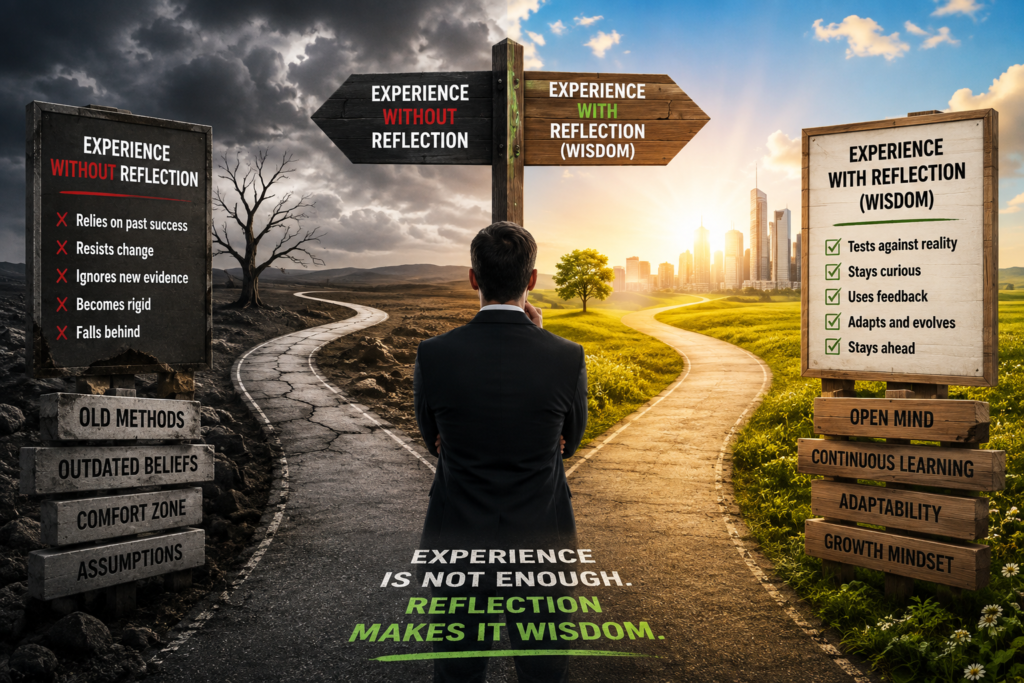
Experience only becomes valuable when it is examined, updated and tested against reality. Without reflection, experience becomes routine. Without humility, it becomes arrogance. Without adaptation, it becomes outdated.
This failure happens when professionals use the past as a map for a world that has changed.
The Biggest Myth
The biggest myth is that experience naturally leads to wisdom.
It does not.
Experience gives people exposure. Wisdom comes from interpretation.
Two people can go through the same ten years and come out completely different. One becomes sharper, calmer and more adaptable. The other becomes rigid, defensive and outdated.
The difference is not the number of years. It is the quality of learning inside those years.
| Aspect | Experience Without Reflection | Experience With Reflection (Wisdom) |
|---|---|---|
| Response to new evidence | Dismisses it as “just a trend” | Tests it against current reality |
| Source of confidence | Past success / memory | Current evidence + past pattern |
| Reaction to feedback | Feels threatened, defensive | Treats it as useful data |
| View of past methods | Fixed rule that always applies | One input among several |
| Curiosity level | Declines over time | Stays active, keeps asking “what changed?” |
| Outcome over time | Becomes rigid, resistant to change | Becomes sharper, more adaptable |
Experience can teach the wrong lesson. A leader who succeeded during a growing market may believe their strategy caused the success, when the market was doing most of the work. A manager who ruled through fear may believe fear creates performance, when employees were simply afraid to speak. A salesperson who once closed deals through relationships may ignore the fact that buyers now research, compare and decide differently.
Experience feels like evidence. But sometimes it is only memory.
What Usually Happens?
The pattern is usually slow.
A person builds a career through competence. They work hard. They gain trust. They become known for something. Their past decisions were rewarded. Their methods worked. Their confidence grows.
Then the environment changes.
Technology shifts. Customers behave differently. Younger employees expect different leadership. Markets move faster. Communication styles change. Old networks lose influence. New skills become important.
At first, the experienced person does not panic. They have survived change before. They assume this is just another cycle.
Then small signs appear.
Their advice becomes less relevant. Their team stops bringing new ideas. Their results flatten. Their language starts sounding dated. They dismiss new tools as hype. They rely more on authority than insight. They become irritated by people who question the old way.
Eventually, experience no longer creates advantage. It creates resistance.
The person has not suddenly become incompetent. They have become misaligned with reality.
Why Does It Happen?
1. Experience Creates Confidence Before It Creates Accuracy
Success changes how people think.
When a person has made good decisions in the past, they begin to trust their instincts. That trust is useful in familiar situations. Experienced people often move faster because they recognise patterns.
But the same confidence becomes dangerous when the situation is new.
The brain prefers familiar explanations. It sees today’s problem and searches yesterday’s memory. That is efficient, but not always accurate. The experienced person may think they are using judgement, when they are actually using pattern recognition from an old environment.
This is why experienced leaders sometimes misread disruption. They are not stupid. They are using intelligence shaped by a previous world.
Research on expertise supports this pattern. According to Dartmouth professor Sydney Finkelstein, deep expertise can quietly work against leaders in two specific ways: it reduces their curiosity about new developments in their field, and it inflates their confidence in solving problems outside their proven area, as discussed in a Harvard Business Review analysis on why expertise can undermine leadership. In other words, the very depth that once made someone valuable can become the reason they stop questioning themselves.
2. Past Success Becomes Personal Identity
Experience is not just professional. It becomes emotional.
People do not only say, “This method worked.” They begin to say, “This is who I am.”
A founder who built a business through instinct may resist data because instinct is part of their identity. A senior manager who rose through discipline may dismiss flexibility as weakness. A professional who succeeded through technical skill may resist leadership development because they see themselves as the expert, not the learner.
Once experience becomes identity, changing your mind feels like losing status.
That is when learning becomes threatening.
3. Organisations Reward Experience Even When It Stops Working
Many organisations confuse seniority with wisdom.
They promote people because they have been around longer. They listen to the loudest experienced voice in the room. They assume years equal judgement. They give decision-making power to people whose knowledge may no longer match the current environment.
This creates a dangerous culture.
Younger or newer employees see problems earlier but stay quiet. Middle managers avoid challenging senior leaders. Innovation gets filtered through old assumptions. The organisation becomes polite, slow and politically safe.
The experienced people are not always the problem. The system around them often protects their outdated thinking.
4. Experience Can Reduce Curiosity
Curiosity is strongest when people know they do not know.
Experience can weaken that feeling.
The more someone has seen, the easier it becomes to say, “I’ve seen this before.” Sometimes that is true. Often, it is only partly true.
The danger is not ignorance. The danger is premature certainty.
Experienced professionals may stop asking basic questions:
- What has changed?
- What are younger people seeing that I am missing?
- What evidence would prove me wrong?
- Is this still true?
- Am I solving today’s problem with yesterday’s answer?
When curiosity declines, experience stops expanding. It starts repeating itself.
5. The World Changes Faster Than Professional Habits
Experience is built slowly. Markets can change quickly.
A person may spend fifteen years mastering one model of work, only for technology, regulation, customer behaviour or culture to change the rules.
This is especially visible in leadership.
The old leadership model valued control, presence and command. The modern workplace values trust, clarity, emotional intelligence and adaptability. An experienced leader who still believes authority is enough may struggle to retain talent, even if they were once effective.
The problem is not that their experience was false. It is that it expired.
6. Ego Blocks Feedback
The more experienced someone becomes, the harder honest feedback can be to receive.
People around them may soften the truth. Junior staff may not challenge them. Peers may avoid conflict. Senior leaders may only hear what others think they want to hear.
This creates a feedback vacuum.
Without feedback, experience becomes self-confirming. The person keeps doing what they have always done because nobody tells them clearly that it is no longer working.
Failure often arrives after years of small truths being hidden.
7. Experience Can Create Over-Reliance on Instinct
Instinct is useful when conditions are stable. It is dangerous when conditions are changing.
Experienced people often say, “I know what works.” That may be true in familiar circumstances. But instinct is built from previous patterns. When the pattern changes, instinct can mislead.
This is why experienced investors miss new markets. Experienced retailers underestimate changing customers. Experienced managers misunderstand younger employees. Experienced professionals ignore new tools until they become unavoidable.
The problem is not instinct itself. The problem is instinct without evidence.
Warning Signs
Experience is becoming a weakness when:
- You rely on phrases like “this is how we’ve always done it.”
- You feel irritated by new ideas before examining them.
- Younger or less senior people stop challenging you.
- Your results are stable but no longer improving.
- You dismiss new tools, trends or behaviours as temporary.
- You talk more about what worked before than what is changing now.
- You avoid feedback from people outside your comfort zone.
- You confuse being respected with being right.
- You protect your reputation more than your learning.
- You feel threatened by people who learn faster than you.
These signs are often ignored because experience gives people social protection. Others assume the experienced person knows best. The experienced person assumes doubt is unnecessary. By the time the gap becomes visible, the damage may already be deep.
What Could Have Prevented It?
The solution is not to reject experience. It is to manage it properly.
1. Treat Experience as Evidence, Not Proof
Experience should start the conversation, not end it.
A good leader can say, “In the past, this worked. But what is different now?”
That single question protects experience from becoming arrogance.
2. Build Feedback Loops
Experienced people need honest feedback more, not less.
They should actively seek views from juniors, peers, customers and outsiders. Not performative feedback. Real feedback. The kind that shows where judgement is becoming outdated.
3. Keep Learning Close to the Work
Learning cannot be separate from performance.
The best professionals update their knowledge while doing the job. They test assumptions. They study new competitors. They observe younger behaviours. They use new tools. They stay close to the front line.
4. Separate Status From Being Right
In weak cultures, senior people must always appear correct.
In strong cultures, senior people can change their minds without losing authority.
This matters because people only adapt when they feel safe enough to admit that their old answer no longer works.
5. Use Mixed-Age, Mixed-Experience Decision-Making
Experience is powerful when combined with fresh observation.
The best decisions often come from a blend: senior judgement, current data, frontline truth and younger perspective.
Experience should provide depth. It should not silence reality.
Lessons
Experience is valuable only when it remains alive.
A career does not fail because someone grows older. It fails when they stop updating the mental model that made them successful.
The experienced professional must keep asking:
- What has changed?
- What am I assuming?
- Who sees this differently?
- What would I do if I were starting again?
- Where is my past success making me blind?
The greatest danger is not inexperience. Inexperience knows it must learn. The greater danger is outdated experience that believes it has nothing left to learn.
Failure Pattern
The dominant failure pattern is complacency disguised as expertise.
This pattern appears repeatedly because human beings naturally protect the knowledge that gave them status. Organisations reinforce it by rewarding seniority, avoiding uncomfortable conversations and mistaking confidence for competence.
Experience becomes dangerous when it stops being questioned.
The person still sounds credible. They still have stories. They still have authority. But their thinking is no longer being tested against reality.
That is how failure hides inside success.
Hidden Lesson
The hidden lesson is this:
Experience does not fail because the past was wrong. It fails because the past becomes too important.
The most successful people do not abandon experience. They keep it flexible. They respect what they have learned, but they do not worship it.
Experience should be a tool, not a prison.
Failure Scorecard
Leadership: 6/10
Experienced leaders may have authority, but authority can weaken if they stop listening.
Self-awareness: 4/10
The failure often begins when people cannot see how much their thinking has hardened.
Adaptability: 3/10
This is usually the weakest area. Old success creates resistance to new methods.
Communication: 6/10
Experienced people may communicate clearly, but not always openly. They may explain more than they listen.
Learning: 3/10
The biggest risk is believing learning is no longer urgent.
Decision-making: 5/10
Past judgement can help, but only when supported by current evidence.
Emotional Intelligence: 5/10
Ego, pride and fear of losing status often block growth.
Long-term Thinking: 6/10
Experienced people may understand consequences, but still underestimate slow change.
Key Takeaways
- Experience is valuable, but only when it is regularly updated.
- Past success can create false confidence.
- Seniority should not be confused with wisdom.
- The most dangerous phrase is “I already know.”
- Feedback becomes more important as people become more experienced.
- Organisations fail when they protect outdated authority.
- Curiosity is what keeps experience useful.
- Instinct must be tested against current evidence.
- A strong career requires learning after success, not only before it.
- Experience should guide judgement, not replace thinking.
Conclusion
Experience does not guarantee success because the world does not reward time served. It rewards judgement that still fits reality.
The experienced person fails when they mistake memory for insight, confidence for accuracy and seniority for relevance.
This is why careers stall, leaders lose influence and organisations miss change they should have seen coming.
The tragedy is that experience often contains the knowledge needed to succeed. But if it becomes rigid, defensive or proud, it stops being wisdom and becomes weight.
The real test of experience is not how much someone has seen.
It is whether they are still willing to see clearly.