Introduction
Many employees do not fail because they lack intelligence, work ethic or ambition. They fail because they become trapped inside a role, a reputation, a routine or an organisation that slowly stops developing them.
Being stuck at work is rarely dramatic. There is usually no single collapse, no public mistake, no obvious turning point. Instead, progress slows quietly. The employee keeps attending meetings, completing tasks and receiving acceptable feedback, but their career stops moving. Months become years. Their skills become familiar rather than valuable. Their confidence weakens. Their name remains known, but not necessarily associated with growth, leadership or future potential.
This is why employees getting stuck is one of the most common career failures. It is not always caused by laziness. Often it is caused by a system where comfort is rewarded, risk is discouraged, managers avoid honest conversations and employees mistake being busy for moving forward.
The failure is not that someone stops working. The failure is that they stop evolving.
What Is It?
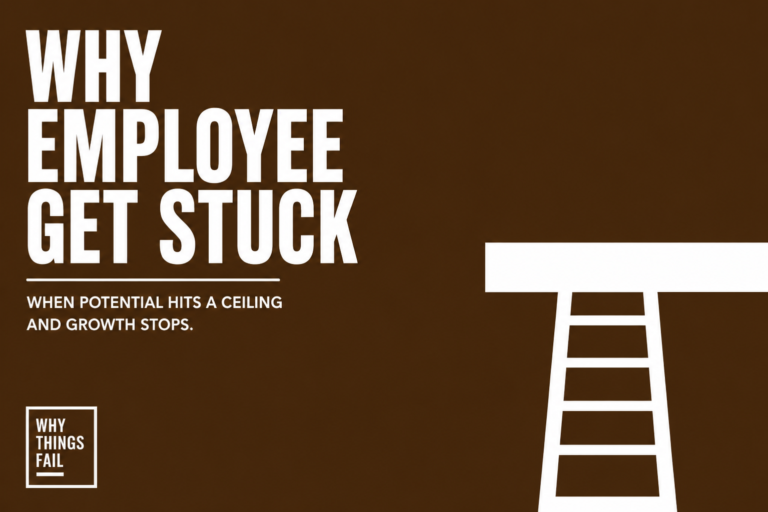
An employee gets stuck when their role, skills, influence and career prospects stop progressing for a long period of time.
They may still be employed. They may even be reliable. But they are no longer growing in meaningful ways. They repeat the same tasks, solve the same problems and operate at the same level while the organisation, industry and labour market move on.
Being stuck can appear in several ways:
An employee stays in the same role for years without promotion.
They become known only for one narrow skill.
They are trusted with work, but not with responsibility.
They are useful to the organisation, but not seen as future leadership material.
They feel busy every day, but their market value is quietly declining.
This is the uncomfortable truth: an employee can be dependable and still become professionally invisible.
The Biggest Myth
The biggest myth is that employees get stuck because they are not good enough.
Sometimes that is true. But often, people get stuck because they are good enough to be useful, but not visible enough to be promoted.
Organisations often depend on reliable people. These employees know the systems, remember the history, fix recurring problems and keep operations moving. But reliability can become a trap. The better someone becomes at doing their current job, the more the organisation may want them to stay exactly where they are.
The employee thinks, “If I keep doing good work, someone will notice.”
But organisations do not always reward quiet competence. They reward perceived value, strategic relevance, visibility, relationships, timing and leadership potential.
Good work matters. But good work alone does not guarantee movement.
What Usually Happens?
The pattern usually begins with stability.
An employee joins a company or role and works hard. They learn quickly, build trust and become dependable. Their manager relies on them. Colleagues come to them for help. They gain confidence.
Then the role becomes familiar. The work still feels important, but it no longer stretches them. They become efficient, but not challenged. Their learning slows. They stop asking difficult questions. They avoid internal politics. They wait for recognition.
At some point, the organisation begins to see them in a fixed way. They are “the operations person”, “the admin person”, “the technical person”, “the safe pair of hands”. Their identity becomes attached to their current usefulness.
When new opportunities appear, leadership looks elsewhere. Not because the stuck employee is bad, but because nobody imagines them differently.
That is how careers stall: first in the mind of the employee, then in the mind of the organisation.
Why Does It Happen?
1. Employees confuse activity with progress
Many stuck employees are busy. That is part of the problem.
Busy work creates the feeling of movement. Emails are answered. Tasks are completed. Meetings are attended. Problems are handled. But career progress is not measured by how tired someone feels at the end of the day.
Progress comes from increasing value. That may mean learning harder skills, solving bigger problems, improving judgement, leading others, influencing decisions or becoming useful at a more strategic level.
The stuck employee often asks, “Why am I not moving forward when I work so hard?”
The better question is: “Is my work increasing my future value, or only maintaining my current usefulness?”
2. Managers keep strong employees where they are
A weak manager may avoid developing a strong employee because that employee makes the manager’s life easier.
If someone is reliable, experienced and low-maintenance, moving them creates risk. The manager may lose stability. A gap may open in the team. Training someone else takes time. So the employee remains in place.
This is not always malicious. Often it is simply short-term thinking. The organisation protects today’s performance at the cost of tomorrow’s talent.
The employee becomes trapped by their own competence.
3. The employee has no clear career strategy
Many people work hard without a career strategy.
They know they want “growth”, “promotion” or “better opportunities”, but they cannot clearly explain what kind of role they want next, what skills they need, who must trust them, or what evidence would prove they are ready.
Without a strategy, careers become dependent on luck and other people’s decisions.
A stuck employee often waits for someone to open a door. A growing employee learns which door matters, who controls it and what must be demonstrated before it opens.
4. Organisations reward visibility, not just contribution
This is uncomfortable, but true.
In many workplaces, the people who progress are not always the people who contribute the most. They are often the people whose contribution is seen, understood and connected to organisational priorities.
A quiet employee may solve important problems, but if senior leaders never hear about those problems, the work does not shape perception.
Visibility is not the same as arrogance. It means making value legible.
Employees get stuck when their work is real but invisible.
5. Fear keeps people in familiar roles
Many employees say they want growth, but avoid the discomfort that growth requires.
They avoid applying for internal roles because rejection would hurt.
They avoid difficult conversations because they fear seeming ambitious.
They avoid learning new skills because being a beginner feels embarrassing.
They avoid leaving because uncertainty feels more dangerous than dissatisfaction.
Over time, fear disguises itself as patience. The employee tells themselves they are waiting for the right time. But often they are waiting for risk to disappear.
It never does.
6. Identity becomes fixed
People get stuck when they believe the story the organisation tells about them.
If someone has always been treated as a support person, they may stop imagining themselves as a leader. If they have always been given operational work, they may stop asking for strategic work. If they have always been overlooked, they may begin to behave like someone who expects to be overlooked.
This is how external labels become internal limits.
The organisation may put someone in a box. But the deeper failure happens when the employee starts decorating the box.
7. Feedback is too polite to be useful
Many workplaces avoid honest feedback.
Managers say, “You’re doing well,” when they mean, “You are reliable, but not ready for the next level.”
They say, “Keep doing what you’re doing,” when the employee actually needs to change.
They say, “We’ll see what happens,” when there is no real plan.
Polite feedback protects feelings in the short term, but damages careers in the long term. The employee remains unaware of the real barrier.
They may need stronger communication, better commercial understanding, more confidence, greater technical depth or improved stakeholder management. But nobody says it clearly.
So they continue performing well at the wrong level.
8. Office politics decide opportunity
Employees often dislike office politics, but ignoring politics does not make it disappear.
Every organisation has informal power. Decisions are influenced by trust, relationships, reputation and timing. Employees who refuse to understand this often become frustrated when less capable people move ahead.
Politics becomes toxic when it rewards manipulation. But influence itself is not toxic. It is part of organisational life.
A stuck employee may believe their work should speak for itself. In reality, work often needs translation. Someone must connect it to priorities, explain its value and build trust around it.
Those who do not manage perception may be managed by someone else’s perception of them.
9. Skills become outdated quietly
Employees rarely become obsolete overnight.
The decline is gradual. A tool changes. A process is automated. A new generation enters with different skills. Customers expect faster service. Data becomes more important. AI changes workflows. Communication standards rise.
The employee who was once strong becomes average because the standard around them has changed.
This is especially dangerous because past competence creates false security. The employee thinks, “I have experience.”
But experience only remains valuable when it is updated.
Old experience plus no learning becomes nostalgia.
10. The organisation has no development culture
Some employees are stuck because the organisation itself is poorly designed.
There are no clear progression routes. Promotions are political. Managers are not trained to develop people. Internal hiring is weak. Performance reviews are vague. Learning budgets exist on paper but not in practice.
In such environments, ambitious employees either leave or shrink.
The organisation may say it values talent, but its systems tell a different story. If people cannot see a future, they eventually stop building one inside the company.
Warning Signs
The first warning sign is repetition without growth. The employee is doing more work, but not more advanced work.
The second is vague praise. Being told “you are doing a great job” without any discussion of next steps is often a sign of career stagnation.
The third is exclusion from important conversations. If decisions happen elsewhere and the employee only receives instructions afterwards, their influence is limited.
The fourth is emotional flatness. The employee is not failing, but they are no longer curious, challenged or energised.
The fifth is resentment. When someone starts saying, “They never recognise me,” it may be true — but it may also mean they have outsourced their career progress to other people.
These signs are often ignored because nothing looks urgent. The employee still has a job. The salary still arrives. The work still gets done.
Stagnation is dangerous because it feels stable before it becomes costly.
What Could Have Prevented It?
The prevention is not dramatic. It requires clearer conversations, better systems and more ownership.
Employees need to ask direct questions earlier:
What would I need to demonstrate to be considered for the next level?
What skill gap is currently limiting me?
How am I perceived by senior people?
What work would increase my value, not just my workload?
Managers need to stop using good employees only as operational support. They must create stretch assignments, honest feedback and visible pathways.
Organisations need to build systems where development is not dependent on one generous manager. Career progression should be discussed, documented and reviewed.
The employee also has responsibility. They must not wait passively to be discovered. They must learn, communicate value, build relationships and make deliberate moves before frustration turns into bitterness.
The realistic prevention is simple: do not allow usefulness today to destroy growth tomorrow.
Lessons
The first lesson is that career progress is not automatic. Time served does not equal value created.
The second lesson is that competence can become a trap when it makes someone too useful in their current position.
The third lesson is that employees need visibility, not vanity. Quiet work may be noble, but invisible value is rarely rewarded.
The fourth lesson is that managers can damage careers by avoiding honest feedback. Kindness without clarity is not kindness.
The fifth lesson is that learning must continue before it becomes urgent. Waiting until skills are outdated is waiting too long.
The sixth lesson is that organisations lose talent slowly before they lose it officially. Employees mentally leave long before they resign.
Failure Pattern
The dominant failure pattern is complacency disguised as loyalty.
The employee stays because they are comfortable, needed or afraid to move. The manager keeps them because they are useful. The organisation benefits from their reliability but fails to develop their future value.
Everyone has a reason to maintain the situation.
That is why the pattern repeats across industries. Stability serves the short-term interests of the system. The employee gets predictability. The manager gets reliability. The organisation gets continuity.
But over time, the cost grows. The employee loses momentum. The manager loses future leadership talent. The organisation loses adaptability.
A career does not get stuck because nothing is happening. It gets stuck because the same thing keeps happening for too long.
Hidden Lesson
The hidden lesson is this:
Employees do not only get stuck when they fail. They often get stuck when they become too successful at the wrong level.
This is the deeper truth. Many people are not trapped by weakness. They are trapped by being useful in a role that no longer develops them.
The system rewards them for staying the same. Then years later, it judges them for not changing.
Failure Scorecard
Leadership: 6/10
Leadership often notices performance but fails to create development. Managers keep people productive, but not always progressing.
Self-awareness: 5/10
Many stuck employees sense dissatisfaction but do not clearly diagnose the cause. They know something is wrong, but not what must change.
Adaptability: 5/10
The employee may be capable of change, but comfort and routine weaken adaptability over time.
Communication: 6/10
Career expectations are often assumed rather than discussed. Employees wait; managers avoid direct conversations.
Learning: 4/10
This is usually the weakest area. Once the role becomes familiar, learning becomes optional — and then neglected.
Decision-making: 6/10
The problem is not one bad decision, but repeated non-decisions: not applying, not asking, not learning, not leaving.
Emotional Intelligence: 6/10
Employees may misread workplace signals, avoid politics or allow resentment to replace strategy.
Long-term Thinking: 4/10
Short-term comfort often wins. The employee, manager and organisation all delay difficult decisions.
Key Takeaways
Employees get stuck when they remain useful but stop growing.
Hard work does not guarantee progression unless it increases value.
Reliability can become a career trap.
Managers often keep strong employees in place because it protects short-term performance.
Visibility matters because unseen value rarely influences promotion decisions.
Polite feedback can be more damaging than honest criticism.
Skills decline quietly when learning stops.
Office politics cannot be avoided; they must be understood without becoming manipulative.
A career strategy is more powerful than waiting to be recognised.
The biggest danger is staying too long in a role that rewards who you were, not who you could become.
Conclusion
Employees getting stuck is not usually a story of sudden failure. It is a story of slow professional narrowing.
The employee becomes known for what they already do. The manager becomes dependent on that usefulness. The organisation allows stability to replace development. Everyone benefits in the short term, until the employee’s growth, confidence and future value begin to decline.
The tragedy is that stuck employees often look successful from the outside. They are employed, trusted and busy. But beneath the surface, their career has stopped compounding.
That is why this failure is so easy to miss. It does not announce itself as failure. It arrives quietly, dressed as routine.