Introduction
Few human behaviours are more confusing than self-sabotage.
People spend years pursuing a goal building a business, improving their health, finding a meaningful relationship or advancing their career only to undermine their own progress just as success appears within reach. They procrastinate before important deadlines, avoid opportunities, damage relationships, ignore good advice, abandon healthy habits and repeatedly make decisions they later regret.
To outside observers, these actions appear irrational. Why would someone knowingly make life harder for themselves?
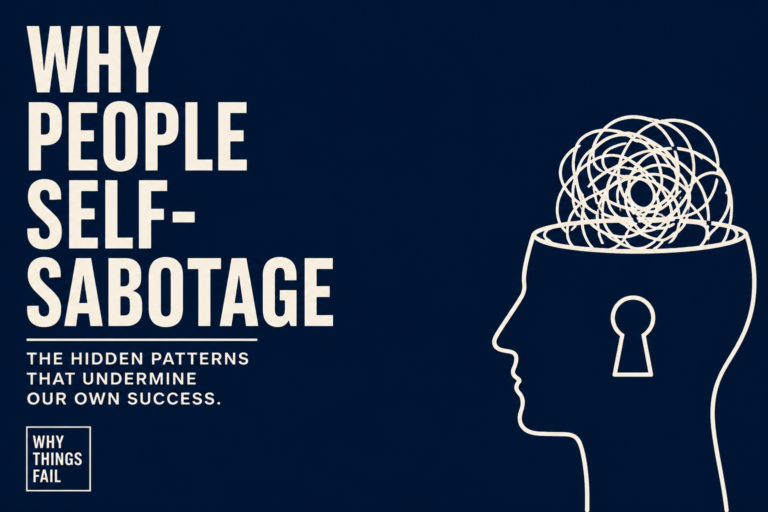
The answer is that self-sabotage is rarely a conscious decision. Most people do not wake up intending to fail. Instead, self-sabotage emerges from a conflict between conscious goals and unconscious beliefs. One part of the mind seeks growth, while another seeks safety, familiarity and emotional protection.
This is why self-sabotage appears across every area of life. Entrepreneurs delay launching businesses. Students avoid studying until the last minute. Athletes neglect training before major competitions. Employees refuse promotions. People leave healthy relationships for unhealthy ones.
The behaviour changes, but the underlying pattern remains remarkably consistent.
Understanding self-sabotage requires looking beyond individual mistakes. It requires investigating the psychological systems that make failure predictable long before it becomes visible.
What Is Self-Sabotage?
Self-sabotage is behaviour that interferes with a person’s own long-term goals.
Importantly, it is not simply making mistakes. Everyone makes mistakes. Self-sabotage involves repeatedly acting against one’s own interests despite knowing better.
Common examples include:
- Chronic procrastination
- Perfectionism
- Fear of making decisions
- Avoiding opportunities
- Overspending despite financial goals
- Returning to unhealthy relationships
- Ignoring health advice
- Giving up shortly before success
These behaviours often appear unrelated, yet they share one feature: they reduce short-term discomfort while increasing long-term pain.
The brain often prioritises immediate emotional relief over future success.
The Biggest Myth
The biggest myth is that people sabotage themselves because they are lazy.
Laziness is often an oversimplified explanation for behaviour that has deeper psychological roots.
Many people who procrastinate are exceptionally hardworking in other areas.
Many perfectionists work longer than anyone else.
Many anxious people spend enormous amounts of mental energy worrying about failure.
The issue is not a lack of effort.
It is that effort is directed towards avoiding emotional discomfort rather than achieving meaningful progress.
Self-sabotage is usually a protection strategy—not a motivation problem.
What Happens?
Self-sabotage usually follows a predictable sequence.
First, a meaningful opportunity appears.
This could be a new job, a business opportunity, an exam, a relationship or a major life change.
Initially, motivation is high.
However, as success becomes increasingly possible, anxiety begins to rise.
Questions emerge:
“What if I fail?”
“What if I succeed and cannot maintain it?”
“What will people expect from me?”
“What if everything changes?”
To reduce these uncomfortable emotions, the individual delays action.
Temporary relief follows.
Unfortunately, deadlines become tighter.
Stress increases.
Performance declines.
Failure becomes more likely.
The eventual failure appears to confirm existing negative beliefs.
“I knew I wasn’t good enough.”
This reinforces the cycle, making future self-sabotage even more likely.
Why Does Self-Sabotage Happen?
Self-sabotage rarely has a single cause.
It usually results from several psychological systems interacting.
Fear of Failure
Failure threatens self-esteem.
If success requires genuine effort, failure becomes deeply personal.
Some people unconsciously avoid trying fully because partial effort provides an excuse.
“If I had really tried, I would have succeeded.”
This protects identity.
Ironically, protecting self-esteem often destroys achievement.
Fear of Success
Success creates new pressures.
Higher expectations.
Greater responsibility.
More visibility.
More competition.
Some individuals unconsciously associate success with stress, criticism or loneliness.
Remaining where they are feels emotionally safer than moving forward.
Low Self-Worth
People often behave in ways consistent with their beliefs about themselves.
If someone fundamentally believes they are undeserving of happiness or success, they may unconsciously reject opportunities that contradict this identity.
External success struggles to survive when internal beliefs reject it.
Familiarity Feels Safe
The brain values familiarity more than happiness.
Even painful situations become psychologically comfortable if they are predictable.
Someone raised in unstable relationships may unconsciously recreate similar dynamics because uncertainty feels more threatening than dysfunction.
People often choose familiar pain over unfamiliar growth.
Cognitive Dissonance
Humans seek consistency.
When actions conflict with beliefs, psychological discomfort emerges.
If someone believes they are incapable of success but begins succeeding, this creates tension.
One way to reduce the discomfort is to change beliefs.
Another is to destroy the success.
Many unknowingly choose the second option because changing identity feels harder.
Instant Gratification
The human brain evolved for immediate survival rather than long-term planning.
Social media.
Junk food.
Online shopping.
Entertainment.
These provide immediate rewards.
Long-term goals often require delayed gratification.
The conflict between short-term pleasure and long-term benefit explains much everyday self-sabotage.
Stress and Decision Fatigue
Under chronic stress, the brain shifts towards short-term thinking.
Planning declines.
Impulse control weakens.
Habits dominate.
Poor decisions become increasingly likely.
This explains why self-sabotage often increases during periods of exhaustion or burnout.
Warning Signs
Self-sabotage rarely appears suddenly.
It usually begins with subtle behaviours.
Common warning signs include:
- Constant procrastination despite clear goals
- Waiting for the “perfect” moment
- Setting unrealistic standards
- Frequently changing plans
- Avoiding feedback
- Giving excuses before trying
- Abandoning projects close to completion
- Repeating identical mistakes
- Negative self-talk
- Believing success belongs to others
The earlier these signs are recognised, the easier the cycle becomes to interrupt.
What Could Have Prevented It?
Breaking self-sabotage requires addressing causes rather than symptoms.
Clear systems reduce reliance on motivation.
Small consistent actions outperform occasional bursts of enthusiasm.
Developing realistic self-awareness helps identify distorted thinking.
Learning emotional regulation reduces avoidance.
Replacing perfectionism with progress encourages action.
Building supportive environments increases accountability.
Most importantly, individuals must recognise that discomfort often signals growth rather than danger.
The goal is not eliminating fear.
It is learning to act despite fear.
Lessons
Self-sabotage teaches several important lessons.
First, knowledge alone does not change behaviour.
Most people already know what they should do.
The challenge lies in acting consistently.
Second, emotions frequently outweigh logic.
People rarely make purely rational decisions.
Third, identity drives behaviour.
Changing habits without changing underlying beliefs often produces only temporary improvements.
Finally, success depends less on avoiding mistakes than on recovering quickly after them.
Failure Pattern
Self-sabotage follows a recurring pattern across careers, businesses, relationships and personal development.
Opportunity appears.
Anxiety increases.
Avoidance begins.
Temporary relief follows.
Performance declines.
Failure occurs.
Negative beliefs strengthen.
The next opportunity triggers the same cycle.
This pattern repeats because each failure appears to validate the beliefs that caused it in the first place.
Unless those beliefs are challenged, behaviour rarely changes.
Hidden Lesson
Perhaps the most surprising insight is that self-sabotage is often an attempt at self-protection.
The brain is not trying to destroy success.
It is trying to avoid perceived danger.
Unfortunately, many psychological dangers exist only in imagination rather than reality.
The systems designed to protect us from emotional pain can become the very systems preventing growth.
Growth often requires convincing the brain that progress is safer than remaining stuck.
Failure Scorecard
| Factor | Score (1–10) | Explanation |
| Fear of Failure | 10 | One of the strongest drivers of avoidance behaviour. |
| Low Self-Worth | 9 | Deep beliefs strongly influence long-term behaviour. |
| Fear of Success | 8 | Less obvious but highly influential. |
| Perfectionism | 8 | Delays progress indefinitely. |
| Instant Gratification | 9 | Constantly competes with long-term goals. |
| Stress | 8 | Reduces self-control and planning. |
| Poor Self-Awareness | 9 | Prevents recognition of destructive patterns. |
Key Takeaways
- Self-sabotage is rarely intentional.
- People often seek emotional safety over long-term success.
- Fear of failure and fear of success can produce similar behaviours.
- Identity influences behaviour more than motivation.
- Familiarity often feels safer than improvement.
- Small repeated actions change behaviour more effectively than sudden motivation.
- Awareness is the first step towards breaking destructive patterns.
Conclusion
Self-sabotage is not evidence that people want to fail. It is evidence that the human mind is designed to prioritise survival over achievement.
Throughout history, avoiding uncertainty often increased the chances of survival. In modern life, however, the same protective mechanisms can become obstacles. The fear that once kept people safe may now prevent them from applying for a job, starting a business, ending a harmful relationship or pursuing an ambitious goal.
The tragedy of self-sabotage is that it often disguises itself as caution, perfectionism or waiting for the right moment. In reality, these behaviours quietly reinforce the very outcomes people hope to avoid.
The encouraging truth is that self-sabotage is not an unchangeable personality trait. It is a learned pattern. Patterns can be recognised, questioned and replaced.
The most successful people are not those who never experience fear or self-doubt. They are those who recognise these internal forces, understand why they exist and choose to act anyway.
Failure becomes predictable when unconscious patterns remain invisible. Once those patterns are understood, success becomes far more than luck it becomes a deliberate and repeatable choice.