Introduction
Success feels like proof.
When a person, business, leader, product or system succeeds, it creates a powerful belief: we were right. The decisions worked. The strategy worked. The instincts worked. The habits worked. The people in charge were competent. The model was strong. The market approved.
But this is where failure often begins.
Success does not usually destroy people immediately. It does something more dangerous. It quietly changes how they think. It reduces doubt. It rewards repetition. It protects bad assumptions. It makes warning signs easier to dismiss. It turns yesterday’s strengths into tomorrow’s weaknesses.
Many failures do not happen because people never succeeded. They happen because people succeeded for long enough to stop questioning why.
This is the paradox of success: the very thing that builds confidence can also create blindness.
What Is It?
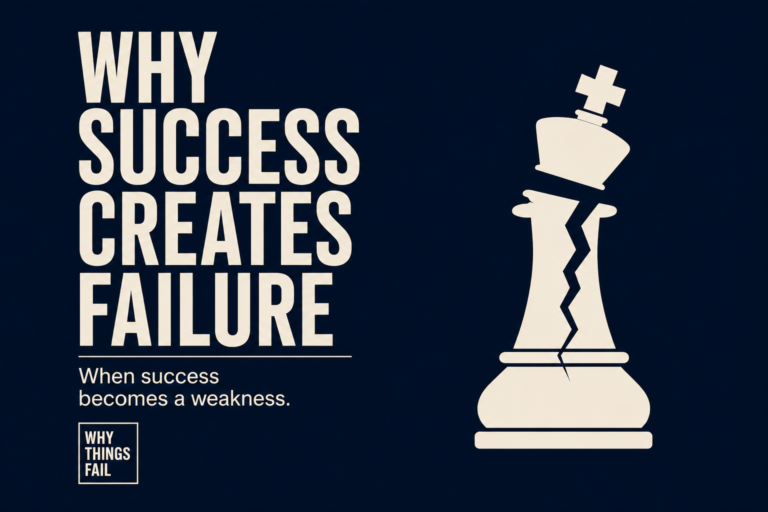
Success-created failure is the process where achievement produces the conditions for future decline.
It happens when success leads to overconfidence, complacency, rigid thinking, inflated ego, weak feedback, poor risk awareness and resistance to change.
At the beginning, success creates energy. People work harder, take bold action, attract attention and build momentum. But over time, success can create a psychological trap. People begin to believe the result proves the method will always work.
They stop asking:
Why did this work?
What has changed?
Are we still right?
What are we missing?
This is not only a business problem. It happens in careers, relationships, politics, sport, leadership and personal life. The student who was naturally gifted stops studying properly. The company with a winning product stops listening to customers. The leader who was once decisive becomes arrogant. The professional who gets promoted stops learning. The investor who wins early starts believing they are smarter than risk.
Success becomes dangerous when it turns into identity.
The Biggest Myth
The biggest myth is that success makes people wiser.
Sometimes it does. But often, success makes people more certain.
Failure forces reflection because it hurts. Success often avoids reflection because it feels like confirmation. When things go well, people rarely investigate their own assumptions. They celebrate the outcome and move forward.
This creates a problem: success is not always caused by skill.
Sometimes success comes from timing, luck, weak competition, market conditions, inherited advantage, temporary demand, or one unusually good decision. But the human mind prefers a cleaner story. It wants to believe: “We succeeded because we are good.”
That belief can become the first step towards failure.
The danger is not confidence itself. Confidence is useful. The danger is unexamined confidence — confidence without evidence, humility or feedback.
What Happened?
The pattern is common.
A person or organisation achieves success. At first, the success is real. There is growth, praise, money, recognition or influence. The winning formula becomes clear. People copy it. Systems are built around it. The culture starts rewarding the same behaviours again and again.
Then the environment changes.
Customers change. Competitors improve. Technology shifts. Costs rise. Attention moves elsewhere. The original formula becomes less effective.
But the successful person or organisation does not adapt quickly enough.
Why?
Because the old model has emotional power. It is not just a strategy anymore. It is proof of identity. Changing it feels like admitting the past was wrong. Leaders defend it. Teams repeat it. Warning signs are explained away.
Eventually, the gap between reality and belief becomes too large. Performance drops. Reputation weakens. Money is lost. Trust declines. People finally accept what the warning signs were already saying.
By then, the failure looks sudden.
But it was not sudden. It was built slowly by success that stopped learning.
Why Did It Happen?
Success creates failure because it changes behaviour before people notice.
The first cause is overconfidence. When something works, people naturally assume they understand why. They become more comfortable making decisions with less evidence. They take bigger risks because past outcomes made them feel protected.
The second cause is repetition. Success teaches people to repeat what worked before. This is logical at first. But repetition becomes dangerous when the world changes. A method that once solved a problem can later become the problem.
The third cause is weak feedback. Successful people often receive less honest criticism. Employees become afraid to challenge leaders. Friends soften their words. Customers leave quietly. Teams report good news upwards and hide bad news. The more powerful success becomes, the harder truth becomes to hear.
The fourth cause is identity protection. Once success becomes part of someone’s identity, criticism feels personal. A business model is no longer just a model. A leadership style is no longer just a style. A product is no longer just a product. It becomes “who we are”. This makes adaptation emotionally difficult.
The fifth cause is incentive distortion. Success brings rewards, status and comfort. People become motivated to protect what already exists rather than question it. Leaders may avoid hard decisions because short-term numbers look good. Teams may avoid innovation because the old system still pays them.
The sixth cause is loss of hunger. Early success often comes from urgency. People are alert, curious and willing to work harder. Later success can create comfort. The organisation becomes slower. The individual becomes less disciplined. The sharpness that created success begins to fade.
The seventh cause is selective memory. People remember the decisions that worked and forget the uncertainty, luck and mistakes around them. The past becomes simplified into a heroic story. This false story then becomes the guide for future decisions.
The deeper issue is that success often removes the very pressure that created it.
When people are struggling, they are forced to observe reality closely. When they are winning, they can afford to ignore it — for a while.
That “for a while” is where failure grows.
Warning Signs
The warning signs are usually visible before the failure happens.
The first warning sign is when people say, “This is how we have always done it.” That sentence often signals that habit has replaced thinking.
The second warning sign is when criticism disappears. Healthy success still attracts challenge. Dangerous success creates silence.
The third warning sign is when past results are used as proof against present concerns. People say, “It worked before,” instead of asking whether it still works now.
The fourth warning sign is when leaders stop being curious. They talk more than they listen. They defend more than they investigate.
The fifth warning sign is when small failures are explained away instead of studied. A lost customer, missed target, weak product review or unhappy employee becomes “not a big issue” rather than useful evidence.
The sixth warning sign is when success becomes entitlement. People begin to expect loyalty, attention, promotion, profit or respect without continuing to earn it.
What Could Have Prevented It?
Success-created failure can be prevented, but only if success is treated as evidence to examine, not proof of permanent superiority.
The first prevention is disciplined reflection. After success, people should ask: what exactly caused this result? What part was skill? What part was timing? What part was luck? What part may not repeat?
The second prevention is honest feedback. Successful people need systems that protect truth. This means encouraging challenge, listening to complaints, measuring reality and rewarding people who raise uncomfortable issues early.
The third prevention is controlled reinvention. The goal is not to abandon what works. The goal is to keep testing whether it still works. Strong systems evolve before they are forced to.
The fourth prevention is humility. Humility does not mean weakness. It means remembering that success is temporary unless it keeps adapting.
The fifth prevention is separating identity from method. A person or organisation must be able to say: “This worked before, but we are not emotionally attached to it.”
The sixth prevention is keeping beginner behaviour. Beginners ask questions. Beginners learn. Beginners pay attention. The most durable successful people keep some beginner habits even after they become experts.
Lessons
The main lesson is that success should increase responsibility, not reduce awareness.
The more successful something becomes, the more carefully it must be examined. Growth creates complexity. Recognition creates ego. Profit creates comfort. Status creates distance from reality.
Success is not the end of risk. It is a new type of risk.
The second lesson is that failure often begins when learning stops. People do not fail only because they make bad decisions. They fail because they keep making old decisions in a new environment.
The third lesson is that confidence needs correction. Without correction, confidence becomes arrogance.
The fourth lesson is that success should be questioned more than failure. Failure automatically demands attention. Success quietly asks to be trusted. That is why it can be more dangerous.
Failure Pattern
The failure pattern is simple:
Success creates confidence.
Confidence creates repetition.
Repetition creates rigidity.
Rigidity ignores change.
Ignored change creates decline.
Decline is denied.
Denial delays action.
Delayed action turns a manageable problem into failure.
This pattern repeats because it feels rational at every stage. Repeating what worked seems sensible. Trusting successful leaders seems reasonable. Protecting a profitable model seems responsible.
But failure often hides inside reasonable behaviour continued for too long.
Hidden Lesson
The hidden lesson is that success does not test character as clearly as failure does. It tests something quieter: humility.
Failure asks, “Can you recover?”
Success asks, “Can you stay honest?”
That is harder than it sounds.
When people are praised, promoted, funded, followed or rewarded, they naturally want to believe the story. They want to believe they earned it completely. They want to believe their judgement is special.
But long-term success belongs to those who keep questioning their own success.
The strongest people and organisations do not simply win. They investigate why they won — and whether the reasons still apply.
Failure Scorecard
Overconfidence: 9/10
Success strongly increases the risk of overconfidence because it makes people feel validated.
Resistance to change: 8/10
The more successful a method has been, the harder it becomes to abandon or update.
Weak feedback: 8/10
Success often reduces honest criticism because people become afraid to challenge winners.
Complacency: 9/10
Comfort is one of the most common side effects of success.
Warning signs ignored: 8/10
Early signals are often dismissed because they conflict with the success story.
Preventability: 7/10
This failure pattern is preventable, but only with humility, feedback and disciplined self-review.
Repeat risk: 10/10
This pattern repeats constantly because human beings naturally trust what has rewarded them before.
Key Takeaways
Success can create failure when it produces overconfidence, complacency and rigid thinking.
The biggest danger is not success itself, but the belief that past success guarantees future correctness.
Many failures begin when people stop asking why their success happened.
Warning signs are often ignored because they threaten identity, status and comfort.
The best protection is humility, honest feedback and continuous adaptation.
Conclusion
Success is one of the most misunderstood causes of failure.
People usually look for failure in weakness, incompetence or bad luck. But some failures are born from strength. A winning product. A strong reputation. A confident leader. A profitable model. A proven habit.
These things can create progress. But they can also create blindness.
Success becomes dangerous when it stops being studied. It becomes dangerous when people treat it as proof instead of information. It becomes dangerous when confidence replaces curiosity.
The real lesson is not to fear success. It is to manage it.
Success should make people more alert, not less. It should create better questions, not fewer. It should increase humility, not ego.
Because failure often does not begin when things go wrong.
It begins when things go right for so long that people stop paying attention.