Introduction
Difficult decisions rarely fail because people do not know they matter. They fail because people know they matter too much.
A hard decision carries weight. It threatens comfort, identity, relationships, reputation, money, status or certainty. It may force someone to disappoint others, admit a mistake, close a door, confront a problem or accept responsibility for an outcome that cannot be fully guaranteed.
So people delay.
They ask for more information. They wait for a better time. They hope circumstances will make the choice for them. They tell themselves they are being careful, patient or strategic. Sometimes they are. But often, avoidance disguises itself as wisdom.
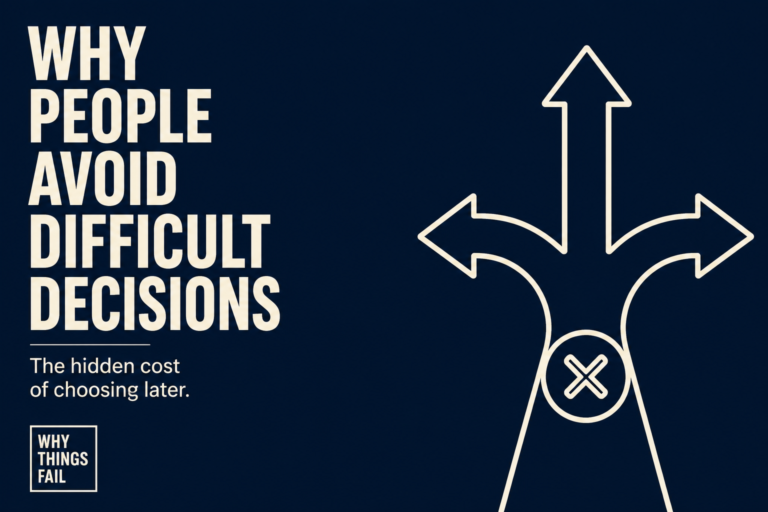
The tragedy is that avoiding a difficult decision is still a decision. It is a decision to let time, pressure, other people or deteriorating circumstances decide instead.
And that is why things fail.
What Is It?
Decision avoidance is the act of delaying, deflecting or refusing to make a necessary choice because the emotional cost feels too high.
It can appear in personal life, business, leadership, careers, relationships and organisations. A manager avoids removing an underperforming employee. A founder avoids shutting down a failing product. A person avoids ending a relationship that is no longer healthy. A company avoids adapting to a changing market. A leader avoids telling the truth because the truth will create conflict.
On the surface, avoidance looks passive. In reality, it is active protection. People are protecting themselves from discomfort, blame, regret or uncertainty.
The problem is that difficult decisions usually become more expensive with time. What could have been handled early becomes a crisis later.
The Biggest Myth
The biggest myth is that people avoid difficult decisions because they are lazy or weak.
Usually, the real reason is fear.
Fear of being wrong. Fear of hurting someone. Fear of losing money. Fear of being judged. Fear of choosing one path and closing another. Fear of discovering that the problem is bigger than expected.
Another myth is that more time always improves decisions. Sometimes time helps. But sometimes time becomes a hiding place. People keep collecting information not because they need it, but because research feels safer than action.
The most dangerous form of avoidance is intelligent avoidance. This is when capable people use analysis, meetings, reports, advice and planning to delay the moment of commitment.
They do not look careless. They look responsible.
That is what makes the failure harder to see.
What Happened?
In most cases, the pattern begins with a problem that is uncomfortable but manageable.
A business notices declining sales. A team member repeatedly misses expectations. A strategy is no longer working. A relationship becomes tense. A personal habit is causing damage. The evidence is visible, but not yet catastrophic.
At this stage, action is possible.
But action requires discomfort. Someone must speak honestly, make a trade-off or accept short-term pain. Instead, the decision is delayed. The person tells themselves they need more time, more proof or more confidence.
Then the situation worsens.
The weak employee affects team morale. The declining product drains resources. The unresolved conflict becomes resentment. The financial issue becomes debt. The health warning becomes a diagnosis. The market shift becomes a competitive collapse.
By the time the decision can no longer be avoided, the available options are worse.
This is the core failure pattern: people avoid pain in the present and create greater pain in the future.
Why Did It Happen?
The first cause is uncertainty.
Difficult decisions rarely come with perfect information. There is no guarantee that the chosen path will work. People want certainty before acting, but many important decisions require action before certainty arrives.
This creates a trap. The person waits until the answer becomes obvious. But by the time it is obvious, the best options may already be gone.
The second cause is loss aversion.
People feel losses more strongly than gains. Losing money, status, approval or comfort feels more painful than the possible benefit of making the right decision. So they protect what they already have, even when keeping it is damaging them.
This explains why people stay in bad jobs, failing businesses, poor partnerships and outdated strategies. The current situation may be bad, but it is familiar. The alternative may be better, but it is uncertain.
The third cause is fear of responsibility.
A difficult decision creates ownership. Once someone chooses, they can be blamed. If they do nothing, they can pretend the outcome was caused by circumstances.
Avoidance protects the ego. It allows people to say, “I did not cause this.” But leadership, maturity and progress require the opposite. They require someone to say, “I will decide, and I will carry the consequences.”
The fourth cause is emotional discomfort.
Many decisions are avoided because they involve difficult conversations. Telling someone they are not performing. Saying no. Ending an agreement. Challenging a powerful person. Admitting failure. Asking for change.
People often underestimate how much of decision-making is emotional labour. The decision itself may be logical. The conversation around it is painful.
So the decision is postponed.
The fifth cause is identity protection.
Some decisions threaten how people see themselves. A founder may avoid closing a failing business because it feels like admitting they are not successful. A leader may avoid changing strategy because it proves their earlier judgement was wrong. A person may avoid leaving a bad situation because it challenges the identity they built around loyalty, patience or sacrifice.
In these cases, the decision is not only practical. It is psychological.
The sixth cause is sunk cost thinking.
People continue with bad choices because they have already invested time, money, emotion or reputation. They think stopping means the investment was wasted.
But the investment is already gone. The real question is whether continuing will waste even more.
This is one of the clearest reasons failure repeats. People do not want to accept a smaller loss, so they create a larger one.
The seventh cause is social pressure.
Some decisions disappoint other people. A business leader may fear upsetting staff. A parent may fear upsetting family. A manager may fear conflict. A friend may fear being seen as selfish.
Humans are social creatures. Approval matters. Belonging matters. But when approval becomes more important than truth, bad decisions continue unchecked.
The eighth cause is false hope.
People often delay decisions because they believe the situation may improve by itself. Sometimes it does. But hope becomes dangerous when it replaces evidence.
False hope sounds like:
“Let’s give it a bit more time.”
“Maybe things will change.”
“They might improve.”
“The market might come back.”
“It is not that bad yet.”
Hope is useful when paired with action. It becomes harmful when it becomes an excuse for inaction.
The ninth cause is unclear priorities.
People avoid decisions when they do not know what matters most. If every option has a cost, the person must choose which cost they are willing to accept.
Without clear priorities, all options feel equally risky. The result is paralysis.
The tenth cause is weak systems.
In organisations, difficult decisions are often avoided because no system forces clarity. Meetings happen, but no owner is assigned. Problems are discussed, but no deadline is set. Risks are identified, but no action follows.
The organisation becomes excellent at noticing problems and poor at resolving them.
This is how failure becomes predictable.
Warning Signs
The first warning sign is repeated discussion without progress.
If the same issue appears in meetings again and again, it usually means the problem is not lack of awareness. It is lack of decision.
The second warning sign is the phrase “not yet”.
Not yet can be reasonable. But when “not yet” appears repeatedly, it often means people are waiting for courage, not information.
The third warning sign is emotional avoidance.
If people avoid the topic, change the subject, soften the truth or speak vaguely, the decision is probably being delayed because it feels uncomfortable.
The fourth warning sign is growing cost.
A delayed decision usually creates visible damage. More money lost. More time wasted. More complaints. More stress. More confusion. More people affected.
The fifth warning sign is dependence on a miracle.
When the plan becomes “hopefully things improve”, the decision has already been avoided for too long.
What Could Have Prevented It?
The first prevention is defining the real decision.
Many people avoid decisions because the problem feels too large. The solution is to ask: what exactly must be decided now?
Not everything needs to be solved at once. But something usually needs to be decided.
The second prevention is setting a decision deadline.
Without a deadline, difficult decisions drift. A clear date forces movement. It does not guarantee the perfect answer, but it prevents endless delay.
The third prevention is separating discomfort from danger.
A decision may feel uncomfortable without being wrong. Many necessary decisions create anxiety because they involve change, not because they are bad.
The fourth prevention is using evidence honestly.
People should ask: what do we already know? What evidence would actually change the decision? Are we gathering information to improve judgement or to delay action?
The fifth prevention is accepting trade-offs.
Every serious decision has a cost. Waiting for a cost-free option often means waiting forever.
The sixth prevention is creating accountability.
Someone must own the decision. In organisations, vague responsibility creates avoidance. Clear ownership creates movement.
The seventh prevention is practising smaller hard decisions.
People who avoid small difficult decisions often struggle with larger ones. Courage is built through repetition. Saying no, giving feedback, admitting mistakes and making timely choices strengthen decision-making ability.
Lessons
The first lesson is that delay has a price.
Avoiding a difficult decision may feel safe today, but it often transfers the cost into the future with interest.
The second lesson is that no decision is neutral.
When people do not choose, circumstances choose. Markets move. People leave. Trust erodes. Problems grow.
The third lesson is that clarity beats comfort.
The right decision is not always the most comfortable one. In many cases, the uncomfortable decision is the one that prevents deeper failure.
The fourth lesson is that courage is operational, not motivational.
Courage is not a feeling. It is a behaviour. It means acting responsibly while still feeling uncertain.
The fifth lesson is that difficult decisions reveal priorities.
People discover what they truly value when they must choose between competing costs.
Failure Pattern
The failure pattern is simple:
A problem appears.
The decision feels uncomfortable.
The person delays.
The delay is justified as caution.
The problem grows.
Options narrow.
Pressure increases.
The final decision becomes more painful than the original decision would have been.
This pattern repeats because avoidance offers immediate emotional relief. The reward is instant. The punishment arrives later.
That is why people keep doing it.
Hidden Lesson
The hidden lesson is that people do not usually avoid decisions because they lack intelligence. They avoid them because they want to avoid the emotional identity cost of choosing.
Hard decisions force people to confront reality.
They reveal that a plan is not working. That someone is not suitable. That a relationship has changed. That money has been wasted. That time has passed. That a belief was wrong.
The difficult decision is painful because it ends an illusion.
But failure often grows inside illusions. The longer people protect the illusion, the more damage reality eventually causes.
Failure Scorecard
Clarity: 7/10
Most people know the decision exists, but they avoid naming it directly.
Emotional Pressure: 9/10
Fear, guilt, pride and uncertainty strongly influence behaviour.
Preventability: 8/10
Many failures could be reduced if decisions were made earlier.
Repeat Risk: 9/10
This pattern repeats because avoidance gives short-term relief.
Damage Potential: 8/10
Delayed decisions can damage careers, businesses, relationships and finances.
Leadership Impact: 10/10
Leaders who avoid difficult decisions create confusion, mistrust and decline.
Key Takeaways
Difficult decisions do not disappear when ignored.
Avoidance often looks like patience, research or caution.
The longer a necessary decision is delayed, the fewer good options remain.
People avoid decisions mainly because of fear, uncertainty, identity protection and emotional discomfort.
A bad situation usually becomes worse when nobody owns the decision.
The best prevention is clear ownership, honest evidence, deadlines and acceptance of trade-offs.
Conclusion
People avoid difficult decisions because difficult decisions demand a price.
They demand honesty. They demand responsibility. They demand the courage to choose without perfect certainty. They may require conflict, loss, disappointment or admission of error.
But avoiding the decision does not remove the price. It only changes who pays it, when they pay it and how much it costs.
This is why difficult decisions sit at the centre of so many failures. The collapse rarely begins when the crisis becomes visible. It begins earlier, when someone sees the truth and chooses not to act.
Failure becomes predictable when discomfort becomes stronger than judgement.
The lesson is not that every decision must be made quickly. Some decisions deserve time, evidence and reflection. But there is a difference between thoughtful delay and fearful avoidance.
Thoughtful delay improves the decision.
Fearful avoidance protects the person from making it.
That difference can decide whether a problem is solved early or becomes another example of why things fail.