Introduction
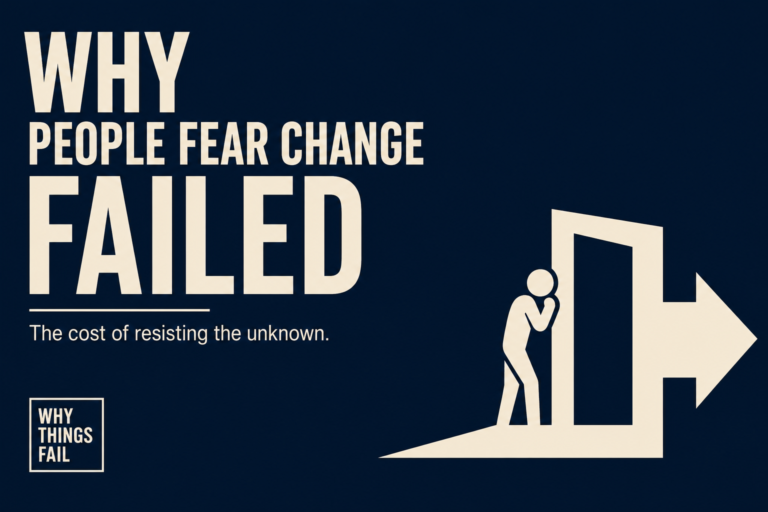
Change rarely fails because people are stupid, lazy or irrational. It fails because human beings are built to protect what feels familiar, even when the familiar is no longer working.
Most people do not fear change itself. They fear what change threatens: certainty, identity, control, status, competence, routine, comfort and belonging. A new system, new job, new business model, new relationship pattern or new way of thinking can look logical on paper, but emotionally it can feel like danger.
That is why change is one of the most repeated failure patterns in human life, organisations and society. People stay in bad jobs. Companies defend outdated products. Leaders ignore market shifts. Families repeat old arguments. Individuals delay decisions they know they need to make.
The tragedy is that many failures are visible long before they happen. The warning signs appear early. The need for change becomes obvious. Yet people hesitate, deny, resist, delay or sabotage the very change that could save them.
To understand why people fear change, we must look beneath behaviour and examine the psychology, incentives and hidden systems that make resistance predictable.
What Is It?
Fear of change is the emotional and psychological resistance people feel when life demands a shift from what is known to what is uncertain.
It can appear as avoidance, overthinking, anger, procrastination, denial, nostalgia, perfectionism or constant questioning. On the surface, people may say they need “more time”, “more proof” or “a better plan”. Sometimes that is true. But often, the deeper issue is fear.
Change asks people to leave a familiar mental map. Even if that map is flawed, it gives them a sense of control. The old situation may be painful, inefficient or outdated, but at least it is known. The new situation may be better, but it is unknown.
That is the psychological trap. The human brain often prefers a familiar problem to an unfamiliar solution.
The Biggest Myth
The biggest myth is that people resist change because they do not understand it.
In reality, many people understand change perfectly well. Employees understand why a business needs new systems. Business owners understand why old methods are no longer producing results. Individuals understand why they need to improve their health, finances, habits or relationships.
Understanding does not automatically remove fear.
People resist change because change creates emotional costs before it creates visible benefits. The pain of disruption arrives immediately. The reward is delayed. That imbalance makes change feel risky, even when staying the same is more dangerous.
This is why facts alone rarely change behaviour. A person can know the truth and still avoid acting on it.
What Happened?
The failure usually begins quietly.
A person, team or organisation notices that something is no longer working. Results slow down. Stress increases. Customers complain. Health declines. Motivation disappears. Opportunities are missed.
At first, the problem is explained away. It is blamed on timing, luck, the economy, other people or temporary pressure. Then the evidence grows. The old way becomes harder to defend, but change still feels uncomfortable.
Instead of adapting early, people protect the existing system. They make small adjustments. They delay difficult conversations. They wait for confidence. They hope the pressure will pass.
Eventually, the cost of not changing becomes larger than the fear of change. By then, the damage is often already done.
Why Did It Happen?
The brain treats uncertainty as danger
Human beings are wired to detect threats. For most of human history, uncertainty could mean physical danger. A strange sound, unknown place or unfamiliar group could be risky. The modern world is different, but the nervous system still reacts strongly to uncertainty.
Change creates uncertainty. The brain asks: What will happen? Will I cope? Will I lose something? Will I look foolish? Will I fail?
Even positive change can trigger stress because it removes predictability. A promotion, new business opportunity or better lifestyle can still feel threatening if it requires a new identity.
Familiar pain feels safer than unknown progress
People often stay with familiar pain because they know how to survive it.
A bad job may be stressful, but the person understands the routine. A failing business model may be declining, but the owner knows how it works. A toxic habit may be damaging, but it provides comfort.
Change offers improvement, but it also demands risk. The person must face the possibility that the new path may not work. That fear can make the old pain feel safer than the new opportunity.
Change threatens identity
Many people do not simply do things. They become attached to who they are through those things.
A manager who has always led in one way may feel personally attacked by new leadership methods. A business owner who built success through old marketing may struggle to accept that the market has moved on. A person who sees themselves as “not good with money”, “not confident” or “not technical” may resist actions that challenge that identity.
Change does not only ask, “What will you do differently?”
It asks, “Who will you become?”
That is why change often feels personal.
People fear losing status
Change can expose weakness. A new system may reveal that someone is no longer skilled. A new market may show that a company has lost relevance. A new habit may prove that previous excuses were not the full truth.
People often resist change not because they hate improvement, but because they fear the humiliation of becoming a beginner again.
This is especially powerful in organisations. Senior people may resist new ideas because those ideas threaten their authority. Teams may reject innovation because it reduces the value of old expertise.
Status protection is one of the hidden engines of resistance.
The cost is immediate, but the reward is delayed
Change usually demands effort before results appear.
Learning a new skill is uncomfortable before it becomes useful. Changing a business strategy may reduce short-term certainty before it creates growth. Improving health requires discipline before visible progress appears.
The human mind is strongly influenced by immediate discomfort. This makes delay attractive. People tell themselves they will change later, when they have more time, more money, more confidence or less pressure.
But later often becomes never.
Systems reward staying the same
Fear of change is not only psychological. It is also structural.
Many workplaces reward stability more than experimentation. Families reward familiar roles. Markets reward short-term performance. Leaders are praised for confidence, not doubt. Employees are punished for mistakes, not for silence.
So people learn that change is risky. Staying the same may be inefficient, but it is socially safer.
This is why organisations often say they want innovation while quietly punishing the behaviours that create it.
Warning Signs
The fear of change usually shows itself before failure becomes visible.
Common warning signs include:
- Constantly saying “now is not the right time”
- Asking for endless proof but never acting
- Defending the old way mainly because it is familiar
- Blaming external factors while ignoring internal weaknesses
- Feeling angry when new ideas are suggested
- Confusing discomfort with danger
- Waiting for confidence before taking action
- Treating early warnings as isolated problems
- Using past success as proof that change is unnecessary
The most dangerous warning sign is when people know something must change but keep behaving as if knowledge alone is progress.
What Could Have Prevented It?
Fear of change cannot be removed completely, but it can be managed.
The first prevention method is to make change smaller. Large change overwhelms people because it feels like a complete identity shift. Small experiments feel safer. A pilot project, trial period, limited test or first step reduces emotional resistance.
The second method is to explain the cost of not changing. People often focus only on the risk of action. They need to see the risk of inaction too. Staying the same is not neutral. It has a price.
The third method is psychological safety. People adapt better when they are allowed to learn without humiliation. If every mistake becomes punishment, people will hide, deny and resist.
The fourth method is honest leadership. Leaders must explain why change is needed, what will be difficult, what support exists and what the future could look like. Vague optimism does not build trust. Clear reality does.
The fifth method is identity protection. People need to feel that change does not erase their value. The message should not be, “Everything you did before was wrong.” It should be, “What worked before helped us get here, but it may not get us there.”
Lessons
The first lesson is that fear of change is normal. It is not weakness. It is a human response to uncertainty.
The second lesson is that resistance often hides a deeper fear: fear of failure, loss, embarrassment, rejection or loss of control.
The third lesson is that logic alone is not enough. People need emotional permission to change, not just intellectual reasons.
The fourth lesson is that delay is expensive. The longer change is avoided, the more painful it becomes.
The fifth lesson is that the most dangerous phrase in any life or organisation is: “This is how we have always done it.”
Failure Pattern
The pattern usually looks like this:
A system works.
Success creates comfort.
Comfort creates attachment.
Attachment creates resistance.
Resistance delays adaptation.
Delay increases the damage.
The need for change becomes urgent.
Urgent change becomes more painful than early change would have been.
This is how fear of change turns manageable problems into major failures.
Hidden Lesson
The hidden lesson is that people do not fear change only because the future is uncertain.
They fear change because the present gives them identity, even when it is failing.
A person may dislike their current situation, but still understand themselves within it. Change threatens that understanding. It asks them to become someone new before they feel ready.
That is why successful change is not just about strategy. It is about helping people cross the emotional gap between who they have been and who they need to become.
Failure Scorecard
Clarity of Warning Signs: 9/10
The need for change is often visible early. The signs are usually ignored, not hidden.
Preventability: 8/10
Many failures caused by resistance to change could have been prevented through earlier action, smaller experiments and better leadership.
Psychological Difficulty: 10/10
Change challenges deep human needs: certainty, identity, control, competence and belonging.
Organisational Risk: 9/10
Companies that fear change can lose relevance even while appearing stable.
Long-Term Damage: 8/10
Delayed change often creates avoidable losses: missed opportunities, declining trust, financial pressure and emotional exhaustion.
Key Takeaways
People fear change because uncertainty feels dangerous.
Resistance is often emotional before it is logical.
The familiar can feel safe even when it is harmful.
Change threatens identity, status and control.
Delay makes change harder, not easier.
The best way to manage change is to make it smaller, clearer and safer.
The real risk is often not changing.
Conclusion
People fear change because change asks them to step away from certainty before they can see the reward. It removes familiar routines, challenges identity, exposes weakness and creates emotional discomfort.
But the greatest failures rarely come from change itself. They come from resisting change until there is no easy option left.
The organisations, leaders and individuals who survive are not those who feel no fear. They are those who recognise fear early, understand it honestly and act before the cost of inaction becomes too high.
Change is uncomfortable. But avoiding necessary change is often the beginning of failure.
That is why people fear change — and why that fear, left unmanaged, makes failure predictable.