Introduction
People like to believe they make decisions rationally. They imagine themselves weighing facts, comparing options, calculating risks and choosing the most logical path.
But in real life, many of the most important decisions are made emotionally first and justified logically afterwards.
People stay in bad relationships because leaving feels frightening. They buy things they cannot afford because the purchase makes them feel successful. They hire the wrong person because they like their confidence. They reject good advice because it threatens their pride. They take revenge, avoid difficult conversations, ignore warning signs and choose short-term comfort over long-term benefit.
Emotional decision-making does not always look dramatic. Often, it looks calm from the outside. A person may sound reasonable, professional and confident. But beneath the surface, fear, pride, insecurity, anger, hope, shame or social pressure may already have made the decision.
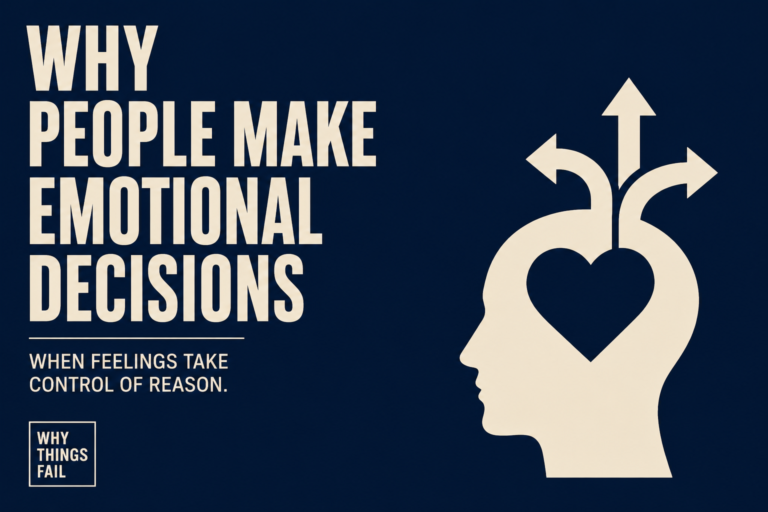
The failure is not that humans have emotions. Emotions are essential. They help people detect danger, form relationships, act quickly and attach meaning to life. The failure begins when emotion takes control of judgement while pretending to be logic.
That is why emotional decisions fail so often. Not because feelings are useless, but because feelings are powerful enough to disguise themselves as truth.
What Is It?
Emotional decision-making happens when a person’s feelings become the main driver of a decision, even if the decision is later explained using logic.
This can happen in many ways. Fear may make someone avoid a risk they should take. Anger may push someone into a reaction they later regret. Excitement may make an opportunity look better than it really is. Pride may stop someone from admitting they were wrong. Shame may keep someone silent when they should ask for help.
The key issue is not emotion itself. The issue is emotional dominance.
A balanced decision uses both emotion and reason. Emotion says, “This matters.” Reason asks, “Is this true? Is this wise? What are the consequences?” Failure begins when the emotional part answers all the questions before the rational part has entered the room.
The person still feels certain. In fact, emotional decisions often feel more certain than rational ones. That is what makes them dangerous. Calm analysis usually contains doubt. Emotional certainty often feels clean, urgent and obvious.
That urgency is often the warning sign.
The Biggest Myth
The biggest myth is that emotional people make emotional decisions and rational people do not.
This is false.
Everyone makes emotional decisions. Intelligent people, successful people, educated people and experienced leaders are not immune. In some cases, they are more vulnerable because they become better at explaining their emotional decisions in intellectual language.
A business owner may say, “This is a strategic expansion,” when the real driver is fear of being left behind. A manager may say, “This person is not the right cultural fit,” when the real issue is personal dislike. An investor may say, “The market will recover,” when the truth is that accepting a loss feels too painful.
The myth exists because people confuse explanation with cause. Just because someone can explain a decision logically does not mean logic caused the decision.
Often, logic is not the driver. It is the lawyer hired after the emotion has already committed the crime.
What Happened?
The pattern is familiar.
A person faces a decision. There is uncertainty, pressure or emotional discomfort. Instead of slowing down, they move quickly towards the option that reduces the feeling they dislike most.
If they feel afraid, they choose safety.
If they feel embarrassed, they protect their image.
If they feel angry, they punish.
If they feel excited, they chase.
If they feel insecure, they seek approval.
If they feel guilty, they overcompensate.
The decision feels right because it gives emotional relief. But emotional relief is not the same as a good outcome.
This is where failure begins. The person mistakes relief for wisdom.
They may ignore facts that challenge the decision. They may seek advice only from people who agree with them. They may rush the process because waiting would allow doubt to return. They may become defensive when questioned because questioning the decision feels like questioning their identity.
Over time, the consequences appear. Money is wasted. Relationships are damaged. Opportunities are missed. Trust is lost. The person may then say, “I don’t know why I did that.”
But the reason was there from the beginning. The decision was not random. It followed an emotional logic.
Why Did It Happen?
Emotional decisions happen because the human brain is not designed to be a perfect reasoning machine. It is designed to survive, belong, avoid pain and seek reward.
That means the brain often prioritises emotional safety over objective truth.
When a decision feels threatening, the mind does not calmly ask, “What is the best long-term outcome?” It often asks, “How can I stop feeling this discomfort now?”
This creates the first root cause: short-term emotional relief.
Many bad decisions are not made because people want bad outcomes. They are made because people want immediate relief. Avoiding a conversation feels easier than facing conflict. Spending money feels better than feeling inadequate. Saying yes feels safer than disappointing someone. Quitting feels better than feeling uncertain.
The second cause is fear.
Fear is one of the strongest decision-making forces. It can make people avoid change, reject opportunities, stay silent or accept poor conditions. Fear narrows attention. It makes risks look larger, options look smaller and uncertainty feel unbearable.
A person under fear does not see the full picture. They see the threat.
The third cause is pride.
Pride makes people protect the image they have of themselves. This is why people struggle to admit mistakes. A person may continue defending a bad decision not because they still believe in it, but because admitting the truth would damage their ego.
This is especially dangerous in leadership. Leaders often make poor emotional decisions when they confuse being wrong with being weak. Instead of correcting course, they double down.
The fourth cause is identity.
People do not only make decisions based on facts. They make decisions based on who they believe they are. Someone who sees themselves as strong may refuse help. Someone who sees themselves as loyal may stay too long. Someone who sees themselves as ambitious may chase every opportunity. Someone who sees themselves as unlucky may not even try.
When a decision threatens identity, emotion becomes defensive.
The fifth cause is social pressure.
Humans are social animals. Approval matters. Rejection hurts. This means people often make decisions based on how they will be seen rather than what is best.
They choose careers to impress others. They buy status symbols to signal success. They remain quiet in groups to avoid standing out. They agree publicly while disagreeing privately. They follow crowds because being wrong with others feels safer than being right alone.
The sixth cause is emotional memory.
Past experiences shape present decisions. Someone who was embarrassed before may avoid visibility. Someone who was betrayed may struggle to trust. Someone who failed publicly may fear trying again. The current decision may look new, but the emotional response may belong to the past.
This is why some reactions seem too strong for the situation. The person is not only responding to what is happening now. They are responding to what the situation reminds them of.
The seventh cause is urgency.
Emotion often creates pressure to act now. Anger says, “Reply immediately.” Fear says, “Escape immediately.” Excitement says, “Buy immediately.” Shame says, “Hide immediately.”
But important decisions usually improve with time. Emotional decisions often worsen with speed.
The eighth cause is confirmation bias.
Once emotion chooses a direction, the mind starts looking for evidence to support it. This is why people can become extremely logical after making an emotional decision. They search for reasons, examples and opinions that defend what they already feel.
The danger is that the person feels objective because they have evidence. But they selected the evidence after the emotion had already decided.
The ninth cause is incentives.
People often make emotional decisions because the environment rewards them. A workplace may reward confidence over accuracy. Social media may reward outrage over reflection. Sales environments may reward urgency over honesty. Families may reward silence over truth.
When systems reward emotional reaction, emotional decisions become normal.
The tenth cause is lack of self-awareness.
Many people do not know what they are feeling before they decide. They say, “This is the right choice,” when a more honest statement would be, “This choice makes me feel less afraid.”
Without emotional awareness, people cannot separate feeling from fact.
Warning Signs
There are clear warning signs that a decision is being driven by emotion.
The first warning sign is urgency. If a decision feels like it must be made immediately, emotion may be controlling the process.
The second warning sign is defensiveness. If questions feel like attacks, the decision is probably tied to ego.
The third warning sign is selective evidence. If someone only wants information that supports their view, they are no longer investigating. They are defending.
The fourth warning sign is relief. If the strongest benefit of a decision is that it removes discomfort, the person should pause.
The fifth warning sign is extreme certainty. Good decisions often contain healthy doubt. Emotional decisions often feel completely obvious.
The sixth warning sign is personalisation. If disagreement feels disrespectful, the issue is no longer only about the decision. It has become about identity.
The seventh warning sign is repetition. If the same type of decision keeps producing the same type of regret, there is likely an emotional pattern underneath.
What Could Have Prevented It?
Emotional decisions can be prevented, but not by removing emotion. The solution is to slow emotion down long enough for judgement to return.
The first prevention method is delay.
Time weakens emotional intensity. A decision that feels urgent today may look different tomorrow. This is especially true for anger, fear, excitement and shame.
The second method is naming the emotion.
A person should ask, “What am I feeling right now?” Fear? Pride? Pressure? Embarrassment? Hope? Anger?
Naming the emotion creates distance from it. It turns the feeling from a hidden driver into visible information.
The third method is asking what problem the decision is really solving.
Is it solving the actual problem, or is it only reducing emotional discomfort?
The fourth method is seeking disagreement.
A good decision process needs someone who can challenge the emotional story. Not someone negative, but someone honest.
The fifth method is writing down the reasoning before acting.
Writing exposes weak logic. It forces the person to explain the decision clearly, list risks and separate facts from assumptions.
The sixth method is considering the future self.
Many emotional decisions serve the present self and punish the future self. Asking, “Will I respect this decision in six months?” can reveal whether the decision is wise or merely comforting.
The seventh method is building better systems.
Individuals need habits. Organisations need processes. Big decisions should not depend only on mood, pressure or personality. They need review, challenge, evidence and accountability.
Lessons
The first lesson is that emotion is not the enemy. Unexamined emotion is the enemy.
The second lesson is that bad decisions often feel good at the moment they are made.
The third lesson is that intelligence does not protect people from emotional bias. Sometimes it only makes the justification more impressive.
The fourth lesson is that repeated bad decisions usually reveal a repeated emotional pattern.
The fifth lesson is that slowing down is not weakness. It is often the difference between reaction and judgement.
The sixth lesson is that the question is not, “Am I being emotional?” The better question is, “Which emotion is influencing me, and should it be trusted?”
Failure Pattern
The failure pattern is simple:
Discomfort appears.
Emotion demands relief.
The person chooses the option that reduces the feeling fastest.
Logic is used afterwards to justify the choice.
Warning signs are ignored.
Consequences arrive later.
The person repeats the pattern because the emotional cause was never addressed.
This is why emotional decisions repeat. The visible decision changes, but the hidden emotional driver remains the same.
Hidden Lesson
The hidden lesson is that people do not only fail because they make the wrong decision.
They fail because they misunderstand why they made the decision.
A person who thinks they made a logical decision will defend it logically. A person who understands the emotional root can examine it honestly.
That is where real change begins.
The most dangerous decisions are not the ones that feel emotional. They are the ones that feel rational while quietly protecting fear, pride, shame or insecurity.
Failure Scorecard
Emotional Pressure: 9/10
Emotional decisions are powerful because they feel urgent and personal. The stronger the feeling, the harder it becomes to think clearly.
Risk of Repetition: 8/10
Unless the emotional pattern is recognised, the same behaviour often repeats in different situations.
Visibility of Warning Signs: 7/10
The warning signs are usually present, but people ignore them because the decision feels justified.
Preventability: 8/10
Many emotional decisions can be prevented through delay, reflection, challenge and better systems.
Long-Term Damage: 7/10
The damage depends on the decision. Some emotional decisions cause minor regret. Others destroy careers, relationships, finances and organisations.
Overall Failure Risk: 8/10
Emotional decision-making is one of the most common causes of avoidable failure because it hides beneath confidence, logic and urgency.
Key Takeaways
People do not make emotional decisions because they are weak. They make them because they are human.
The problem begins when emotion becomes the driver and logic becomes the excuse.
Fear, pride, shame, anger, excitement and social pressure can all distort judgement.
The strongest warning signs are urgency, defensiveness, selective evidence and the need for immediate relief.
Better decisions require delay, self-awareness, honest challenge and a clear separation between feeling and fact.
Conclusion
People make emotional decisions because emotions are faster than reason, louder than evidence and closely tied to identity.
In the moment, emotional decisions often feel right. They reduce discomfort, protect pride, create excitement or avoid fear. But the comfort they provide is often temporary, while the consequences last much longer.
This is why emotional decision-making fails. It solves the feeling before it solves the problem.
The lesson is not to remove emotion from decisions. That would be impossible and undesirable. The lesson is to understand emotion before obeying it.
Because when people do not understand the feeling behind a decision, they are not truly choosing.
They are reacting.
And reaction, when mistaken for judgement, is one of the most predictable ways things fail.