Introduction
People often assume that when a situation becomes painful enough, a person will simply leave.
They imagine someone trapped in a bad job, toxic relationship, failing business, unsafe home, exploitative friendship or damaging routine and ask the obvious question: why do they stay?
The question sounds simple. The answer is not.
People stay in bad situations not because they are weak, foolish or unaware, but because human beings are not purely rational decision-makers. We are emotional, social, fearful, hopeful, tired, attached and often trapped by invisible systems of pressure.
A bad situation rarely begins as obviously bad. It usually begins with compromise, hope, loyalty, fear or necessity. By the time the damage is clear, the person may already be emotionally invested, financially dependent, socially entangled or psychologically exhausted.
This is why bad situations survive. Not because they are good, but because leaving them feels even harder.
What Is It?
Staying in a bad situation means remaining in an environment, relationship, role, habit or system that consistently harms your wellbeing, growth, safety, dignity or future.
It can appear in many forms:
A person stays in a job that destroys their confidence.
A founder continues funding a failing business because they cannot accept defeat.
Someone remains in a relationship where they feel small, controlled or ignored.
A family keeps repeating destructive patterns because nobody wants confrontation.
An employee tolerates exploitation because they fear unemployment.
A person stays in a city, routine or lifestyle that no longer fits who they are becoming.
The situation may be emotionally painful, financially draining, mentally exhausting or morally uncomfortable. Yet the person remains.
The failure is not simply staying. The deeper failure is that the person slowly adjusts to pain and begins to treat it as normal.
The Biggest Myth
The biggest myth is that people stay in bad situations because they do not know the situation is bad.
In reality, many people know.
They know the job is damaging them. They know the relationship is unhealthy. They know the business is failing. They know the pattern keeps repeating.
The problem is not always awareness. The problem is action.
Knowing something is bad does not automatically make leaving feel possible.
People often stay because they are calculating risk. They are asking:
What happens if I leave?
What if I regret it?
What if I cannot survive financially?
What will people say?
What if the next situation is worse?
What if things improve?
What if I am the problem?
This is where bad situations become powerful. They do not need to convince someone they are good. They only need to make the alternative feel frightening.
What Happened?
At first, the bad situation usually seemed manageable.
The job was stressful, but there was a salary.
The relationship had problems, but there were good moments.
The business was struggling, but success still felt possible.
The family dynamic was painful, but it was familiar.
The person accepted small discomforts because they believed they were temporary.
Then the discomfort became routine.
One compromise became two. One excuse became a pattern. One disappointment became normal. The person lowered their expectations, adjusted their behaviour and learned how to survive inside the situation.
Eventually, they stopped asking, “Is this good for me?”
They started asking, “Can I get through another day?”
That is the turning point. A bad situation becomes dangerous when survival replaces judgement.
Why Did It Happen?
People stay in bad situations because leaving is not one decision. It is many decisions at once.
Leaving may mean losing income, identity, community, security, reputation, comfort, hope and certainty. Even when staying is painful, leaving can feel like stepping into chaos.
One major reason is fear of uncertainty.
The human mind often prefers familiar pain over unknown possibility. A bad situation may be damaging, but at least it is known. The future after leaving is unclear. People fear empty space. They fear starting again. They fear discovering that they made the wrong choice.
Another reason is the sunk cost fallacy.
The more time, money, emotion and effort someone has invested, the harder it becomes to walk away. They think, “I have given too much to leave now.” This logic feels sensible, but it is dangerous. Past investment cannot be recovered by future suffering.
Hope also plays a major role.
Bad situations often contain just enough good moments to keep people attached. One apology. One good week. One promising conversation. One small improvement. These moments reset the person’s patience and make them believe change is coming.
This is especially powerful in relationships, workplaces and businesses. People do not stay only because things are bad. They stay because things are sometimes good.
Identity is another hidden force.
A person may not want to leave because leaving threatens who they believe they are. A business owner does not want to become “someone who failed”. A loyal employee does not want to become “someone who quit”. A partner does not want to become “someone who gave up”. A parent does not want to admit the family system is broken.
So they stay to protect an identity, even when that identity is costing them peace.
Social pressure also keeps people trapped.
Humans are deeply influenced by how others see them. People worry about shame, judgement, disappointment and gossip. They may fear being misunderstood more than they fear staying unhappy.
In some cases, people stay because the bad situation has weakened them.
Long-term stress reduces confidence. Criticism damages self-belief. Repeated disappointment creates learned helplessness. The person begins to believe they cannot leave, cannot cope, cannot rebuild or cannot do better.
This is one of the cruelest parts of bad situations: they reduce the very strength required to escape them.
Bad situations also survive because of practical barriers.
Money matters. Housing matters. Children matter. Immigration status matters. Debt matters. Health matters. Social support matters. Not every person has the same freedom to walk away.
This is why simplistic advice such as “just leave” often fails. It ignores the real-world costs of leaving.
The deepest reason people stay is that bad situations often train people to doubt themselves.
They begin to question their judgement. They minimise their pain. They compare themselves to people who have it worse. They tell themselves they are being dramatic. They wait for permission to trust what they already know.
By the time they are ready to leave, they may no longer feel like the kind of person who can.
Warning Signs
The first warning sign is constant self-negotiation.
If someone repeatedly tells themselves, “It is not that bad,” “Maybe I am overreacting,” or “I just need to be more patient,” they may already be adapting to harm.
Another warning sign is shrinking.
The person becomes less confident, less expressive, less ambitious or less alive. They stop making plans. They stop speaking honestly. They stop expecting better.
A third warning sign is emotional exhaustion.
When a person no longer has energy to imagine change, the situation has moved from difficult to dangerous.
Another warning sign is repeated broken promises.
Bad situations often continue through cycles: problem, apology, hope, disappointment, repeat. Each cycle makes leaving harder because the person keeps waiting for the promised version of the future.
The clearest warning sign is this: the person becomes more afraid of leaving than of staying.
When that happens, the bad situation has captured the mind.
What Could Have Prevented It?
The first prevention is early honesty.
People need to recognise small patterns before they become large systems. A single bad day is not the issue. A repeated pattern is.
The second prevention is external perspective.
Bad situations are easier to see from the outside. Trusted friends, mentors, counsellors or advisors can help a person separate reality from fear.
The third prevention is clear personal standards.
People who know their non-negotiables are harder to trap. They can say, “This is not acceptable,” before years pass.
The fourth prevention is practical preparation.
Sometimes people cannot leave immediately, but they can prepare. Saving money, gathering information, building skills, documenting problems, seeking advice and creating options all reduce the fear of exit.
The fifth prevention is accepting that leaving late is better than never leaving.
Many people stay because they feel embarrassed that they did not act sooner. But delay is not a reason to continue. The best time to leave may have been earlier. The second-best time is when the truth becomes impossible to ignore.
Lessons
The first lesson is that bad situations often survive through hope, not just fear.
People do not stay only because they are trapped. They stay because part of them still believes the situation can become what it once promised to be.
The second lesson is that familiarity is powerful.
The mind often mistakes familiar pain for safety. This is why people repeat patterns they dislike.
The third lesson is that leaving requires more than courage.
It requires information, support, resources, timing and self-trust.
The fourth lesson is that people should judge situations by patterns, not promises.
A promise shows intention. A pattern shows reality.
The fifth lesson is that staying can become a form of slow self-abandonment.
Every time someone ignores what they know, they teach themselves that their own judgement does not matter.
Failure Pattern
The failure pattern is clear:
A person enters a situation with hope.
Small problems appear.
The person explains them away.
The problems repeat.
The person invests more time, emotion or money.
Leaving becomes harder.
The person waits for improvement.
The situation damages their confidence.
They begin to doubt their ability to leave.
Eventually, staying feels safer than change.
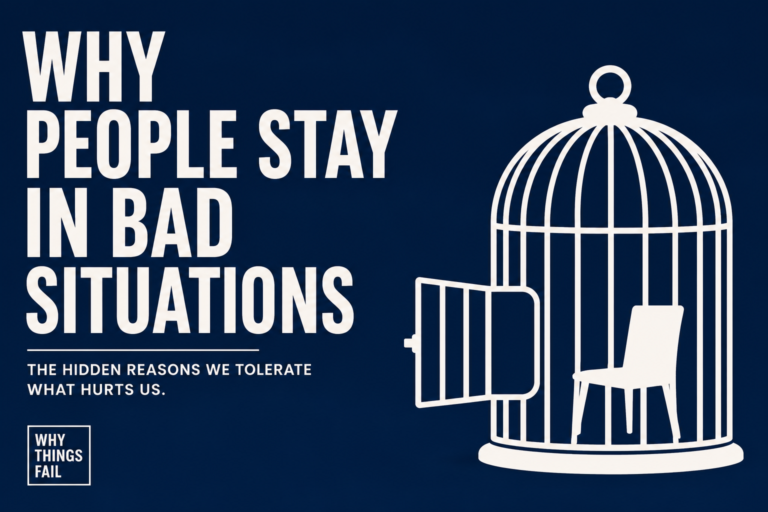
This is how bad situations become prisons without visible walls.
Hidden Lesson
The hidden lesson is that people do not only stay in bad situations because they cannot leave.
Sometimes they stay because leaving would force them to face a painful truth:
That they accepted less than they deserved.
That they ignored warning signs.
That someone they trusted was not who they hoped.
That a dream was failing.
That loyalty was being used against them.
That the future they imagined will not happen.
Leaving is not just a physical act. It is an emotional admission. That is why it hurts.
Failure Scorecard
Self-awareness: 7/10
Most people know more than they admit. The problem is not always blindness. It is fear of acting on what they know.
Emotional pressure: 9/10
Hope, guilt, shame, fear and attachment are powerful forces. They often overpower logic.
Practical barriers: 8/10
Money, housing, family, work, legal status and social support can make leaving genuinely difficult.
Warning signs ignored: 9/10
Bad situations usually show signs early. The failure is often in minimising them until they become normal.
Preventability: 6/10
Some situations could be prevented with boundaries and early action. Others require support, resources and time to escape safely.
Long-term damage: 9/10
The longer someone stays, the more the situation can damage confidence, identity and decision-making.
Key Takeaways
People stay in bad situations because leaving often feels more frightening than staying.
Bad situations usually become harmful gradually, not suddenly.
Hope can be as trapping as fear.
The sunk cost fallacy makes people protect past investment instead of future wellbeing.
A pattern matters more than a promise.
The longer someone stays, the harder leaving can feel.
Leaving requires self-trust, support and practical preparation.
Conclusion
People stay in bad situations for deeply human reasons.
They stay because they are afraid. Because they hope. Because they have invested too much. Because they feel responsible. Because they lack support. Because they are tired. Because they do not yet believe they are allowed to choose something better.
The failure is not simply that people stay. The failure is that bad situations often understand human psychology better than people do.
They use fear, hope, habit, guilt, identity and uncertainty to keep people attached.
That is why this pattern repeats across relationships, careers, families, businesses and personal lives.
People do not escape bad situations only by realising they are bad.
They escape when they finally believe that the cost of staying is greater than the fear of leaving.
And that moment, though painful, is often where recovery begins.