Introduction
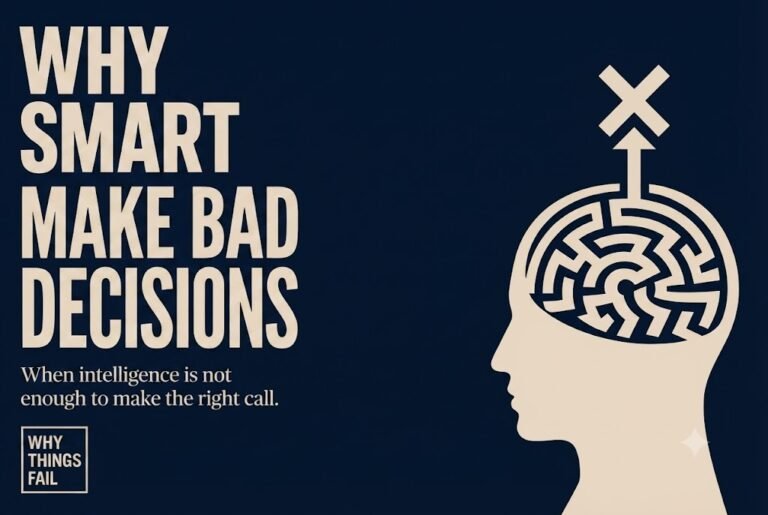
Intelligence is one of the most misunderstood advantages in human life.
We often assume that smart people make better decisions because they can process more information, understand complexity and predict consequences. In many situations, that is true. Intelligence helps people solve technical problems, recognise patterns and learn quickly.
But intelligence does not make people immune to bad judgement.
In fact, smart people can sometimes make especially poor decisions because they are better at justifying them. They can build stronger arguments for weak choices, defend mistaken beliefs with confidence and explain away warning signs that others might take seriously.
This is why bad decisions are not always caused by stupidity. They are often caused by confidence, pressure, incentives, identity, emotion and blind spots.
The failure does not begin when the decision goes wrong. It begins much earlier, when intelligence starts serving the ego instead of the truth.
What Is It?
A bad decision is not simply a decision that produces a bad outcome.
Sometimes good decisions fail because of bad luck. Sometimes risky decisions succeed because of luck. The real problem is not the outcome alone. The real problem is the quality of thinking behind the decision.
Smart people make bad decisions when their intelligence is used to defend assumptions rather than test them.
They may ignore inconvenient evidence, overestimate their ability, underestimate risk, trust their past success too much or surround themselves with people who do not challenge them.
The decision may look rational from the outside. It may involve data, strategy, analysis and confident language. But beneath the surface, the thinking is often distorted.
The person is not asking, “What is true?”
They are asking, “How can I prove that what I want to believe is true?”
That is where failure begins.
The Biggest Myth
The biggest myth is that intelligence protects people from poor judgement.
It does not.
Intelligence is a tool. Like any tool, it can be used well or badly. It can help someone question their assumptions, but it can also help them defend their assumptions more aggressively.
A less intelligent person may make a bad decision because they fail to see the problem. A highly intelligent person may see the problem and still explain why it does not apply to them.
This is more dangerous.
Smart people often fail not because they lack information, but because they misuse information. They collect facts that support their view. They dismiss evidence that challenges it. They mistake clever reasoning for sound judgement.
The myth is that bad decisions come from lack of intelligence.
The reality is that many bad decisions come from intelligence without humility.
What Happened?
Across business, politics, careers, relationships and personal life, smart people repeatedly make decisions that look irrational in hindsight.
Successful founders expand too fast despite clear financial warning signs. Senior executives ignore market changes because the old model made them rich. Educated professionals stay in failing careers because they fear losing status. Investors chase bubbles while knowing bubbles exist. Leaders surround themselves with loyal voices instead of honest ones.
At the time, these decisions rarely feel foolish.
They feel strategic. Necessary. Bold. Visionary. Logical.
The person often has reasons. They may have spreadsheets, forecasts, expert opinions and previous experience. They may believe they are seeing something others cannot see.
But later, when the failure becomes obvious, the pattern is clear.
The warning signs were there. The risks were visible. The assumptions were weak. The feedback was ignored.
The problem was not that the person could not think.
The problem was that they did not think against themselves.
Why Did It Happen?
1. Intelligence Creates Overconfidence
Smart people are often used to being right.
From school to career success, intelligence is frequently rewarded. Over time, this can create a dangerous belief: “My judgement is usually better than other people’s.”
That belief may be partly true in some areas. But it becomes dangerous when it spreads into areas where the person has limited experience.
A brilliant engineer may assume they understand marketing. A successful entrepreneur may assume they understand people. A high-performing professional may assume they can predict risk better than others.
The issue is not confidence itself. Confidence is useful. The problem is overconfidence without correction.
When smart people trust their own judgement too much, they stop looking for disconfirming evidence. They do not ask enough: “Where could I be wrong?”
2. They Confuse Intelligence With Wisdom
Intelligence helps people solve problems.
Wisdom helps people choose which problems matter, when to stop, whom to trust and what consequences to consider.
These are not the same thing.
A person can be highly intelligent and still lack emotional maturity, patience, self-awareness or ethical judgement. They may understand complex systems but fail to understand their own motives.
Bad decisions often happen when smart people believe intelligence is enough.
They analyse the numbers but ignore the culture. They understand the strategy but ignore the human cost. They see the opportunity but miss the timing.
Wisdom asks slower questions.
Intelligence asks, “Can this be done?”
Wisdom asks, “Should this be done?”
3. They Rationalise What They Already Want
One of the most dangerous human abilities is rationalisation.
Smart people are especially good at it.
If they want something badly enough, they can create a convincing argument for why it makes sense. They can turn emotion into strategy. They can dress desire in the language of logic.
This happens in business decisions, hiring choices, investments, relationships and career moves.
The person may say, “The data supports this.”
But often, the data was selected after the desire already existed.
This is why intelligence can become a servant of emotion. Instead of controlling the impulse, it protects it.
The decision feels rational because the explanation is intelligent.
But a good explanation is not the same as a good decision.
4. Past Success Becomes a Trap
Success creates evidence.
If someone has made good decisions in the past, they naturally trust their instincts. That trust can be useful, but it can also become a trap.
The world changes. Markets change. People change. Timing changes. What worked before may not work again.
Smart people often fail when they treat past success as proof of future correctness.
They say, “This worked last time.”
But last time may have involved different conditions, fewer competitors, better timing, lower risk or pure luck.
Success is dangerous because it feels like proof.
The smarter the person, the easier it becomes to build a story around that proof.
5. They Ignore Emotional Influences
Many smart people believe they are rational because they think deeply.
But thinking deeply is not the same as thinking objectively.
Fear, pride, envy, ambition, insecurity and status anxiety can influence decisions quietly. The person may not feel emotional. They may sound calm and analytical. But emotion can still be driving the choice.
A leader may refuse to change direction because admitting failure would damage their identity. An investor may take excessive risk because they do not want to miss out. A professional may stay in the wrong role because leaving would feel like defeat.
The decision is emotional first.
The explanation comes later.
6. They Surround Themselves With Agreement
Smart people often attract respect.
That respect can become dangerous when people stop challenging them.
In organisations, senior people may receive filtered information. Employees may avoid difficult truths. Friends may offer encouragement instead of honesty. Advisers may say what the powerful person wants to hear.
Over time, the smart person lives inside a distorted reality.
They are not stupid. They are under-challenged.
Bad decisions grow in environments where disagreement feels risky.
The more powerful or successful someone becomes, the more they need honest feedback. Unfortunately, that is often when they receive the least of it.
7. They Mistake Complexity for Depth
Smart people can overcomplicate decisions.
They may build complex models, frameworks and theories when the basic truth is simple.
The business is losing money.
The customer does not want the product.
The team does not trust the leader.
The relationship is unhealthy.
The risk is too high.
But complexity can hide reality. It can make a weak decision look sophisticated. It can delay action. It can create the illusion of control.
Sometimes the smartest decision is not the most complex one.
It is the clearest one.
8. Incentives Distort Judgement
People do not make decisions in a vacuum.
They make decisions inside systems of reward and punishment.
A manager may approve a risky project because promotion depends on growth. A founder may keep expanding because investors expect momentum. A politician may avoid the truth because honesty could cost votes. A professional may stay silent because speaking up could damage their career.
Smart people are not immune to incentives. In fact, they may be better at navigating them.
The problem is that incentives can reward the appearance of good decision-making rather than the reality of it.
If the system rewards confidence, people become confident.
If it rewards growth, people chase growth.
If it rewards loyalty, people hide criticism.
Bad decisions become predictable when the system rewards the wrong behaviour.
Warning Signs
There are usually warning signs before smart people make bad decisions.
One warning sign is certainty. When a person becomes too certain, they stop learning. Strong conviction is not always wrong, but certainty without challenge is dangerous.
Another warning sign is defensive reasoning. If every criticism is dismissed quickly, the decision is no longer being tested. It is being protected.
A third warning sign is selective evidence. When someone only shares data that supports their view, they may already be trapped inside confirmation bias.
Another warning sign is speed. Some decisions need urgency, but unnecessary haste often hides fear, pressure or ego.
The most important warning sign is the absence of dissent.
If nobody serious is challenging the decision, the decision is probably not being examined deeply enough.
What Could Have Prevented It?
Bad decisions by smart people can rarely be prevented by simply giving them more information.
The better solution is better process.
The person needs systems that force them to test their own thinking.
This includes asking what evidence would prove them wrong, inviting criticism before committing, separating emotion from analysis and reviewing incentives honestly.
They also need people around them who are allowed to disagree.
Not symbolic disagreement. Real disagreement.
A strong decision-making process should include uncomfortable questions:
What are we assuming?
What happens if we are wrong?
Who benefits from this decision?
What evidence are we ignoring?
Are we choosing this because it is right, or because it protects our ego?
Could a simpler explanation be true?
These questions do not guarantee success. But they reduce the chance of intelligent failure.
Lessons
The first lesson is that intelligence is not enough.
Good judgement requires humility, self-awareness and discipline. Smart people must learn to doubt themselves productively.
The second lesson is that confidence should be earned repeatedly.
Past success does not remove the need for fresh evidence.
The third lesson is that disagreement is protection.
People who challenge your thinking are not always obstacles. Sometimes they are early warning systems.
The fourth lesson is that emotions must be named.
A decision influenced by fear, pride or status is not automatically wrong, but it becomes dangerous when the emotion is hidden.
The fifth lesson is that incentives matter.
When people are rewarded for looking right, they will avoid admitting they are wrong.
Failure Pattern
The pattern usually looks like this:
A smart person succeeds.
Success creates confidence.
Confidence becomes identity.
Identity resists criticism.
Criticism gets dismissed.
Warning signs are explained away.
The decision fails.
The person says the failure was unpredictable.
But it was not unpredictable.
It was protected from correction.
Hidden Lesson
The hidden lesson is that bad judgement often hides behind good intelligence.
The smartest person in the room may still be wrong if they are emotionally attached to being right.
Real intelligence is not just the ability to argue well.
It is the ability to change your mind when the evidence changes.
It is the ability to notice when your ego is influencing your judgement.
It is the ability to ask, “What am I missing?”
The strongest thinkers are not those who never make bad decisions.
They are those who build systems that make bad decisions harder to defend.
Failure Scorecard
Intelligence: 8/10
Smart people often have enough intelligence to understand the risks. The failure is not usually lack of mental ability. It is the misuse of ability.
Humility: 3/10
This is often the weakest area. Overconfidence, pride and identity protection make it difficult to admit uncertainty.
Feedback: 4/10
Many bad decisions happen because honest feedback is ignored, softened or never invited.
Emotional Awareness: 5/10
Smart people may understand emotions intellectually but still fail to see how emotions influence their own choices.
Incentive Awareness: 6/10
They may understand incentives in theory, but underestimate how strongly incentives shape their own behaviour.
Decision Process: 5/10
The process often looks professional but lacks real challenge, independent review or disconfirming evidence.
Preventability: 8/10
Many of these failures could have been prevented with better questioning, stronger feedback loops and more humility.
Key Takeaways
Smart people make bad decisions because intelligence does not remove bias, emotion, ego or pressure.
The danger is not stupidity. The danger is clever self-justification.
Bad decisions become predictable when people stop testing their assumptions.
Past success can create overconfidence and make future failure more likely.
The best protection is not more intelligence. It is better judgement, honest feedback and humility.
Conclusion
Smart people do not fail because they cannot think.
They fail because they think too confidently in the wrong direction.
They use intelligence to defend what they want to believe, protect their identity, avoid uncomfortable truths and explain away warning signs.
That is why intelligence alone cannot prevent failure.
The real test of judgement is not how clever someone sounds when they are right.
It is how willing they are to question themselves before they are wrong.
In the end, smart people make bad decisions for a simple reason: being intelligent helps you build powerful arguments.
But only humility helps you build better decisions.