Quick Answer
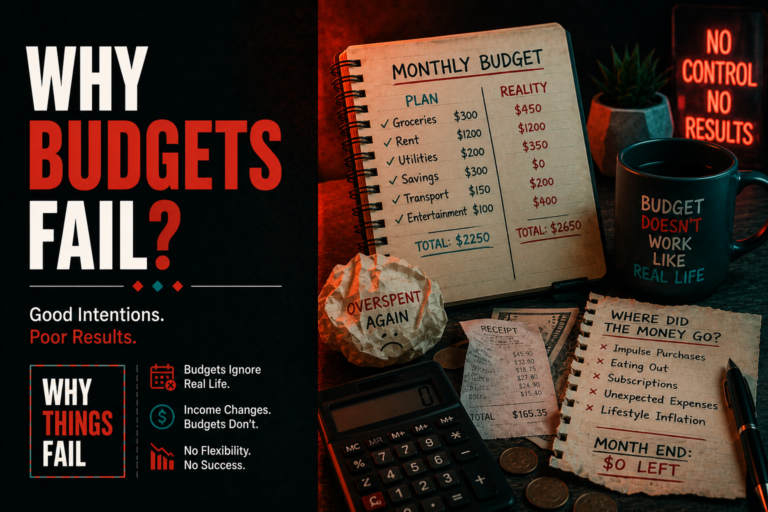
Budgets rarely fail because the numbers are wrong. They fail because human behaviour, emotional spending, unrealistic expectations, poor planning and inconsistent decision making gradually undermine even well designed financial plans. A successful budget is less about mathematics and more about psychology.
Introduction
Almost everyone believes budgeting is the foundation of good financial management.
Financial advisers recommend it. Businesses depend on it. Governments prepare annual budgets. Families create monthly spending plans in the hope of improving their financial future.
Yet despite its widespread acceptance, budgeting often fails.
Many people begin each month with a carefully prepared financial plan only to abandon it within weeks. Businesses regularly exceed operating budgets despite detailed forecasts. Governments announce spending targets that are later revised as costs continue rising.
This raises an important question.
If budgeting is one of the oldest financial management tools, why does it fail so often?
The obvious explanation is poor arithmetic.
The deeper explanation is far more interesting.
Budgets are not simply financial documents. They are behavioural commitments. Every budget assumes that future decisions will remain consistent with present intentions.
That assumption frequently proves incorrect.
Understanding why budgets fail requires looking beyond spreadsheets and expense categories. It requires examining the psychological forces, incentives and decision making patterns that quietly weaken financial discipline long before the numbers begin to drift.
What Is Budget Failure?
Budget failure is often misunderstood.
Many people believe a budget has failed the moment spending exceeds the planned amount.
In reality, occasional deviations are normal. Unexpected expenses, changing priorities and economic uncertainty affect every household and organisation.
True budget failure occurs when financial plans consistently fail to influence behaviour.
The budget exists on paper, but everyday decisions ignore it.
Income is earned.
Money is allocated.
Spending gradually moves away from the original plan.
Savings goals are postponed.
Debt increases.
Financial pressure grows.
Eventually the budget is abandoned, not because it was impossible, but because it no longer reflected actual behaviour.
Budget failure therefore represents a failure of execution rather than calculation.
The Biggest Myth
The most common belief about budgeting is simple.
People fail because they lack self control.
This explanation sounds reasonable, yet it ignores decades of behavioural research.
Most people genuinely intend to follow their budgets.
They do not wake each morning planning to overspend.
Instead, they encounter hundreds of small decisions throughout the month.
Each decision appears insignificant.
A meal ordered for convenience.
An online purchase during a sale.
An unexpected social event.
A subscription that remains unnoticed.
None of these choices seems capable of causing financial difficulty.
Collectively, they reshape the entire budget.
The problem is therefore not a single act of irresponsibility.
It is the accumulation of ordinary decisions made without recognising their long term consequences.
Budgeting fails not because people refuse to plan.
It fails because planning and behaviour often operate independently.
What Usually Happens?
The pattern is remarkably consistent.
A person creates a realistic monthly budget.
The first few days go well.
Unexpected expenses begin to appear.
Small discretionary purchases increase.
The budget becomes slightly inaccurate.
Instead of making adjustments, spending continues.
Feelings of frustration replace confidence.
Tracking expenses becomes less frequent.
The budget is eventually ignored until the following month, when the entire process begins again.
Businesses often experience a similar cycle.
Departments receive annual spending limits.
Early performance appears manageable.
New opportunities emerge.
Operating costs increase.
Forecasts become outdated.
Managers justify additional spending because each individual decision appears reasonable.
By the end of the financial period, the original budget bears little resemblance to actual expenditure.
Although the circumstances differ, the behavioural pattern remains strikingly similar.
Budget failure develops gradually through repeated small decisions rather than one dramatic financial mistake.
Understanding budget failure requires moving beyond numbers and examining human behaviour.
Why Do Budgets Fail?
Budgets assume people will consistently make rational financial decisions.
Behavioural economics suggests otherwise.
Human beings rarely evaluate money through pure logic. Decisions are influenced by emotion, habits, social expectations, cognitive biases and immediate rewards.
These psychological forces quietly reshape financial behaviour long before anyone notices that the budget is failing.
Present Bias Encourages Immediate Rewards
One of the strongest explanations comes from behavioural economics.
People naturally value immediate satisfaction more highly than future benefits.
This tendency is known as present bias.
Saving money for a goal six months away provides little emotional reward today.
Buying something enjoyable produces an immediate feeling of satisfaction.
The brain therefore places greater value on today’s pleasure than tomorrow’s financial security.
Budgets repeatedly ask people to sacrifice immediate enjoyment for future stability.
Psychologically, this is far more difficult than it appears.
The challenge is not understanding the value of saving.
The challenge is resisting rewards that are available immediately.
Emotional Spending Replaces Rational Spending
Many purchasing decisions have little to do with genuine financial need.
People spend money when they feel stressed.
They reward themselves after achieving personal goals.
They shop out of boredom.
They celebrate important occasions.
They seek comfort during periods of disappointment.
Money becomes a tool for emotional regulation rather than financial management.
A carefully prepared budget cannot anticipate changing emotional states throughout the month.
This explains why spending often increases during periods of stress even when income remains unchanged.
The numbers remain the same.
Human behaviour changes.
Lifestyle Inflation Quietly Expands Every Budget
As income increases, spending usually follows.
Economists describe this pattern as lifestyle inflation.
A higher salary often leads to a larger home, newer vehicles, premium subscriptions, expensive holidays and greater everyday spending.
None of these decisions appears unreasonable individually.
Collectively they eliminate the financial flexibility created by higher earnings.
Ironically, many people earning significantly more than they did five years earlier continue feeling financially constrained.
Their income has increased.
Their financial commitments have increased even faster.
The budget therefore struggles because fixed expenses continuously expand to match available income.
People Budget With Optimism Instead Of Evidence
Another common reason budgets fail is unrealistic forecasting.
People estimate future behaviour based on their best intentions rather than historical evidence.
They assume they will spend less on entertainment.
They expect fewer unexpected expenses.
They believe they will cook more meals at home.
They plan to avoid unnecessary shopping.
These expectations reflect optimism rather than observed behaviour.
Behavioural psychologists call this the planning fallacy.
People consistently underestimate the time, effort and resources required to achieve future goals.
Budgets built on optimistic assumptions are difficult to sustain because they do not reflect how people actually behave.
Social Pressure Influences Spending More Than Most People Realise
Financial decisions rarely occur in isolation.
Friends invite us to restaurants.
Colleagues organise celebrations.
Family expectations influence holidays, birthdays and major purchases.
Social media constantly exposes people to lifestyles that appear desirable and attainable.
These influences reshape spending priorities without conscious awareness.
Many purchases are made not because they improve financial wellbeing, but because they support belonging, status or social acceptance.
The budget gradually loses influence as external expectations become stronger than internal financial goals.
Poor Financial Feedback Delays Behavioural Change
One of the most overlooked reasons budgets fail is delayed feedback.
Most financial decisions produce immediate enjoyment but delayed consequences.
A credit card purchase feels rewarding today.
The financial impact becomes visible weeks later.
Small discretionary purchases rarely create immediate financial stress.
Instead, they accumulate gradually until the monthly budget has already been exceeded.
Because consequences arrive slowly, people struggle to connect individual spending decisions with long term financial outcomes.
This weak feedback loop makes poor habits difficult to recognise and even harder to correct.
Warning Signs
Budget failure rarely begins with a financial crisis. It begins with subtle behavioural changes that appear harmless until they become recurring habits.
One warning sign is stopping expense tracking after only a few weeks. People often monitor spending carefully at the beginning of the month but gradually lose interest once daily life becomes busy. Without regular feedback, small spending decisions accumulate unnoticed.
Another warning sign is relying on credit cards to maintain a planned lifestyle. Borrowing temporarily hides the gap between income and expenditure, creating the illusion that the budget is still working. In reality, future income has already been committed to past spending.
Repeatedly adjusting the budget to justify unnecessary purchases is another indicator. Instead of questioning spending decisions, people modify the budget itself. Over time, the budget becomes a record of past behaviour rather than a guide for future decisions.
Ignoring irregular expenses is equally common. Car repairs, medical bills, insurance renewals and home maintenance are predictable over the long term even if their exact timing is uncertain. Budgets that fail to account for these costs often appear successful until unexpected expenses suddenly create financial pressure.
Perhaps the strongest warning sign is believing that the following month will naturally be better. This optimism delays meaningful behavioural change because people expect future discipline to solve problems created by present decisions.
These warning signs are often ignored because none appears serious on its own. Together, however, they steadily weaken financial control until the budget becomes ineffective.
What Could Have Prevented It?
Most budget failures cannot be prevented by creating more detailed spreadsheets or stricter spending limits.
They are prevented by designing financial systems that recognise how people actually behave.
A realistic budget begins with historical spending rather than optimistic expectations. Reviewing previous months provides a far more reliable foundation than assuming future behaviour will suddenly improve.
Flexibility is equally important. Financial plans should accommodate unexpected expenses because uncertainty is a normal part of life. Budgets that leave no room for change often collapse after the first unforeseen cost.
Regular reviews create another important safeguard. Monthly or weekly assessments provide immediate feedback, allowing small problems to be corrected before they become significant financial difficulties.
Automation can also reduce behavioural mistakes. Automatic savings, bill payments and investment contributions reduce the number of decisions that rely on daily willpower. The fewer opportunities there are for emotional spending, the greater the likelihood of maintaining financial discipline.
Most importantly, budgeting should focus on changing behaviour rather than controlling every pound. Numbers alone cannot improve financial outcomes unless they influence everyday decisions.
Lessons
The failure of a budget reveals broader lessons about money, business and decision making.
The first lesson is that financial success depends more on consistent behaviour than perfect planning. Even the most detailed budget becomes ineffective if daily decisions repeatedly contradict it.
Another lesson is that human behaviour is strongly influenced by immediate rewards. Financial plans that ignore psychological realities often fail because they expect rational decisions in situations dominated by emotion.
Budget failure also demonstrates that small decisions matter more than dramatic ones. Rarely does one expensive purchase create lasting financial problems. Instead, repeated everyday choices gradually reshape financial outcomes over months and years.
Perhaps the most valuable lesson is that successful financial systems reduce dependence on willpower. They create environments where good decisions become easier and poor decisions become less frequent.
Failure Pattern
The dominant pattern behind budget failure is Poor Financial Discipline reinforced by Present Bias and Lifestyle Inflation.
People naturally prioritise immediate satisfaction over future financial security. As income grows, spending expectations often grow alongside it. At the same time, emotional purchases, social pressure and unrealistic optimism gradually weaken financial discipline.
This pattern appears repeatedly across households, businesses and even governments. Revenue increases create confidence, confidence encourages greater spending and greater spending eventually reduces financial flexibility.
The numbers may differ, but the behavioural cycle remains remarkably consistent.
Hidden Lesson
The greatest weakness in most budgets is not poor mathematics.
It is the assumption that future behaviour will always reflect present intentions.
Budgets are written by the rational mind but lived through emotion, habit and uncertainty.
The deeper truth is that financial failure rarely begins when money runs out. It begins when everyday decisions quietly stop supporting long term financial objectives. The budget simply reveals behavioural patterns that have already been developing beneath the surface.
Failure Scorecard
| Area | Score | Explanation |
| Financial Discipline | 4/10 | Many budgets fail because spending habits remain inconsistent with financial goals. |
| Decision Making | 5/10 | Emotional purchases and optimism frequently influence spending decisions. |
| Risk Management | 5/10 | Unexpected expenses are often underestimated or ignored entirely. |
| Long Term Thinking | 4/10 | Immediate gratification regularly outweighs future financial stability. |
| Financial Knowledge | 6/10 | Most people understand budgeting principles but struggle to apply them consistently. |
| Emotional Control | 4/10 | Stress, celebrations and social situations frequently alter spending behaviour. |
| Planning | 5/10 | Budgets are often based on optimistic assumptions instead of historical spending patterns. |
| Adaptability | 6/10 | Successful budgets evolve with changing circumstances, while unsuccessful ones remain unrealistic. |
Key Takeaways
- Budgets fail because behaviour changes more easily than financial plans.
- Present bias encourages immediate spending over future financial security.
- Emotional spending quietly weakens even well designed budgets.
- Lifestyle inflation often removes the financial benefits of higher income.
- Small daily decisions have a greater long term impact than occasional large purchases.
- Financial systems are more reliable than relying solely on willpower.
- Regular financial reviews identify problems before they become crises.
- Lasting financial discipline comes from consistent habits rather than perfect budgets.
Frequently Asked Questions
Why do budgets fail even when people have good intentions?
Budgets fail because good intentions are often replaced by emotional spending, present bias and changing priorities. Behaviour frequently differs from financial plans.
What is the biggest reason budgets fail?
The biggest reason is inconsistent behaviour. Most budgets are based on ideal spending patterns rather than actual spending habits.
Can a simple budget be more effective than a detailed one?
Yes. A simple budget that people consistently follow is usually more effective than a detailed budget that is ignored after a few weeks.
Why is emotional spending difficult to control?
Emotional spending provides immediate psychological rewards while the financial consequences appear much later. This delayed feedback makes poor spending habits difficult to recognise.
How can people make budgets more realistic?
Budgets become more realistic when they are based on previous spending behaviour, include allowances for unexpected expenses and are reviewed regularly instead of being created once and forgotten.
Conclusion
Budgets rarely fail because people cannot calculate income and expenses. They fail because financial plans must compete with emotion, habit, uncertainty and the desire for immediate gratification. Every budget is ultimately a behavioural system rather than a mathematical exercise.
Understanding why budgets fail changes the conversation from blaming poor discipline to recognising predictable patterns of human behaviour. The numbers merely record financial outcomes. The real causes lie in the everyday decisions that quietly shape those outcomes long before the budget reveals them.