Quick Answer
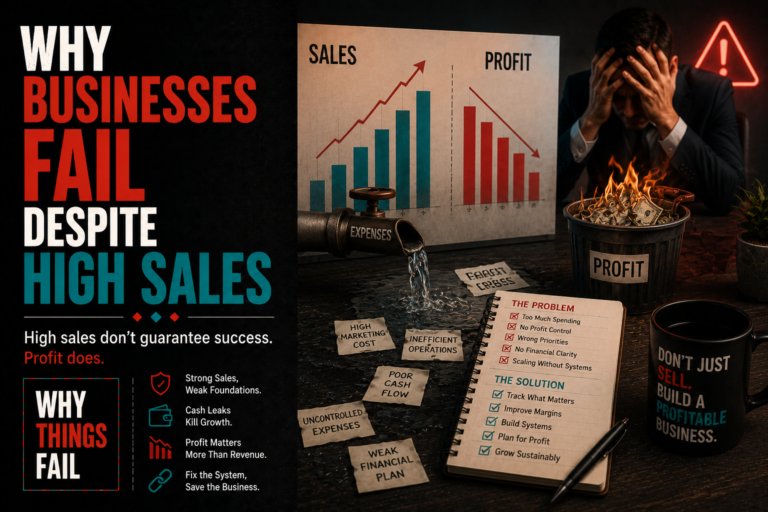
Businesses rarely fail because they cannot generate sales. More often, they fail because revenue is mistaken for profitability. Weak cash flow management, poor decision making, rapid expansion, thin profit margins and behavioural biases gradually erode financial stability until the business can no longer survive.
Introduction
High sales are often seen as the ultimate measure of business success.
Customers are buying. Revenue is increasing. The company appears busy and employees remain occupied. From the outside, the business looks healthy and profitable.
Yet every year, thousands of businesses with impressive sales figures close their doors.
Restaurants with fully booked tables file for bankruptcy. Ecommerce brands generating millions in annual revenue run out of cash. Construction companies with long project pipelines collapse before completing their contracts. Fast growing startups attract customers but still fail to survive.
This contradiction confuses many entrepreneurs.
How can a business that sells so much still fail?
The answer reveals one of the most misunderstood truths in business.
Sales create revenue.
They do not automatically create financial strength.
Understanding why businesses fail despite high sales requires looking beyond income statements. It requires examining cash flow, incentives, leadership, decision making, financial psychology and the systems that determine whether a company can survive periods of uncertainty.
Business failure is rarely caused by one poor month.
It is usually the result of hundreds of decisions that quietly weaken resilience until even strong sales can no longer prevent collapse.
What Is Business Failure Despite High Sales?
A business can generate significant revenue while steadily moving towards insolvency.
This happens because revenue measures how much money enters the business through sales.
Profit measures what remains after expenses.
Cash flow measures whether the business has enough available money to meet its financial obligations.
These are three very different measurements.
A company may report record sales while simultaneously struggling to pay suppliers, employees, taxes or loan repayments.
Customers continue buying products.
Revenue continues growing.
Yet the business gradually loses the financial flexibility needed to operate.
Eventually, cash runs out before opportunities do.
This explains why many companies fail during periods of growth rather than decline.
Growth increases complexity, operating costs and financial commitments. Without disciplined financial management, higher sales simply accelerate existing weaknesses.
The Biggest Myth
The most common belief in business is remarkably simple.
More sales automatically mean a stronger business.
This assumption encourages entrepreneurs to focus almost entirely on increasing revenue.
Marketing budgets expand.
Sales targets become increasingly ambitious.
New customers become the primary objective.
Far less attention is given to profitability, cash flow management or operational efficiency.
The result is a dangerous misunderstanding.
Revenue creates activity.
Profit creates sustainability.
Cash flow creates survival.
A business cannot pay wages, suppliers or taxes with impressive revenue figures alone.
It needs available cash at the right time.
Many companies therefore fail not because customers disappear but because financial obligations arrive before incoming payments.
The true measure of business health is not how much a company sells.
It is whether those sales create sustainable financial resilience.
What Usually Happens?
The pattern is surprisingly consistent across industries.
Sales begin increasing.
Management becomes optimistic.
The business hires additional employees, leases larger premises and invests in equipment to support future demand.
Operating expenses rise.
Inventory expands.
Borrowing increases.
Profit margins begin shrinking.
Cash becomes increasingly difficult to manage.
Because sales remain strong, these warning signs receive little attention.
Leaders believe continued growth will eventually solve every financial problem.
Instead, growth magnifies weaknesses that already exist.
One unexpected event, delayed customer payment or increase in operating costs suddenly exposes years of accumulated financial pressure.
The business appears successful until the day it can no longer meet its obligations.
Why Does It Happen?
The collapse of businesses with strong sales is rarely caused by poor products or weak customer demand.
More often, failure develops through the interaction of behavioural decisions, financial systems and organisational incentives.
Revenue Creates A False Sense Of Security
High sales generate confidence.
Confidence influences judgement.
When entrepreneurs see increasing revenue, they naturally assume the business is becoming stronger.
This psychological response is understandable but often misleading.
Revenue is highly visible.
Cash flow problems are not.
A growing business can therefore appear healthier than it actually is.
Management celebrates sales records while quietly extending supplier payments, increasing borrowing or delaying essential investments.
The business becomes financially weaker even as revenue continues climbing.
The danger lies in confusing activity with stability.
Busy businesses are not always healthy businesses.
Overconfidence Encourages Rapid Expansion
Success changes decision making.
A company experiencing strong sales often believes current demand will continue indefinitely.
Management opens additional locations.
Production capacity increases.
More employees are recruited.
Marketing expenditure grows.
These decisions may appear logical during periods of expansion.
However, they also increase fixed costs and long term financial commitments.
Behavioural economists describe this as overconfidence bias.
Previous success convinces leaders that future outcomes are equally predictable.
Risk begins to feel smaller than it actually is.
The business gradually loses flexibility because expenses become increasingly difficult to reduce when market conditions change.
Growth itself is not the problem.
Uncontrolled growth is.
Cash Flow Is More Important Than Revenue
Many entrepreneurs underestimate the importance of cash flow because it receives less attention than sales figures.
A business may invoice customers today but receive payment several months later.
Meanwhile, wages, rent, suppliers, taxes and loan repayments must still be paid.
This creates a timing problem.
Revenue exists on paper.
Cash is unavailable in reality.
As this gap widens, businesses become increasingly dependent on overdrafts, short term borrowing or delayed supplier payments.
Eventually, even profitable companies experience liquidity problems.
Cash flow does not simply support operations.
It determines whether operations can continue at all.
Thin Profit Margins Leave No Room For Error
Some businesses generate extraordinary sales while earning very little profit on each transaction.
At first glance, this appears manageable because revenue continues increasing.
The problem emerges when costs unexpectedly rise.
Inflation increases supplier prices.
Interest rates increase borrowing costs.
Shipping becomes more expensive.
Customer demand slows.
Businesses operating with thin margins have little financial cushion to absorb these shocks.
Every additional sale creates more work but not necessarily more financial strength.
The company becomes trapped in a cycle where increasing sales require increasing expenditure while profitability remains fragile.
Poor Decision Making Gradually Weakens Financial Health
Business failure rarely begins with one catastrophic mistake.
It usually begins with many reasonable decisions made without considering their combined impact.
Hiring one additional employee.
Purchasing more inventory.
Offering longer payment terms.
Accepting lower profit margins to increase market share.
Borrowing to finance expansion.
Each decision appears manageable in isolation.
Together, they create a financial system that depends on continuous growth to survive.
Once growth slows, the weaknesses become impossible to ignore.
Incentives Often Reward Revenue Instead Of Profit
Many organisations unintentionally encourage behaviour that increases sales while reducing financial stability.
Sales teams receive bonuses based on revenue.
Managers are rewarded for expansion.
Investors celebrate rapid growth.
Very few incentives prioritise cash flow, profitability or capital efficiency.
This creates conflicting objectives throughout the organisation.
Employees optimise for sales because that is how success is measured.
The business quietly sacrifices long term resilience for short term performance.
Eventually, impressive revenue masks deteriorating financial fundamentals until the organisation reaches a point where recovery becomes increasingly difficult.
Warning Signs
Business failure rarely arrives without warning. The difficulty is that warning signs often appear during periods of rapid growth, when management feels most confident about the future.
One of the earliest warning signs is consistently declining cash reserves despite increasing sales. Revenue continues to grow, but the business struggles to pay suppliers, salaries or tax obligations on time. This imbalance suggests that growth is consuming cash faster than it is generating financial strength.
Another warning sign is relying heavily on debt to finance everyday operations. Borrowing can support strategic expansion, but when loans become necessary to cover routine expenses, the business has begun depending on external funding rather than sustainable profitability.
Shrinking profit margins also deserve close attention. Many businesses celebrate record revenue while ignoring the fact that each additional sale contributes less profit than before. Increased sales without healthy margins create more activity but not more resilience.
Rapid hiring without proportional improvements in productivity is another indicator. Expanding payroll increases fixed costs and reduces financial flexibility. If demand slows unexpectedly, these commitments quickly become difficult to sustain.
Delayed supplier payments should never be viewed as a normal business practice. Extending payment terms may temporarily improve liquidity, but it often signals underlying cash flow pressure rather than financial health.
Perhaps the most dangerous warning sign is leadership becoming obsessed with revenue while ignoring profitability and cash flow. Businesses rarely collapse because sales suddenly disappear. They collapse because management focuses on visible growth while overlooking the financial systems supporting that growth.
What Could Have Prevented It?
Businesses that survive periods of rapid growth usually share one characteristic.
They manage financial systems with the same discipline they apply to generating sales.
Cash flow forecasting is one of the most effective safeguards. Leaders who regularly project future inflows and outflows identify financial pressure before it becomes a crisis. This allows corrective action while options remain available.
Maintaining healthy profit margins is equally important. Growth should strengthen financial resilience rather than simply increase operational complexity. Businesses that pursue every sales opportunity regardless of profitability often become larger but financially weaker.
Disciplined expansion also reduces unnecessary risk. Every new employee, location or investment should improve long term sustainability rather than satisfy short term optimism. Sustainable growth allows organisations to adapt when economic conditions change.
Decision making improves when performance is measured using multiple indicators rather than revenue alone. Profit margins, operating cash flow, working capital, customer acquisition costs and return on invested capital provide a more complete picture of financial health.
Finally, leadership should actively challenge optimistic assumptions. Encouraging constructive disagreement, scenario planning and regular financial reviews prevents overconfidence from becoming embedded within organisational culture.
Successful businesses rarely eliminate uncertainty.
They build systems capable of surviving it.
Lessons
The failure of businesses with strong sales reveals lessons that extend far beyond entrepreneurship.
The first lesson is that revenue measures demand, not financial strength. Customers may value a product while the business quietly loses its ability to finance operations.
The second lesson is that growth magnifies existing weaknesses. Efficient businesses often become stronger through expansion, while poorly managed businesses accelerate their own decline because every additional sale increases financial pressure.
Another lesson is that financial discipline matters more than public perception. A business praised for rapid growth may be significantly weaker than a smaller competitor with consistent profitability and healthy cash flow.
Perhaps the most important lesson is that business success depends on balancing ambition with discipline. Pursuing expansion without understanding financial consequences creates vulnerability that remains hidden until conditions become difficult.
Failure Pattern
The dominant pattern behind this form of business failure is Poor Financial Discipline combined with Overconfidence and Weak Cash Flow Management.
The pattern begins with strong sales.
Revenue creates optimism.
Optimism encourages expansion.
Expansion increases operating costs, financial commitments and organisational complexity.
Management assumes future growth will solve emerging financial problems.
Instead, every new commitment increases dependence on continuous revenue growth.
When customer payments slow, costs rise or market conditions change, the business discovers that impressive sales never translated into sustainable financial resilience.
This pattern appears repeatedly across retail, hospitality, manufacturing, technology startups and construction because it reflects human behaviour rather than industry specific challenges.
Leaders naturally celebrate visible success.
Financial weakness develops quietly.
Hidden Lesson
Businesses rarely fail because they cannot generate customers.
They fail because they misunderstand what keeps a business alive.
Sales create opportunity.
Cash flow creates survival.
The deeper lesson is that financial collapse often begins during periods of apparent success. Growth creates confidence, confidence reduces caution and reduced caution weakens the financial systems that support long term stability.
The market does not punish businesses for growing.
It punishes businesses that mistake growth for financial strength.
Failure Scorecard
| Area | Score | Explanation |
| Financial Discipline | 4/10 | Revenue often receives greater attention than profitability and cash flow. |
| Decision Making | 5/10 | Growth decisions are frequently influenced by optimism instead of financial evidence. |
| Risk Management | 4/10 | Expansion increases fixed costs without adequate contingency planning. |
| Long Term Thinking | 5/10 | Short term sales targets often outweigh sustainable financial planning. |
| Financial Knowledge | 6/10 | Many leaders understand revenue but underestimate working capital and liquidity management. |
| Emotional Control | 5/10 | Confidence during rapid growth can reduce objective judgement. |
| Planning | 4/10 | Financial forecasting and scenario analysis are often neglected during expansion. |
| Adaptability | 6/10 | Businesses that monitor financial indicators adjust more effectively to changing market conditions. |
Key Takeaways
- High sales do not guarantee business success.
- Cash flow determines whether a business can continue operating.
- Profitability is more important than revenue growth alone.
- Rapid expansion increases financial risk when systems cannot support growth.
- Strong financial management prevents growth from becoming a liability.
- Overconfidence often causes leaders to ignore early warning signs.
- Sustainable businesses measure success through profit, cash flow and operational resilience rather than sales alone.
- Long term survival depends on disciplined decision making instead of continuous expansion.
Frequently Asked Questions
Why can a business fail even with high sales?
Because revenue does not guarantee profitability or positive cash flow. A business may generate substantial sales while lacking enough available cash to pay employees, suppliers and other financial obligations.
What is the difference between sales and profit?
Sales represent total revenue generated from customers. Profit is the amount remaining after all business expenses have been deducted. High sales with low profit can still lead to financial failure.
Why is cash flow more important than revenue?
Cash flow determines whether a business can meet its financial commitments when payments are due. Without sufficient liquidity, even profitable businesses can become insolvent.
What is the biggest mistake growing businesses make?
Many businesses expand too quickly without ensuring that profitability, cash flow and operational systems can support additional growth. This creates financial pressure that becomes difficult to reverse.
How can businesses avoid failing despite high sales?
By monitoring cash flow, protecting profit margins, controlling operating costs, expanding gradually and making decisions based on financial sustainability rather than revenue growth alone.
Conclusion
Businesses rarely fail because customers stop buying. They fail because increasing sales often conceal weakening financial foundations. Revenue creates momentum, but only disciplined cash flow management, healthy profitability and sound decision making create resilience.
Understanding this changes how business success is measured. The strongest organisations are not always those with the highest sales. They are the ones that convert growth into lasting financial strength through disciplined systems, balanced leadership and decisions that remain sustainable long after the excitement of rising revenue has passed.