Quick Answer
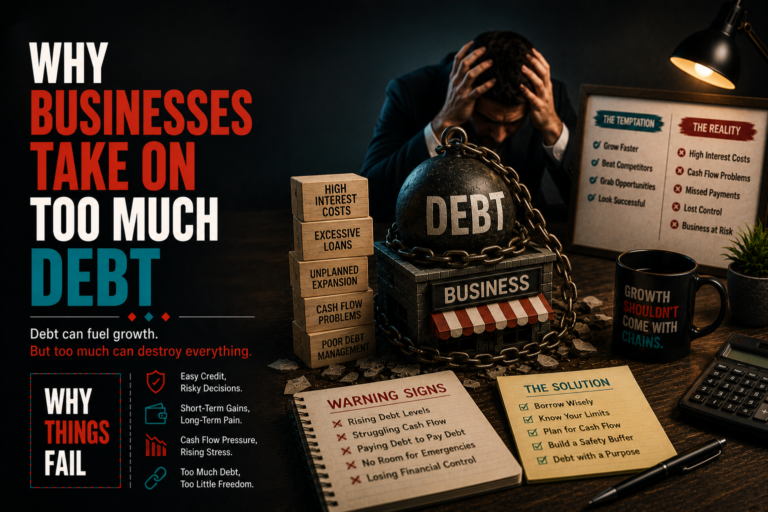
Businesses rarely fail simply because they borrow money. They fail because debt gradually becomes a substitute for sustainable growth. Overconfidence, poor decision making, weak cash flow management, unrealistic growth expectations and behavioural biases often encourage businesses to borrow beyond their ability to repay. Debt becomes dangerous when it finances optimism instead of resilience.
Introduction
Debt has helped build some of the world’s largest companies. It finances expansion, supports innovation and allows businesses to invest before profits are fully realised. Used carefully, debt is an important financial tool that can accelerate growth and improve competitiveness.
Yet history tells another story.
Many successful businesses have collapsed under the weight of borrowing they once believed was manageable. Economic downturns, rising interest rates and declining sales often receive the blame, but these events usually expose problems that had been developing for years.
The important question is not why debt exists.
The more revealing question is why intelligent business owners repeatedly take on more debt than their businesses can safely support.
This question matters because excessive borrowing affects businesses of every size. Family businesses, start ups, multinational corporations and rapidly growing companies all face the same temptation. Access to credit can create opportunities, but it can also encourage decisions that weaken long term financial stability.
Understanding why businesses take on too much debt requires looking beyond balance sheets and loan agreements. It requires examining the psychology of decision making, the incentives that reward rapid growth and the behavioural patterns that make financial failure increasingly predictable.
What Is Excessive Business Debt?
Business debt becomes excessive when borrowing grows faster than the company’s ability to generate reliable cash flow.
The amount borrowed is not the defining issue.
A large company may safely manage billions in liabilities because its income, profitability and liquidity support those obligations. A much smaller loan can overwhelm another business if revenue becomes unstable or operating costs continue rising.
Excessive debt therefore reflects an imbalance between financial commitments and financial resilience.
The danger often develops gradually.
Businesses continue making loan repayments during periods of strong sales. Confidence grows because obligations appear affordable. Management begins believing additional borrowing will produce even greater growth.
The business becomes increasingly dependent on favourable economic conditions.
When those conditions change, debt that once appeared manageable quickly becomes a source of financial pressure.
According to the Federal Reserve’s most recent Small Business Credit Survey, 41% of small firms in 2024 said they were denied financing specifically because of debt they already carried up sharply from 22% in 2021. That’s a direct, data-backed picture of how debt loads compound over time.
The Biggest Myth
The most common belief is that businesses fail because they borrow too much.
This explanation is only partly true.
Businesses rarely collapse the moment they sign a loan agreement.
Failure usually begins much earlier.
The real problem is not borrowing itself.
The real problem is borrowing without fully understanding future uncertainty.
Debt becomes dangerous when it finances unrealistic expectations rather than sustainable growth.
Many successful companies use borrowing responsibly for decades because every financial decision is supported by realistic cash flow forecasts, disciplined risk management and careful capital allocation.
Unsuccessful businesses often view debt as a solution to existing weaknesses.
Instead of improving profitability, operational efficiency or customer value, they continue borrowing to maintain growth that the business cannot naturally support.
Debt therefore becomes a symptom rather than the original cause.
The deeper causes lie within leadership decisions, organisational incentives and human psychology.
What Usually Happens?
The pattern is remarkably consistent.
A business experiences steady growth.
Management becomes increasingly optimistic.
Expansion plans become more ambitious.
Borrowing appears inexpensive and easily available.
New loans finance additional staff, equipment, acquisitions or expansion into new markets.
Initially, revenue continues growing.
Confidence increases.
Success reinforces the belief that further borrowing will produce even greater success.
Over time, financial commitments increase faster than financial flexibility.
Interest payments consume more operating income.
Cash flow becomes increasingly sensitive to even small changes in sales.
An economic slowdown, higher borrowing costs or unexpected disruption eventually exposes the growing imbalance.
The business does not suddenly become weak.
Its financial resilience has been gradually declining beneath the surface for years.
Why Do Businesses Take On Too Much Debt?
This is where financial failure becomes far more interesting than simple accounting.
Most businesses do not intentionally create excessive debt.
They gradually drift towards it through a series of decisions that appear reasonable when viewed individually.
Each decision seems justified.
Collectively, they increase financial vulnerability.
Overconfidence Creates The Illusion Of Permanent Growth
One of the strongest behavioural forces behind excessive borrowing is overconfidence.
Periods of strong revenue growth encourage business leaders to believe future success will closely resemble recent success.
Expansion plans become increasingly ambitious because previous decisions appeared successful.
This confidence often changes how risk is perceived.
Management begins viewing debt as an accelerator rather than a financial obligation.
Sales forecasts become more optimistic.
Future demand appears more predictable.
Potential risks receive less attention.
Behavioural economists have repeatedly found that success often reduces perceived uncertainty. Leaders become more willing to accept financial commitments because previous positive outcomes create the impression that future outcomes are equally controllable.
Markets, however, rarely reward certainty for long.
Economic conditions change.
Consumer demand shifts.
Competition increases.
Costs rise unexpectedly.
Businesses that borrowed on the assumption of uninterrupted growth suddenly discover that their financial structure was designed for optimism rather than resilience.
Growth Becomes More Important Than Sustainability
Modern business environments frequently reward visible growth.
Investors celebrate expanding revenue.
Banks support businesses demonstrating rapid expansion.
Competitors encourage management to grow quickly in order to protect market share.
These incentives create a powerful psychological effect.
Growth gradually becomes the primary objective, while financial resilience becomes secondary.
Leaders begin measuring success through larger offices, additional locations, increased production capacity and higher revenue instead of sustainable profitability.
Debt appears to solve every obstacle.
When internal profits cannot finance expansion quickly enough, borrowing becomes the preferred alternative.
The danger is that rapid expansion often creates permanent financial obligations while the expected increase in revenue remains uncertain.
Growth funded primarily through borrowing therefore increases exposure to future economic shocks.
Optimism Bias Distorts Financial Planning
Successful entrepreneurs are naturally optimistic.
Without optimism, few businesses would ever be created.
Yet the same characteristic that encourages entrepreneurship can also distort financial judgement.
Optimism bias encourages leaders to overestimate future opportunities while underestimating potential setbacks.
Sales forecasts become ambitious.
Operating costs appear manageable.
Loan repayments seem affordable.
Unexpected events receive little attention because management assumes favourable conditions will continue.
This bias does not result from poor intelligence.
It results from the human tendency to give greater weight to positive possibilities than negative probabilities.
Financial models built upon optimistic assumptions often perform well during favourable conditions.
They become fragile when reality proves less predictable than expected.
Poor Cash Flow Management Remains Hidden During Good Times
Many businesses focus primarily on revenue and profit while paying insufficient attention to cash flow.
This creates a dangerous misunderstanding.
A profitable business can still experience financial distress if cash entering the business arrives too slowly to meet immediate financial obligations.
Debt increases this pressure.
Loan repayments continue regardless of seasonal demand, delayed customer payments or temporary declines in revenue.
During periods of strong economic performance these pressures remain largely invisible.
When trading conditions weaken, however, businesses often discover that their greatest challenge is not profitability.
It is liquidity.
Cash flow, rather than profit, ultimately determines whether a business can continue meeting its financial commitments.
Poor Financial Education Creates False Confidence
Many business owners possess exceptional knowledge of their products, customers and industries. That expertise, however, does not always extend to corporate finance.
Borrowing decisions often focus on whether a lender is willing to provide capital rather than whether the business can comfortably support additional financial obligations through different economic conditions.
This creates a dangerous misconception.
Easy access to credit is often interpreted as evidence that borrowing is safe.
In reality, lenders evaluate whether loans can be secured and repaid under expected conditions. They cannot eliminate the uncertainty that businesses face after the funds have been borrowed.
Without a clear understanding of leverage, debt servicing, interest coverage, liquidity and cash reserves, management may underestimate how quickly financial flexibility can disappear.
Delayed Consequences Encourage Risk Taking
One reason excessive debt becomes so common is that its consequences rarely appear immediately.
A new loan often produces positive results in the beginning.
The business expands.
Revenue increases.
Operations appear stronger.
Employees become more confident.
Customers see visible growth.
These early successes reinforce the belief that borrowing was the correct decision.
Behavioural economists describe this as delayed feedback.
When risky decisions produce positive short term outcomes, people naturally repeat them.
The financial cost remains hidden until market conditions change.
By the time declining sales or higher interest costs expose the problem, the business has already accumulated obligations that cannot easily be reversed.
The collapse appears sudden.
The underlying behavioural mistakes developed over many years.
Warning Signs
Excessive debt rarely arrives without warning.
One of the earliest signs is declining cash flow despite increasing revenue. Sales continue growing, yet the business has less financial flexibility because more income is being used to service debt.
Another warning sign is borrowing to cover everyday operating expenses rather than productive investment. When loans finance payroll, rent or existing liabilities instead of creating future value, the business begins depending on debt to maintain normal operations.
Management may also become increasingly optimistic while financial performance becomes increasingly fragile. Expansion plans continue even though profit margins are narrowing and liquidity is weakening.
Ignoring stress testing is another common warning sign. Businesses often prepare financial forecasts based on expected success without asking how they would survive falling demand, rising interest rates or unexpected disruptions.
Perhaps the clearest warning sign is the belief that future growth will solve today’s financial pressures.
This assumption encourages businesses to postpone difficult decisions until circumstances leave few realistic options.
What Could Have Prevented It?
Preventing excessive debt begins with changing how borrowing is viewed.
Debt should support sustainable growth rather than replace it.
Every borrowing decision should be evaluated against realistic cash flow rather than optimistic revenue projections. Businesses that regularly test their finances against adverse economic conditions develop greater resilience because they recognise weaknesses before markets expose them.
Strong capital allocation also reduces unnecessary borrowing. Investment decisions should prioritise projects capable of generating measurable long term value rather than expanding simply because financing is available.
Corporate governance plays an equally important role. Leadership teams that encourage constructive disagreement and challenge optimistic assumptions are more likely to identify hidden financial risks before they become critical.
Most importantly, businesses should recognise that financial flexibility has value in itself. Maintaining reserves, controlling fixed costs and limiting unnecessary leverage often creates fewer opportunities for rapid expansion, but it significantly increases the ability to survive periods of uncertainty.
Lessons
The reasons businesses take on too much debt reveal broader lessons about financial failure.
The first lesson is that borrowing does not create sustainable success. It only brings future financial resources into the present. Long term prosperity still depends on profitable operations, disciplined management and consistent cash generation.
The second lesson is that growth without resilience creates hidden fragility. Businesses often celebrate expansion while overlooking whether their financial structure can withstand changing economic conditions.
Another lesson is that incentives strongly influence behaviour. Markets frequently reward rapid growth, encouraging leaders to prioritise expansion over financial stability. Without disciplined decision making, external expectations gradually shape internal strategy.
Perhaps the most important lesson is that financial failure usually develops quietly. It is rarely one dramatic decision that destroys a business. It is the accumulation of many small decisions that individually appear reasonable but collectively increase vulnerability.
Failure Pattern
The dominant pattern behind excessive business debt is Overconfidence combined with Poor Risk Management and Short Term Thinking.
Periods of success reduce caution.
Optimistic forecasts justify larger loans.
Easy access to credit encourages additional borrowing.
Growing obligations reduce financial flexibility.
When economic conditions change, businesses discover they built growth upon assumptions rather than resilience.
This pattern appears repeatedly across family businesses, property developers, retailers, technology companies and multinational corporations because it reflects predictable human behaviour rather than industry specific problems.
Hidden Lesson
Businesses rarely fail because debt exists.
They fail because debt gradually changes how decisions are made.
Once repayment obligations become a constant pressure, management begins making choices to protect cash flow rather than strengthen the business. Long term strategy gives way to short term survival.
The deeper truth is that excessive debt often removes the freedom that borrowing was originally intended to create.
Failure Scorecard
| Area | Score | Explanation |
| Financial Discipline | 4/10 | Borrowing often expands faster than financial resilience. |
| Decision Making | 5/10 | Optimism frequently outweighs objective risk assessment. |
| Risk Management | 3/10 | Many businesses underestimate leverage and economic uncertainty. |
| Long Term Thinking | 4/10 | Immediate expansion often receives greater attention than sustainable growth. |
| Financial Knowledge | 6/10 | Operational expertise is often stronger than financial understanding. |
| Emotional Control | 5/10 | Confidence and ambition frequently influence borrowing decisions. |
| Planning | 4/10 | Financial forecasts commonly assume favourable conditions will continue. |
| Adaptability | 6/10 | Businesses that adjust quickly survive, while highly leveraged businesses struggle to respond. |
Key Takeaways
- Businesses usually take on too much debt because optimism gradually replaces caution.
- Sustainable cash flow matters more than rapid revenue growth.
- Easy access to credit does not mean borrowing is low risk.
- Overconfidence often causes leaders to underestimate financial uncertainty.
- Strong risk management protects businesses during economic downturns.
- Debt should finance productive growth rather than ongoing operating expenses.
- Financial resilience is often more valuable than rapid expansion.
- Most business failures begin with small behavioural decisions rather than one major mistake.
Frequently Asked Questions
How much debt is too much for a small business? There’s no universal number what matters is the ratio between debt service and reliable cash flow, not the loan amount itself. A common early warning sign is when more than 30–40% of operating cash flow goes toward debt repayment, leaving little cushion for a bad month.
Can a profitable business still fail because of debt? Yes. Profit is an accounting measure; cash flow is what actually pays creditors. A business can show a profit on paper while still missing loan payments if customer payments arrive slower than obligations come due.
What’s a healthy debt-to-equity ratio for a small business? This varies significantly by industry, but many lenders view a debt-to-equity ratio above 2:1 as a signal for closer scrutiny. Capital-intensive industries like manufacturing typically carry higher ratios than service businesses.
What’s the difference between good debt and bad debt for a business? Good debt finances an asset or activity that generates enough return to cover its own cost equipment, inventory ahead of confirmed demand, or expansion into a validated market. Bad debt covers recurring operating shortfalls or expansion based on optimistic, untested assumptions the same trap described on the consumer side in Why Buy Now Pay Later Becomes a Debt Trap.
Why do lenders approving a loan not guarantee it’s a safe amount to borrow? Lenders assess whether a loan can be secured and is likely to be repaid under expected conditions at the time of approval. They aren’t forecasting how the business will perform under a downturn, a rate hike, or unexpected disruption that risk assessment is the borrower’s responsibility.
Conclusion
Businesses do not usually collapse because borrowing is inherently dangerous. They collapse because debt gradually magnifies weaknesses that already exist within decision making, financial planning and risk management. Economic downturns merely expose vulnerabilities that were created long before conditions deteriorated.
Understanding why businesses take on too much debt reveals a broader truth about financial failure. Lasting business success depends not on how much capital a company can borrow, but on how wisely its leaders balance ambition with resilience and growth with financial discipline.