Introduction: Why This Failure Matters
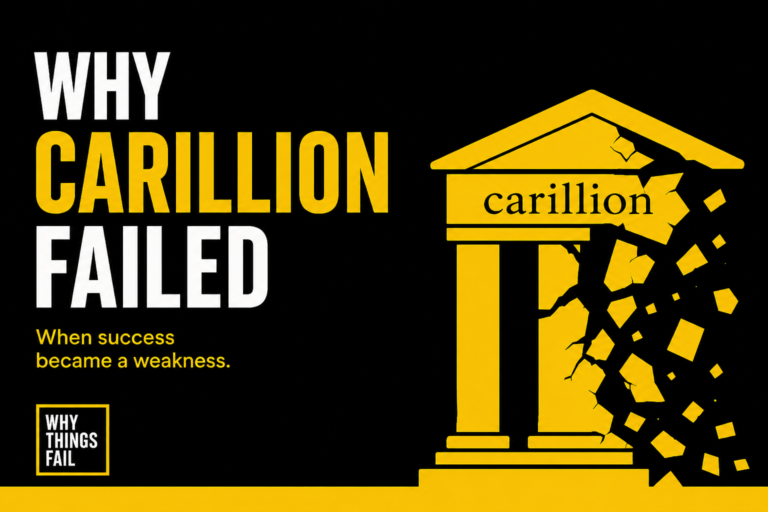
Carillion did not fail like a normal company.
It was not a small business that ran out of customers. It was not a startup that failed to find product-market fit. It was not a company destroyed by one sudden technological change.
Carillion was one of the UK’s largest construction and outsourcing companies. It built hospitals, maintained roads, delivered school meals, managed prisons, supported defence contracts, and worked deeply inside public services. When it collapsed in January 2018, the failure was not just a corporate event. It became a national warning.
The lesson of Carillion is uncomfortable because it shows how a company can look large, important, professional, and successful while quietly becoming fragile underneath.
Its collapse exposed weaknesses in leadership, accounting, public-sector outsourcing, audit, risk management, supplier treatment, pension obligations, and government dependency on private contractors.
Carillion matters because it proves that failure often begins long before the final crisis.
By the time a company collapses, the failure is usually already old.
Who Failed?
Carillion was a British construction and facilities management company.
At its peak, it was one of the UK’s biggest public-sector contractors. It worked across construction, infrastructure, maintenance, support services, and government outsourcing.
Carillion was involved in projects including hospitals, schools, roads, railways, prisons, military facilities, and local authority services.
By the time it collapsed in January 2018, Carillion had around 43,000 employees worldwide, including around 19,000 in the UK. It also had thousands of suppliers and subcontractors depending on it for payment.
The company went into compulsory liquidation on 15 January 2018.
Common Myth
Common Myth:
“Carillion failed because government outsourcing is bad.”
Reality:
Government outsourcing was part of the story, but it was not the full story.
Carillion failed because it built a business model that depended on winning contracts, reporting profits early, managing cash aggressively, delaying payments, carrying too much debt, underfunding long-term obligations, and pretending that weak contracts were stronger than they really were.
The deeper problem was not only outsourcing.
The deeper problem was a company that confused scale with strength.
Carillion became large, but not resilient.
1. What Happened?
Carillion grew through public contracts, construction projects, facilities management, and acquisitions.
For years, it appeared to be a successful British outsourcing giant. It paid dividends. It won major government contracts. It operated in essential sectors. It presented itself as stable, strategic, and valuable.
But beneath the surface, the company was under pressure.
Construction contracts are difficult businesses. They often involve fixed prices, long timelines, complex risks, delayed payments, cost overruns, legal disputes, and thin margins. A company can report profits today while future losses are still hidden inside unfinished projects.
Carillion had several large problematic contracts. It also had rising debt, pension obligations, stretched cash flow, and pressure to keep investors confident.
The crisis became visible in July 2017 when Carillion issued a major profit warning and announced an £845 million write-down on contracts. This was not a small adjustment. It was a signal that previous confidence had been badly misplaced.
More profit warnings followed. The company tried to secure rescue funding. It asked lenders and government for support. But confidence had already collapsed.
In January 2018, Carillion entered liquidation.
The collapse affected workers, suppliers, pension members, public services, government departments, and taxpayers.
But the real question is not only what happened.
The real question is why it was allowed to happen.
2. Why Did It Happen?
2.1 Carillion Chased Growth Without Building Strength
Carillion’s business model depended heavily on growth.
It needed to keep winning contracts. It needed to keep showing revenue. It needed to keep convincing investors that it was stable. It needed to keep paying dividends. It needed to keep suppliers waiting while cash was managed tightly.
This created a dangerous machine.
The company had to keep moving because stopping would reveal weakness.
Growth can hide problems for a long time. A company can win new contracts, increase revenue, and appear successful while its underlying economics deteriorate. New work creates the appearance of momentum. New contracts create optimism. New announcements make the business look alive.
But growth is not the same as profitability.
And profitability is not the same as cash.
Carillion’s failure shows one of the oldest business dangers: a company can grow itself into collapse.
2.2 It Treated Cash Flow Like A Tactical Problem, Not A Strategic Warning
Cash flow is not just a finance issue. It is a truth-telling system.
When a business reports profit but struggles to generate cash, something is wrong. It may be recognising profits too early. It may be delaying costs. It may be relying on supplier credit. It may be using accounting judgement to make today look better than tomorrow.
Carillion appeared to have a serious gap between reported performance and underlying cash reality.
One major criticism after the collapse was that Carillion relied heavily on aggressive working-capital management, including slow payment to suppliers.
This matters because delaying supplier payments can make cash flow look better temporarily.
But it does not create a healthy business.
It simply transfers pressure from the main company to smaller companies underneath it.
That is not resilience. That is hidden borrowing.
2.3 Suppliers Became A Source Of Finance
One of the darkest lessons from Carillion is how suppliers were effectively used as a financial buffer.
Large companies often have power over smaller suppliers. They can dictate payment terms. They can delay payments. They can demand discounts. They can create systems that improve their own cash position while weakening the businesses below them.
Carillion’s supplier network was huge. Many subcontractors depended on the company. When Carillion collapsed, many smaller businesses were exposed to unpaid invoices and uncertainty.
This is a failure pattern that appears in many large organisations.
When leadership wants to protect headline numbers, pressure gets pushed downward.
Executives protect dividends.
Management protects appearances.
Suppliers absorb the pain.
The company may look stronger for a while, but the ecosystem becomes weaker.
A business that survives by squeezing its suppliers is not building strength. It is consuming trust.
2.4 Dividends Continued While The Business Was Weakening
One of the most damaging features of the Carillion story was its commitment to dividends.
Dividends are not automatically wrong. They can reward shareholders and signal confidence. But when a company is under financial pressure, rising dividends can become dangerous theatre.
They tell the market: everything is fine.
They tell executives: protect the story.
They tell critics: the board is confident.
But if the underlying business is weakening, dividends can become a form of denial.
Carillion continued to present confidence even while its balance sheet, cash flow, pension position, and contract risks were becoming more serious.
This reveals a powerful human behaviour problem.
Leaders often fear the consequences of admitting weakness early.
So they continue the performance.
They hope the next contract, next refinancing, next negotiation, or next accounting period will solve the problem.
But when a company uses confidence as a substitute for correction, the eventual correction becomes much more severe.
2.5 Long-Term Contracts Created Space For Optimism
Construction and outsourcing contracts can be dangerous because they involve judgement.
How much profit should be recognised today?
How much cost will appear later?
How likely is a dispute to be resolved?
Will the client pay variations?
Will delays be recoverable?
Will the project finish on budget?
These questions are not always simple. They require estimates. And estimates create space for optimism, pressure, and manipulation.
If a company wants to look profitable, long-term contracts can allow profits to be recognised before cash arrives.
This does not mean every estimate is dishonest. But it does mean the system depends heavily on discipline.
Carillion’s problem was that optimistic assumptions appear to have become part of the business culture.
Weak contracts were not confronted early enough.
Losses were not recognised quickly enough.
Risks were not communicated clearly enough.
This is how financial failure often develops.
Not through one obvious lie.
But through hundreds of optimistic judgements that gradually detach the reported company from the real company.
2.6 Leadership Incentives Rewarded Appearance Over Resilience
Carillion’s leadership had strong incentives to maintain confidence.
Share price matters. Investor perception matters. Dividend policy matters. Contract wins matter. Executive reputation matters.
But these incentives can become dangerous when they reward short-term appearance over long-term survival.
A leadership team can become trapped by its own story.
Once the company has told the market it is strong, admitting weakness becomes harder.
Once it has promised dividends, cutting them becomes embarrassing.
Once it has presented contracts as profitable, writing them down becomes painful.
Once it has built its identity around being a major public-sector partner, admitting fragility threatens the whole image.
This is why failure is often psychological before it is financial.
The numbers collapse last.
The denial comes first.
2.7 The Board Failed To Challenge Hard Enough
A board’s job is not to admire management.
A board’s job is to challenge management.
In a company like Carillion, the board should have been asking difficult questions repeatedly:
Why is cash so weak compared with reported profit?
Why are suppliers being paid so slowly?
Why are dividends rising while debt and pension obligations remain serious?
Why are large contracts carrying so much risk?
Why are write-downs appearing so late?
Why is the company still bidding aggressively?
Why does the business need so much confidence to survive?
Good governance is not about having impressive people in board seats. It is about whether those people are willing to interrupt the story before reality does.
Carillion’s collapse suggests that challenge was too weak, too late, or too ineffective.
The company did not need more optimism.
It needed more resistance.
2.8 Audit And External Scrutiny Did Not Save The Company
Auditors are not responsible for running a company. But they are supposed to provide independent scrutiny.
In Carillion’s case, external scrutiny failed to prevent a deeply misleading picture from persisting.
This is important because large corporate failures often reveal the same pattern:
Management says the business is fine.
The board accepts too much.
Auditors challenge too little.
Investors trust the published numbers.
Regulators react after the damage is done.
The public only understands the risk when the collapse has already happened.
Carillion shows that financial reporting can create false comfort when everyone in the system has incentives to avoid confrontation.
An audit should not be a ritual of confirmation.
It should be a test of reality.
2.9 Public-Sector Dependency Created Moral Hazard
Carillion was not just another private company. It delivered essential public services.
That created a dangerous assumption: surely a company this important would not be allowed to fail.
When a private contractor becomes deeply embedded in public services, both sides can become exposed.
The company may believe its importance gives it leverage.
Government may assume the company is stable because it keeps winning contracts.
Departments may focus on contract delivery rather than financial fragility.
Competitors may be limited.
Suppliers may assume public work is safer than private work.
But public-sector importance does not remove business risk.
It can hide it.
Carillion’s collapse showed that government outsourcing can create systemic risk when too many essential services depend on financially fragile contractors.
The problem was not simply that Carillion worked for government.
The problem was that government, suppliers, workers, and communities became dependent on a contractor whose internal condition was weaker than its public image.
2.10 Complexity Made The Risk Harder To See
Carillion was complex.
It had many contracts, subsidiaries, sectors, obligations, suppliers, projects, and stakeholders.
Complexity can protect a failing company because it makes simple truth harder to identify.
When a business is simple, weakness is visible quickly.
When a business is complex, problems can hide inside divisions, accounting judgements, project assumptions, legal disputes, and future expectations.
Complexity creates fog.
And in that fog, leaders can persuade themselves that things are manageable.
One project will recover.
One client will pay.
One refinancing will help.
One contract win will restore confidence.
One government negotiation will buy time.
But failure does not disappear because it is complex.
It only becomes harder to explain until it becomes impossible to ignore.
3. What Warning Signs Existed?
3.1 Weak Cash Flow
A major warning sign was the gap between reported performance and cash generation.
When a business says it is profitable but cash is under pressure, investors, boards, lenders, and auditors should become suspicious.
Profit is an opinion.
Cash is harder to fake.
Carillion’s cash weakness should have raised deeper questions about contract accounting, supplier payments, and true profitability.
3.2 Rising Debt
Debt is not always bad. Used carefully, it can support growth.
But debt becomes dangerous when it supports a weak operating model.
Carillion carried significant debt while also facing pension obligations and contract risk. This reduced room for error.
A company with low debt can survive mistakes.
A company with high debt has less time.
Carillion did not just have problems. It had problems with limited financial oxygen.
3.3 Pension Deficit
The pension deficit was another warning sign.
Pension obligations represent promises to people, not just numbers on a balance sheet. When a company continues dividends while pension funding remains under pressure, it reveals something about priorities.
A pension deficit is not only a financial issue.
It is a governance issue.
It asks: who gets protected first?
In Carillion’s case, the answer looked uncomfortable.
3.4 Aggressive Contract Bidding
Carillion continued to compete for major contracts even while risk was building.
This is common in failing businesses.
When a company is under pressure, it may become more aggressive, not less. It bids for more work because it needs revenue, confidence, and cash flow.
But desperate growth can worsen the problem.
Winning bad contracts does not save a company.
It only delays the moment of truth.
3.5 Supplier Payment Practices
Slow supplier payment was a major warning sign.
Healthy companies do not need to survive by stretching smaller suppliers to breaking point.
When a company’s cash position depends on delaying payments, the business model is already under stress.
Supplier pain is often an early warning system.
But because suppliers are weaker, their warnings are often ignored.
3.6 Profit Warnings
The July 2017 profit warning was the public moment when hidden weakness became visible.
But by then, the failure was already advanced.
Profit warnings are rarely the beginning of a problem. They are usually the moment when management can no longer contain the problem.
The key question is not why Carillion collapsed after the warning.
The key question is why the warning came so late.
4. What Could Have Prevented It?
4.1 Earlier Recognition Of Losses
Carillion needed earlier honesty.
If contracts were weak, losses should have been recognised sooner. If assumptions were optimistic, they should have been challenged. If cash was under pressure, it should have been treated as a strategic crisis.
Early pain is often cheaper than late collapse.
The company needed to accept smaller damage earlier rather than allow huge damage later.
4.2 Stronger Board Challenge
The board needed to challenge management more aggressively.
A stronger board would have focused on cash, debt, pension obligations, supplier treatment, contract risk, and dividend sustainability.
It would have asked whether the business was genuinely strong or merely reporting strength.
Boards do not prevent failure by attending meetings.
They prevent failure by refusing to accept comfortable answers.
4.3 Dividend Discipline
Carillion could have preserved cash by cutting or suspending dividends earlier.
This would have damaged investor confidence in the short term, but it may have protected the company’s survival.
The lesson is simple: when a company is fragile, cash should defend the business before it rewards shareholders.
Dividends should follow strength.
They should not be used to pretend strength exists.
4.4 Better Contract Risk Management
Carillion needed stricter controls on bidding, pricing, project monitoring, and contract accounting.
Not every contract is worth winning.
A company under pressure often says yes to work it should reject.
Better discipline would have meant walking away from contracts where risk, margin, complexity, or cash timing were dangerous.
The best contract is not the one with the biggest headline value.
It is the one the company can deliver profitably without weakening itself.
4.5 Less Dependence On Supplier Financing
Carillion needed a healthier relationship with suppliers.
If a company cannot survive while paying suppliers fairly, the business model is already broken.
Supplier payment should not be treated as a hidden bank facility.
A resilient company protects the ecosystem that supports it.
4.6 Stronger Government Oversight
Government departments needed better visibility of contractor financial health.
When private companies deliver essential public services, government cannot rely only on contract documents and market confidence.
It must understand financial risk, concentration risk, contingency planning, and supplier exposure.
Public services require operational continuity.
That means contractor failure must be planned for before crisis arrives.
5. What Can Readers Learn?
Principle 1: Size Is Not Strength
Carillion was large, but fragile.
Many people confuse scale with safety. They assume that if a company is big, visible, and government-backed, it must be stable.
But scale can hide weakness.
A large company with poor cash flow, weak governance, and bad contracts is not strong. It is simply a bigger failure waiting to happen.
Principle 2: Cash Tells The Truth Earlier Than Profit
Profit can be shaped by assumptions.
Cash is more honest.
When profit and cash move in different directions, pay attention.
Many failures are visible in cash flow long before they appear in headlines.
Principle 3: Incentives Shape Reality
People do not only make decisions based on facts.
They make decisions based on what they are rewarded for protecting.
If executives are rewarded for revenue, they chase revenue.
If they are rewarded for share price, they protect share price.
If they are rewarded for dividends, they defend dividends.
If they are punished for admitting weakness, they delay honesty.
Carillion shows that incentives can quietly train people to avoid reality.
Principle 4: Complexity Needs More Challenge, Not More Trust
The more complex a business is, the more challenge it needs.
Complexity should not make people less questioning.
It should make them more questioning.
When nobody fully understands the risk, the risk is not lower.
It is higher.
Principle 5: Delayed Truth Becomes Expensive Truth
Carillion’s collapse was not just the result of bad contracts.
It was the result of delayed recognition.
Problems that are admitted early can be managed.
Problems that are hidden become crises.
6. Failure Pattern
Primary Failure Pattern: Poor Financial Management Disguised By Growth
Carillion’s primary failure pattern was poor financial management disguised by growth.
The company looked active. It looked important. It kept winning contracts. It maintained the appearance of confidence.
But beneath that image, it was financially weak.
This pattern appears repeatedly in business failures because growth is emotionally powerful. It makes leaders feel successful. It reassures investors. It gives employees confidence. It gives lenders a story. It gives boards something positive to discuss.
But growth can become a drug.
It can delay discipline.
It can hide bad margins.
It can justify risky decisions.
It can make leadership believe that the next win will solve the last mistake.
Carillion did not fail because it lacked work.
It failed because too much of the work did not create enough real strength.
7. The Hidden Lesson
The hidden lesson of Carillion is this:
A company can be essential to society and still be financially weak.
Importance does not equal resilience.
Carillion worked on hospitals, schools, roads, military sites, and public services. It was deeply embedded in the country’s infrastructure. That made it look safe.
But being important is not the same as being well managed.
This is the deeper warning.
Many organisations survive because others depend on them. But dependency can create false confidence. People assume that because the organisation is needed, it must be stable.
Carillion proves the opposite.
Sometimes the organisations we depend on most are the ones we examine least carefully.
Failure Scorecard
Leadership: 3/10
Carillion’s leadership failed to confront reality early enough. The company maintained confidence while risks were growing. Leadership appeared too focused on preserving the story and not focused enough on protecting the business.
Strategy: 4/10
The strategy relied too heavily on contract volume, acquisitions, public-sector work, and financial engineering. It created scale, but not resilience.
Adaptability: 3/10
Carillion did not adapt quickly enough when contract risk, cash pressure, and market concerns became visible. It reacted late.
Innovation: 4/10
Innovation was not the core issue. Carillion was not disrupted like Kodak or Blockbuster. Its failure was more about execution, risk, finance, and governance.
Financial Management: 2/10
This was the central weakness. Debt, cash pressure, supplier financing, pension obligations, dividends, and contract write-downs all point to poor financial discipline.
Customer Understanding: 5/10
Carillion understood how to win public and private contracts, but winning contracts is not the same as understanding sustainable value. It focused too much on securing work and not enough on whether the work strengthened the company.
Long-Term Thinking: 2/10
The company repeatedly prioritised short-term confidence over long-term resilience. Dividends, delayed recognition of risk, and supplier pressure all suggest weak long-term thinking.
Key Takeaways
1. A big company can still be fragile.
2. Profit without cash is a warning sign.
3. Growth can hide failure.
4. Supplier pressure often reveals financial weakness.
5. Dividends should not be protected when the business is unstable.
6. Boards must challenge success stories, not just crisis stories.
7. Long-term contracts require disciplined accounting.
8. Public-sector importance does not guarantee financial strength.
9. Delayed honesty increases the cost of failure.
10. A company does not collapse when problems appear. It collapses when hidden problems can no longer be hidden.
Failure Timeline
1999 → Carillion formed after demerger from Tarmac.
2000s → Expands through construction, facilities management, outsourcing, and public-sector contracts.
2011 → Acquires Eaga, later criticised as a poor acquisition.
2016 → Continues presenting itself as stable while debt, pension obligations, and contract risks remain serious.
July 2017 → Announces major profit warning and £845 million contract write-down.
Late 2017 → Further profit warnings and rescue attempts follow.
15 January 2018 → Carillion enters compulsory liquidation.
2018 onwards → Parliamentary, regulatory, audit, pension, and government investigations examine the causes and consequences.
Conclusion
Carillion failed because it became better at looking strong than being strong.
It had contracts, revenue, public-sector importance, a major market position, and a professional corporate image. But underneath, the business was weakened by poor cash flow, risky contracts, rising debt, pension obligations, supplier pressure, weak challenge, and delayed honesty.
Its collapse was not sudden.
It was the final result of decisions made over many years.
The real lesson is not simply that Carillion was badly managed.
The real lesson is that failure often hides inside success when nobody wants to interrupt the story.
Carillion looked essential.
But essential does not mean safe.
And when a company depends on confidence more than reality, reality eventually wins.