
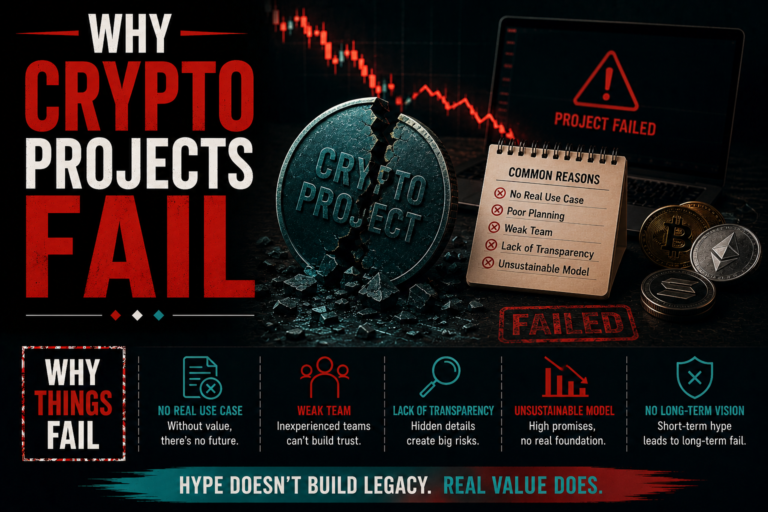
Introduction
Few industries have created wealth and destroyed it as quickly as the cryptocurrency sector.
Over the past decade, thousands of crypto projects have launched promising to transform finance, gaming, social media, identity, payments and the internet itself. Some became global phenomena worth billions of dollars. Many others disappeared quietly, leaving investors with worthless tokens and communities with abandoned roadmaps.
What makes this remarkable is not that some projects failed. Failure is normal in any innovative industry. What deserves investigation is why so many crypto projects fail in strikingly similar ways.
The technology differs. The branding differs. The founders differ.
Yet the pattern repeats.
A compelling vision attracts attention. Token prices rise rapidly. Communities grow. Expectations become extreme. Risk management weakens. Incentives become distorted. Confidence turns into certainty. Then growth slows, liquidity disappears, trust collapses and the project unravels.
This article examines crypto failure not as a technical problem but as a human and economic one. The goal is to understand the behavioural, financial and organisational forces that repeatedly turn promising projects into cautionary tales.
What Is A Crypto Project Failure?
A crypto project fails when it loses the ability to sustain its ecosystem, maintain user trust or create lasting economic value.
Failure does not always mean a dramatic collapse.
Some projects fail slowly through declining activity, shrinking developer participation and fading community interest. Others fail suddenly through hacks, liquidity crises, governance disputes or the collapse of their token price.
Common signs of failure include:
- Falling transaction activity
- Declining developer engagement
- Unsustainable token emissions
- Loss of liquidity
- Governance conflicts
- Security breaches
- Broken economic incentives
- Erosion of community trust
The crucial distinction is that many projects fail before they officially shut down. Economic weakness often becomes visible months or years before the final collapse.
The Biggest Myth
The most common belief is simple.
If the technology is good enough, the project will succeed.
History suggests otherwise.
Many technically sophisticated crypto projects have failed despite talented engineers and innovative ideas.
Technology is only one component of success.
A project must also solve a real problem, create sustainable incentives, manage risk, attract users, retain developers and maintain trust through volatile market conditions.
In other words, crypto projects are not just technology systems. They are economic systems, social systems and psychological systems.
Most failures occur because one of these systems breaks down.
What Usually Happens?
Although every project is unique, many failures follow a recognisable progression.
- A compelling narrative attracts attention.
- Token prices rise rapidly.
- Media coverage increases.
- Communities become highly optimistic.
- Speculation overtakes utility.
- Projects expand aggressively.
- Revenue and usage fail to match expectations.
- Market conditions weaken.
- Liquidity declines.
- Confidence disappears.
- The ecosystem contracts or collapses.
At first glance this appears to be a market problem.
In reality, the deeper causes are usually behavioural and structural.
Why Does It Happen?
This is where the investigation becomes most revealing.
Crypto markets combine extreme uncertainty, rapid feedback, social influence and financial incentives in a way few industries do. These conditions magnify human biases and make poor decisions appear rational during periods of excitement.
Overconfidence Creates Fragile Systems
Many crypto projects are born during bull markets when prices are rising and capital is abundant.
Early success often creates the illusion that demand will continue indefinitely.
Teams hire aggressively, expand into multiple products and spend heavily on marketing. Investors assume rapid growth validates the business model.
The problem is that rising token prices can hide weak fundamentals.
When market conditions change, projects discover that speculation was driving much of the activity.
Overconfidence therefore becomes a form of hidden leverage. It encourages commitments that only work while optimism remains high.
Speculation Often Replaces Utility
Many crypto ecosystems attract users because people expect the token price to rise, not because they need the product.
This creates a dangerous feedback loop.
- Higher prices attract more buyers.
- More buyers push prices higher.
- Rising prices create social proof.
- Social proof attracts even more buyers.
As long as prices rise, the system appears healthy.
However, if genuine utility remains limited, demand can disappear quickly once expectations change.
The project then discovers that its strongest growth driver was speculation rather than sustainable usage.
Tokenomics Frequently Incentivise The Wrong Behaviour
Tokenomics is often presented as a technical design problem.
In practice, it is an incentive design problem.
Many projects reward short term participation while unintentionally encouraging short term extraction.
Examples include:
- Excessive token emissions
- Unsustainable staking rewards
- Yield farming incentives
- Early investor advantages
- Large token unlocks
- Poor treasury management
Participants may behave rationally from their own perspective by maximising short term returns. Collectively, however, these behaviours can weaken the ecosystem.
This is a classic tragedy of the commons problem where individually rational actions produce collectively damaging outcomes.
Fear And Greed Dominate Decision Making
Behavioural finance plays an enormous role in crypto markets.
During bull markets, greed encourages investors to ignore valuation, risk and sustainability.
During bear markets, fear encourages panic selling and the abandonment of projects that may still have viable technology.
Both extremes distort judgement.
Project founders are not immune. They also experience pressure from price movements, community expectations and competitive comparisons.
As a result, strategic decisions are often made under emotional conditions rather than purely rational ones.
Weak Governance Becomes Visible Under Stress
Governance problems rarely matter during periods of rapid growth.
When everyone is making money, disagreements remain manageable.
Stress reveals weaknesses.
Questions suddenly become difficult:
- Who controls the treasury?
- Who makes strategic decisions?
- How are conflicts resolved?
- What happens when stakeholders disagree?
- Can the community realistically govern a complex organisation?
Many projects discover that governance structures designed for optimism are poorly suited for crisis management.
Liquidity Is More Important Than Many Projects Realise
Crypto markets depend heavily on liquidity.
When liquidity is abundant, tokens can be bought and sold easily. Prices appear stable and confidence remains high.
When liquidity dries up, small amounts of selling can cause large price declines. Falling prices then reduce confidence, which leads to more selling.
This creates a self reinforcing cycle where liquidity loss becomes trust loss, and trust loss accelerates liquidity loss.
Many projects survive technical challenges but fail after this financial spiral begins.
The Deeper Root Cause
After examining dozens of crypto failures, a deeper pattern emerges.
Most projects do not fail because blockchain technology is impossible.
They fail because building a sustainable economic network is extraordinarily difficult.
A successful project must align the incentives of founders, developers, investors, users, validators and communities over many years.
That is not merely a technology challenge.
It is a challenge involving economics, psychology, governance and long term trust.
And those are often the hardest systems to build.
Warning Signs
Crypto failures rarely arrive without warning. The challenge is that warning signs often appear during periods of excitement, when investors and communities are least willing to question the narrative.
One early indicator is rapid token price appreciation without corresponding growth in users, revenue or network activity. When valuation rises much faster than real usage, speculation may be driving the ecosystem.
Another warning sign is unsustainably high yields. Projects promising unusually large staking rewards or farming returns often rely on continuous token issuance rather than genuine economic productivity. The system can appear healthy while inflation quietly weakens long term value.
Excessive dependence on influencers is another concern. When marketing dominates technical progress and community discussion focuses primarily on price, the project may be attracting speculators rather than long term users.
Large upcoming token unlocks also deserve attention. Early investors, venture funds and team members may eventually receive significant amounts of tokens. If the market cannot absorb that supply, selling pressure can become substantial.
Perhaps the most important warning sign is defensive leadership. Projects that dismiss criticism, avoid transparency or constantly promise future breakthroughs often struggle to confront underlying problems.
These signals are frequently ignored because they appear during periods of optimism. Rising prices create social proof, making scepticism feel uncomfortable even when risks are increasing.
What Could Have Prevented It?
Most crypto failures cannot be prevented by predicting market cycles perfectly.
They can often be mitigated by building stronger systems.
Sustainable tokenomics is one foundation. Rewards should encourage long term participation without creating excessive inflation. Treasury management should prioritise resilience rather than assuming perpetual growth.
Governance also matters. Clear decision making structures, transparent reporting and defined crisis procedures can reduce confusion when market conditions deteriorate.
Projects benefit from focusing on real utility before aggressive expansion. Ecosystems built around genuine user demand tend to survive downturns better than those built primarily around speculation.
Risk management is equally important. Holding diversified treasury assets, limiting leverage and preparing for lower liquidity can improve survival during bear markets.
For investors, the most useful safeguard is often separating technology from narrative. A compelling story does not guarantee a sustainable business model.
Lessons
The failure of crypto projects reveals lessons that extend beyond digital assets.
First, incentives shape behaviour more powerfully than intentions. Well meaning founders can still create systems that reward short term extraction over long term value creation.
Second, rapid growth can hide structural weakness. Rising prices often delay difficult questions about revenue, governance and sustainability.
Third, communities are not the same as customers. Large online followings can create visibility without creating durable demand.
Finally, trust is a financial asset. Once users lose confidence in a project’s governance, treasury management or incentives, recovery becomes extremely difficult regardless of technical quality.
Failure Pattern
The dominant pattern behind crypto failure is Overconfidence combined with Poor Incentive Design and Short Term Thinking.
This pattern repeats because bull markets reward growth, optimism and aggressive expansion. Projects that appear successful attract more capital, which reinforces confidence and encourages even greater risk taking.
Over time, speculation begins replacing utility. Token prices become the primary measure of success. Governance weaknesses are ignored, treasury discipline weakens and sustainability becomes a future problem.
When market conditions reverse, the same incentives that fuelled rapid growth accelerate decline.
The pattern is not unique to crypto. Similar dynamics have appeared in technology bubbles, real estate booms and speculative investment manias throughout history.
Hidden Lesson
The deepest lesson is that crypto projects rarely fail solely because of technology.
They fail because creating a sustainable economic network requires aligning human incentives over long periods of time.
Code can be audited. Human behaviour cannot be fully programmed.
The projects that survive are often those that design for imperfect human behaviour rather than assuming everyone will act in the ecosystem’s long term interest.
Failure Scorecard
Financial Discipline
4/10
Many projects spend aggressively during bull markets and underestimate the importance of treasury preservation.
Decision Making
5/10
Strategic choices are often influenced by market sentiment and competitive pressure.
Risk Management
3/10
Liquidity risk, token dilution and concentration risk are frequently underestimated.
Long Term Thinking
4/10
Short term growth metrics often receive more attention than sustainable value creation.
Financial Knowledge
6/10
Technical expertise may be strong, but economic design is often weaker.
Emotional Control
4/10
Bull market euphoria and bear market panic influence both founders and investors.
Planning
5/10
Many projects plan for rapid growth but not for prolonged downturns.
Adaptability
6/10
Successful projects adapt to changing conditions, while failing projects often remain committed to outdated assumptions.
Key Takeaways
- Most crypto projects fail because of incentives and behaviour, not technology alone.
- Speculation can create the illusion of sustainable demand.
- Overconfidence often leads to aggressive expansion and weak risk management.
- Unsustainable tokenomics can quietly undermine an ecosystem.
- Liquidity and trust are closely connected.
- Governance problems usually become visible during periods of stress.
- Communities do not automatically create long term economic value.
- The strongest projects align incentives for users, developers, investors and founders over many years.
Conclusion
Crypto projects fail for many reasons, but the deepest cause is rarely a single bug, hack or market crash. Failure usually emerges from a combination of human psychology, distorted incentives, weak governance and short term thinking that gradually undermines the ecosystem from within.
Understanding this changes the conversation. The central question is no longer whether blockchain technology can work. It is whether a project can build an economic and social system strong enough to survive both human greed and human fear for long enough to create lasting value.