Quick Answer
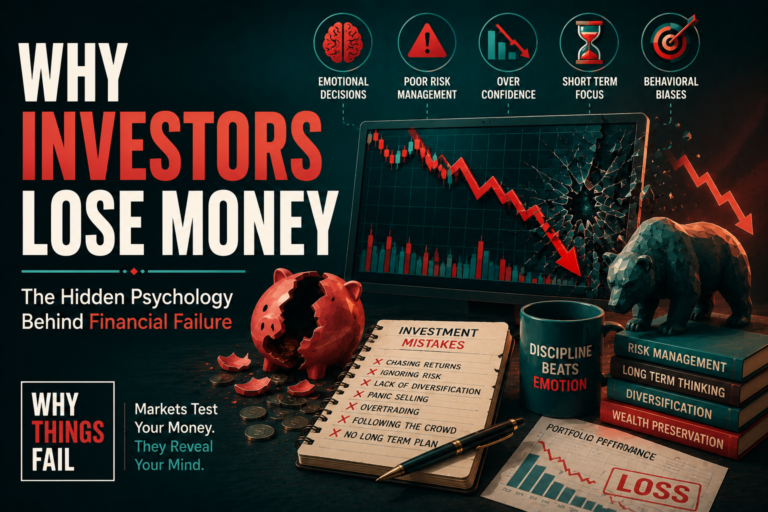
Investors rarely lose money because markets are unpredictable alone. Financial losses usually result from emotional decision making, poor risk management, behavioural biases, overconfidence and weak long term planning. Successful investing depends as much on psychology and discipline as it does on choosing the right assets.
Introduction
Every market cycle produces the same headlines.
Investors panic during market crashes. Others chase rapidly rising stocks. Some lose their life savings through speculative investments, while others abandon carefully planned portfolios after temporary losses.
The names of the companies change. The technology changes. Financial products become more sophisticated.
Yet the pattern remains remarkably consistent.
People continue losing money in markets that have historically rewarded patience, discipline and long term thinking.
This raises an important question.
Why do intelligent people repeatedly make financial decisions that damage their own wealth?
Many explanations focus on poor stock selection or unfortunate timing.
These explanations are incomplete.
Investment failure is rarely created by one bad decision. More often, it develops through a series of predictable behavioural choices that gradually increase financial risk while reducing rational judgement.
Behavioural economists have spent decades studying why investors consistently make the same mistakes despite having access to more information than any previous generation. Their findings reveal that financial markets do not simply test investment knowledge.
They test human behaviour.
Understanding why investors lose money is therefore not simply about understanding markets.
It is about understanding ourselves.
What Is Investment Failure?
Investment failure is often misunderstood.
Many people believe losing money on a single investment means they have failed.
In reality, temporary losses are a normal part of investing.
Financial failure occurs when repeated decisions destroy long term wealth through poor judgement rather than unavoidable market fluctuations.
An investor may own quality assets yet still fail because they panic during volatility.
Another investor may generate impressive short term gains before losing everything through excessive risk taking.
Others quietly destroy wealth through inflation because they never invest at all.
Investment failure therefore extends beyond stock market losses.
It includes every decision that consistently reduces the ability to build sustainable wealth over time.
The Biggest Myth About Investing
The most common belief is simple.
Successful investors always pick winning investments.
This idea dominates financial media.
Stories celebrate investors who identified the next successful company or predicted the next market boom.
Far less attention is given to how those investors managed risk, controlled emotions or avoided catastrophic mistakes.
Research into behavioural finance paints a very different picture.
Long term investment success depends less on finding extraordinary opportunities and more on avoiding predictable behavioural errors.
The greatest investors are not necessarily those who make the smartest decisions every day.
They are often those who consistently avoid making disastrous ones.
This distinction changes the entire conversation.
Instead of asking,
“Which investment will make me rich?”
A better question becomes,
“Which behaviours repeatedly destroy investor wealth?”
That question reveals far more about financial success than any discussion about stock tips.
What Usually Happens?
Most investment failures follow a surprisingly similar pattern.
An investor enters the market with optimism.
Early gains increase confidence.
Confidence gradually becomes certainty.
Risk increases.
Diversification decreases.
Warning signs appear.
Losses begin.
Instead of reassessing the strategy, emotions take control.
Some investors refuse to sell because they hope prices will recover.
Others panic and sell quality investments at precisely the wrong moment.
Some borrow more money to recover previous losses.
Others stop investing altogether after one painful experience.
Although the circumstances differ, the underlying behavioural pattern remains remarkably similar.
Financial losses rarely occur because markets suddenly become irrational.
They occur because investors respond irrationally to normal market behaviour.
Why Do Investors Lose Money?
This is where the investigation begins.
Markets themselves are not designed to destroy wealth.
Over long periods, diversified equity markets have historically rewarded patient investors despite recessions, financial crises and geopolitical uncertainty.
If markets generally create wealth over time, why do so many individuals experience the opposite outcome?
The answer begins with human psychology.
Money affects the brain in ways that few people recognise.
Investment decisions involve uncertainty, reward, fear and identity all at once.
These emotional forces frequently overpower logical analysis.
Overconfidence Creates Invisible Risk
One of the most studied behavioural biases in finance is overconfidence.
After several profitable investments, many people begin believing their success reflects exceptional skill rather than favourable market conditions.
They trade more frequently.
They concentrate investments into fewer assets.
They ignore diversification.
They underestimate uncertainty.
Ironically, confidence often reaches its highest point immediately before significant financial losses.
This happens because previous success reduces the perceived need for caution.
Investors stop asking difficult questions.
They seek information that confirms existing beliefs while ignoring evidence that contradicts them.
Psychologists describe this as confirmation bias.
Instead of analysing investments objectively, people begin defending previous decisions.
The market becomes a place to prove themselves right rather than a system for allocating capital efficiently.
The greatest financial danger is therefore not uncertainty.
It is false certainty.
Fear Is More Powerful Than Logic
Behavioural economists have demonstrated that people experience the pain of losing money much more intensely than the pleasure of gaining it.
This principle, known as loss aversion, explains why investors frequently make irrational decisions during market declines.
When markets fall sharply, fear narrows attention.
Long term investment strategies suddenly feel irrelevant.
Temporary losses appear permanent.
Investors focus on protecting what remains rather than evaluating future opportunities objectively.
Selling quality investments during periods of panic often feels emotionally comforting.
Financially, however, it may lock in losses that disciplined investors eventually recover as markets stabilise.
Fear rarely asks whether an investment remains fundamentally strong.
It simply demands immediate relief from uncertainty.
Why Do Investors Lose Money? The Root Causes Beneath the Surface
Poor investment returns are often blamed on market volatility, economic recessions or unexpected events. These factors certainly influence short term performance, but they rarely explain why one investor survives a downturn while another suffers permanent financial damage.
The difference usually lies in behaviour rather than circumstance.
Herd Behaviour Makes Investors Feel Safe Until It Is Too Late
Humans naturally seek reassurance from the actions of others. In financial markets, this instinct creates herd behaviour, where investors follow the crowd instead of independent analysis.
When markets are rising, optimism becomes contagious. News headlines celebrate record highs. Social media is filled with stories of quick profits. Friends and colleagues discuss their latest successful investments.
As more people buy, prices continue rising, creating the illusion that buying is becoming less risky.
In reality, the opposite is often true.
By the time an investment becomes popular, much of its future growth may already be reflected in its price. Investors who enter at this stage are frequently paying for yesterday’s success rather than tomorrow’s opportunity.
The same behaviour appears during market declines. Panic spreads quickly, convincing investors that selling is the safest option even when business fundamentals remain strong.
History repeatedly shows that markets often reward independent thinking while punishing emotional conformity.
Greed Gradually Replaces Discipline
Few investors begin their journey intending to take excessive risks.
The process is usually gradual.
A successful investment increases confidence.
Confidence encourages larger positions.
Larger gains create higher expectations.
Eventually, preserving wealth no longer feels exciting enough. Investors begin chasing extraordinary returns instead of consistent returns.
Behavioural economists describe this as reward seeking behaviour. Each successful investment raises expectations, making ordinary market performance feel disappointing.
This explains why some investors abandon diversified portfolios in favour of speculative assets, highly leveraged positions or fashionable sectors promising exceptional growth.
Greed rarely appears as obvious recklessness.
More often, it disguises itself as ambition.
Recency Bias Distorts Reality
One of the most damaging psychological biases in investing is recency bias.
People naturally assume recent events will continue indefinitely.
During a bull market, investors begin believing prices will always rise.
During a bear market, they assume losses will continue forever.
Neither assumption reflects reality.
Financial markets move through cycles driven by economic growth, corporate earnings, interest rates, inflation and investor sentiment.
Yet the human brain struggles to separate temporary conditions from permanent trends.
As a result, investors frequently buy after long periods of rising prices and sell after prolonged declines. This behaviour creates the opposite of successful investing.
They buy optimism at expensive prices and sell fear at discounted prices.
Poor Diversification Increases Fragility
Diversification is often misunderstood as simply owning several investments.
Effective diversification means spreading risk across different assets, industries, sectors and sometimes geographical markets.
Many investors believe they are diversified because they own multiple companies within the same industry.
Others invest heavily in businesses they know well through their careers.
This creates concentration risk.
When one industry experiences difficulties, large portions of their portfolio decline simultaneously.
The problem is rarely the individual investment.
It is the absence of a resilient system capable of surviving unexpected events.
Diversification does not maximise short term returns.
It increases the probability of long term survival.
Financial Knowledge Without Emotional Control Is Not Enough
Modern investors have access to unprecedented amounts of information.
Financial news updates every minute.
Company reports are freely available.
Investment research has never been more accessible.
Yet access to information has not eliminated poor investment decisions.
Why?
Because knowledge alone does not determine behaviour.
An investor may fully understand concepts such as asset allocation, valuation, cash flow and portfolio management while still making emotional decisions during periods of uncertainty.
Psychologists distinguish between knowing the correct action and executing the correct action under pressure.
Financial markets constantly test this difference.
The greatest investment challenge is rarely understanding how markets work.
It is maintaining rational behaviour when emotions encourage the opposite.
Delayed Consequences Hide Growing Risk
Investment failure rarely arrives without warning.
Instead, risk accumulates quietly.
Excessive borrowing appears manageable while markets are rising.
Speculative investments seem sensible after several profitable trades.
Ignoring diversification feels harmless during periods of strong performance.
These decisions often produce positive results in the short term, reinforcing dangerous behaviour.
Behavioural economists refer to this as delayed feedback.
When poor decisions are not immediately punished, people incorrectly assume those decisions were correct.
Eventually, market conditions change.
Liquidity disappears.
Volatility increases.
Highly leveraged positions become difficult to manage.
What once appeared to be intelligent investing is exposed as excessive risk taking.
The final loss often receives the blame.
In reality, the failure began months or even years earlier through a series of small decisions that gradually weakened the investor’s financial resilience.
The market simply revealed vulnerabilities that had already been created.
Lessons
The reasons investors lose money extend far beyond financial markets. They reveal how people make decisions under uncertainty, how emotions influence judgement and why success often creates the conditions for future failure.
One important lesson is that investing is less about predicting markets and more about managing behaviour. Investors spend enormous effort searching for the next winning stock while overlooking the habits that consistently destroy wealth. Emotional discipline often produces better long term outcomes than exceptional market forecasts.
Another lesson is that knowledge alone is insufficient. Many investors understand concepts such as diversification, compound growth and asset allocation, yet abandon them when markets become volatile. This gap between knowledge and behaviour explains why financial education does not always translate into financial success.
Perhaps the most enduring lesson is that wealth is built through consistency rather than brilliance. Avoiding catastrophic mistakes, controlling risk and maintaining disciplined decision making usually matter more than achieving occasional extraordinary returns.
Failure Pattern
The dominant pattern behind investment failure is Emotional Decision Making reinforced by Overconfidence and Short Term Thinking.
This pattern appears repeatedly because financial markets reward patience while human psychology seeks certainty and immediate results. Investors become optimistic after periods of success and fearful after periods of loss. Both emotional states distort judgement.
Overconfidence encourages excessive risk taking, weak diversification and speculative investing. Fear encourages panic selling and abandoning well considered strategies. Together, these behaviours create a cycle in which investors repeatedly buy assets at expensive prices and sell them after prices have already fallen.
The same pattern is visible in business failures, property bubbles and entrepreneurial mistakes. The underlying cause is not the market itself but the human tendency to react emotionally instead of systematically.
Hidden Lesson
The greatest threat to an investor is rarely the market.
It is the belief that financial success depends solely on choosing the right investment.
In reality, markets expose existing behavioural weaknesses rather than creating them. Poor risk management, emotional decision making and overconfidence remain hidden during favourable conditions. Market volatility simply reveals vulnerabilities that were already present.
The deeper truth is that investors usually lose money long before they realise it. Financial failure begins with small behavioural compromises that gradually weaken discipline until a market downturn exposes the accumulated consequences.
Failure Scorecard
| Area | Score | Explanation |
| Financial Discipline | 4/10 | Emotional spending and inconsistent investing often replace structured portfolio management. |
| Decision Making | 5/10 | Decisions are frequently influenced by fear, greed and market sentiment rather than objective analysis. |
| Risk Management | 3/10 | Excessive concentration, leverage and poor diversification increase vulnerability during market declines. |
| Long Term Thinking | 4/10 | Many investors focus on immediate returns instead of sustainable wealth creation. |
| Financial Knowledge | 6/10 | Information is widely available, but understanding does not always translate into disciplined behaviour. |
| Emotional Control | 3/10 | Panic, excitement and overconfidence frequently override rational judgement. |
| Planning | 5/10 | Many investors begin investing without a clearly defined strategy or exit plan. |
| Adaptability | 6/10 | Successful investors adapt to changing conditions, while unsuccessful investors often cling to outdated assumptions. |
Key Takeaways
- Investors rarely lose money because markets are unpredictable alone. Behaviour usually plays the larger role.
- Overconfidence often creates more financial damage than lack of knowledge.
- Fear and greed influence investment decisions more than most investors realise.
- Diversification protects wealth by reducing the impact of unexpected events.
- A disciplined investment process is more valuable than trying to predict market movements.
- Small behavioural mistakes accumulate into significant financial losses over time.
- Financial success depends on managing risk as carefully as pursuing returns.
- Long term wealth is preserved through consistency, patience and rational decision making rather than emotional reactions.
Frequently Asked Questions
Why do most investors lose money?
Most investors lose money because they allow emotions such as fear and greed to influence their decisions. Behavioural biases, poor risk management and short term thinking often have a greater impact on returns than market conditions.
What is the biggest mistake investors make?
The most common mistake is abandoning a disciplined investment strategy during periods of market volatility. Emotional buying and selling frequently lead to buying at high prices and selling after losses have already occurred.
Can experienced investors still lose money?
Yes. Experience does not eliminate behavioural biases. Even professional investors can become overconfident, ignore warning signs or underestimate risk when market conditions appear favourable.
Why is diversification important?
Diversification reduces the impact of poor performance from any single investment. It strengthens portfolio resilience and helps investors manage uncertainty without relying on one company, sector or asset class.
How can investors reduce emotional decision making?
Investors can reduce emotional decisions by following a structured investment process, reviewing portfolios periodically instead of reacting daily, defining acceptable levels of risk and making decisions based on long term objectives rather than short term market movements.
Conclusion
Investors do not usually lose money because markets are designed to defeat them. They lose money because financial markets expose predictable weaknesses in human behaviour, including overconfidence, fear, poor judgement and short term thinking.
Understanding these psychological patterns changes the way investment failure is viewed. It becomes less about unfortunate market movements and more about recognising that lasting wealth is ultimately determined by the quality of decisions made long before the market delivers its verdict.