Introduction: Why This Failure Matters
Nokia did not fail because it was small, weak, unknown, or badly resourced. It failed from a position of strength. That is what makes the Nokia story so important.
At its peak, Nokia was one of the most powerful technology companies in the world. For millions of people, the word “phone” almost meant “Nokia.” Its devices were reliable, affordable, durable, and globally trusted. Nokia understood distribution. It understood hardware. It understood manufacturing. It understood mobile networks. It had money, talent, brand power, and market access.
Yet within a few years, Nokia lost its dominance in the mobile phone market and eventually sold most of its phone business to Microsoft.
The common lesson people take from Nokia is simple: “Nokia failed because it did not innovate.” That is too shallow.
Nokia did innovate. It had smartphones before the iPhone became dominant. It had touch-screen research. It had strong engineers. It had global scale. The deeper problem was not a total lack of innovation.
The deeper problem was that Nokia misunderstood what the mobile phone was becoming. The phone was no longer just a device. It was becoming a platform.
And Nokia, built for the age of devices, could not move fast enough into the age of ecosystems.
Nokia matters today because many companies face the same danger. They are strong in the old version of their industry, but weak in the next version. They improve what already works while the market quietly changes the definition of success.
Nokia’s failure is not just about mobile phones. It is about how success can make organisations slow, defensive, political, and blind.
Who Failed?
Nokia was a Finnish technology company that became the global leader in mobile phones.
For years, Nokia was known for reliable handsets, strong battery life, simple design, and global availability. Its phones were everywhere: Europe, Asia, Africa, the Middle East, and emerging markets.
At its height, Nokia controlled a huge share of the global mobile phone market. Its brand was trusted. Its products were affordable. Its supply chain was world-class. Its distribution network was powerful.
But after the launch of the iPhone in 2007 and the rise of Android, Nokia began to lose ground rapidly in smartphones.
In 2011, Nokia formed a major partnership with Microsoft and adopted Windows Phone as its main smartphone platform. In 2014, Nokia completed the sale of substantially all of its Devices & Services business to Microsoft.
Nokia as a company survived. It later focused more on network infrastructure and other technology areas. But Nokia as the world’s dominant mobile phone brand was finished.
Common Myth
Common Myth: “Nokia failed because Apple launched the iPhone.”
Reality: The iPhone was not the only reason Nokia failed.
Apple exposed Nokia’s weaknesses. Android accelerated them. Microsoft did not solve them. But Nokia’s deeper failure came from inside the company.
Nokia failed because it was too attached to the old rules of mobile success. It believed hardware strength, brand loyalty, carrier relationships, and global distribution would protect it. For many years, those things had been enough.
Then the market changed. Customers no longer wanted just a strong phone. They wanted a beautiful interface, smooth software, app ecosystems, easy internet access, and a device that felt like a personal computer in the pocket.
Nokia was still thinking like a phone company. Apple and Google were thinking like platform companies. That difference changed everything.
1. What Happened?
Nokia dominated the mobile phone industry for years. Its devices were popular because they were practical, reliable, and widely available.
Before the smartphone era, Nokia’s strengths were exactly what the market wanted:
- Strong hardware
- Long battery life
- Durable design
- Good call quality
- Wide price range
- Global distribution
- Strong carrier relationships
Nokia’s operating system, Symbian, worked well enough for earlier mobile phones. It supported many devices and helped Nokia serve different markets.
But the smartphone market changed rapidly.
In 2007, Apple launched the iPhone. The iPhone was not just another phone. It changed customer expectations. It made software, touch interaction, mobile browsing, and user experience central to the product.
Then Android grew quickly. Unlike Apple’s closed system, Android gave many manufacturers a flexible smartphone operating system. Samsung, HTC, Motorola, and others could compete using Android while building their own hardware.
Nokia was caught between two models. Apple controlled both hardware and software. Android created a large open ecosystem.
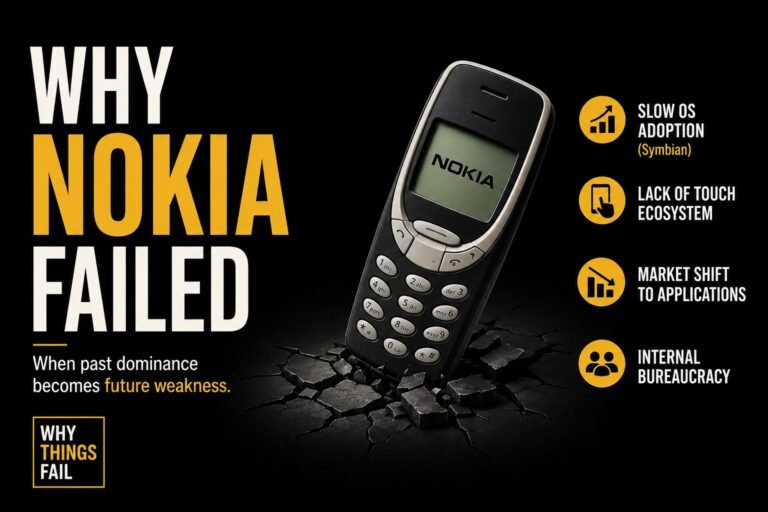
Nokia had Symbian, but Symbian was not built for the new smartphone world in the same way. It was old, complex, and difficult to develop for. Nokia also had other software projects, including MeeGo, but it struggled to create a clear, fast, unified strategy.
In 2011, Nokia made a major decision. It partnered with Microsoft and chose Windows Phone as its main smartphone platform. This was a bold move, but also a risky one.
Instead of joining Android, Nokia tied its future to a platform that had limited market share and a weaker app ecosystem than iOS and Android.
The Lumia phones had good design and some positive reviews, but the market had already moved strongly toward Apple and Android.
By 2014, Nokia completed the sale of most of its phone business to Microsoft. The company that once defined mobile phones had lost the smartphone war.
2. Why Did It Happen?
2.1 Nokia Confused Product Leadership With Market Leadership
Nokia was excellent at making phones. But the market stopped rewarding phone-making alone. This is one of the most important lessons in the Nokia case.
In the old mobile phone market, success came from hardware variety, cost control, durability, distribution, and carrier relationships. Nokia mastered that system.
The problem was that the smartphone market changed the basis of competition. The winning question was no longer: “Who makes the best phone?” It became: “Who controls the best mobile ecosystem?”
That included:
- Operating system
- App store
- Developer community
- User interface
- Cloud services
- Content
- Payments
- Search
- Mapping
- Media
- Software updates
Nokia’s old strengths did not disappear, but they became less decisive. A strong device with weak software was no longer enough.
Nokia was still optimising for a world it already understood, while Apple and Google were building the world that came next. This happens often in failure. Companies do not always fail because they become bad at what they do. They fail because what they do becomes less important.
2.2 Symbian Became A Strategic Burden
Symbian was once an asset. Then it became a liability.
For earlier phones, Symbian helped Nokia support many different models and markets. But as smartphones became more advanced, Symbian became harder to adapt. It was not as smooth, intuitive, or developer-friendly as iOS or Android.
The issue was not only technical. It was organisational.
When a company builds around a system for many years, that system gains political power. Teams understand it. Processes depend on it. Careers are built around it. Managers defend it because replacing it threatens status, budgets, and certainty.
This is why legacy systems are dangerous. They are not just old technology. They become internal power structures.
Nokia could see that Symbian was struggling, but moving away from it was difficult. A clean break would have been painful. It would have required admitting that the foundation of Nokia’s smartphone strategy was no longer good enough.
So Nokia moved too slowly. It tried to improve, patch, and manage the transition while competitors moved faster.
This is a common failure pattern: companies delay hard decisions because the cost of change is visible, while the cost of delay is hidden. By the time the cost of delay becomes obvious, it is often too late.
2.3 Nokia Underestimated Software As The New Centre Of Value
Nokia’s culture was deeply engineering-driven, but much of that engineering strength was hardware-focused.
The company knew how to produce high-quality devices at scale. It knew how to serve different markets. It knew how to negotiate with carriers. It knew how to manufacture efficiently.
But the smartphone era rewarded a different kind of excellence. It rewarded software elegance.
Apple understood that the emotional experience of using a device mattered. The iPhone was not only a technical product. It was a consumer experience.
Google understood that mobile would become an internet platform. Android was not just a phone operating system. It was a way to extend Google’s services into the mobile world.
Nokia saw smartphones through the lens of phones. Apple and Google saw phones through the lens of computing, software, and ecosystems. That difference was critical.
Nokia had software, but it did not have software culture at the same level. It struggled to make software feel simple, beautiful, and exciting for everyday users.
The company had strong engineers, but the market was no longer rewarding engineering complexity. It was rewarding simplicity. That is painful for large technical companies. They often believe that more capability means more value. But customers often reward less complexity, not more.
2.4 Internal Fear Slowed Honest Communication
One of the most damaging forces inside any declining company is fear.
When an organisation is winning, people often report good news upward. When it starts struggling, the pressure to protect careers, departments, and reputations becomes stronger.
Problems get softened. Deadlines become optimistic. Weak products are described as “almost ready.” Strategic risks become “manageable.”
Nokia had many talented people. The issue was not that nobody understood the threat. The issue was that the organisation struggled to turn internal knowledge into decisive action.
In large companies, bad news often travels slowly because every layer of management edits it. By the time reality reaches the top, it may be too late or too polished.
This creates a dangerous gap between market reality and executive belief. Nokia’s leaders were not completely blind. But the organisation had become too complex, too political, and too slow to respond with the urgency required.
Fear does not always look like panic. Sometimes it looks like meetings, delayed decisions, internal competition, and safe presentations.
2.5 The Company Had Too Many Priorities
Nokia was not doing nothing. That was part of the problem. It was doing too many things.
It had Symbian. It had MeeGo. It had feature phones. It had smartphone ambitions. It had different regional needs. It had internal teams competing for resources and attention.
When a company faces disruption, focus becomes critical. Nokia needed a clear answer to one question: “What is our future smartphone platform?” For too long, the answer was unclear.
This created confusion internally and externally. Developers did not know where to invest. Customers did not know what Nokia’s future looked like. Employees did not have a single direction. Partners could not be fully confident.
Apple had iOS. Google had Android. Nokia had complexity.
Complexity can look like optionality, but during a platform war it becomes weakness. The market rewards clarity. Nokia’s strategic message became harder to understand at exactly the moment when it needed to be strongest.
2.6 The Microsoft Bet Was Bold But Late
Nokia’s partnership with Microsoft was a dramatic attempt to solve the platform problem. It gave Nokia a fresh operating system, a powerful partner, and a way to differentiate from Android.
But the decision came with serious risks. Windows Phone did not have the app ecosystem of iOS or Android. Developers follow users, and users follow apps. Once that cycle starts, it becomes extremely hard for a third platform to break through.
Nokia was betting that Microsoft could become a serious mobile platform competitor. That was possible, but difficult.
The decision also created a transition problem. Once Nokia announced its future was Windows Phone, its existing Symbian products became less attractive. Customers and developers had little reason to invest in a platform Nokia itself was moving away from.
This is sometimes called a burning platform problem. When a company tells the market its old platform is finished, it must move to the new platform very quickly. If the new platform is not ready or not strong enough, the company can fall between two worlds.
That is what happened to Nokia. It weakened the old system before the new system could fully replace it.
2.7 Nokia Chose Differentiation Over Ecosystem Strength
One reason Nokia avoided Android was likely the fear of becoming just another Android manufacturer. That fear was understandable.
If Nokia had adopted Android, it would have competed directly with Samsung and many other manufacturers. Margins could have been pressured. Differentiation may have been difficult.
Windows Phone offered a different path. Nokia could stand apart. But standing apart is only valuable if customers want the thing that makes you different.
This is a crucial strategic principle. Differentiation is not automatically good. Bad differentiation isolates you. Good differentiation creates customer preference.
Nokia’s Windows Phone strategy made it different, but not different enough in the ways that mattered most to customers. Many users cared more about apps, familiarity, and ecosystem than visual uniqueness.
Nokia tried to avoid being one of many Android companies. Instead, it became the strongest company on a weak platform. That is a dangerous position. Being the best player in the wrong game does not save you.
2.8 Nokia’s Old Success Created The Wrong Incentives
Nokia’s leaders were not stupid. They were operating inside a system shaped by past success. That matters.
When a company has won for years, its internal incentives reward the behaviours that created the old success. Managers are promoted for protecting existing revenue. Teams are funded because they support current products. Risky ideas are questioned because they threaten predictable profits.
This creates a problem. The people who need to destroy the old model are often the same people rewarded for maintaining it.
Nokia’s feature phone and Symbian businesses were still important for revenue. Moving aggressively away from them would have meant short-term pain, uncertainty, and internal resistance.
So the company faced a classic case of what Harvard professor Clayton Christensen called the Innovator’s Dilemma the same trap that caused Kodak to protect film profits instead of committing fully to digital, years earlier.. The rational short-term decision was to protect the existing business. The necessary long-term decision was to disrupt it.
Nokia moved too slowly because the old business still looked too valuable to abandon.
2.9 Competitors Changed Customer Psychology
Before smartphones, many customers bought phones based on durability, battery life, design, price, and brand familiarity.
After the iPhone and Android, customers began to think differently. They wanted:
- Touchscreens
- Apps
- Better internet browsing
- Better cameras
- Music and video
- Social media
- Maps
- Smooth user experience
The phone became personal. It became emotional. It became part of identity.
Nokia’s brand had been built on trust and practicality. But Apple made phones aspirational. Android made smartphones accessible across many price ranges.
Nokia was squeezed from both sides. Apple took the premium emotional space. Android manufacturers attacked the scale and affordability space.
Nokia’s old brand promise — reliable mobile phones — was no longer enough to dominate. The customer’s definition of value had changed. Nokia did not adapt fast enough to that new psychology.
3. What Warning Signs Existed?
Warning Sign 1: The iPhone Changed Expectations Immediately
The iPhone was an obvious warning sign because it changed the user experience standard. It made older smartphone interfaces feel complicated.
The threat was not only Apple’s first sales numbers. The deeper warning sign was emotional response. People talked about the iPhone differently. It felt new. It made existing phones feel old.
That is often how disruption begins. Not with immediate market domination, but with a change in expectations. Once customers experience a simpler and better interface, they rarely want to go backwards.
Nokia should have treated the iPhone as a signal that the basis of competition had changed. Instead, like many incumbents, it could still point to its scale, distribution, and existing market share. Those numbers made the threat look smaller than it was.
Warning Sign 2: Android’s Growth Showed The Power Of Ecosystems
Android was another warning sign. It showed that the future was not just one premium device from Apple. It showed that a platform model could spread across many manufacturers and price points.
This mattered because Nokia’s global strength had always included scale. Android attacked scale. It allowed competitors to produce smartphones quickly without building their own operating systems from scratch. That made Nokia’s advantage weaker.
The warning sign was clear: the smartphone market was becoming a platform war, not a handset war. Nokia still had hardware advantages, but Android reduced the value of those advantages by giving many manufacturers access to good software.
Warning Sign 3: Developers Were Moving Elsewhere
Developers are early indicators of platform health. If developers are excited about a platform, it grows. If they ignore it, the platform weakens.
Nokia’s ecosystem was not as attractive as iOS or Android. Developers want large audiences, simple tools, and strong monetisation opportunities. As developers focused more on iOS and Android, Nokia’s position became harder.
This created a loop:
- Fewer apps made Nokia phones less attractive.
- Fewer users made developers less interested.
That loop is extremely difficult to reverse. Nokia should have treated developer attention as a strategic emergency. In platform markets, developers are not a side issue. They are part of the product.
Warning Sign 4: Internal Complexity Was Slowing Execution
Another warning sign was Nokia’s own complexity. Multiple platforms, internal competition, slow decision-making, and unclear software direction all showed that Nokia was not organised for the speed of the new market.
Disruption punishes slow organisations. It does not matter how intelligent a company is if it cannot act quickly enough. Nokia had knowledge, but knowledge without execution is not protection. The internal system was not converting insight into speed.
Warning Sign 5: The Brand Was Strong But Losing Meaning
Nokia still had brand recognition, but brand recognition is not the same as brand relevance. This is a subtle warning sign.
People may still know your name while no longer seeing you as the future. Nokia remained familiar, but Apple and Android became exciting.
That shift matters. Once a brand becomes associated with the past, it becomes harder to attract premium customers, developers, media attention, and top talent. Nokia’s brand did not disappear overnight. It slowly lost cultural energy. That was a serious warning sign.
4. What Could Have Prevented It?
4.1 A Faster Break From Symbian
Nokia needed to make a faster and clearer platform decision. This does not mean the answer was obvious. Moving away from Symbian was risky. But delaying the transition was also risky.
The realistic alternative would have been to recognise earlier that Symbian could not carry Nokia through the next phase of smartphones.
Nokia could have either:
- Rebuilt its software strategy faster
- Committed earlier to MeeGo or another internal platform
- Adopted Android sooner
- Created a separate internal unit free from legacy constraints
The key issue was not simply choosing the perfect platform. It was speed, clarity, and commitment. Nokia needed to reduce confusion earlier.
4.2 Treating Software As The Core Business
Nokia could have survived if it had understood earlier that software was no longer a support function. Software had become the product.
That required different leadership priorities, different talent, different design culture, and different performance measures.
Instead of asking, “How many devices can we ship?”, Nokia needed to ask:
- “How good is the user experience?”
- “How strong is our app ecosystem?”
- “How easy is development?”
- “How fast can we update?”
- “How emotionally valuable is this product?”
These questions became more important than traditional handset metrics. A company cannot win a software era with a hardware-era mindset.
4.3 Building Around Developers
Nokia needed to compete for developers with the same seriousness it competed for customers. A smartphone without apps becomes weaker over time.
To prevent decline, Nokia needed better developer tools, clearer platform direction, stronger incentives, and a more attractive ecosystem. This required long-term thinking. Developers do not invest in uncertainty. If Nokia’s platform future looked unclear, developers naturally chose iOS and Android. Nokia needed to make its ecosystem feel inevitable. It did not.
4.4 Creating A Separate Future-Focused Unit
One realistic option would have been to create a protected internal unit focused only on next-generation smartphones. This unit would have needed freedom from Symbian politics, legacy processes, and short-term revenue pressure.
Large companies often fail because the future is forced to ask permission from the past. Nokia needed a structure where the future could move independently. That might not have guaranteed success, but it would have improved the chance of faster execution.
4.5 Considering Android Earlier
Adopting Android earlier may have helped Nokia remain a major smartphone manufacturer. It was not a perfect solution. Nokia may have faced margin pressure and competition from Samsung.
But Android had momentum, developer support, and customer adoption.
The question is not whether Android would have restored Nokia’s old dominance. The question is whether it would have kept Nokia relevant longer. It probably would have given Nokia a stronger platform than Windows Phone.
The Windows Phone strategy was bold, but it required Microsoft to win a platform war that was already moving against it. That was a heavy dependency.
5. What Can Readers Learn?
Principle 1: Success Can Hide Strategic Weakness
Nokia was successful for so long that its strengths became difficult to question. This happens in business, careers, and leadership. When something has worked for years, people assume it will continue working. But every strength has an expiry date if the environment changes. The question is not, “Are we strong today?” The question is, “Will this strength still matter tomorrow?”
Principle 2: The Market Can Change The Definition Of Value
Nokia did not become useless. The market changed what it valued. Durability and distribution still mattered, but software, apps, design, and ecosystems mattered more. Failure often begins when people keep improving old value while customers move toward new value.
Principle 3: Legacy Systems Are Not Just Technical Problems
Symbian was not only software. It was history, process, politics, identity, and internal power. That is why legacy systems are hard to replace. In careers and companies, the past can become infrastructure. And infrastructure resists change.
Principle 4: Speed Matters During Platform Shifts
Nokia had ideas. It had talent. It had resources. But it moved too slowly. During normal competition, slow improvement can work. During platform shifts, slow improvement becomes decline. When the rules change, speed is not a luxury. It is survival.
Principle 5: Being Different Is Not Enough
Nokia’s Windows Phone strategy made it different from Android manufacturers. But difference alone does not create demand. Customers reward useful difference, not lonely difference. A business must ask: “Are we different in a way customers deeply value?” If not, differentiation becomes isolation.
Principle 6: Internal Fear Can Destroy External Competitiveness
When employees are afraid to tell the truth, leaders make decisions based on edited reality. This creates dangerous confidence. Organisations need systems where bad news travels fast. If bad news moves slowly, failure moves quickly.
Principle 7: Platforms Beat Products When Ecosystems Matter
Nokia had strong products. Apple and Google had ecosystems. In industries where ecosystems matter, product quality alone may not be enough. The winner is not always the company with the best individual product. It is often the company with the strongest network of users, developers, partners, and services.
6. Failure Pattern
Primary Failure Pattern: Past Dominance Becoming Future Weakness
Nokia’s main failure pattern was not laziness. It was dominance becoming a trap.
The company had mastered the old mobile phone world so well that it struggled to accept the new one. Past dominance creates three risks:
- It makes leaders trust old assumptions.
- It makes organisations protect existing revenue.
- It makes change feel more dangerous than decline.
This pattern appears repeatedly in business history. Market leaders often do not ignore the future because they are foolish. They ignore it because the present is still profitable. That is the trap. By the time the present stops being profitable, the future has already been taken by someone else.
7. The Hidden Lesson
The hidden lesson of Nokia is this: Past dominance can become future weakness when a company becomes loyal to the system that made it successful.
Nokia did not fail because it forgot how to make phones. It failed because the meaning of a phone changed. The phone became software. The phone became an ecosystem. The phone became identity. The phone became a platform.
Nokia was still trying to win the phone business while Apple and Google were redefining what the phone business was.
That is the deeper danger. Failure does not always arrive as a direct attack. Sometimes it arrives as a new definition. And when the definition changes, the leader of the old category can become a follower in the new one.
Failure Scorecard
- Leadership: 5/10 Nokia’s leadership recognised some of the danger, but not early enough or clearly enough. The Microsoft partnership showed urgency, but it came after years of strategic confusion. Leadership struggled to overcome internal complexity and legacy thinking.
- Strategy: 4/10 The strategy lacked clarity during the most important years of transition. Nokia moved between Symbian, MeeGo, and Windows Phone without creating a strong enough ecosystem. The company made bold moves, but boldness is not the same as strategic strength.
- Adaptability: 3/10 Nokia adapted too slowly to the smartphone era. It had the resources to respond, but its internal systems and assumptions delayed decisive action. The company was built for hardware scale, not software speed.
- Innovation: 6/10 Nokia was not an innovation-free company. It had strong engineering, advanced ideas, and early smartphone experience. But innovation that does not become a market-winning product is incomplete. Nokia had technical innovation without enough strategic execution.
- Financial Management: 6/10 Nokia was financially powerful for many years, but its dependence on the existing phone business made change difficult. The company had resources, but resources were not enough to overcome poor platform direction.
- Customer Understanding: 4/10 Nokia understood traditional mobile phone customers very well. It did not understand quickly enough how smartphone customers were changing. The emotional, software-driven, app-based customer experience became more important than Nokia expected.
- Long-Term Thinking: 5/10 Nokia knew the market was changing, but it did not commit early enough to the future. It protected the old system for too long and made its biggest strategic shift when the market had already moved heavily toward iOS and Android.
Key Takeaways
- A company can be innovative and still fail if it innovates in the wrong direction.
- Market leadership is dangerous when it makes old assumptions feel permanent.
- Legacy systems become dangerous when they control strategy instead of serving it.
- Customers do not stay loyal when the definition of value changes.
- In platform markets, ecosystems can matter more than individual products.
- Internal fear slows truth, and slow truth creates bad decisions.
- Differentiation only works when customers value the difference.
- The strongest company in the old market may not be strongest in the new one.
- Delayed change is often more expensive than painful change.
- Failure often begins while the company still looks successful.
Failure Timeline
- 1865 → Nokia begins as a Finnish pulp mill business.
- 1990s → Nokia becomes a major mobile phone company.
- 1998 → Nokia becomes the world’s largest mobile phone manufacturer.
- Early 2000s → Nokia dominates global mobile phones.
- 2007 → Apple launches the iPhone.
- 2008 → Android begins gaining momentum.
- 2010 → Nokia’s smartphone position weakens as iOS and Android grow.
- 2011 → Nokia announces partnership with Microsoft and adopts Windows Phone.
- 2011–2013 → Lumia phones launch but struggle to overcome iOS and Android ecosystem strength.
- 2013 → Microsoft announces plan to acquire Nokia’s Devices & Services business.
- 2014 → Nokia completes sale of substantially all of its Devices & Services business to Microsoft.
- After 2014 → Nokia shifts focus away from consumer mobile phones and continues in networks and technology.
Frequently Asked Questions
What happened to Nokia after it failed?
Nokia sold most of its phone business to Microsoft in 2014 and shifted focus to network infrastructure and 5G technology. The Nokia phone brand is now licensed to HMD Global, founded by former Nokia employees, which has released new Nokia-branded phones since 2017.
Did Nokia go bankrupt?
No. Unlike many failed companies, Nokia didn’t go bankrupt or get fully acquired it sold its struggling phone division and survived as a smaller company focused on telecom infrastructure, patents and licensing.
Why didn’t Nokia just switch to Android?
Nokia feared becoming just another Android manufacturer competing on price against Samsung and others, so it bet on Windows Phone for differentiation instead a decision that left it without the strong app ecosystem Android and iOS already had.
How much market share did Nokia lose?
Nokia held roughly 51% of the global mobile phone market at its peak in 2007. By 2013, it was struggling to hold onto just 1% of the smartphone market.
Did Nokia’s own CEO admit the failure?
Yes. In a leaked 2011 memo, then-CEO Stephen Elop famously admitted the company was standing on a “burning platform,” and later remarked that Nokia hadn’t done anything obviously wrong yet had still lost its position.
Conclusion
Nokia’s failure was not a simple story of one bad product, one bad leader, or one competitor. It was a deeper strategic failure.
Nokia had power, talent, brand recognition, distribution, and technical knowledge. But it was built for a version of the mobile industry that was disappearing. The company improved phones while competitors reimagined the phone. It defended hardware strength while the market moved toward software ecosystems. It protected legacy systems while customers moved toward new experiences.
Nokia’s story matters because it shows that failure does not always come from weakness. Sometimes failure comes from strength that has expired.
The most dangerous moment for any organisation is not when it is obviously losing. It is when it is still winning, but the rules of winning have already changed.