Introduction
Passive income has become one of the most attractive ideas in modern finance. Social media is filled with promises of earning money while sleeping, automated online businesses, rental portfolios that supposedly run themselves, and digital products that generate endless revenue with little ongoing effort. The appeal is understandable: who would not want financial freedom without sacrificing time?
Yet the reality is strikingly different. Thousands of passive income ventures disappear every year. Affiliate websites stop generating traffic, dropshipping stores close, rental properties become financial burdens, subscription businesses lose customers, and automated investments fail to meet expectations. What begins as a path to freedom often becomes another source of financial stress.
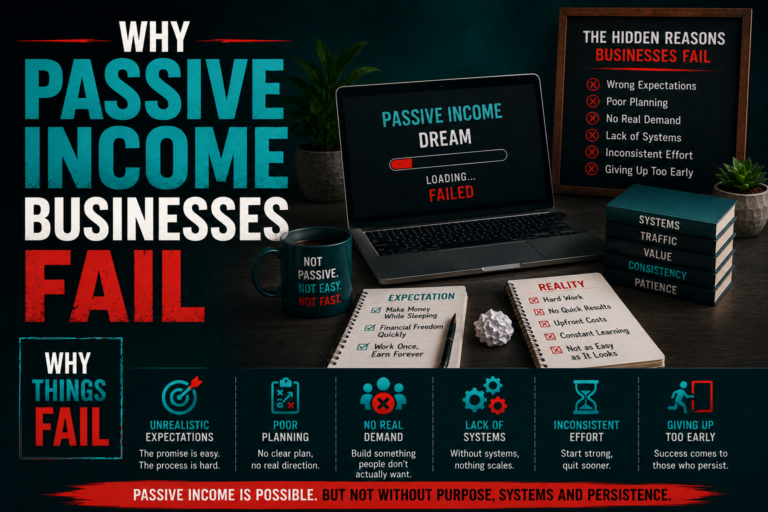
Understanding why passive income businesses fail matters because the concept itself is not flawed. Rather, failure usually results from unrealistic expectations, poor business design, weak financial systems, and predictable human behaviour. The most successful passive income businesses are rarely passive in their early years, and many never become entirely hands-off.
What Is a Passive Income Business?
A passive income business is a venture designed to generate ongoing revenue without requiring continuous day-to-day labour for every sale. Common examples include:
- Affiliate marketing websites
- Digital products such as online courses or templates
- Software subscriptions (SaaS)
- Rental property portfolios
- Dividend investment portfolios
- Licensing intellectual property
- Automated e-commerce businesses
- Print-on-demand stores
The defining characteristic is not the absence of work but the separation of income from hourly effort. Revenue can continue after the initial work has been completed, provided the underlying system remains valuable and well maintained.
The Biggest Myth
The biggest misconception is that passive income means no work.
In reality, nearly every successful passive income business begins with years of active effort. Products must be developed, audiences built, marketing refined, customer support managed, systems improved, and risks controlled.
Many ventures fail because entrepreneurs focus on becoming passive before building something worth automating. They attempt to eliminate effort before creating value.
The phrase “passive income” describes the outcome of a mature business model, not the process of creating one.
What Usually Happens?
The pattern is remarkably consistent.
Someone discovers a popular passive income idea online. Inspired by stories of financial independence, they invest money, time, or both. Early progress is slow, revenue is inconsistent, and unexpected challenges appear.
Instead of refining the system, many abandon the project or chase another opportunity that appears easier. They repeat the cycle with multiple business models, accumulating costs while gaining little lasting income.
The business rarely fails because passive income is impossible. It fails because the systems needed to support long-term income were never fully developed.
Why Does It Happen?
The Attraction of Effortless Wealth
Humans naturally seek efficiency. The promise of earning more while working less appeals to deeply rooted psychological preferences.
Unfortunately, this creates unrealistic expectations. When reality proves slower and more demanding, disappointment replaces commitment. Many entrepreneurs quit during the difficult phase that every sustainable business must pass through.
The desire for effortless wealth often becomes the first obstacle to creating genuine wealth.
Confusing Automation with Value Creation
Automation can reduce repetitive tasks, but it cannot replace customer value.
Many people spend considerable time automating marketing, payments, and fulfilment before confirming whether customers actually want their product.
Technology can improve efficiency, but it cannot compensate for weak demand.
Businesses survive because they solve meaningful problems—not because they use sophisticated automation tools.
Poor Financial Psychology
Behavioural economics shows that people consistently overestimate future rewards while underestimating present costs.
This optimism bias leads entrepreneurs to believe:
- Sales will arrive quickly.
- Marketing will be inexpensive.
- Customers will remain loyal.
- Competition will stay limited.
- Income will become stable within months.
When these assumptions prove inaccurate, financial pressure grows rapidly.
Overconfidence
Success stories are highly visible.
Failures rarely receive the same attention.
This creates survivorship bias. Entrepreneurs see thousands of successful YouTube channels discussing passive income while never seeing the millions of abandoned websites, unsuccessful stores, or closed businesses.
As a result, risks appear much smaller than they really are.
Chasing Trends Instead of Building Assets
Many passive income businesses depend on temporary trends.
Examples include:
- Viral products
- Short-lived SEO tactics
- Social media algorithms
- Trending niches
- Temporary advertising opportunities
Businesses built around trends often generate quick revenue but struggle to survive once market conditions change.
Long-term businesses rely on enduring customer needs rather than temporary excitement.
Weak Cash Flow Management
Many ventures fail despite generating revenue.
Revenue is not the same as profit.
Marketing costs rise.
Software subscriptions accumulate.
Advertising becomes more expensive.
Customer acquisition slows.
Unexpected expenses emerge.
Without disciplined cash flow management, businesses become financially fragile even when sales appear healthy.
Poor Risk Management
Many entrepreneurs rely on a single traffic source, supplier, platform, or customer segment.
Examples include:
- Only Google search traffic
- One affiliate programme
- A single supplier
- One advertising platform
- One digital marketplace
Any disruption can reduce revenue almost overnight.
Diversification is often ignored because concentration appears more profitable during periods of growth.
Emotional Decision-Making
Financial decisions become increasingly emotional under pressure.
Owners begin making reactive choices:
- Constantly changing strategies.
- Launching unnecessary products.
- Reducing prices excessively.
- Abandoning marketing campaigns too early.
- Investing in expensive “secret systems.”
Rather than improving performance, emotional reactions increase instability.
Short-Term Thinking
Many passive income businesses require years before becoming highly profitable.
However, modern culture rewards immediate results.
When progress appears slower than expected, entrepreneurs often conclude that the business model itself has failed.
In reality, many simply stopped investing before compounding effects became significant.
Poor Financial Education
Many founders understand how to create products but not how businesses operate.
They underestimate:
- Tax obligations
- Operating costs
- Customer acquisition
- Retention economics
- Pricing strategy
- Cash reserves
- Opportunity costs
Business failure frequently reflects financial misunderstanding rather than poor effort.
Ignoring Maintenance
No passive income system remains passive forever.
Websites require updates.
Rental properties require repairs.
Software needs maintenance.
Markets evolve.
Customer expectations change.
Competition improves.
Businesses fail when owners assume yesterday’s system will continue producing tomorrow’s income without ongoing adaptation.
Warning Signs
Several indicators often appear long before financial failure becomes obvious:
- Revenue depends on one customer or platform.
- Cash flow becomes increasingly unpredictable.
- Expenses rise faster than income.
- Marketing costs continually increase.
- Customer acquisition slows.
- Maintenance is repeatedly delayed.
- Growth relies on temporary trends.
- The owner constantly searches for the next opportunity instead of improving the current one.
These warning signs are often ignored because optimism encourages entrepreneurs to believe conditions will improve naturally.
What Could Have Prevented It?
Most failures are not prevented by working harder but by building stronger systems.
Effective prevention includes:
- Validating market demand before investing heavily.
- Building multiple sources of revenue.
- Maintaining emergency cash reserves.
- Monitoring cash flow rather than revenue alone.
- Diversifying traffic, suppliers, and customers.
- Reviewing business performance regularly.
- Accepting that maintenance is a permanent business function.
- Making decisions using evidence rather than emotion.
Strong businesses are designed to withstand uncertainty rather than assuming favourable conditions will continue indefinitely.
Lessons
Passive income is not the absence of work.
It is the result of well-designed systems that continue delivering value after substantial effort has already been invested.
The most resilient businesses share common characteristics:
- They solve genuine customer problems.
- They prioritise cash flow over appearance.
- They diversify risks.
- They adapt continuously.
- They improve gradually rather than pursuing shortcuts.
Financial freedom usually emerges from consistency rather than sudden breakthroughs.
Failure Pattern
Weak Cash Flow Management Combined with Short-Term Thinking
The dominant pattern behind passive income business failure is the combination of poor cash flow management and unrealistic time expectations.
Individuals expect immediate financial returns while underestimating the investment required to build durable systems.
Businesses spend aggressively before revenue stabilises.
When growth slows, financial pressure exposes weaknesses that were hidden during optimistic projections.
This pattern appears repeatedly across affiliate businesses, online stores, property investments, subscription services, and digital product companies because human expectations consistently underestimate the time required for sustainable wealth creation.
Hidden Lesson
The greatest irony of passive income is that the businesses most capable of becoming passive usually demand the highest levels of active discipline in their early years.
What eventually feels effortless is often the product of years of careful planning, continuous maintenance, disciplined financial management, and countless small decisions that outsiders never see.
The real source of passive income is not automation.
It is resilient systems.
Failure Scorecard
| Area | Score | Explanation |
|---|---|---|
| Financial Discipline | 4/10 | Spending often grows faster than stable income. |
| Decision-Making | 5/10 | Emotional choices frequently replace evidence-based analysis. |
| Risk Management | 3/10 | Heavy dependence on single income sources is common. |
| Long-Term Thinking | 4/10 | Many abandon businesses before compounding benefits appear. |
| Financial Knowledge | 5/10 | Revenue is often confused with profitability. |
| Emotional Control | 4/10 | Fear and excitement regularly influence financial decisions. |
| Planning | 5/10 | Initial planning often ignores maintenance and uncertainty. |
| Adaptability | 6/10 | Successful businesses improve continuously, while failing ones resist necessary change. |
Key Takeaways
- Passive income is built, not discovered.
- Automation cannot replace genuine customer value.
- Revenue without strong cash flow creates hidden risk.
- Diversification protects businesses from sudden disruption.
- Most failures begin long before financial collapse becomes visible.
- Behavioural biases often cause entrepreneurs to underestimate risk.
- Maintenance is a permanent business responsibility.
- Sustainable passive income depends on resilient systems rather than shortcuts.
- Long-term wealth usually grows through consistency, not rapid success.
Conclusion
Passive income businesses rarely fail because the concept is unrealistic. They fail because the systems supporting them are incomplete, fragile, or built on unrealistic assumptions. Beneath almost every collapse lies a familiar combination of optimism, weak planning, poor risk management, and the belief that automation can replace the continuous creation of value.
The deeper lesson is that passive income is not a shortcut around work—it is the delayed reward for designing systems that continue to create value long after the initial effort has been invested. Those who understand this distinction stop chasing effortless income and start building businesses capable of enduring uncertainty. In the end, the true predictor of lasting passive income is not how little work a business requires today, but how well its foundations can withstand the challenges of tomorrow.