Quick Answer
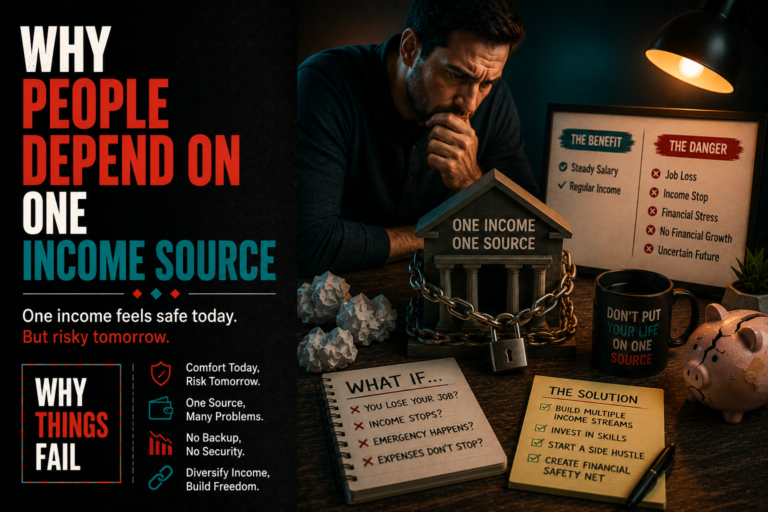
People depend on one income source because of behavioural habits, perceived security, financial psychology, social expectations and short term thinking. The greatest risk is not having one source of income itself. The real danger is believing that one income source will always remain stable despite economic uncertainty and changing labour markets.
Introduction
For generations, society has promoted a simple financial formula.
Study hard.
Find a secure job.
Work consistently.
Receive a regular salary.
Retire comfortably.
For many people, this model worked reasonably well in stable economic environments. A single employer often provided long term employment, predictable income and retirement benefits.
The modern economy tells a different story.
Companies restructure without warning. Industries disappear through automation. Economic recessions reduce hiring. Inflation weakens purchasing power. Artificial intelligence is transforming professional roles that once appeared secure.
Despite these changes, millions of people continue relying on one income source.
This creates an important question.
Why do intelligent and hardworking people continue placing their entire financial future on a single source of income despite growing economic uncertainty?
The answer extends far beyond employment.
It involves psychology, incentives, education, human behaviour and the way society defines financial security.
Depending on one income source is rarely a deliberate financial strategy.
More often, it becomes the result of gradual behavioural patterns that feel sensible today but create vulnerability tomorrow.
Understanding these patterns explains why financial insecurity remains common even among people with stable careers and respectable incomes.
What Is Depending on One Income Source?
Depending on one income source means relying on a single salary, business, client or revenue stream to fund every aspect of daily life.
This does not automatically represent financial failure.
Many people successfully support themselves through one stable profession for decades.
The problem arises when there is no financial resilience if that income suddenly disappears.
Income dependence becomes a financial weakness when a household has no meaningful alternatives during unexpected events such as redundancy, illness, economic recession, business failure or technological disruption.
The issue is therefore not employment itself.
It is concentration of financial risk.
Just as investors reduce investment risk through diversification, individuals also reduce financial vulnerability when income is generated from more than one source.
The Biggest Myth
The most common belief is simple.
A stable job guarantees financial security.
This idea has shaped financial thinking for decades.
Regular pay cheques create a powerful feeling of certainty.
People naturally assume that predictable income means predictable financial stability.
Reality is more complex.
Employment contracts can end.
Businesses can fail.
Entire industries can decline.
Technology continuously changes labour demand.
Even highly skilled professionals experience unexpected career disruptions.
The salary itself is not the guarantee.
It is merely one source of cash flow.
Confusing stable income with permanent security often prevents people from recognising growing financial risk until circumstances change unexpectedly.
What Usually Happens?
Most people begin their careers with one income source.
As earnings increase, expenses also increase.
Mortgage payments become larger.
Lifestyle expectations improve.
Family responsibilities expand.
Monthly financial commitments gradually become dependent upon one regular salary.
During periods of stable employment, this arrangement feels completely normal.
Because income continues arriving every month, few people question whether additional income streams are necessary.
The system appears reliable.
Only when employment changes unexpectedly do many households realise that almost every financial obligation depended upon one source of cash flow.
The financial problem did not begin when income stopped.
It began years earlier when financial resilience was never developed.
Why Do People Depend on One Income Source?
The explanation begins with human psychology rather than economics.
Most people do not consciously decide to become financially dependent.
Instead, dependence develops through behavioural habits reinforced by education, social expectations and perceived security.
The Human Brain Prefers Certainty
Behavioural economists have long recognised that people naturally prefer certainty over uncertainty.
A predictable monthly salary creates emotional comfort.
Even if opportunities exist to develop additional income, they often appear uncertain compared with regular employment.
The brain therefore favours immediate stability over long term resilience.
Ironically, this desire for certainty may increase financial risk.
When every household expense depends upon one employer or one business, financial stability becomes vulnerable to circumstances beyond personal control.
The psychological comfort of one predictable income can conceal the economic reality of concentrated risk.
Financial Education Focuses On Earning Rather Than Diversifying
Many education systems prepare students to obtain employment.
Far less attention is given to income diversification, asset ownership, cash flow management or financial resilience.
As a result, people often measure success by securing employment rather than strengthening financial independence.
This mindset influences financial decisions throughout adulthood.
Career progression receives considerable attention.
Income concentration receives very little.
Consequently, many individuals improve earnings while leaving financial vulnerability unchanged.
Higher salaries increase lifestyle quality but do not necessarily reduce dependence on one source of income.
Lifestyle Inflation Quietly Locks People Into Dependence
One of the strongest behavioural forces affecting personal finance is lifestyle inflation.
As income rises, spending usually follows.
People purchase larger homes.
Vehicle payments increase.
Travel becomes more frequent.
Monthly subscriptions accumulate.
None of these decisions appears unreasonable in isolation.
Collectively, however, they transform fixed expenses into permanent financial obligations.
The higher the monthly financial commitments become, the more essential the primary income source appears.
This creates an invisible cycle.
Higher income supports greater spending.
Greater spending increases financial dependence.
Financial dependence discourages taking calculated risks that could create additional income opportunities.
Lifestyle inflation therefore reduces financial flexibility without most people recognising the long term consequences.
Social Expectations Shape Financial Behaviour
Human beings constantly compare themselves with others.
Behavioural psychology demonstrates that people evaluate success relative to their social environment rather than objective financial resilience.
Society often celebrates visible achievements.
A prestigious career.
A larger house.
A luxury vehicle.
Professional promotions.
Very little attention is given to invisible financial strengths such as diversified income, emergency savings or resilient cash flow.
This creates powerful incentives.
People invest significant effort into protecting professional status while overlooking financial resilience.
The result is a household that appears financially successful yet remains highly vulnerable to one unexpected loss of income.
Present Bias Encourages Short Term Comfort
Present bias explains why people consistently prioritise immediate rewards over future benefits.
Developing additional income requires time, patience and uncertainty.
The rewards may not appear for months or years.
By contrast, leisure, entertainment and immediate consumption provide instant satisfaction.
The brain naturally values immediate certainty more highly than future resilience.
This explains why many individuals postpone developing secondary income sources despite understanding their long term value.
The decision feels rational today.
The financial consequences emerge much later.
Delayed consequences are among the most powerful drivers of financial vulnerability because they allow risky behaviour to continue without immediate feedback.
Overconfidence Creates False Security
Long periods of uninterrupted employment often create overconfidence.
People begin believing that because income has always arrived on time, it always will.
They underestimate economic cycles.
They overlook technological disruption.
They ignore industry specific risks.
This confidence gradually reduces preparation for uncertainty.
Emergency planning becomes less urgent.
Skill development slows.
Alternative income opportunities receive less attention.
When unexpected disruption finally occurs, the financial damage appears sudden.
In reality, vulnerability had been developing quietly for years through assumptions that were never questioned.
Weak Financial Systems Reinforce The Problem
Individual behaviour explains only part of the story.
Broader financial systems also encourage dependence on one income source.
Many households operate within structures where employment provides healthcare, retirement contributions, credit approval and financial stability simultaneously.
Banks frequently assess borrowing capacity using employment income.
Housing affordability depends heavily on salary verification.
Consumer credit becomes easier for those with predictable employment.
These incentives reinforce the belief that maintaining one primary income source is the safest financial strategy.
The system rewards stability.
It does not always reward resilience.
As a result, dependence becomes normal rather than exceptional, even though economic uncertainty continues increasing.
Warning Signs
Financial dependence rarely becomes obvious overnight. It develops gradually through habits that feel sensible in the present but increase vulnerability over time.
One warning sign is that every monthly expense depends entirely on one salary or one business. If losing that income would immediately threaten mortgage payments, household bills or essential living costs, financial resilience is already limited.
Another warning sign is postponing alternative income because the current job feels secure. Many people believe they will diversify their income “one day,” but that day continues moving further into the future as responsibilities increase.
A lack of emergency savings is another important indicator. Without financial reserves, even a temporary interruption in income can force households into debt or the sale of long term assets.
Ignoring changes within an industry should also raise concern. Technological innovation, automation, artificial intelligence and changing consumer demand can transform labour markets much faster than people expect. Assuming that current employment conditions will remain unchanged often delays necessary preparation.
Perhaps the clearest warning sign is believing that financial security depends entirely on keeping one job. When every future plan relies upon circumstances outside personal control, dependence has quietly become vulnerability.
These warning signs are often ignored because no immediate consequences appear. As long as income continues arriving, the underlying financial risk remains hidden.
What Could Have Prevented It?
Reducing dependence on one income source does not begin with earning more money.
It begins with changing the way financial security is understood.
Financial resilience improves when people recognise that income should be viewed as a system rather than a single event. Multiple sources of cash flow reduce the impact of unexpected disruption because financial stability no longer depends upon one employer, one client or one business.
Long term planning also changes decision making. Households that regularly review future risks are more likely to identify opportunities for developing additional skills, building assets or creating complementary income before financial pressure appears.
Financial education plays an important role as well. Understanding concepts such as cash flow, opportunity cost, asset ownership, inflation and economic cycles helps people evaluate security more realistically rather than emotionally.
Equally important is maintaining financial flexibility. Avoiding unnecessary fixed expenses preserves the ability to adapt when circumstances change. Flexibility allows individuals to respond thoughtfully instead of reacting under financial pressure.
Ultimately, preventing income dependence is less about predicting economic change and more about preparing for uncertainty before it arrives.
Lessons
The reasons people depend on one income source extend beyond employment. They reveal how human beings naturally seek certainty even when that certainty may be temporary.
One lesson is that stability and resilience are not identical. A reliable salary may create short term stability, but resilience depends on the ability to withstand unexpected change.
Another lesson is that financial vulnerability usually develops during periods of success. When income is predictable, preparing for disruption appears unnecessary. Ironically, this is often the best time to strengthen financial resilience.
The investigation also highlights that behaviour matters more than income level. High earners can remain financially fragile if every financial commitment depends on one source of cash flow, while moderate earners with diversified income may possess greater resilience.
Perhaps the most important lesson is that financial security should be measured by adaptability rather than predictability. Economies evolve continuously. Individuals who adapt their income systems are generally better positioned to manage uncertainty than those relying upon one permanent solution.
Failure Pattern
The dominant pattern behind this financial failure is Lack of Planning combined with Short Term Thinking and Weak Cash Flow Diversification.
This pattern appears repeatedly because people naturally optimise for present comfort instead of future resilience. Stable employment encourages confidence. Confidence reduces preparation. Reduced preparation increases vulnerability when unexpected events occur.
The same behavioural pattern appears in business. Companies depending on one major customer often struggle when that customer leaves. Investors concentrating wealth in one asset face similar risks. Entrepreneurs relying upon one product experience comparable challenges when markets change.
The common factor is concentration.
Whenever financial security depends upon one source, one decision or one outcome, resilience becomes weaker regardless of current success.
Hidden Lesson
The greatest financial risk is not earning income from one source.
It is believing that one source will always exist.
Most people do not lose financial stability because they lacked intelligence or worked too little. They lose it because they underestimated uncertainty and overestimated permanence.
Economic systems continue changing. Technology evolves. Consumer behaviour shifts. Industries transform.
Financial resilience therefore depends less on predicting these changes and more on accepting that change is inevitable.
The deeper lesson is that diversification is not only an investment principle.
It is a principle of financial survival.
Failure Scorecard
| Area | Score | Explanation |
| Financial Discipline | 6/10 | Regular income supports budgeting, but dependence limits financial resilience. |
| Decision Making | 5/10 | Many decisions prioritise immediate certainty over long term flexibility. |
| Risk Management | 3/10 | Relying upon one income source creates concentrated financial risk. |
| Long Term Thinking | 4/10 | Future uncertainty is often underestimated during stable employment. |
| Financial Knowledge | 5/10 | Many people understand earning income but receive little education about income diversification. |
| Emotional Control | 6/10 | Fear of uncertainty often discourages exploring additional opportunities. |
| Planning | 4/10 | Long term contingency planning is frequently delayed until financial disruption occurs. |
| Adaptability | 5/10 | Adaptation usually happens after change rather than before it. |
Key Takeaways
- Depending on one income source creates concentration risk similar to relying on one investment.
- Stable employment does not guarantee permanent financial security.
- Lifestyle inflation often increases dependence without people recognising it.
- Financial resilience depends on flexibility rather than income alone.
- Behavioural biases encourage immediate certainty over long term preparation.
- Diversified cash flow strengthens the ability to withstand unexpected disruption.
- Preparing before economic change is easier than reacting after it occurs.
- Financial security should be evaluated by resilience, not only by salary.
Frequently Asked Questions
Why is depending on one income source risky?
Relying on one income source creates concentrated financial risk. If that source is interrupted through redundancy, illness or economic change, household finances may be affected immediately.
Does having one job always mean financial insecurity?
No. Many people successfully build wealth with one profession. The risk arises when there is no financial resilience if that income unexpectedly disappears.
Why do most people rely on one income source?
Most people prioritise certainty, follow traditional career paths, experience lifestyle inflation and receive limited financial education about income diversification. These behavioural and systemic factors encourage dependence.
How does lifestyle inflation increase financial risk?
As income rises, spending often rises as well. Higher fixed expenses increase reliance on maintaining the same level of income, reducing financial flexibility if circumstances change.
What is the biggest misconception about financial security?
The biggest misconception is believing that a stable salary guarantees permanent security. True financial resilience depends on the ability to adapt when economic conditions change.
Conclusion
People rarely depend on one income source because they deliberately choose financial vulnerability. They do so because psychology, education, social expectations and financial systems collectively reward stability while quietly overlooking resilience.
Understanding this distinction changes the conversation. The greatest financial weakness is not having one source of income. It is assuming that today’s certainty will remain unchanged tomorrow.