
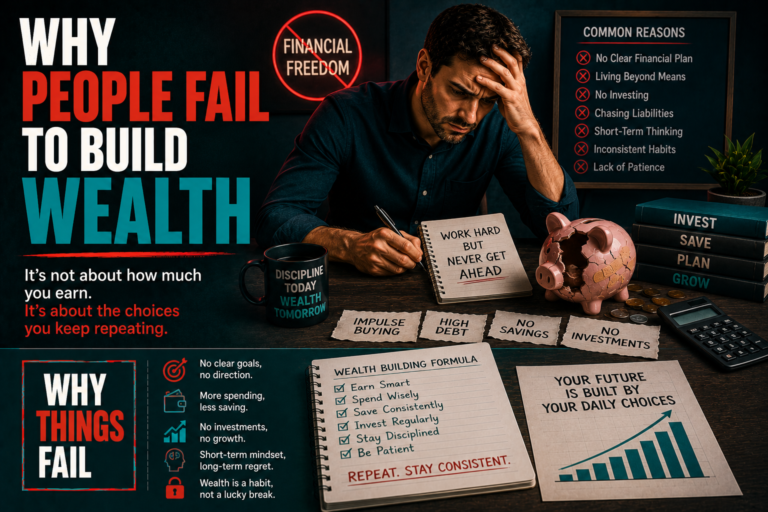
Introduction
Building wealth has never been easier in terms of access.
People can invest through mobile applications, start businesses from home, learn financial skills online and access information that was once available only to professionals. Financial markets, entrepreneurship and digital opportunities have opened new paths to wealth creation for millions of people.
Yet despite these opportunities, many individuals spend decades working without achieving lasting financial security.
Some earn high incomes but accumulate little wealth.
Others receive promotions and salary increases, yet continue living from one pay cheque to the next.
Many save money for years only to watch unexpected expenses erase their progress.
This raises an important question.
Why do so many people fail to build wealth despite having more financial opportunities than previous generations?
The common explanation is that wealth depends mainly on income.
This belief is comforting because it places responsibility on external circumstances.
However, history repeatedly shows that people with modest incomes have built substantial wealth, while others with exceptional earnings have experienced financial instability.
The difference is rarely explained by income alone.
Wealth is not simply the result of earning money.
It is the outcome of thousands of decisions made over many years. Those decisions are shaped by psychology, incentives, habits, financial systems and the ability to think beyond immediate rewards.
Understanding why people fail to build wealth therefore requires looking beneath bank balances and investment portfolios.
It requires understanding how human behaviour influences financial outcomes.
What Is Wealth Building Failure?
Many people assume wealth building failure means becoming bankrupt or losing significant amounts of money.
The reality is much broader.
Wealth building failure occurs when an individual consistently struggles to increase net worth despite earning income over a long period.
This does not necessarily involve dramatic financial mistakes.
For many people, wealth slowly slips away through ordinary decisions.
Income increases.
Expenses increase even faster.
Savings remain inconsistent.
Investments are delayed.
Debt gradually expands.
Years pass without meaningful growth in assets.
From the outside, everything appears stable.
Behind the scenes, financial progress remains limited.
This explains why wealth building is fundamentally different from income generation.
Income measures how much money enters a household.
Wealth measures what remains after spending, borrowing and financial obligations have been considered.
People often focus on earning more while overlooking the behaviours that determine whether additional income becomes lasting wealth.
The Biggest Myth
The most common belief about wealth is simple.
People fail to build wealth because they do not earn enough money.
Income certainly influences financial opportunities.
Someone earning a higher salary has greater capacity to save and invest than someone struggling to meet basic living expenses.
However, income alone does not explain long term wealth.
Many professional athletes, entertainers and business executives have earned millions while eventually facing serious financial difficulties.
At the same time, countless households with ordinary incomes have steadily accumulated wealth through disciplined financial behaviour.
The difference lies in what happens after income is received.
Behavioural economists argue that wealth is primarily influenced by financial decisions rather than financial events.
Every pay rise creates a choice.
Spend more.
Save more.
Invest more.
Reduce debt.
Build assets.
These choices, repeated over decades, determine financial outcomes far more consistently than isolated income increases.
The myth persists because income is visible.
Financial behaviour is not.
People compare salaries with neighbours and colleagues.
Few compare savings rates, investment habits, debt levels or long term planning.
As a result, wealth often appears to be created by earnings alone when it is actually created through consistent financial behaviour.
What Usually Happens?
The journey towards financial stagnation rarely begins with one major mistake.
It develops gradually.
A person begins working and enjoys increasing income.
Higher earnings improve spending power.
Lifestyle expectations also begin rising.
A larger home seems reasonable.
A newer vehicle feels justified.
Dining out becomes more frequent.
Luxury purchases become normal rather than occasional.
Each individual decision appears affordable because income continues increasing.
However, savings fail to grow at the same pace.
Investment contributions remain inconsistent.
Unexpected expenses require borrowing.
Debt repayments consume future income.
Financial flexibility gradually disappears.
Years later, despite earning substantially more than before, wealth remains limited.
This pattern repeats across different income groups because it reflects human behaviour rather than earning capacity.
Why Does It Happen?
Understanding why people fail to build wealth requires moving beyond budgeting advice.
The deeper causes are psychological.
Financial decisions are rarely made through logic alone.
They are influenced by emotions, social expectations, cognitive biases and immediate rewards.
Present Bias Prioritises Immediate Satisfaction
One of the strongest behavioural biases affecting wealth creation is present bias.
People naturally value immediate rewards more highly than future benefits.
Buying something today provides instant satisfaction.
Saving the same amount produces no immediate emotional reward.
The financial benefit may not become visible for years.
This imbalance creates a predictable pattern.
Short term spending consistently wins against long term investing.
The decision rarely feels irresponsible because each purchase appears relatively small.
However, repeated hundreds of times over many years, these choices significantly reduce wealth accumulation.
The problem is not individual purchases.
It is the psychological preference for immediate gratification over delayed financial security.
Lifestyle Inflation Quietly Consumes Higher Income
Lifestyle inflation is one of the least recognised barriers to wealth creation.
Most people expect higher income to improve financial security.
Instead, increased earnings often lead to increased spending.
As salaries rise, expectations rise alongside them.
Homes become larger.
Cars become more expensive.
Holidays become more luxurious.
Monthly commitments increase.
The additional income disappears almost as quickly as it arrives.
Behavioural economists explain this through hedonic adaptation.
People quickly become accustomed to improved living standards.
What once felt luxurious gradually becomes ordinary.
Satisfaction fades.
New desires replace previous achievements.
The result is a continuous cycle where spending expands to match income, leaving little room for meaningful wealth accumulation.
Social Comparison Encourages Financial Decisions That Serve Appearance Rather Than Security
Human beings naturally compare themselves with others.
Modern technology has intensified this tendency.
Social media presents carefully selected images of success, luxury and achievement.
Expensive holidays, designer products and luxury homes become symbols of progress.
Few people publicly display investment portfolios, emergency savings or retirement accounts.
As a result, visible consumption receives greater attention than invisible wealth.
Many financial decisions are therefore influenced by social status rather than financial necessity.
Individuals begin measuring success through possessions instead of financial resilience.
This creates spending patterns designed to impress others rather than strengthen long term financial stability.
In behavioural economics, this is often described as status driven consumption.
The financial cost extends far beyond individual purchases.
It changes the purpose of money itself, shifting it from wealth creation towards social signalling.
Poor Financial Education Explains Only Part of the Problem
Financial literacy certainly matters.
Understanding concepts such as compound growth, inflation, asset allocation, interest rates, diversification and cash flow improves financial decision making.
However, knowledge alone rarely guarantees wealth.
Many highly educated professionals struggle financially despite understanding basic financial principles.
The missing element is behavioural consistency.
People often know what they should do.
They simply struggle to continue doing it when faced with emotional spending, social pressure or unexpected financial events.
This explains why education alone cannot solve wealth inequality or poor financial habits.
Behaviour consistently outweighs knowledge when financial decisions are repeated over many years.
Warning Signs
People rarely wake up one morning and realise they have failed to build wealth. Financial stagnation develops slowly, making it difficult to recognise until many years have passed.
One warning sign is that every salary increase immediately leads to higher spending rather than higher saving or investing. Income grows, yet net worth changes very little.
Another warning sign is relying entirely on earned income while owning few appreciating assets. Employment provides cash flow, but long term wealth is usually created by assets that increase in value or generate passive income over time.
Growing consumer debt is another indicator. Borrowing for lifestyle purchases reduces future financial flexibility because tomorrow’s income is committed to paying for yesterday’s consumption.
Many people also postpone investing because they believe they will start when they earn more money. This delay often continues for years. The opportunity cost becomes substantial because compound growth depends more on time than on large initial contributions.
Perhaps the most overlooked warning sign is the absence of a financial plan. People carefully plan holidays, weddings and career changes, yet many spend decades without clear financial objectives. Decisions become reactive instead of intentional, allowing circumstances rather than strategy to shape financial outcomes.
These warning signs are often ignored because they do not create immediate consequences. The financial damage accumulates gradually, making it easy to believe everything is under control until meaningful wealth has already been lost through missed opportunities.
What Could Have Prevented It?
Wealth building does not require perfect decisions.
It requires consistently making decisions that improve financial resilience over time.
The first step is recognising that income alone cannot create wealth. A higher salary only creates greater opportunity. Whether that opportunity becomes lasting wealth depends on how additional income is allocated.
Creating automatic saving and investing systems reduces the influence of emotion. When financial decisions become habitual rather than optional, present bias loses much of its influence.
Another important safeguard is separating lifestyle decisions from income growth. Increasing spending after every pay rise may improve comfort in the short term, but it often delays financial independence. Maintaining modest lifestyle growth while increasing investment contributions allows assets to expand more rapidly.
Developing financial literacy is equally important, but education should focus on behaviour as much as knowledge. Understanding compound growth, inflation, diversification, cash flow and risk management provides a stronger foundation for consistent decision making.
Regular financial reviews also improve long term outcomes. Measuring net worth, monitoring debt, evaluating asset allocation and reassessing financial goals help identify behavioural patterns before they become permanent habits.
Ultimately, wealth is built through systems that reduce poor decisions rather than through occasional moments of financial brilliance.
Lessons
The investigation into wealth building reveals that financial success depends less on exceptional opportunities and more on ordinary decisions repeated consistently over decades.
One lesson is that behaviour compounds just as money compounds. Small spending habits, saving patterns and investment decisions appear insignificant individually, yet collectively they determine long term financial outcomes.
Another lesson is that wealth is largely invisible. Expensive possessions may signal income, but they reveal very little about financial security. Assets, low debt and disciplined financial behaviour often remain unseen.
The article also demonstrates that financial knowledge without emotional discipline rarely produces lasting wealth. Understanding investment principles has little value if emotional spending repeatedly overrides rational planning.
Perhaps the most important lesson is that building wealth is not primarily an economic challenge. It is a behavioural challenge. The quality of daily financial decisions matters far more than occasional financial opportunities.
Failure Pattern
The dominant pattern behind wealth building failure is Lifestyle Inflation combined with Short Term Thinking.
Higher income creates higher expectations. Higher expectations create higher spending. Higher spending reduces saving and investing, leaving little opportunity for assets to compound over time.
This pattern appears across different income levels because it is driven by psychology rather than earnings. People naturally adapt to improved lifestyles and quickly view previous luxuries as necessities.
The same behavioural cycle appears in entrepreneurs, investors and businesses. Periods of success encourage greater spending before long term financial resilience has been established. Eventually, unexpected events expose the weakness created by years of prioritising immediate rewards over future security.
Hidden Lesson
The greatest obstacle to building wealth is not a lack of opportunity.
It is the invisible belief that financial success is created by earning more rather than behaving differently.
People often spend years searching for higher income while overlooking the habits that quietly determine whether additional income becomes lasting wealth.
The deeper truth is that wealth is rarely destroyed by one major financial mistake. It is more often prevented from developing because thousands of ordinary decisions consistently favour present comfort over future financial resilience.
Failure Scorecard
| Area | Score | Explanation |
| Financial Discipline | 4/10 | Spending habits frequently grow faster than saving and investing habits. |
| Decision Making | 5/10 | Financial decisions are often influenced by emotion, convenience and social comparison. |
| Risk Management | 5/10 | Many households underestimate the importance of emergency savings and diversified assets. |
| Long Term Thinking | 4/10 | Immediate rewards often receive greater priority than future financial security. |
| Financial Knowledge | 6/10 | Information is widely available, but behavioural application remains inconsistent. |
| Emotional Control | 4/10 | Status driven spending, fear of missing out and impulse purchases weaken financial progress. |
| Planning | 5/10 | Many people have career plans but lack structured wealth building plans. |
| Adaptability | 6/10 | Those who regularly review financial decisions are more likely to improve long term outcomes. |
Key Takeaways
- Wealth is created through behaviour more consistently than through income.
- Lifestyle inflation quietly prevents many people from accumulating meaningful assets.
- Present bias encourages spending today at the expense of future financial security.
- Financial discipline is more valuable than occasional financial success.
- Assets build wealth while excessive liabilities limit financial flexibility.
- Compound growth rewards consistency and patience rather than perfection.
- Social comparison often encourages visible consumption instead of invisible wealth creation.
- Long term financial resilience depends on systems, planning and disciplined decision making.
Frequently Asked Questions
Why do people fail to build wealth even with high incomes?
High income increases financial opportunity but does not guarantee disciplined financial behaviour. Lifestyle inflation, poor planning and emotional spending often prevent income from becoming lasting wealth.
What is the biggest reason people struggle to build wealth?
The biggest reason is consistently prioritising short term consumption over long term asset accumulation. Small behavioural choices repeated for many years have a greater impact than isolated financial events.
Does financial education automatically lead to wealth?
No. Financial knowledge improves decision making, but lasting wealth depends on consistently applying that knowledge despite emotional pressure, social influence and changing life circumstances.
Why is lifestyle inflation so damaging?
Lifestyle inflation causes spending to rise alongside income, leaving little additional money available for saving or investing. As a result, higher earnings fail to translate into higher net worth.
Can ordinary income still build significant wealth?
Yes. History shows that consistent saving, disciplined investing, prudent risk management and long term planning often contribute more to wealth creation than exceptionally high income alone.
Conclusion
People rarely fail to build wealth because opportunity is entirely absent. More often, they fail because predictable behavioural patterns gradually redirect income away from assets and towards immediate consumption. Financial outcomes reflect thousands of ordinary decisions that remain unnoticed until many years have passed.
Understanding these patterns changes the conversation about wealth. The challenge is no longer simply earning more money. It is recognising how psychology, incentives and everyday behaviour quietly shape financial success long before the numbers in a bank account reveal the result.