
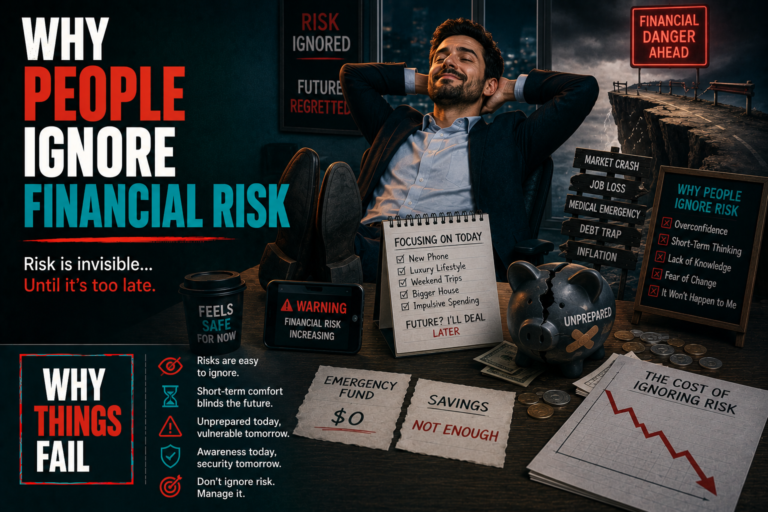
Quick Answer
People ignore financial risk because the human brain is not naturally designed to evaluate uncertainty objectively. Overconfidence, optimism bias, social influence, delayed consequences and emotional decision making often make financial dangers appear smaller than they really are. Most financial failures begin long before money is actually lost.
Introduction
Every financial crisis leaves behind the same question.
Why did so many people fail to see the warning signs?
Homeowners borrowed beyond their means before the housing market collapsed.
Investors continued buying expensive assets before market crashes.
Businesses expanded aggressively despite weakening cash flow.
Families accumulated debt while believing future income would solve today’s financial problems.
Looking back, many of these risks appear obvious.
At the time, however, they rarely felt dangerous.
This contradiction reveals one of the most important truths in behavioural economics.
Financial risk is not ignored because people lack intelligence.
It is ignored because the human brain interprets uncertainty through emotion rather than objective probability.
Modern financial markets contain more information than ever before. Economic forecasts, financial news, investment research and risk analysis are available almost instantly.
Yet greater access to information has not eliminated poor financial decisions.
Instead, financial failure continues to follow remarkably similar patterns across individuals, businesses and entire economies.
Understanding why people ignore financial risk therefore requires looking beyond economics.
It requires examining psychology, incentives, decision making and the behavioural patterns that quietly transform manageable risks into major financial losses.
What Is Financial Risk?
Financial risk is the possibility that a decision may reduce wealth, income, purchasing power or financial stability.
Many people associate financial risk only with investing.
In reality, financial risk exists in almost every economic decision.
Borrowing excessive money.
Depending on one source of income.
Starting a business without sufficient cash reserves.
Ignoring inflation.
Failing to diversify investments.
Buying assets that cannot be afforded.
Postponing retirement planning.
Each decision carries uncertainty.
Financial failure occurs when these risks are ignored, underestimated or misunderstood until their consequences become impossible to avoid.
The danger is rarely one dramatic mistake.
It is usually the accumulation of many small decisions that appear reasonable in isolation but become destructive when combined.
The Biggest Myth
The most common misunderstanding is that people knowingly take excessive financial risks.
Behavioural research suggests something very different.
Most people genuinely believe their financial decisions are reasonable.
Very few individuals wake up intending to create financial problems.
Instead, they underestimate probability.
They overestimate future income.
They assume favourable conditions will continue.
They believe unexpected problems happen to other people.
Psychologists refer to this as optimism bias.
People naturally expect positive outcomes while assigning a lower probability to negative events.
This bias creates confidence during periods when caution would be far more valuable.
The result is predictable.
Financial risk remains invisible until financial reality forces it into view.
What Usually Happens?
The pattern rarely changes.
Financial conditions improve.
Confidence increases.
People borrow more.
Businesses expand.
Investors accept greater risk.
Consumers increase spending.
Rising asset prices reinforce optimism.
Warnings appear.
Most people dismiss them because recent experience feels more convincing than future uncertainty.
Eventually conditions change.
Interest rates rise.
Economic growth slows.
Asset prices decline.
Cash flow weakens.
Debt becomes difficult to manage.
What appeared to be sensible financial decisions suddenly look reckless.
The failure seems sudden.
In reality, it developed gradually over months or even years.
Why Do People Ignore Financial Risk?
Financial risk is rarely ignored because information is unavailable.
It is ignored because human psychology systematically distorts how uncertainty is perceived.
Behavioural economists have repeatedly shown that people evaluate financial decisions emotionally before they evaluate them logically.
This creates a gap between objective risk and perceived risk.
Understanding this gap explains why financial mistakes continue repeating across generations despite improvements in education, technology and economic knowledge.
The Brain Rewards Immediate Benefits More Than Future Security
One of the strongest behavioural tendencies affecting financial decisions is present bias.
People naturally value immediate rewards more highly than future benefits.
Receiving something today feels more satisfying than avoiding a problem several years from now.
This explains why many households prioritise current spending over emergency savings.
Businesses focus on quarterly growth rather than long term resilience.
Investors chase rapid returns while underestimating future volatility.
The financial risk is visible.
The immediate reward simply feels more important.
Over time, repeated short term decisions quietly weaken long term financial stability.
Overconfidence Makes Risk Appear Smaller
Confidence is necessary for economic activity.
Without confidence, businesses would never invest and entrepreneurs would never launch new ventures.
However, excessive confidence changes the quality of financial judgement.
After several successful decisions, people begin believing they understand financial uncertainty better than they actually do.
Investors assume they can consistently identify winning opportunities.
Business owners believe demand will continue growing indefinitely.
Consumers believe future salary increases will comfortably repay today’s debt.
This illusion of control reduces the perceived need for caution.
Risk itself does not disappear.
Only awareness of risk declines.
History repeatedly demonstrates that periods of widespread confidence often precede periods of significant financial loss.
Delayed Consequences Encourage Poor Decisions
One reason financial risk is frequently ignored is that poor decisions rarely produce immediate consequences.
A family may increase debt without experiencing financial stress for several years.
An investor may take excessive risk during a prolonged bull market and continue earning profits.
A company may weaken its balance sheet while revenue remains strong.
Because no immediate penalty exists, people naturally assume the decision was correct.
Behavioural economists describe this as delayed feedback.
The human brain learns more effectively from immediate consequences than distant ones.
When financial mistakes remain hidden for long periods, confidence grows instead of caution.
Eventually circumstances change.
The accumulated risk becomes impossible to ignore.
At that point, many people mistakenly blame the triggering event rather than recognising the long series of behavioural decisions that quietly created vulnerability.
Social Proof Changes Risk Perception
Financial decisions rarely occur in isolation.
People constantly observe the behaviour of friends, colleagues, family members and society.
When everyone appears confident, confidence becomes socially acceptable.
When property prices continue rising, buying expensive homes feels sensible because everyone else is doing the same.
When speculative investments dominate conversations, avoiding them begins to feel like missing an opportunity.
Behavioural scientists describe this tendency as social proof.
Humans naturally assume that widespread behaviour must contain useful information.
In financial markets, this assumption often produces bubbles.
Popularity becomes mistaken for safety.
The number of people making a decision becomes confused with the quality of the decision itself.
History repeatedly shows that crowds can underestimate risk just as easily as individuals.
Fear Often Arrives Too Late
Fear is commonly viewed as the opposite of risk taking.
In reality, fear often appears only after financial damage has already begun.
During periods of economic expansion, optimism suppresses caution.
When markets decline or incomes weaken, fear suddenly dominates decision making.
This delayed emotional response explains why many people ignore financial risk before a crisis yet become excessively cautious during recovery.
Ironically, the period when fear becomes strongest is often the period when risks are already declining.
By contrast, the period when confidence becomes strongest is frequently when financial risks are quietly increasing.
This emotional cycle causes people to underestimate danger during prosperity and overestimate danger during uncertainty.
Understanding this behavioural pattern explains why financial crises often appear predictable in hindsight but remain surprisingly difficult for individuals to recognise while they are unfolding.
Warning Signs
Financial risk rarely announces itself through dramatic events. More often, it appears through subtle behavioural changes that seem harmless until they accumulate into serious financial vulnerability.
One warning sign is believing that favourable conditions will continue indefinitely. Rising property values, steady employment, growing investment returns or expanding business revenue create a false sense of permanence. People gradually assume that tomorrow will resemble today, reducing the perceived need for caution.
Another warning sign is making financial decisions without considering worst case outcomes. Borrowing more money, concentrating investments or expanding a business may appear reasonable when everything is going well. The absence of contingency planning suggests confidence has begun replacing objective risk assessment.
Ignoring independent opinions is another important indicator. When individuals seek only information that supports existing beliefs, confirmation bias begins influencing financial judgement. Constructive criticism is dismissed while optimistic opinions receive greater attention.
An increasing dependence on debt can also indicate that financial resilience is weakening. Debt itself is not always problematic, but relying on future income to solve present financial commitments increases exposure to unexpected economic changes.
Perhaps the most overlooked warning sign is believing that financial risk only affects other people. This illusion encourages complacency and delays corrective action until circumstances become far more difficult to manage.
These warning signs are often ignored because they develop during periods of confidence rather than crisis. Success creates reassurance, making caution appear unnecessary precisely when it is becoming most valuable.
What Could Have Prevented It?
Financial risk cannot be eliminated because uncertainty is an unavoidable part of economic life.
What can be improved is the quality of decisions made before uncertainty becomes expensive.
One important safeguard is recognising that confidence and safety are not the same thing. Feeling comfortable about a financial decision does not necessarily mean the decision carries low risk. Separating emotion from analysis encourages more balanced judgement.
Long term planning also reduces vulnerability. Individuals and businesses that regularly evaluate cash flow, savings, debt obligations and future uncertainties are better prepared when economic conditions change unexpectedly.
Diversification provides another layer of protection. Depending entirely on one investment, one customer, one employer or one income source increases financial fragility. Multiple sources of income and diversified assets improve resilience without requiring perfect predictions.
Financial education should extend beyond understanding money. It should include understanding behavioural biases such as optimism bias, loss aversion, confirmation bias and overconfidence. Recognising these psychological tendencies allows people to question their own assumptions before financial risks become irreversible.
Finally, decision making improves when uncertainty is accepted rather than denied. People who acknowledge that unexpected events will occur are more likely to prepare for them than those who assume favourable conditions will continue indefinitely.
Lessons
The reasons people ignore financial risk reveal important lessons that apply far beyond personal finance.
The first lesson is that intelligence alone does not protect people from poor financial decisions. Behaviour often has a greater influence on financial outcomes than knowledge.
The second lesson is that risk is most dangerous when it feels invisible. Periods of economic growth, rising markets and stable employment often encourage decisions that quietly increase long term vulnerability.
Another lesson is that financial resilience depends on preparation rather than prediction. Individuals and businesses rarely fail because they could not predict every future event. They fail because they assumed preparation was unnecessary.
Perhaps the most valuable lesson is that successful financial decisions require balancing optimism with realism. Confidence encourages growth, but disciplined caution protects that growth when circumstances inevitably change.
Failure Pattern
The dominant pattern behind ignoring financial risk is Overconfidence combined with Short Term Thinking and Poor Risk Management.
This pattern appears repeatedly because immediate rewards are more emotionally satisfying than preparing for uncertain future events. As confidence grows, perceived risk declines even though actual risk often increases.
Individuals borrow more because income appears secure. Investors chase higher returns because markets have performed well. Businesses expand aggressively because recent demand has been strong.
Each decision appears reasonable when viewed independently.
Together they gradually reduce financial resilience.
The same behavioural pattern has contributed to property bubbles, corporate failures, banking crises, excessive consumer debt and speculative investment booms throughout history. Human psychology changes far more slowly than financial markets, which is why these patterns continue repeating across generations.
Hidden Lesson
People rarely ignore financial risk because they enjoy taking unnecessary chances.
They ignore it because the human brain confuses familiarity with safety.
When uncertainty remains hidden for long periods, confidence naturally increases. The absence of immediate consequences creates the illusion that risk has disappeared, when in reality it has simply not yet been revealed.
The deeper truth is that financial crises rarely begin with economic collapse.
They begin with ordinary decisions repeated under the assumption that tomorrow will always resemble today.
Failure Scorecard
| Area | Score | Explanation |
| Financial Discipline | 5/10 | Many people maintain reasonable financial habits until confidence encourages unnecessary risk. |
| Decision Making | 4/10 | Behavioural biases frequently influence financial judgement without being recognised. |
| Risk Management | 4/10 | Financial risks are often underestimated during periods of stability and growth. |
| Long Term Thinking | 5/10 | Immediate rewards commonly receive greater attention than future financial resilience. |
| Financial Knowledge | 6/10 | Information is widely available, yet behavioural understanding often remains limited. |
| Emotional Control | 4/10 | Optimism and fear regularly influence financial choices more than objective analysis. |
| Planning | 5/10 | Financial planning frequently overlooks unlikely but financially significant events. |
| Adaptability | 6/10 | Many people adjust only after financial conditions have already deteriorated. |
Key Takeaways
- People ignore financial risk because emotions often outweigh objective probability.
- Optimism bias encourages individuals to underestimate negative outcomes.
- Delayed consequences make poor financial decisions appear successful in the short term.
- Social proof can make risky financial behaviour appear normal.
- Overconfidence reduces the perceived need for preparation and contingency planning.
- Financial resilience depends on systems rather than predictions.
- Understanding behavioural psychology is just as important as understanding economics.
- Most financial failures begin long before money is actually lost.
Frequently Asked Questions
Why do people ignore financial risk?
People ignore financial risk because behavioural biases such as optimism bias, overconfidence and present bias distort how uncertainty is perceived. Immediate rewards often appear more important than preparing for future risks.
What is the biggest reason people underestimate financial risk?
The biggest reason is that financial consequences are often delayed. When poor decisions produce no immediate penalty, people mistakenly believe those decisions are safe.
How does psychology influence financial risk?
Psychology influences financial risk through emotions, cognitive biases and social influence. These factors affect how people judge probability, evaluate uncertainty and respond to changing financial conditions.
Why do financial crises often seem obvious in hindsight?
Once the outcome is known, warning signs become easier to recognise. During periods of growth, optimism and recent success make those same warning signs appear less important.
Can financial education reduce risk?
Financial education improves decision making, but lasting improvement also requires understanding behavioural biases and creating systems that reduce emotional decision making.
Conclusion
People do not ignore financial risk because they lack information. They ignore it because human psychology consistently interprets uncertainty through emotion, recent experience and social influence rather than objective probability.
Understanding this changes the way financial failure is viewed. The greatest risks are rarely hidden within complex economic systems. They are often hidden within ordinary decisions that feel safe today but quietly increase vulnerability for tomorrow.