Quick Answer
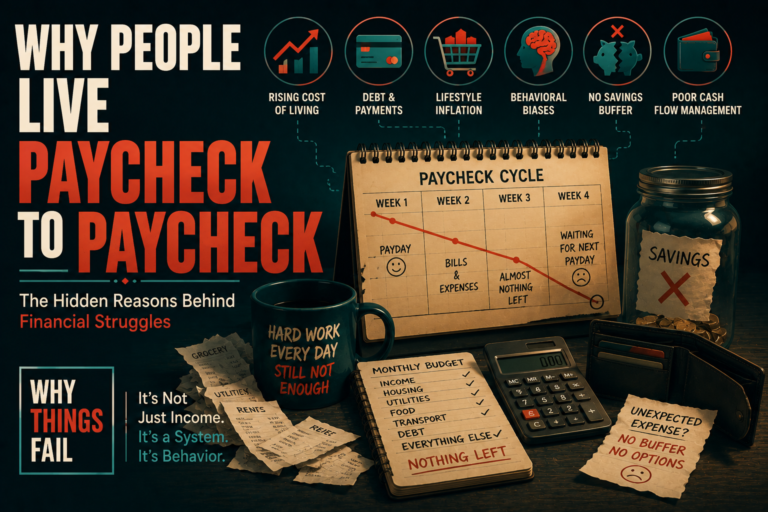
Living paycheck to paycheck is rarely caused by low income alone. It is usually the result of a complex interaction between rising living costs, financial habits, behavioural biases, poor cash flow management, limited financial literacy and economic systems that encourage immediate spending over long-term wealth building. Understanding these underlying forces helps explain why financial instability persists across different income levels.
Introduction
Living paycheck to paycheck has become one of the defining financial realities of modern life. Millions of people work full-time, earn regular incomes and appear financially stable from the outside, yet find themselves unable to cover an unexpected expense without borrowing money or using credit.
This raises an uncomfortable question.
How can someone earn a reasonable income and still struggle to build financial security?
The obvious answer is that they simply do not earn enough. While low wages undoubtedly contribute, this explanation is incomplete. High-income professionals, business owners and even six-figure earners can also find themselves trapped in the same cycle.
The problem, therefore, cannot be explained by income alone.
Living paycheck to paycheck is not merely a budgeting issue. It is the outcome of behavioural patterns, financial systems, psychological biases and economic incentives that gradually erode financial resilience. Small decisions accumulate over months and years until every payday becomes a reset button rather than a step towards wealth.
Understanding this pattern matters because the same forces that keep households financially vulnerable also influence investing, entrepreneurship and long-term wealth creation. The issue is less about money itself and more about how people interact with it.
This investigation explores why living paycheck to paycheck has become so common, why intelligent people often fail to escape it and what the pattern reveals about human behaviour, financial decision-making and modern economic systems.
What Is Living Paycheck to Paycheck?
Living paycheck to paycheck means relying almost entirely on the next pay cheque to meet everyday financial obligations. Once essential expenses such as housing, food, transport, utilities, insurance and debt repayments have been paid, little or no disposable income remains.
The defining feature is not income level but cash flow vulnerability.
A household earning £40,000 a year and another earning £250,000 a year can both live paycheck to paycheck if their recurring expenses consume almost all available income.
This distinction is often overlooked.
Financial security is not determined solely by earnings. It depends on the relationship between income, expenses, savings, debt and financial flexibility. When that balance disappears, even temporary disruptions—such as a medical emergency, job loss or unexpected repair can trigger significant financial stress.
In this sense, living paycheck to paycheck is less a measure of wealth than a measure of resilience.
The Biggest Myth
The most common belief is that people live paycheck to paycheck because they are poor or irresponsible.
Reality is more complicated.
Certainly, some households struggle because incomes simply fail to keep pace with the cost of living. Rising housing costs, inflation, healthcare expenses and childcare can consume a significant share of earnings.
However, this explanation fails to account for a surprising fact.
Many higher-income earners also report living paycheck to paycheck despite earning salaries that would once have been considered financially comfortable.
Why?
Because financial pressure is shaped not only by income but also by expectations, lifestyle choices, debt obligations and spending patterns.
A growing salary often leads to growing expenses rather than growing wealth. As incomes rise, homes become larger, vehicles become more expensive and discretionary spending expands. This phenomenon known as lifestyle inflation reduces the financial benefits of higher earnings.
The real question is not simply, “How much do people earn?”
It is, “Why do expenses continue rising until they consume nearly every increase in income?”
That question leads us beyond income statistics and into behavioural economics.
What Usually Happens?
The journey into living paycheck to paycheck rarely begins with a financial crisis.
Instead, it develops gradually.
An individual receives a pay rise and upgrades to a larger home. Monthly mortgage or rent payments increase. A new vehicle is financed because the monthly payment appears affordable. Subscription services accumulate. Credit cards bridge occasional gaps in cash flow. Small discretionary purchases become everyday habits.
Each decision appears manageable in isolation.
Together, however, they create a financial structure with very little margin for error.
When an unexpected expense eventually arrives—a medical bill, car repair, redundancy or family emergency—the household discovers that its financial stability depended entirely on receiving the next pay cheque on time.
The problem was never the emergency.
The problem was the absence of resilience long before the emergency occurred.
Why Does It Happen?
The financial habits that keep people living paycheck to paycheck are rarely formed overnight. They develop through repeated interactions between psychology, economic incentives and daily decision-making. The deeper we investigate, the clearer it becomes that this pattern is less about income and more about how people respond to uncertainty, opportunity and financial pressure.
Decision Fatigue: Why Good Financial Choices Become Harder
Every day, people make hundreds of decisions about money.
Should they cook at home or order takeaway? Should they save part of their salary or pay off another bill? Should they replace an old car or keep repairing it?
Individually, these choices seem insignificant. Collectively, they place a heavy burden on the brain.
Psychologists refer to this as decision fatigue the gradual decline in decision quality after making repeated choices. As mental energy decreases, people naturally favour the easiest option rather than the most beneficial one.
This explains why someone who carefully budgets at the beginning of the month may make impulsive purchases by the end of it. Their financial knowledge has not disappeared; their mental capacity to resist temptation has simply weakened.
Living paycheck to paycheck often creates even greater decision fatigue because financial uncertainty forces people to think constantly about bills, debt repayments and upcoming expenses. Instead of making proactive financial decisions, they become trapped in a cycle of reacting to immediate problems.
Scarcity Mindset: When Financial Pressure Changes the Brain
One of the most overlooked causes of financial instability is the scarcity mindset.
When money is consistently limited, the brain begins prioritising immediate survival over long-term planning.
People become focused on questions such as:
- Can I pay this week’s rent?
- How will I cover tomorrow’s fuel costs?
- Which bill should I delay?
These concerns are entirely rational.
However, they also reduce the mental space available for strategic thinking.
Behavioural researchers have found that scarcity narrows attention. People become highly effective at solving today’s financial problem while unintentionally neglecting next month’s.
This is why individuals living paycheck to paycheck often struggle to build emergency savings, despite fully understanding their importance. The immediate demands of survival leave little room for long-term wealth building.
Loss Aversion: Why People Resist Financial Change
Behavioural economics shows that people fear losses more intensely than they value equivalent gains.
This principle, known as loss aversion, influences many financial decisions.
Someone may avoid investing because they fear losing money, even if doing nothing guarantees inflation will reduce purchasing power over time.
Similarly, a household may continue paying for unused subscriptions or expensive memberships because cancelling them feels like giving something up, despite the long-term financial benefit.
Loss aversion encourages people to preserve familiar spending patterns instead of making uncomfortable adjustments that could strengthen their financial future.
Ironically, avoiding small short-term sacrifices often results in much larger financial losses later.
Status Signalling and the Cost of Looking Successful
Modern society often measures success through visible consumption.
Cars.
Houses.
Clothing.
Technology.
Luxury holidays.
These purchases communicate achievement to others, a behaviour psychologists describe as status signalling.
The challenge is that many status symbols are financed through debt rather than accumulated wealth.
From the outside, two households may appear equally prosperous.
One owns appreciating assets, maintains healthy cash flow and invests consistently.
The other depends entirely on monthly income to support an expensive lifestyle.
The appearance is similar.
The financial reality is completely different.
Living paycheck to paycheck frequently reflects the pursuit of visible wealth rather than financial resilience.
Weak Financial Systems Encourage Consumption
Individual behaviour tells only part of the story.
Modern financial systems also influence decision-making.
Banks promote accessible credit.
Retailers encourage buy-now-pay-later services.
Subscription businesses rely on automatic renewals.
Advertising personalises spending opportunities through algorithms.
Each system makes consumption easier while making saving comparatively less rewarding.
None of these systems force people to overspend.
However, they create incentives that encourage immediate consumption over delayed financial security.
Behavioural economists recognise that people rarely make decisions in isolation. Their environment strongly shapes their choices.
When the environment consistently rewards spending, maintaining financial discipline requires considerably greater effort.
Delayed Consequences Hide Financial Risk
One reason people ignore financial danger is that the consequences rarely appear immediately.
A financed vehicle seems affordable because the first monthly payment is manageable.
A new credit card appears harmless because the minimum repayment is low.
A larger mortgage feels comfortable while interest rates remain stable.
The true costs emerge gradually.
Debt accumulates.
Interest compounds.
Cash flow tightens.
Financial flexibility disappears.
By the time these consequences become visible, reversing the situation often requires painful adjustments.
This delay creates a dangerous illusion that previous financial decisions were sensible, even when they were quietly reducing long-term resilience.
Why High-Income Earners Also Live Paycheck to Paycheck
One of the most surprising aspects of this issue is that financial vulnerability exists across nearly every income level.
Higher earnings certainly create greater opportunities to save and invest.
They do not automatically create financial discipline.
As incomes rise, expectations often rise alongside them.
Larger homes become normal.
Private education becomes expected.
Luxury travel becomes routine.
Higher earnings increase spending capacity, but they also increase financial obligations.
Without disciplined cash flow management, growing income simply supports a more expensive version of the same financial pattern.
This explains why some households earning six-figure salaries experience the same financial anxiety as those earning significantly less.
Their lifestyles expanded as quickly as their incomes.
The Root Cause: Financial Behaviour Is More Powerful Than Income
After examining psychology, behavioural economics and financial systems, one conclusion becomes increasingly clear.
Living paycheck to paycheck is rarely the result of one catastrophic mistake.
It emerges from dozens of individually reasonable decisions shaped by behavioural biases, social expectations, delayed consequences and economic incentives.
Income matters.
Inflation matters.
Housing costs matter.
But behaviour determines how people respond to those realities.
The households that gradually build financial resilience are not necessarily those with the highest incomes. They are often those that consistently prioritise cash flow, delayed gratification, thoughtful planning and long-term decision-making over immediate consumption.
Ultimately, living paycheck to paycheck is not simply a financial condition.
It is a behavioural pattern reinforced by psychology, environment and systems—making it both remarkably common and, with the right structural changes, entirely understandable.
Warning Signs
Living paycheck to paycheck rarely begins with a financial emergency. The warning signs often appear months or even years before the situation becomes serious, but they are easy to dismiss because they develop gradually.
One of the earliest indicators is the inability to save consistently despite receiving regular income. Every pay cheque is allocated before it arrives, leaving little room for unexpected expenses.
Another warning sign is increasing reliance on credit cards, overdrafts or buy-now-pay-later services to cover routine living costs rather than genuine emergencies. Debt gradually shifts from being an occasional tool to becoming part of everyday cash flow management.
Lifestyle inflation is another subtle indicator. Every salary increase is quickly absorbed by higher spending, meaning financial security never improves despite earning more money.
Many households also experience growing financial anxiety. They avoid checking bank balances, postpone opening bills or feel stressed whenever an unexpected expense arises. These emotional responses often signal deeper cash flow problems long before financial hardship becomes visible.
These warning signs are frequently ignored because they do not create immediate consequences. Monthly bills continue to be paid, and life appears financially stable. The absence of a crisis creates the illusion that no problem exists, even as financial resilience steadily weakens.
What Could Have Prevented It?
Preventing a paycheck-to-paycheck lifestyle does not require perfect financial decisions. It requires systems that reduce the impact of human bias.
The first priority is protecting cash flow rather than increasing visible wealth. Households that consistently maintain a financial buffer are better equipped to absorb unexpected expenses without relying on debt.
Secondly, separating income growth from lifestyle growth can significantly improve long-term financial resilience. Allowing savings and investments to increase alongside earnings creates financial flexibility instead of permanent financial obligations.
Behavioural systems are equally important. Automatic savings, investment contributions and debt repayments reduce the need for repeated financial decisions, limiting the effects of present bias and decision fatigue.
Financial education should also focus less on mathematical concepts and more on behavioural psychology. Understanding why people overspend, compare themselves with others or underestimate future risks is often more valuable than knowing how to calculate investment returns.
Finally, economic systems can support better financial outcomes by encouraging emergency savings, improving financial education and designing financial products that reward long-term stability rather than immediate consumption.
Lessons
The investigation reveals several lessons that extend far beyond household budgeting.
Financial success is not determined solely by income. It depends on how consistently people convert income into financial resilience.
Behaviour frequently matters more than knowledge. Many individuals understand sound financial principles but struggle to apply them because emotions, habits and environmental influences shape daily decisions.
Cash flow deserves greater attention than visible wealth. Expensive assets can create the appearance of prosperity while quietly reducing financial flexibility.
Long-term wealth is built through repeated small decisions rather than occasional large ones. Consistent saving, disciplined spending and thoughtful planning often outperform dramatic financial changes.
Finally, financial stability is a product of systems rather than willpower. Well-designed habits reduce the need for constant self-control, making good decisions easier to sustain over time.
Failure Pattern
The dominant failure pattern is Lifestyle Inflation reinforced by Short-Term Thinking.
As income increases, spending increases alongside it. Immediate rewards consistently take priority over future security, while easy access to credit masks the growing imbalance between income and financial obligations.
This pattern appears repeatedly across households, entrepreneurs, professional athletes, lottery winners and even successful businesses.
Regardless of income level, organisations and individuals that continually expand fixed expenses faster than financial resilience eventually become vulnerable to unexpected shocks.
The common factor is not a lack of opportunity.
It is the gradual erosion of financial flexibility.
Hidden Lesson
The deepest lesson is that living paycheck to paycheck is rarely a failure of earning—it is often a failure of resilience.
Money does not create security by itself.
Security comes from maintaining the flexibility to absorb uncertainty without depending entirely on the next source of income.
The households that appear wealthy are not always financially secure, while those with modest incomes can often withstand financial shocks because they have prioritised resilience over consumption.
In the long run, financial resilience is a stronger predictor of lasting wealth than income alone.
Failure Scorecard
| Area | Score | Analysis |
| Financial Discipline | 4/10 | Spending frequently expands to match or exceed income, limiting opportunities to save consistently. |
| Decision-Making | 5/10 | Decisions are often influenced by emotion, convenience and short-term rewards rather than long-term objectives. |
| Risk Management | 3/10 | Limited emergency savings leave households vulnerable to relatively small financial shocks. |
| Long-Term Thinking | 4/10 | Immediate needs and lifestyle expectations often outweigh future financial security. |
| Financial Knowledge | 6/10 | Many people understand basic financial concepts but struggle to translate knowledge into consistent behaviour. |
| Emotional Control | 5/10 | Stress, social comparison and consumer culture frequently influence spending decisions. |
| Planning | 4/10 | Financial planning often focuses on monthly survival rather than long-term resilience. |
| Adaptability | 6/10 | Many households adjust during crises but have limited flexibility because most income is already committed. |
Key Takeaways
- Living paycheck to paycheck is not determined by income alone; cash flow and financial resilience matter just as much.
- Lifestyle inflation quietly absorbs income growth, preventing lasting financial progress.
- Behavioural biases such as present bias, loss aversion and social comparison strongly influence spending decisions.
- Easy access to credit often delays the consequences of poor financial choices rather than preventing them.
- Financial knowledge without behavioural discipline rarely changes long-term outcomes.
- Emergency savings represent resilience, not simply spare cash.
- Long-term wealth is created through consistent systems rather than occasional financial successes.
- Financial security depends on maintaining flexibility before a crisis occurs, not reacting after one.
Frequently Asked Questions
Do high-income earners also live paycheck to paycheck?
Yes. Higher income does not automatically create financial security. If expenses, debt repayments and lifestyle commitments increase alongside earnings, even high-income households can remain financially vulnerable.
Is living paycheck to paycheck always caused by poor financial decisions?
No. Rising housing costs, inflation, healthcare expenses, stagnant wages and unexpected life events can all contribute. However, behavioural patterns and financial systems often determine whether these pressures become long-term financial traps.
What is the biggest behavioural reason people remain paycheck to paycheck?
Present bias is one of the strongest influences. People naturally prioritise immediate rewards over future benefits, making it difficult to save consistently or reduce unnecessary spending despite understanding the long-term consequences.
Why do salary increases rarely solve the problem?
Without changes in financial behaviour, higher earnings frequently lead to higher spending through lifestyle inflation. As a result, financial pressure remains despite increased income.
Can someone escape the paycheck-to-paycheck cycle?
Yes, but lasting improvement usually requires changes in both financial systems and behaviour. Improving cash flow management, limiting fixed expenses and creating automatic saving habits are generally more effective than relying on willpower alone.
Conclusion
Living paycheck to paycheck is often portrayed as a simple consequence of earning too little or spending too much. This investigation reveals a far more complex reality. Financial vulnerability emerges from the interaction of psychology, behavioural biases, social expectations, economic incentives and delayed consequences that gradually weaken resilience over time.
The most important insight is that financial failure rarely arrives as a single dramatic event. More often, it is the predictable result of countless ordinary decisions that appear harmless in isolation but collectively shape a life where every pay cheque becomes essential for survival. Understanding those hidden patterns is the first step towards understanding why financial resilience not income alone defines lasting financial security.