
Quick Answer
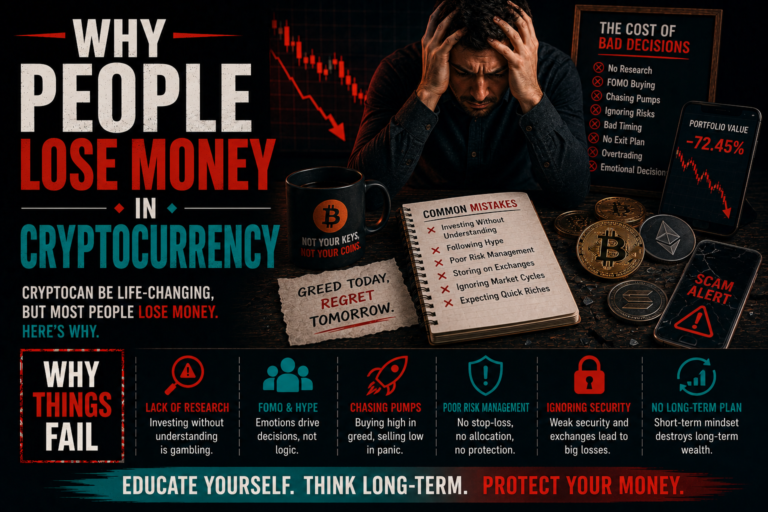
People lose money in cryptocurrency not because digital assets are destined to fail, but because emotions, poor risk management, unrealistic expectations and behavioural biases often influence their decisions more than objective analysis. Cryptocurrency markets expose psychological weaknesses that remain hidden during periods of rising prices.
Introduction
Cryptocurrency has transformed the way people think about money, investing and financial freedom. What began as an alternative form of digital money has grown into a global financial market worth trillions of dollars at its peak. Millions of people have entered the market hoping to build wealth through assets such as Bitcoin, Ethereum and thousands of alternative cryptocurrencies.
Alongside stories of extraordinary gains are countless stories of significant financial losses.
Some investors bought near market highs before watching prices collapse. Others invested in projects that disappeared overnight. Many lost money through scams, fraudulent exchanges or emotional trading decisions. Even experienced investors have struggled to navigate the extreme volatility that defines cryptocurrency markets.
This raises an important question.
If cryptocurrency has created substantial wealth for some people, why do so many others lose money?
The common explanation is that cryptocurrency is simply too risky.
The deeper explanation is far more complex.
Most financial losses are not caused by blockchain technology itself. They result from predictable patterns of human behaviour, weak decision making, unrealistic expectations and poor risk management. Cryptocurrency simply magnifies these weaknesses because of its speed, volatility and constant flow of information.
Understanding why people lose money in cryptocurrency is therefore less about understanding digital assets and more about understanding how people behave when uncertainty, opportunity and emotion collide.
What Is Cryptocurrency Investment Failure?
Losing money on a cryptocurrency investment does not automatically mean someone has failed.
Every financial market experiences cycles of growth and decline. Temporary losses are a normal part of investing.
Cryptocurrency investment failure occurs when repeated decisions reduce long term wealth because behaviour consistently overrides rational judgement.
Some people buy highly speculative tokens without understanding their purpose.
Others continue investing after ignoring obvious warning signs.
Many refuse to manage risk because they believe prices will always recover.
The failure is rarely a single bad investment.
It is usually a sequence of decisions driven by emotion instead of evidence.
The Biggest Myth
The biggest myth surrounding cryptocurrency is simple.
People lose money because cryptocurrency has no value.
This explanation ignores an important reality.
Many people also lose money in stocks, property, commodities and foreign exchange markets. Financial losses are not unique to cryptocurrency.
The difference is that cryptocurrency moves faster.
Prices can rise or fall dramatically within hours. This speed amplifies emotional reactions, making behavioural mistakes more frequent and more costly.
Successful cryptocurrency investors do not avoid volatility.
They understand it.
They recognise that uncertainty is part of the market and build decision making processes that account for it rather than reacting emotionally to every price movement.
The market itself is not the greatest risk.
Human behaviour usually is.
What Usually Happens?
Why Does It Happen?
Understanding cryptocurrency losses requires looking beyond price charts and market headlines.
Financial markets reward rational decision making.
Cryptocurrency markets constantly test emotional decision making.
That distinction explains why the same market creates both extraordinary success and devastating losses.
Fear Of Missing Out Replaces Rational Analysis
One of the strongest behavioural forces in cryptocurrency is the Fear of Missing Out, often called FOMO.
When people see others making substantial profits, they naturally compare those results with their own financial position.
Social media accelerates this behaviour.
Success stories spread rapidly.
Luxury lifestyles become symbols of easy wealth.
The thousands of people who quietly lose money receive far less attention.
This creates survivorship bias.
Investors see only successful outcomes while underestimating the risks taken to achieve them.
As excitement grows, many people stop asking important questions.
Does this project solve a genuine problem?
Is the valuation realistic?
Who created the project?
What risks exist?
Instead, the dominant question becomes,
“How much higher can the price go?”
The focus quietly shifts from analysing value to chasing momentum.
Overconfidence Creates Invisible Risk
After several profitable trades, many cryptocurrency investors begin believing they possess exceptional market insight.
Behavioural economists describe this as overconfidence bias.
Profits achieved during favourable market conditions are often mistaken for investing skill.
Confidence gradually encourages larger positions.
Diversification decreases.
Risk management becomes less important.
Some investors borrow money to increase their exposure.
Others place most of their wealth into a single digital asset because previous decisions produced positive results.
The danger is that cryptocurrency markets eventually change direction.
When volatility increases, portfolios built on confidence instead of risk management become extremely vulnerable.
The market has not changed.
The investor’s tolerance for risk has.
Greed Gradually Changes Investment Behaviour
Greed rarely appears suddenly.
It develops through repeated success.
An investor doubles their money.
The original financial goal no longer feels exciting.
Ordinary returns become disappointing.
Instead of protecting gains, investors search for even greater opportunities through newly launched tokens, meme coins or highly speculative decentralised finance projects.
Behavioural psychology explains this as reward seeking behaviour.
Each successful outcome raises expectations for the next one.
Eventually, preserving wealth becomes less satisfying than chasing extraordinary returns.
This gradual shift in priorities often marks the beginning of financial decline.
Confirmation Bias Prevents Objective Thinking
Once investors become emotionally attached to a cryptocurrency, they naturally begin searching for information that supports their existing beliefs.
Positive news receives attention.
Negative evidence is dismissed as fear or market manipulation.
Communities built around individual cryptocurrencies can reinforce this behaviour by rewarding optimism while discouraging criticism.
Instead of evaluating changing conditions objectively, investors begin defending previous decisions.
This reduces adaptability, one of the most valuable qualities in any financial market.
Markets constantly evolve.
Investors who refuse to question their assumptions often continue holding weak investments long after evidence suggests conditions have changed.
Why Does It Happen?
Social Pressure Encourages Poor Financial Decisions
Cryptocurrency investing rarely happens in isolation.
People are influenced by friends, family, online communities, influencers and financial media. Every market rally creates stories of ordinary individuals becoming wealthy in a short period. These stories spread rapidly because they appeal to hope and ambition.
Social proof is a powerful behavioural force.
When thousands of people appear to support the same investment, individuals naturally assume the collective opinion must be correct. The popularity of a cryptocurrency becomes confused with its fundamental value.
The result is predictable.
Many people buy because others are buying rather than because they understand the technology, the business model or the risks involved.
Poor Financial Education Creates False Confidence
Cryptocurrency combines finance, economics, technology and cybersecurity.
Many new investors enter the market without understanding any of these areas.
They know how to open an exchange account but not how blockchain networks operate.
They recognise price charts but cannot evaluate token supply, market capitalisation, liquidity or project sustainability.
This gap creates false confidence.
Investors mistake access to information for understanding. Watching videos or following influencers creates the impression of expertise even though genuine financial analysis requires much deeper knowledge.
Without understanding valuation, risk and portfolio management, investors become vulnerable to unrealistic promises and speculative narratives.
Short Term Thinking Becomes The Default Mindset
Cryptocurrency markets operate twenty four hours a day.
Prices constantly change.
Every notification encourages immediate action.
This environment rewards attention but often punishes patience.
Many investors begin checking prices dozens of times each day.
Small market movements start influencing emotional wellbeing.
Instead of evaluating long term trends, investors react to short term volatility.
Behavioural economists describe this as present bias.
Immediate outcomes receive greater attention than future consequences.
As a result, many people make decisions that provide emotional relief today but create financial losses tomorrow.
Weak Risk Management Turns Small Mistakes Into Major Losses
No investment is free from uncertainty.
The difference between temporary setbacks and permanent financial damage often depends on risk management.
Many cryptocurrency investors ignore this reality.
They invest money needed for essential expenses.
They concentrate their savings into one asset.
Some use borrowed money or leverage to increase potential profits.
Others continue investing in declining projects because they cannot accept previous losses.
These decisions increase fragility.
When market conditions change, even a modest decline can become financially devastating.
The immediate cause appears to be falling prices.
The deeper cause is excessive exposure to risk.
Delayed Consequences Encourage Dangerous Behaviour
One reason people repeat poor financial decisions is that mistakes are not always punished immediately.
An investor may ignore diversification during a bull market and still make substantial profits.
Another may buy speculative meme coins and experience rapid gains.
These positive outcomes reinforce poor habits.
The investor concludes that the behaviour was intelligent because it produced profits.
In reality, favourable market conditions simply delayed the consequences.
When the market cycle changes, the same behaviour suddenly produces heavy losses.
The market has not become unfair.
It has simply exposed weaknesses that remained hidden during periods of optimism.
Warning Signs
Financial failure in cryptocurrency rarely arrives without warning.
One warning sign is believing every market decline is a buying opportunity without considering changing fundamentals.
Another is investing because of social media excitement instead of independent research.
A growing obsession with checking prices every hour often signals emotional attachment rather than rational investing.
Ignoring diversification is another important warning sign. Investors who place most of their wealth into a single cryptocurrency become highly vulnerable to unexpected market events.
Using borrowed money to purchase volatile digital assets is equally concerning because leverage magnifies losses just as quickly as gains.
Perhaps the clearest warning sign is the inability to explain why a cryptocurrency was purchased in the first place. If the only reason is that prices were rising, the decision was probably driven by momentum instead of analysis.
These warning signs are often ignored because optimism creates the illusion that risk has disappeared.
What Could Have Prevented It?
Most cryptocurrency losses could not have been prevented by predicting the next market movement.
They could have been reduced through better decision making systems.
Independent research is one of the strongest forms of protection. Understanding blockchain technology, token economics, project utility and market risks allows investors to distinguish genuine opportunities from speculation.
Diversification also reduces vulnerability. Spreading capital across different asset classes lowers the impact of any single investment failing.
Clear investment objectives help prevent emotional decisions. Investors who define acceptable risk, time horizons and portfolio limits before entering the market are less likely to react impulsively during volatility.
Equally important is accepting uncertainty. Cryptocurrency markets are inherently volatile. Expecting certainty creates frustration, while accepting uncertainty encourages realistic expectations and better judgement.
Ultimately, protecting wealth depends less on finding the next successful cryptocurrency and more on avoiding predictable behavioural mistakes.
Lessons
The reasons people lose money in cryptocurrency reveal broader truths about financial behaviour.
Technology changes, but human psychology changes very little.
Fear, greed and overconfidence continue influencing decisions regardless of whether people invest in digital assets, stocks or property.
Another lesson is that information alone does not create wisdom. Modern investors have unlimited access to news, research and market data, yet behavioural mistakes remain common because knowledge without discipline rarely produces consistent results.
Perhaps the most valuable lesson is that successful investing is built upon risk management rather than excitement. Extraordinary opportunities will always exist, but preserving financial resilience allows investors to benefit from those opportunities over many years instead of one market cycle.
Failure Pattern
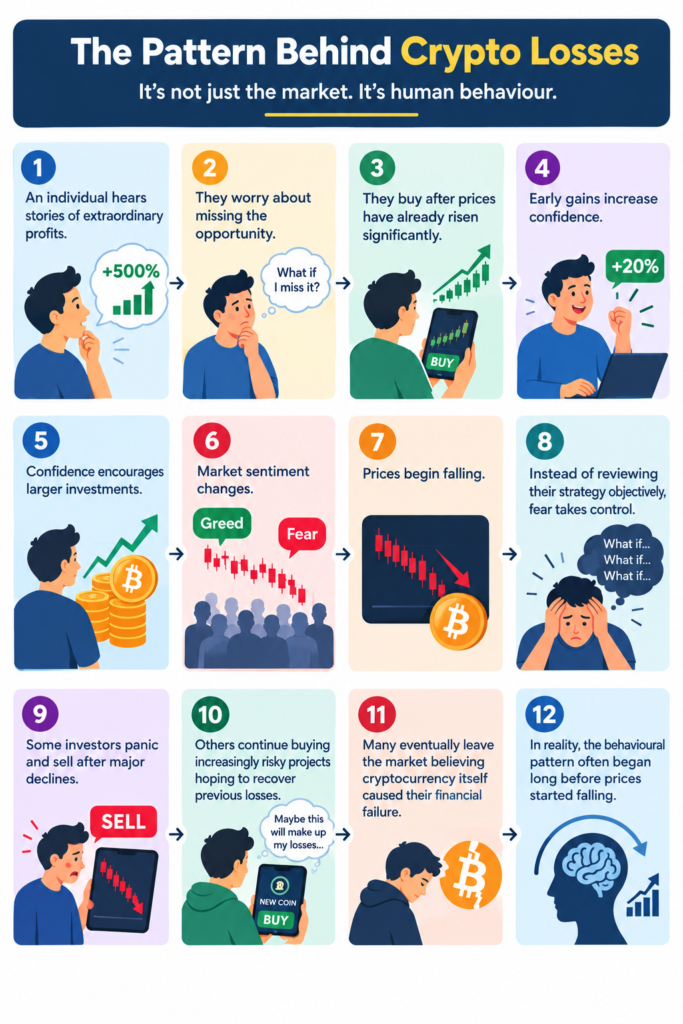
The dominant pattern behind cryptocurrency losses is Emotional Decision Making combined with Overconfidence and Poor Risk Management.
Excitement encourages buying without analysis.
Success creates overconfidence.
Overconfidence reduces caution.
Risk gradually increases.
When market conditions reverse, fear replaces confidence.
Investors then sell under emotional pressure or continue holding weak assets because they hope losses will disappear.
The same behavioural cycle appears in speculative bubbles throughout financial history. The assets change, but the underlying psychology remains remarkably consistent.
Hidden Lesson
People rarely lose money because cryptocurrency exists.
They lose money because cryptocurrency exposes human behaviour more quickly than many traditional financial markets.
Volatility reveals impatience.
Rapid profits reveal greed.
Losses reveal emotional decision making.
The deeper lesson is that financial markets do not create psychological weaknesses.
They expose weaknesses that already exist.
Failure Scorecard
| Area | Score | Explanation |
| Financial Discipline | 4/10 | Emotional investing often replaces structured portfolio management. |
| Decision Making | 4/10 | Decisions are frequently influenced by market sentiment instead of objective analysis. |
| Risk Management | 3/10 | Concentrated positions and leverage create unnecessary financial vulnerability. |
| Long Term Thinking | 4/10 | Short term price movements often dominate long term planning. |
| Financial Knowledge | 5/10 | Many investors understand cryptocurrency prices better than cryptocurrency fundamentals. |
| Emotional Control | 3/10 | Fear and greed frequently influence buying and selling decisions. |
| Planning | 4/10 | Many investments begin without clearly defined objectives or exit strategies. |
| Adaptability | 6/10 | Successful investors reassess evidence, while unsuccessful investors defend previous decisions. |
Key Takeaways
- Most cryptocurrency losses originate from behavioural mistakes rather than technology.
- Fear of Missing Out encourages poor investment timing.
- Overconfidence often increases risk without improving judgement.
- Diversification remains important even in rapidly growing markets.
- Emotional investing usually produces inconsistent long term results.
- Independent research is more valuable than following online trends.
- Risk management protects wealth when market conditions change.
- Successful investing depends on disciplined behaviour rather than perfect market predictions.
Frequently Asked Questions
Why do most people lose money in cryptocurrency?
Most people lose money because emotions such as fear, greed and overconfidence influence their decisions more than objective analysis. Poor risk management and unrealistic expectations also contribute significantly.
Is cryptocurrency too risky to invest in?
Cryptocurrency is a high volatility asset class, but volatility alone does not explain financial losses. Behavioural mistakes and excessive risk taking often play a greater role than market movements.
Why do investors buy cryptocurrency at the wrong time?
Many investors are influenced by Fear of Missing Out after prices have already risen significantly. This leads to buying during periods of excessive optimism rather than after careful analysis.
What is the biggest behavioural mistake in cryptocurrency investing?
The most common mistake is allowing emotions to replace disciplined decision making. Investors often chase rising prices, ignore warning signs and abandon risk management during periods of market excitement.
Can experienced investors lose money in cryptocurrency?
Yes. Experience does not eliminate behavioural biases. Even experienced investors can become overconfident, underestimate risk or allow emotions to influence their decisions.
Conclusion
People lose money in cryptocurrency not because digital assets guarantee failure, but because volatile markets expose predictable weaknesses in human behaviour. Every market cycle reveals the same psychological patterns, including fear, greed, overconfidence and short term thinking, even though the technology continues to evolve.
Understanding these patterns changes the conversation from blaming cryptocurrency itself to recognising that lasting financial success depends on disciplined decision making, effective risk management and the ability to remain rational when markets encourage emotional reactions.