Quick Answer
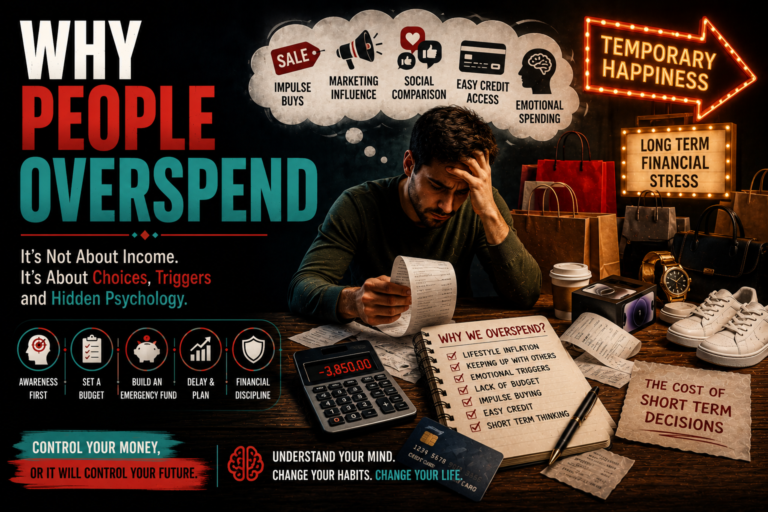
People overspend because spending decisions are rarely driven by logic alone. Behavioural biases, emotional decision making, social comparison, lifestyle inflation and short term thinking encourage people to consume more than they can sustainably afford. Overspending is often a behavioural problem rather than an income problem.
Introduction
Overspending is one of the most common financial problems in modern society.
It affects people with modest incomes as well as high earners. Some struggle with credit card debt despite earning comfortable salaries. Others receive promotions, bonuses or inheritances only to find themselves facing the same financial pressures a few years later.
This creates an important question.
If income increases, why do financial problems often remain the same?
Many assume the answer is simple. They believe people overspend because they lack self control or financial knowledge.
The reality is far more complex.
Modern economies are built to encourage spending. Businesses compete for attention. Digital payments remove the physical feeling of handing over money. Advertising appeals to emotions rather than logic. Social media constantly exposes people to lifestyles that appear desirable but are often financially unrealistic.
These forces interact with predictable patterns in human psychology.
People rarely overspend because they carefully calculate that spending more than they earn is a sensible decision. They overspend because countless small behavioural influences shape everyday choices without attracting much attention.
Understanding why people overspend therefore requires looking beyond bank balances.
It requires understanding how incentives, emotions and social environments influence financial behaviour.
What Is Overspending?
Overspending occurs when a person consistently spends beyond what their income and financial resources can support over time.
This does not mean buying an occasional luxury item or enjoying a holiday.
It refers to a pattern where consumption repeatedly exceeds sustainable financial capacity.
Some people rely on credit cards to maintain their lifestyle.
Others regularly withdraw savings to cover everyday expenses.
Many increase spending every time their income rises, leaving little room for emergency savings or future investments.
Overspending is therefore less about individual purchases and more about repeated financial behaviour.
The long term consequences often include rising debt, weak cash flow, financial stress and reduced wealth accumulation.
The Biggest Myth
The most common belief is that people overspend because they are irresponsible.
This explanation is convenient, but incomplete.
Many individuals who overspend are intelligent, hardworking and fully aware that they should save more.
If knowledge alone solved the problem, financial education would eliminate overspending.
Evidence suggests otherwise.
Behavioural economics shows that people frequently make decisions that conflict with their long term interests. This happens because immediate emotional rewards often outweigh distant financial consequences.
Buying something today produces instant satisfaction.
Saving the same money produces a future benefit that feels psychologically distant.
The human brain naturally places greater value on immediate rewards than delayed ones.
Overspending is therefore not simply a failure of discipline.
It is often the result of predictable behavioural tendencies interacting with an environment designed to encourage consumption.
What Usually Happens?
The pattern is surprisingly consistent.
Income increases.
Lifestyle expectations increase.
Monthly spending gradually rises.
Small purchases become routine.
Credit becomes easier to access.
Savings begin to decline.
Unexpected expenses create financial pressure.
Debt grows.
Financial stress increases.
Many people respond by believing they need a higher income.
In reality, the underlying spending behaviour often remains unchanged.
Without addressing the behavioural causes, additional income frequently leads to additional spending rather than greater financial security.
Why Do People Overspend?
The obvious explanation is that people enjoy buying things.
The deeper explanation is that spending satisfies far more than practical needs.
It satisfies emotional needs, social needs and psychological needs.
Purchases often represent comfort, achievement, identity, belonging and status.
Understanding these hidden motivations explains why overspending remains common across different income levels and cultures.
Emotional Spending Often Replaces Emotional Regulation
Many spending decisions have little to do with the product itself.
Instead, they reflect an attempt to change how a person feels.
People shop after stressful days.
They reward themselves after achieving goals.
They buy gifts when feeling guilty.
They purchase expensive items during periods of sadness, boredom or frustration.
Behavioural psychologists describe this as emotional regulation.
Instead of managing emotions directly, people seek temporary relief through consumption.
The financial cost may appear small in isolation.
Repeated over months or years, however, these purchases become an expensive coping mechanism.
The emotional relief usually fades quickly.
The spending habit remains.
Lifestyle Inflation Quietly Expands Every Budget
Lifestyle inflation is one of the strongest predictors of long term financial difficulty.
When income increases, spending often rises alongside it.
A larger salary leads to a larger house.
A better job encourages a more expensive car.
Higher earnings justify premium subscriptions, luxury holidays and frequent dining out.
None of these decisions appear unreasonable on their own.
The problem emerges when every increase in income is matched by an increase in fixed expenses.
Financial flexibility gradually disappears.
Many households earning high incomes continue living from one pay cheque to the next because every improvement in earnings has been converted into additional consumption.
The issue is not income.
It is the inability to separate higher earnings from higher spending.
Social Comparison Changes Financial Priorities
Human beings naturally compare themselves with others.
Throughout history, social comparison helped individuals understand their place within a community.
Modern technology has transformed this instinct.
People now compare themselves with thousands of carefully edited lifestyles every day.
Luxury holidays.
Designer clothing.
New homes.
Expensive restaurants.
High performance cars.
Social media rarely shows debt, financial stress or the sacrifices made to support these lifestyles.
It presents consumption without context.
As a result, spending decisions increasingly reflect social expectations rather than personal financial priorities.
People begin buying experiences and possessions not because they improve wellbeing, but because they appear to signal success.
The purchase becomes a social statement rather than a financial decision.
The Pain Of Paying Has Almost Disappeared
The way people pay influences how much they spend.
Cash creates an immediate psychological connection between spending and loss.
Digital payments weaken that connection.
A tap of a card.
A mobile payment.
A single click during online shopping.
Each removes part of the emotional discomfort traditionally associated with spending money.
Behavioural economists describe this as reducing the pain of paying.
When spending feels effortless, people become less sensitive to the cumulative financial impact of many small purchases.
Subscriptions provide another example.
Small monthly charges rarely receive the same attention as large annual payments.
Over time, numerous automatic payments quietly reduce disposable income without triggering conscious evaluation.
Short Term Thinking Encourages Long Term Financial Problems
Overspending is strongly linked to present bias.
People naturally value immediate rewards more highly than future benefits.
Saving money offers security that may be needed years later.
Spending money provides satisfaction today.
The psychological attraction of immediate gratification often outweighs the abstract value of future financial stability.
This explains why many people genuinely intend to save more in the future while continuing to spend excessively in the present.
The conflict is not between intelligence and ignorance.
It is between immediate emotion and delayed reward.
Why Do People Overspend?
Consumer Culture Rewards Spending More Than Saving
Modern economies depend on consumer spending. Businesses compete aggressively for attention, loyalty and repeat purchases. Every stage of the buying journey is carefully designed to reduce hesitation and increase consumption.
Limited time offers create urgency.
Free shipping encourages larger baskets.
Buy now pay later services reduce the perceived cost of expensive purchases.
Loyalty programmes reward frequent spending rather than thoughtful spending.
None of these systems force people to spend. Instead, they make spending feel easier, faster and more rewarding.
From a behavioural economics perspective, the environment itself becomes part of the decision making process. People often believe they are making independent choices when, in reality, many of those choices have been carefully influenced by pricing strategies, marketing psychology and digital design.
Overspending therefore reflects not only individual behaviour but also the incentives built into modern consumer markets.
Financial Education Alone Does Not Change Behaviour
Many people know they should spend less and save more.
The challenge is not a lack of information.
The challenge is turning knowledge into consistent behaviour.
Behavioural scientists call this the intention action gap. People form good intentions but fail to follow through because immediate emotions outweigh rational plans.
Someone may understand the importance of budgeting yet continue making impulsive purchases.
Another person may recognise the risks of credit card debt while continuing to rely on borrowed money for everyday expenses.
Knowledge explains what people should do.
Behaviour determines what they actually do.
Closing the gap between these two realities is one of the greatest challenges in personal finance.
Warning Signs
Overspending rarely begins with a major financial mistake. It usually develops through small habits that become normal over time.
One warning sign is regularly using credit to pay for ordinary living expenses. When borrowing becomes part of the monthly budget, spending has already exceeded sustainable income.
Another warning sign is increasing lifestyle expenses after every salary increase. Rather than improving financial security, higher earnings simply create a more expensive standard of living.
Impulse buying is another early indicator. Frequent purchases made without planning often suggest that emotions rather than genuine needs are driving spending decisions.
Ignoring account balances is equally significant. People who avoid checking bank statements or credit card bills often delay confronting financial reality until the problem becomes much larger.
Perhaps the clearest warning sign is feeling temporary excitement after buying something followed by regret shortly afterwards. This cycle often repeats because the emotional reward disappears quickly while the financial cost remains.
These warning signs are commonly ignored because they appear manageable in isolation. Their cumulative effect only becomes visible after months or years of repeated behaviour.
What Could Have Prevented It?
Preventing overspending begins with recognising that financial decisions are behavioural rather than purely mathematical.
One effective approach is creating deliberate pauses before non essential purchases. Time weakens emotional impulses and allows rational thinking to return.
Separating spending from identity is equally important. Financial decisions become healthier when purchases reflect genuine needs instead of attempts to gain status or social approval.
Building financial systems also reduces reliance on willpower. Automatic savings, planned budgets and regular financial reviews create structure that limits emotional decision making.
Understanding behavioural biases provides another layer of protection. Recognising present bias, social comparison and emotional spending makes these influences easier to identify before acting on them.
Most importantly, financial success depends on aligning everyday behaviour with long term priorities. Sustainable wealth is rarely created through one exceptional decision. It is built through thousands of ordinary decisions repeated consistently over time.
Lessons
Overspending teaches lessons that extend beyond household budgets.
The first lesson is that income alone does not determine financial security. Without disciplined spending habits, higher earnings often produce a more expensive lifestyle rather than greater wealth.
The second lesson is that emotions influence financial decisions more than most people realise. Stress, happiness, boredom and social pressure frequently shape spending behaviour without conscious awareness.
Another lesson is that modern financial systems reward consumption more visibly than saving. This makes disciplined financial behaviour increasingly valuable because it often requires resisting environmental influences rather than simply managing money.
Perhaps the most important lesson is that financial success depends less on extraordinary income and more on consistent behavioural choices. Small decisions repeated daily often matter more than occasional large financial events.
Failure Pattern
The dominant pattern behind overspending is Lifestyle Inflation combined with Emotional Decision Making.
As income increases, expectations also increase. What once felt like a luxury gradually becomes an everyday necessity. Spending adapts to earnings until financial pressure returns despite higher income.
At the same time, emotions continue influencing purchasing behaviour. People spend to celebrate success, reduce stress, gain social acceptance or improve their self image.
This pattern appears repeatedly across individuals, families and even businesses. Organisations with growing revenue sometimes increase expenses just as quickly, leaving little financial resilience when conditions change.
The underlying issue is not consumption itself.
It is allowing emotional and social pressures to determine financial priorities.
Hidden Lesson
People rarely overspend because they cannot afford something today.
They overspend because they underestimate the long term consequences of thousands of small decisions.
Financial failure is usually gradual.
Each purchase appears insignificant.
Each subscription feels affordable.
Each lifestyle upgrade seems justified.
Only when these decisions accumulate does the true financial cost become visible.
The hidden lesson is that wealth is often lost quietly through ordinary habits rather than dramatic financial mistakes.
Failure Scorecard
| Area | Score | Explanation |
| Financial Discipline | 4/10 | Spending habits frequently exceed sustainable financial limits. |
| Decision Making | 5/10 | Emotional and social influences often outweigh rational financial planning. |
| Risk Management | 5/10 | Easy access to credit encourages greater financial vulnerability. |
| Long Term Thinking | 4/10 | Immediate satisfaction is commonly prioritised over future financial security. |
| Financial Knowledge | 6/10 | Many people understand financial principles but struggle to apply them consistently. |
| Emotional Control | 4/10 | Stress, boredom and social pressure frequently influence spending behaviour. |
| Planning | 5/10 | Budgeting and long term financial planning are often inconsistent. |
| Adaptability | 6/10 | Financial habits can improve when behavioural patterns are recognised and adjusted. |
Key Takeaways
- Overspending is primarily a behavioural issue rather than an income issue.
- Emotional spending often provides temporary comfort but creates lasting financial consequences.
- Lifestyle inflation quietly reduces financial flexibility as income grows.
- Social comparison encourages unnecessary consumption by changing perceptions of success.
- Digital payments reduce the psychological awareness of spending.
- Small daily financial decisions shape long term wealth more than occasional major purchases.
- Financial systems are designed to encourage consumption, making disciplined spending increasingly valuable.
- Sustainable wealth depends on consistent financial behaviour rather than exceptional income.
Frequently Asked Questions
Why do people overspend even when they know better?
People often overspend because emotions, behavioural biases and immediate rewards have a stronger influence on decision making than long term financial goals.
Is overspending always caused by low income?
No. Overspending affects people across all income levels. Many high earners experience financial stress because their spending increases alongside their income.
What is lifestyle inflation?
Lifestyle inflation occurs when spending rises every time income increases, preventing meaningful improvements in savings and long term wealth.
Why do credit cards encourage overspending?
Credit cards reduce the immediate psychological impact of spending. Because payment is delayed, purchases often feel less expensive at the moment they are made.
Can financial education alone stop overspending?
Financial education is valuable, but behaviour matters more. Lasting improvement depends on changing financial habits and decision making patterns rather than simply increasing knowledge.
Conclusion
People do not usually overspend because they lack intelligence or ambition. They overspend because human psychology evolved to value immediate rewards, while modern financial systems are designed to make spending feel effortless. Together, these forces create predictable patterns of financial behaviour that gradually weaken long term wealth.
Understanding overspending through the lens of behavioural economics reveals that financial failure is rarely caused by one expensive purchase. It is the cumulative result of ordinary decisions shaped by emotion, incentives and environment, making the path to financial difficulty far more predictable than most people realise.