Quick Answer
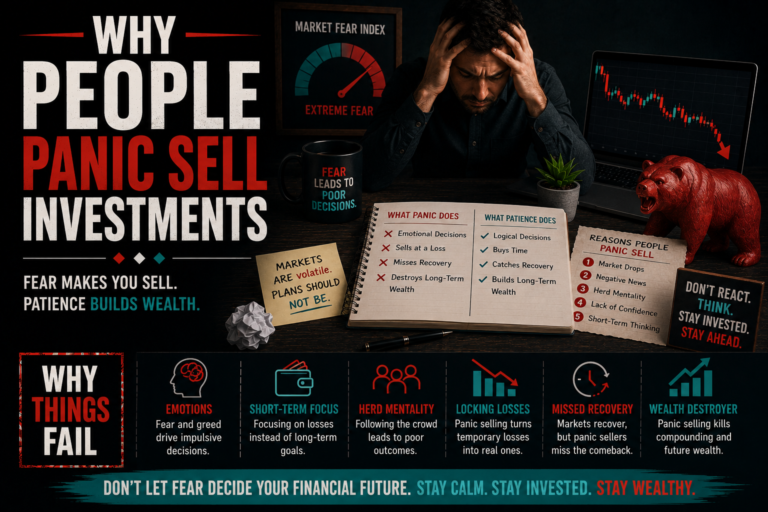
People panic sell investments because fear often overrides rational thinking during market declines. Behavioural biases such as loss aversion, herd behaviour, recency bias and poor risk perception make temporary market volatility feel like permanent financial loss, leading investors to make emotional decisions that can damage long term wealth.
Introduction
Every major market decline tells the same story.
Stock prices fall sharply. News headlines predict economic uncertainty. Television commentators debate whether the downturn will become something much worse. Social media fills with stories of investors selling their portfolios to avoid further losses.
For many people, selling feels like the safest decision.
Yet history repeatedly shows that panic selling has often locked in losses that patient investors later recovered as markets stabilised. This raises an important question. If investors know markets rise and fall over time, why do so many still sell during periods of fear?
The answer lies far beyond economics.
Panic selling is rarely caused by falling prices alone. It is driven by how the human brain interprets uncertainty, risk and financial loss. Markets create volatility, but psychology determines how investors respond to it.
Understanding why people panic sell investments is therefore not simply about understanding financial markets. It is about understanding human behaviour when certainty disappears.
What Is Panic Selling?
Panic selling occurs when investors rapidly sell financial assets because fear overwhelms rational judgement.
The decision is usually triggered by declining prices, negative economic news or widespread uncertainty rather than a careful reassessment of an investment’s long term value.
Temporary market declines are a normal characteristic of investing. Panic selling becomes financially damaging when investors abandon sound investments purely to escape emotional discomfort.
The financial loss is often only one consequence.
Many investors who panic sell also struggle to re enter the market. They wait for certainty to return, only to discover that prices have already recovered. What began as an attempt to reduce risk ultimately creates a larger opportunity cost.
The Biggest Myth
The most common belief is simple.
People panic sell because markets become too risky.
This explanation appears logical but it ignores a crucial reality.
Market volatility does not automatically force investors to sell.
During every major market decline, some investors sell everything while others continue investing or even increase their investments. They experience the same market conditions but reach completely different decisions.
The difference is not the market.
It is the way individuals perceive risk.
Behavioural finance shows that people respond more strongly to the fear of losing money than to the possibility of creating wealth. This emotional imbalance often explains panic selling more effectively than any economic indicator.
Markets influence prices.
Psychology influences behaviour.
What Usually Happens?
The pattern is remarkably consistent across different market cycles.
Markets begin falling.
Investors initially remain calm because they expect prices to recover.
As losses increase, uncertainty replaces confidence.
News coverage becomes increasingly negative.
Friends, family members and social media begin discussing the possibility of a financial crisis.
Fear spreads quickly.
Investors stop evaluating businesses, earnings and long term fundamentals.
Instead, they focus entirely on preventing further losses.
Many sell after significant declines have already occurred.
Weeks or months later, markets begin recovering.
Those who sold often hesitate to invest again because they remain fearful of another downturn.
The cycle ends with investors selling at lower prices and buying back at higher prices.
The financial damage rarely results from one decision.
It develops through a predictable sequence of emotional reactions.
Why Does It Happen?
Understanding panic selling requires looking beyond falling prices.
The deeper causes are rooted in human psychology, behavioural economics and the way the brain processes uncertainty.
Financial markets create emotional environments unlike almost any other activity.
Every decline represents uncertainty.
Every headline increases doubt.
Every falling price appears to confirm previous fears.
The market becomes less of a financial system and more of a psychological stress test.
Loss Aversion Makes Financial Pain Feel Stronger Than Financial Gain
Behavioural economists have consistently found that people experience the pain of losing money much more intensely than the satisfaction of gaining the same amount.
This principle is known as loss aversion.
Imagine two investors.
One earns ten thousand pounds.
Another loses ten thousand pounds.
Although the financial value is identical, the emotional impact is dramatically different. The person experiencing the loss usually feels much stronger emotional discomfort.
This explains why market declines create such powerful reactions.
Investors are not simply watching numbers change.
Their brains interpret falling portfolio values as immediate threats that demand action.
Selling creates the illusion of regaining control even though it may permanently lock in losses.
Fear Narrows Rational Thinking
Fear evolved to protect human survival.
When the brain perceives danger, it naturally prioritises immediate protection over careful analysis.
This response worked effectively when humans faced physical threats.
Financial markets are different.
A falling investment portfolio is not a physical danger, yet the brain often reacts as though it is.
During periods of market volatility, investors become increasingly focused on stopping emotional pain rather than evaluating long term investment quality.
Questions such as whether the business remains profitable or whether economic fundamentals have permanently changed receive less attention.
The immediate objective becomes emotional relief.
Selling appears to provide that relief.
Unfortunately, emotional relief and financial success are not always the same outcome.
Herd Behaviour Makes Fear Spread Faster Than Facts
Human beings naturally seek reassurance from other people during uncertain situations.
When investors observe friends, colleagues, financial commentators and social media users discussing market crashes, fear spreads rapidly.
This is known as herd behaviour.
Following the crowd feels psychologically safe because responsibility appears shared.
If everyone is selling, selling seems reasonable.
Yet markets often reward independent judgement rather than collective emotion.
History shows that periods of widespread panic have frequently created opportunities for disciplined investors while causing unnecessary losses for those driven by fear.
The crowd reduces personal anxiety.
It does not guarantee sound financial decisions.
Recency Bias Distorts Reality
Another behavioural bias that fuels panic selling is recency bias.
People naturally assume that recent events will continue into the future.
When markets decline for several weeks, investors begin believing further declines are inevitable.
Past recoveries become less relevant because recent losses dominate attention.
This psychological shortcut causes temporary market conditions to feel permanent.
Instead of recognising that financial markets have historically moved through cycles of expansion and contraction, investors become convinced that current events represent a lasting change.
Recency bias therefore transforms short term uncertainty into long term pessimism, increasing the likelihood of emotional selling.
Overconfidence Before The Decline Creates Panic During The Decline
Ironically, panic selling often begins long before markets start falling.
During extended bull markets, many investors become increasingly confident that prices will continue rising. They reduce cash reserves, ignore diversification and accept greater levels of risk.
When markets eventually decline, these investors are financially and emotionally unprepared.
The fear they experience is not created solely by falling prices.
It is intensified because previous overconfidence left them without a strategy for managing normal market volatility.
Panic selling therefore begins with optimism long before fear becomes visible.
Why Does It Happen? Continued
Poor Financial Education Creates Unrealistic Expectations
Many investors enter the market with unrealistic expectations about how wealth is created.
Social media, financial influencers and success stories often highlight extraordinary returns while ignoring years of patience, temporary losses and disciplined decision making. This creates the impression that investing should produce consistent gains with very little volatility.
When reality fails to match these expectations, disappointment quickly turns into fear.
Investors who understand market cycles are more likely to view corrections as a normal part of investing. Those with limited financial knowledge often interpret the same decline as evidence that something has gone fundamentally wrong.
The issue is not intelligence.
It is the absence of realistic expectations before uncertainty arrives.
Poor Risk Perception Makes Temporary Losses Feel Permanent
Risk is often misunderstood.
Many people believe risk means losing money.
In reality, risk is the possibility that future outcomes may differ from expectations.
During periods of market optimism, investors underestimate risk because positive outcomes seem more likely.
When markets decline, the opposite occurs.
Every negative headline appears to confirm that further losses are inevitable.
The actual level of risk may not have changed significantly, but the perception of risk changes dramatically.
Behavioural psychologists describe this as an emotional distortion rather than an objective assessment.
People respond to how risky something feels rather than how risky it actually is.
Social Pressure Influences Investment Decisions
Investment decisions rarely occur in isolation.
Family members express concern.
Friends discuss selling their portfolios.
News channels broadcast alarming predictions throughout the day.
Social media rewards dramatic opinions because fear attracts attention more effectively than calm analysis.
This environment creates enormous psychological pressure.
Selling becomes emotionally easier because it aligns with the behaviour of other people.
Remaining invested requires accepting uncertainty while others appear to be taking action.
Most individuals naturally prefer social agreement over independent thinking, especially during periods of stress.
This explains why panic selling often spreads through markets much faster than changes in economic fundamentals.
Delayed Consequences Hide The Real Cost
One reason panic selling continues is that its consequences are rarely immediate.
Selling during a market decline often feels successful because the emotional discomfort disappears.
The investor believes the problem has been solved.
The true cost appears months or years later.
Markets recover.
Corporate earnings improve.
Economic confidence returns.
Investors who sold during periods of fear frequently remain on the sidelines because they are waiting for complete certainty.
By the time confidence returns, asset prices have often recovered significantly.
The greatest financial damage therefore comes not from selling itself but from missing the recovery that follows.
Warning Signs
Panic selling rarely begins with pressing the sell button.
It begins with subtle behavioural changes that gradually weaken rational decision making.
One warning sign is checking portfolio values several times each day during periods of market volatility. Constant exposure to changing prices increases emotional stress while providing very little useful information for long term investors.
Another warning sign is making decisions based on news headlines rather than investment fundamentals. Headlines are designed to capture attention, not necessarily to improve financial judgement.
Seeking reassurance from social media instead of objective analysis is another indicator that emotions are beginning to influence decisions.
Ignoring a previously established investment plan is equally concerning. Investors who suddenly abandon long term objectives because of short term market movements often allow fear to replace discipline.
These warning signs are frequently ignored because they feel like sensible responses to uncertainty. In reality, they often signal that psychological pressure has become stronger than rational analysis.
What Could Have Prevented It?
Most episodes of panic selling cannot be prevented by predicting market movements.
They can be reduced by improving decision making before uncertainty appears.
The first safeguard is having realistic expectations. Investors who understand that market declines are a normal feature of investing are less likely to interpret volatility as permanent failure.
A clearly defined investment process also improves resilience. Decisions based on long term objectives rather than daily market movements reduce the influence of emotional reactions.
Diversification provides another important layer of protection. A balanced portfolio reduces the emotional impact of large declines in any single investment, making disciplined behaviour easier to maintain.
Regular portfolio reviews are valuable, but constant monitoring often increases anxiety without improving results.
Perhaps most importantly, investors benefit from recognising that emotional discomfort is not reliable evidence that a financial decision is correct.
The desire to escape fear is understandable.
It should not automatically determine investment decisions.
Lessons
Panic selling reveals lessons that extend far beyond financial markets.
The first lesson is that behaviour often matters more than knowledge. Understanding investments is valuable, but maintaining discipline during uncertainty is even more important.
The second lesson is that emotions influence financial decisions long before people recognise their impact. Fear rarely announces itself. It quietly changes judgement until emotional decisions begin to feel logical.
Another lesson is that markets reward patience more consistently than emotional reactions. Short term volatility is unavoidable, but permanent financial damage often results from the decisions investors make during that volatility.
Finally, financial resilience depends on preparation before uncertainty appears. Good decisions made during calm periods create stability when markets become unpredictable.
Failure Pattern
The dominant pattern behind panic selling is Fear Driven Emotional Decision Making combined with Short Term Thinking.
The sequence repeats throughout financial history.
Market optimism encourages confidence.
Confidence reduces caution.
A market decline creates uncertainty.
Fear replaces patience.
Investors abandon long term plans to achieve immediate emotional relief.
This behavioural cycle appears in stock markets, property markets, cryptocurrency markets and business decisions because it reflects human psychology rather than economic conditions.
The market changes.
Human behaviour changes very little.
Hidden Lesson
The greatest mistake behind panic selling is believing that reducing emotional discomfort also reduces financial risk.
In many cases, the opposite is true.
Selling during periods of maximum fear often provides immediate psychological relief while creating long term financial consequences.
The deeper truth is that panic selling is rarely a response to market conditions alone.
It is a response to uncertainty.
Markets simply expose how difficult it is for human beings to remain rational when outcomes cannot be guaranteed.
Failure Scorecard
| Area | Score | Explanation |
| Financial Discipline | 4/10 | Emotional reactions often override long term investment plans. |
| Decision Making | 4/10 | Fear frequently replaces objective analysis during market declines. |
| Risk Management | 5/10 | Investors often misunderstand risk and respond emotionally instead of systematically. |
| Long Term Thinking | 3/10 | Short term losses dominate attention even when long term prospects remain strong. |
| Financial Knowledge | 6/10 | Many investors understand markets but underestimate behavioural biases. |
| Emotional Control | 3/10 | Fear becomes the primary driver of financial decisions during volatility. |
| Planning | 5/10 | Investment plans often exist but are abandoned when markets become uncertain. |
| Adaptability | 6/10 | Successful investors adapt to volatility while unsuccessful investors react emotionally. |
Key Takeaways
- Panic selling is primarily a psychological response rather than a rational financial strategy.
- Loss aversion makes financial pain feel stronger than financial gain.
- Herd behaviour encourages emotional decisions during market declines.
- Recency bias makes temporary market conditions appear permanent.
- Overconfidence during bull markets often creates fear during bear markets.
- Risk perception changes with emotions even when market fundamentals remain stable.
- Long term investment success depends on disciplined behaviour rather than perfect predictions.
- The greatest investment mistakes usually occur during periods of maximum uncertainty.
Frequently Asked Questions
Why do people panic sell investments?
People panic sell investments because fear, loss aversion and uncertainty override rational thinking. Emotional discomfort becomes more influential than long term financial analysis.
Is panic selling ever a good decision?
Selling may be appropriate if investment fundamentals have permanently changed or personal financial circumstances require it. Selling purely because prices are falling is often driven by emotion rather than objective analysis.
What behavioural bias causes panic selling?
Loss aversion is one of the strongest behavioural biases behind panic selling. Herd behaviour, recency bias and availability bias also contribute to emotional investment decisions.
Why do investors regret panic selling?
Many investors regret panic selling because markets often recover after periods of decline. Those who sell during moments of fear frequently miss the recovery and re enter the market at much higher prices.
How can investors avoid panic selling?
Investors can reduce the likelihood of panic selling by maintaining realistic expectations, following a structured investment plan, diversifying portfolios and recognising that emotional discomfort is not always a reliable guide for financial decisions.
Conclusion
People panic sell investments because financial markets challenge the very qualities that successful investing requires. They reward patience while human psychology seeks certainty. They demand discipline while emotions encourage immediate action.
Understanding panic selling reveals that the greatest threat to long term wealth is rarely market volatility itself. It is the predictable pattern of human behaviour that transforms temporary uncertainty into permanent financial loss.