Quick Answer
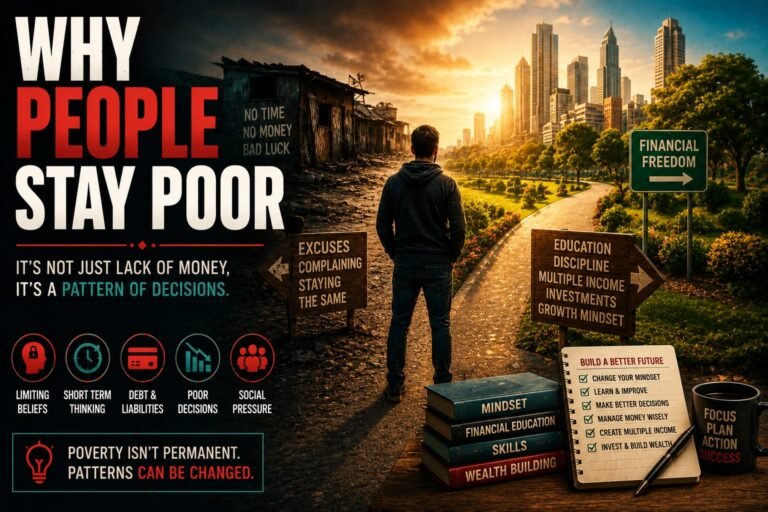
People rarely stay poor because of a single bad decision or a lack of effort. Poverty is usually the result of multiple interacting factors, including financial behaviour, limited opportunities, poor incentives, decision fatigue, weak financial systems, social pressure and the long-term effects of scarcity. Understanding how these forces reinforce one another is the first step towards understanding why financial hardship often persists across individuals, families and even generations.
Introduction
The question of why people stay poor has shaped economic debate for centuries. Governments, economists, business leaders and social scientists have proposed countless explanations. Some argue that poverty results from poor financial decisions. Others blame inequality, education, economic systems or bad luck.
Each explanation contains part of the truth.
Yet none fully explains why two people growing up in similar circumstances can experience completely different financial futures. Nor does it explain why some individuals escape poverty despite enormous obstacles, while others remain financially insecure even after receiving promotions, inheritances or business opportunities.
The answer is more complex than income alone.
Poverty is rarely a single event. It is usually the outcome of a long chain of decisions, incentives, psychological pressures and structural constraints that gradually reinforce one another over time.
Financial failure seldom happens overnight. More often, it develops quietly through repeated choices made under difficult circumstances. Small disadvantages accumulate into larger problems, while opportunities become increasingly difficult to recognise or pursue.
Understanding why people stay poor therefore requires looking beyond income statistics.
It requires examining how human behaviour, financial psychology, risk perception, consumer behaviour, education, institutions, social expectations and economic incentives interact to shape financial outcomes.
The purpose of this article is not to blame individuals or dismiss structural challenges.
Instead, it investigates why poverty often becomes self-reinforcing—and why escaping it is far more complicated than simply earning more money.
What Does It Mean to Stay Poor?
Poverty is often measured using income.
However, financial reality is far more nuanced.
A person earning a modest salary may steadily build assets, reduce debt and improve their financial resilience.
Another individual earning significantly more may live from one pay cheque to the next because every increase in income is matched by higher spending and greater financial commitments.
Remaining poor therefore extends beyond low earnings.
It often reflects a persistent inability to build financial resilience, increase net worth, generate positive cash flow or accumulate productive assets that create future opportunities.
Financial insecurity typically involves several interconnected characteristics:
- Limited emergency savings
- High-interest debt
- Unstable income
- Few appreciating assets
- Restricted access to investment opportunities
- Low financial literacy
- Constant financial stress
- Reduced ability to absorb unexpected expenses
Importantly, these conditions frequently reinforce one another.
When every financial decision is made under pressure, long-term planning becomes increasingly difficult.
This is one reason poverty often persists across generations rather than ending with a single increase in income.
The Biggest Myth About Poverty
Perhaps the most common belief is that poor people remain poor because they simply do not work hard enough.
This explanation is attractive because it appears simple.
Unfortunately, reality is considerably more complicated.
Millions of people work long hours in physically demanding jobs while remaining financially insecure. Many hold multiple jobs, yet still struggle to accumulate savings or build wealth.
Hard work certainly matters.
However, hard work alone does not determine financial outcomes.
History offers countless examples.
Factory workers during the Industrial Revolution often worked exhausting hours yet remained impoverished.
Modern care workers, agricultural labourers and many service employees perform essential work but frequently experience financial insecurity despite their effort.
The opposite is equally revealing.
Some individuals generate substantial wealth through ownership of productive assets rather than working longer hours.
The difference highlights an important distinction.
Income is generated by labour.
Long-term wealth is generally created through ownership, investment, capital allocation and productive assets.
Confusing these two concepts causes many discussions about poverty to miss the deeper issue.
The question is not simply whether someone works hard.
It is whether the economic system, available opportunities and financial decisions allow that effort to compound into lasting wealth.
What Usually Happens?
Although every person’s circumstances differ, financial hardship often follows a recognisable progression.
Limited income reduces savings.
Without savings, unexpected expenses create debt.
Debt increases monthly financial obligations.
Higher repayments reduce disposable income.
Reduced disposable income limits investment in education, business opportunities or skill development.
As financial pressure grows, decision-making becomes increasingly reactive rather than strategic.
Eventually, people spend most of their energy managing today’s problems instead of preparing for tomorrow’s opportunities.
This cycle explains why poverty frequently becomes persistent.
The challenge is rarely one dramatic event.
It is the cumulative effect of many interconnected pressures.
Why Do People Stay Poor?
This is where most discussions become overly simplistic.
Some blame individual behaviour.
Others blame economic systems.
Both perspectives overlook an essential truth.
Financial outcomes emerge from the interaction between people and systems.
Human behaviour influences financial decisions.
Economic systems influence available choices.
Together, they shape long-term outcomes.
Understanding poverty therefore requires investigating both.
Scarcity Changes the Way the Brain Makes Decisions
One of the most important discoveries in behavioural economics is that scarcity affects cognition itself.
When money is constantly limited, the brain naturally focuses on immediate survival.
Rent.
Food.
Utility bills.
Transport.
Unexpected repairs.
These urgent concerns consume mental bandwidth.
Psychologists describe this as decision fatigue and the scarcity effect.
The issue is not intelligence.
The issue is cognitive load.
When people must repeatedly solve urgent financial problems, fewer mental resources remain for long-term planning.
This helps explain why poverty often leads to decisions that appear irrational from the outside.
Many are not irrational at all.
They are rational responses to immediate constraints.
Present Bias Makes Tomorrow Less Important Than Today
Human beings naturally value immediate rewards more highly than future benefits.
Economists call this present bias.
The tendency exists across all income groups.
However, financial scarcity magnifies it.
Imagine someone with no emergency savings.
A small financial windfall arrives.
From a long-term perspective, investing or paying down debt may seem sensible.
From the perspective of someone living under constant financial pressure, immediate relief may feel considerably more valuable.
Present bias therefore encourages decisions that solve today’s discomfort while increasing tomorrow’s financial burden.
This pattern repeats itself across credit card debt, payday loans, consumer spending and insufficient saving.
The issue is not simply poor judgement.
It reflects how the human brain responds to uncertainty.
Lifestyle Inflation Affects More Than High Earners
Lifestyle inflation is often associated with wealthy households.
In reality, it affects almost everyone.
Whenever income rises, expectations frequently rise alongside it.
A pay increase leads to a more expensive apartment.
A promotion encourages financing a newer vehicle.
Higher earnings justify larger recurring expenses.
The problem is not improved living standards.
The problem emerges when spending permanently expands faster than financial resilience.
Without intentional planning, additional income produces greater consumption rather than greater financial security.
This explains why many households earning comfortable salaries still experience financial stress.
Higher income alone does not guarantee wealth.
How income is allocated matters far more.
Financial Literacy Alone Is Not Enough
Financial education is undoubtedly valuable.
Understanding budgeting, investing, compound growth, diversification and risk management improves financial decision-making.
However, knowledge alone rarely changes behaviour.
Many highly educated professionals carry expensive consumer debt.
Some successful entrepreneurs make emotionally driven investment decisions.
Behavioural finance repeatedly demonstrates that people often know the correct choice yet fail to act upon it.
Why?
Because financial decisions are rarely made through logic alone.
They are influenced by stress, habits, identity, emotions, family expectations and social comparison.
Information without behavioural change produces limited results.
This is why simply telling people to “budget better” rarely solves persistent financial hardship.
The deeper causes extend well beyond knowledge itself.
Social Pressure Often Rewards Consumption Instead of Wealth Creation
Financial decisions rarely happen in isolation.
Every person operates within a network of family, friends, colleagues and cultural expectations. Those influences shape spending habits far more than many people realise.
Behavioural economists refer to this as social proof. People naturally compare themselves with those around them and often judge success through visible consumption rather than invisible wealth.
A newer car receives attention.
A larger house signals status.
Designer clothing communicates success.
An investment portfolio does not.
This creates a powerful incentive problem.
Many purchases provide immediate social rewards, while saving, investing and building productive assets often produce no public recognition.
For households with limited financial resources, this pressure can be especially damaging. Income that could improve long-term financial resilience is redirected towards maintaining appearances or meeting social expectations.
Consumer behaviour therefore becomes influenced not only by personal preference but also by identity and belonging.
The result is a cycle where financial decisions maximise short-term social approval rather than long-term economic security.
Poor Risk Perception Leads to Expensive Decisions
People often assume financial risk means investing in volatile markets or starting a business.
In reality, avoiding all risk can be equally costly.
Many individuals keep every available pound in cash because it feels safe.
Others avoid developing new skills because change feels uncertain.
Some reject investment opportunities due to fear of temporary losses.
These decisions reduce immediate anxiety.
However, they frequently increase long-term financial risk.
Behavioural finance distinguishes between perceived risk and actual risk.
Short-term market fluctuations appear dangerous because losses are visible.
Inflation, declining purchasing power and missed investment opportunities are less visible, making them easier to ignore.
This explains why many people unknowingly accept hidden risks while avoiding opportunities that could improve their financial future.
Delayed Consequences Make Poor Decisions Feel Safe
One reason financial habits become difficult to change is that the consequences rarely appear immediately.
A financed vehicle seems affordable because the first monthly payment is manageable.
A credit card purchase feels insignificant because repayment is postponed.
A small loan appears harmless because the interest accumulates gradually.
Behavioural psychologists describe this as temporal discounting.
Humans naturally discount future costs while giving greater importance to immediate benefits.
This creates a dangerous pattern.
Each financial decision appears reasonable on its own.
Collectively, however, these decisions reduce cash flow, increase liabilities and restrict future choices.
Financial hardship often develops through delayed consequences rather than dramatic mistakes.
The Compounding Effect Works Both Ways
People usually associate compound growth with investing.
The same principle also applies to financial mistakes.
One unpaid debt increases interest costs.
Higher repayments reduce monthly savings.
Lower savings increase dependence on credit during emergencies.
Additional borrowing increases future obligations.
Each stage reinforces the next.
This negative compounding effect explains why escaping poverty often becomes progressively more difficult.
Small disadvantages accumulate just as steadily as small investments.
Understanding this principle changes how financial failure is viewed.
Poverty is rarely maintained by one large mistake.
It is sustained through many interconnected decisions that reinforce one another over time.
Warning Signs
Financial decline usually begins long before income becomes the primary problem.
Several early indicators repeatedly appear across households experiencing persistent financial stress.
- Living from one pay cheque to the next despite stable employment.
- Increasing reliance on consumer debt for everyday expenses.
- Having no emergency fund to absorb unexpected costs.
- Spending every salary increase instead of improving financial resilience.
- Delaying investment in education, professional skills or productive assets.
- Making financial decisions primarily to satisfy immediate emotional needs.
- Ignoring long-term planning because today’s pressures feel overwhelming.
These warning signs are frequently overlooked because they develop gradually.
No single month appears disastrous.
Instead, financial flexibility slowly disappears until even a minor setback creates a major crisis.
Why Are These Warning Signs Ignored?
The answer is psychological rather than mathematical.
When people experience constant financial pressure, immediate problems dominate attention.
Paying next month’s rent naturally feels more urgent than planning for retirement.
Repairing today’s car matters more than building an investment portfolio.
This is not evidence of irresponsibility.
It reflects how scarcity changes priorities.
At the same time, optimism bias encourages people to believe future income will solve today’s problems.
Many expect a promotion, overtime opportunities or improved circumstances to restore financial stability.
When those expectations fail to materialise, temporary financial decisions gradually become permanent habits.
What Could Have Prevented It?
Looking back, it is tempting to identify one decision that could have changed everything.
Reality is more complex.
Long-term financial resilience rarely depends on a single breakthrough.
It develops through systems rather than isolated actions.
Households that gradually improve their financial position often share several characteristics:
- They prioritise positive cash flow before increasing lifestyle costs.
- They build financial buffers that reduce dependence on expensive debt.
- They invest in skills that increase future earning potential.
- They distinguish between appreciating assets and depreciating liabilities.
- They make financial decisions using long-term probabilities rather than short-term emotions.
- They recognise that wealth preservation begins with protecting future choices rather than maximising present consumption.
These are not guarantees of financial success.
However, they reduce the likelihood that temporary financial difficulties become permanent economic traps.
Lessons: What This Investigation Reveals About Financial Failure
The most important lesson is that poverty is rarely explained by one cause. It is the outcome of behavioural patterns operating within economic systems.
Hard work matters.
Education matters.
Economic opportunity matters.
But none of these factors exist in isolation.
Financial success usually emerges when sound decision-making, productive incentives, financial literacy and supportive systems reinforce one another over many years.
Likewise, financial hardship often persists when poor cash flow, consumer debt, limited opportunities, emotional decision-making and weak financial planning interact in the opposite direction.
This explains why two households with similar incomes can experience dramatically different financial outcomes.
One gradually accumulates assets, builds net worth, invests in compound growth and improves financial resilience.
The other becomes increasingly dependent on credit, experiences recurring cash flow shortages and remains vulnerable to every unexpected expense.
The difference is not always intelligence or effort.
More often, it is the interaction between behaviour, incentives and long-term planning.
For entrepreneurs, investors and business leaders, the same principle applies.
Businesses rarely fail because of one poor quarter.
Investment portfolios rarely collapse because of one transaction.
Financial failure usually develops through repeated decisions that gradually weaken resilience before the final crisis becomes visible.
Failure Pattern
The Dominant Pattern: Short-Term Thinking Reinforced by Scarcity
The recurring pattern throughout this investigation is short-term decision-making created by long-term financial pressure.
Scarcity encourages people to focus on today’s problems.
Consumer culture encourages immediate gratification.
Social comparison rewards visible spending.
Credit markets make consumption easier.
Meanwhile, the benefits of saving, investing and wealth preservation remain largely invisible for many years.
This creates conflicting incentives.
The financial system often rewards immediate consumption while long-term wealth requires delayed gratification.
Over time, this tension produces familiar outcomes:
- Lifestyle inflation absorbs income increases.
- High-interest debt reduces financial flexibility.
- Limited savings increase dependence on borrowing.
- Decision fatigue weakens judgement.
- Emotional spending replaces deliberate financial planning.
- Risk perception favours immediate certainty over long-term opportunity.
This pattern appears not only among low-income households but also among professionals, entrepreneurs, athletes, lottery winners and businesses.
The underlying behaviour remains remarkably consistent.
The circumstances change.
The psychology does not.
Hidden Lesson
Perhaps the deepest misunderstanding about poverty is the belief that it is primarily an income problem.
Income certainly matters.
However, this investigation suggests that poverty often becomes a systems problem.
Financial behaviour shapes outcomes.
Economic systems shape behaviour.
Neither can be fully understood without the other.
People rarely wake up and choose long-term financial hardship.
Instead, they respond rationally to immediate incentives, emotional pressures and limited opportunities.
When those responses are repeated over many years, poverty becomes increasingly self-reinforcing.
The hidden lesson is therefore not that poor people make poor decisions.
It is that persistent financial pressure changes the environment in which decisions are made, making long-term wealth creation progressively more difficult.
Understanding this distinction changes the conversation from blame to analysis.
Failure Scorecard
| Area | Score | Explanation |
| Financial Discipline | 5/10 | Daily financial pressures often make consistent saving and budgeting difficult to maintain. |
| Decision-Making | 5/10 | Scarcity, stress and decision fatigue frequently reduce the quality of financial choices. |
| Risk Management | 4/10 | Immediate risks receive attention, while long-term financial risks such as inflation and debt are often underestimated. |
| Long-Term Thinking | 4/10 | Present bias naturally prioritises today’s problems over future wealth creation. |
| Financial Knowledge | 6/10 | Access to financial information has improved, but knowledge alone rarely changes behaviour without supportive habits and systems. |
| Emotional Control | 5/10 | Stress, uncertainty and social comparison often influence spending decisions more than rational analysis. |
| Planning | 5/10 | Long-term planning becomes difficult when financial resources are continually stretched by immediate obligations. |
| Adaptability | 6/10 | Many individuals adapt remarkably well to hardship, but limited access to opportunities can restrict meaningful financial progress. |
Key Takeaways
- Poverty is usually the result of multiple interacting causes, not a single failure.
- Hard work alone does not automatically lead to long-term wealth if productive assets are never accumulated.
- Scarcity changes how the brain processes financial decisions, increasing present bias and decision fatigue.
- Lifestyle inflation can trap both low-income and high-income households in persistent financial stress.
- Consumer debt often solves immediate problems while creating larger future obligations.
- Financial literacy is valuable, but behaviour and incentives determine whether knowledge is applied consistently.
- Wealth is built through improving cash flow, acquiring productive assets and making decisions that compound positively over time.
- Lasting financial resilience depends on systems that encourage long-term thinking rather than short-term consumption.
Frequently Asked Questions
Why do some hardworking people remain poor?
Hard work increases earning potential but does not guarantee wealth. Low wages, limited access to productive assets, high living costs, debt, financial stress and systemic barriers can prevent income from translating into long-term financial security.
Does poor financial education cause poverty?
It contributes, but it is rarely the sole cause. Financial literacy improves decision-making, yet behaviour, incentives, emotional pressures and access to opportunities often have an equal or greater influence on financial outcomes.
How does lifestyle inflation keep people poor?
As income increases, spending often rises just as quickly. Without controlling recurring expenses or investing surplus income, higher earnings may improve living standards without increasing wealth or financial resilience.
Is poverty caused more by personal choices or economic systems?
Both matter. Personal decisions influence financial outcomes, but those decisions are shaped by education, labour markets, access to capital, social environments and economic incentives. Poverty is best understood as the interaction between behaviour and systems rather than either factor alone.
What is the biggest behavioural reason people stay poor?
One of the strongest behavioural patterns is present bias prioritising immediate financial needs over long-term wealth creation. When combined with scarcity, decision fatigue and social pressure, this bias can make escaping poverty significantly more difficult.
Conclusion
People do not remain poor because of one mistake, one habit or one circumstance. Financial hardship is usually the cumulative result of behavioural patterns, economic incentives and structural constraints that reinforce one another over time.
Understanding why people stay poor means looking beyond income alone. The deeper explanation lies in how human behaviour, financial systems and long-term decision-making interact revealing that lasting financial failure is often not a single event, but a predictable pattern that develops gradually unless those underlying forces change.