Quick Answer
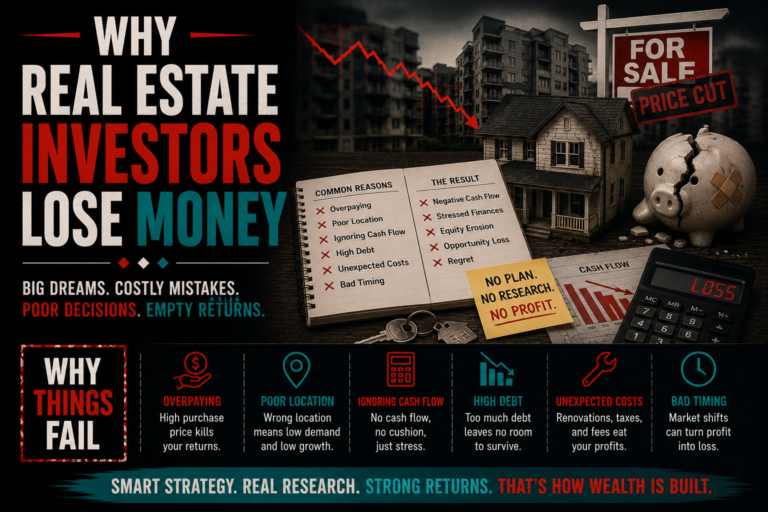
Real estate investors rarely lose money because property is a bad investment. They lose money because emotional decision making, poor risk management, excessive borrowing, unrealistic expectations and weak financial planning gradually turn promising investments into financial liabilities.
Introduction
Real estate has long been viewed as one of the safest ways to build wealth.
Many successful entrepreneurs, institutional investors and wealthy families have accumulated substantial fortunes through property ownership. This success has created a widespread belief that buying real estate is almost guaranteed to produce long term financial security.
Yet every economic cycle tells another story.
Property developers declare bankruptcy. Landlords lose rental properties through foreclosure. Investors purchase homes at inflated prices only to sell them at significant losses. Commercial buildings remain vacant while loan repayments continue increasing. Some investors spend years believing they are building wealth before discovering that rising expenses have quietly destroyed their cash flow.
These failures are often blamed on falling property prices or unexpected economic conditions.
Those explanations only describe what happened.
They do not explain why two investors can purchase similar properties in the same market while achieving completely different financial outcomes.
The deeper explanation lies in human behaviour.
Real estate does not simply test financial knowledge. It tests judgement, patience, risk management and the ability to make rational decisions when emotions, optimism and social pressure encourage the opposite.
Understanding why real estate investors lose money therefore requires looking beyond the property itself.
It requires understanding the psychological and financial decisions that make failure increasingly predictable.
What Is Real Estate Investment Failure?
Many people assume investment failure occurs only when a property is sold for less than its purchase price.
This definition is too narrow.
Real estate investment failure occurs whenever property ownership consistently destroys long term wealth rather than creating it.
An investor may own properties that increase in market value while simultaneously struggling with negative cash flow, excessive debt, expensive maintenance costs or poor financing decisions.
Another investor may purchase multiple rental properties during a booming market only to discover that vacancies, repairs and rising interest rates gradually eliminate profitability.
Some investors become financially trapped because they cannot sell quickly without accepting significant losses.
Others become asset rich but cash poor, owning valuable properties while lacking sufficient liquidity to meet ongoing financial obligations.
Real estate failure therefore extends beyond declining property prices.
It reflects a pattern of decisions that weaken financial resilience over time.
The Biggest Myth
The most common belief is simple.
Property prices always rise over the long term.
History shows that many property markets have appreciated over extended periods.
However, this fact has encouraged a dangerous misunderstanding.
People often assume that purchasing almost any property guarantees financial success if they simply wait long enough.
This belief ignores several critical realities.
Property values move in cycles rather than straight lines.
Interest rates change.
Rental demand fluctuates.
Maintenance costs increase.
Tax policies evolve.
Economic recessions reduce purchasing power.
Most importantly, a successful property investment depends on far more than appreciation.
Cash flow, financing, operating expenses, occupancy rates and risk management often determine whether an investment creates wealth or destroys it.
Owning appreciating property does not automatically make an investor financially successful.
Poor financial decisions can erase years of capital growth.
What Usually Happens?
Most real estate investment failures develop gradually rather than suddenly.
An investor purchases a property after hearing success stories from friends, family members or social media.
Early appreciation creates confidence.
Confidence encourages purchasing additional properties.
Borrowing increases.
Monthly obligations become larger.
Unexpected repairs begin appearing.
Vacancy periods reduce rental income.
Interest rates rise.
Cash flow becomes increasingly difficult to manage.
Instead of reducing risk, many investors purchase additional properties believing that larger portfolios will solve existing financial problems.
Eventually, one unexpected event exposes weaknesses that have been developing for years.
Although every situation is different, the underlying behavioural pattern remains remarkably consistent.
Financial pressure rarely begins with falling property prices.
It begins when optimism gradually replaces disciplined financial planning.
Why Does It Happen?
Understanding why real estate investors lose money requires looking beyond market cycles.
Property markets experience booms and downturns, but these conditions affect investors differently.
Some preserve wealth during difficult periods.
Others lose everything.
The difference usually begins long before economic conditions change.
It begins with behaviour.
Overconfidence Encourages Excessive Borrowing
One of the most common causes of property investment failure is overconfidence.
After one successful purchase, many investors begin believing they have mastered the property market.
A house increases in value.
Rental income arrives consistently.
Equity grows.
These positive experiences create confidence.
Confidence gradually becomes certainty.
Instead of asking whether current conditions are exceptional, investors assume future success will resemble the recent past.
This belief encourages larger mortgages, multiple investment properties and increasingly ambitious expansion.
Debt becomes easier to justify because previous borrowing appeared successful.
The danger is that borrowing magnifies outcomes.
When property values increase, leverage accelerates wealth creation.
When rental income falls or financing costs increase, the same leverage magnifies financial pressure.
The problem is therefore not borrowing itself.
The problem is believing favourable market conditions will continue indefinitely.
Optimism Bias Distorts Risk Perception
Real estate investing naturally attracts optimistic people.
Optimism is valuable because it encourages long term thinking and confidence.
However, excessive optimism often distorts judgement.
Behavioural economists describe this tendency as optimism bias.
Investors consistently underestimate the probability of negative events while overestimating favourable outcomes.
Vacancies seem unlikely.
Unexpected repairs appear manageable.
Interest rates are expected to remain stable.
Future property appreciation is treated as inevitable.
Because risks feel distant, they receive less attention during purchase decisions.
When several unexpected events occur simultaneously, investors discover that their financial plans were built upon assumptions rather than resilience.
Lifestyle Inflation Changes Investment Decisions
Property ownership often changes personal identity.
A successful investment creates social recognition.
Investors begin viewing themselves as experienced property professionals.
This identity shift sometimes influences future decisions more than financial analysis.
Larger properties appear more attractive.
Luxury developments feel safer.
Expensive renovations seem justified because they enhance prestige.
Rather than evaluating investments according to cash flow and long term returns, decisions increasingly reflect lifestyle aspirations.
The property becomes a symbol of personal success instead of a financial asset.
This subtle shift transforms investing into consumption.
Expenses increase while financial discipline gradually weakens.
Confirmation Bias Prevents Objective Analysis
Once investors become convinced that a property market will continue rising, they naturally seek information supporting that belief.
Positive market forecasts receive attention.
Contradictory evidence is dismissed.
Economic warning signs appear temporary.
Higher interest rates are viewed as short lived.
Declining affordability is ignored.
This psychological tendency, known as confirmation bias, reduces adaptability.
Instead of adjusting to changing market conditions, investors become emotionally committed to previous assumptions.
The market eventually changes.
Their thinking does not.
Cash Flow Is Ignored Until It Becomes A Crisis
Many investors become focused on increasing property values while paying too little attention to monthly cash flow.
As long as prices continue rising, weak cash flow appears manageable.
Negative monthly income is justified as a temporary sacrifice.
However, property appreciation cannot pay mortgage repayments, maintenance costs, insurance premiums or property taxes.
Only cash flow can do that.
When rental income falls or financing costs increase, investors suddenly realise that appreciating assets cannot compensate for insufficient liquidity.
In many cases, financial failure occurs because investors ran out of cash long before they ran out of valuable assets.
Why Does It Happen? Continued
Fear Creates Expensive Decisions
Fear influences property investors differently from stock investors.
Property transactions involve large amounts of capital, long holding periods and significant financial commitments. When market conditions deteriorate, investors often experience intense psychological pressure because selling quickly is difficult.
Fear encourages reactive decisions.
Some investors sell quality properties during temporary downturns because they believe prices will continue falling. Others refuse to sell underperforming properties because accepting a loss feels like admitting failure.
Both responses are emotional rather than analytical.
Behavioural economists refer to this as loss aversion. People experience the pain of financial losses more intensely than the satisfaction of equivalent gains. As a result, investors often delay necessary decisions until financial damage becomes far more severe.
Poor Financial Education Creates False Confidence
Many people enter the property market believing real estate is simpler than other investments.
Unlike businesses or financial markets, property feels familiar. Everyone understands houses, apartments and commercial buildings because they interact with them every day.
This familiarity creates an illusion of expertise.
Investors spend considerable time comparing property prices but far less time analysing rental yields, financing structures, vacancy risk, local economic trends, demographic changes or long term cash flow projections.
Knowledge becomes concentrated on buying rather than managing.
The result is a portfolio that appears valuable on paper but performs poorly in practice.
Delayed Consequences Hide Growing Problems
Real estate rarely punishes poor decisions immediately.
An investor can purchase an overpriced property and still appear successful if market prices continue rising.
Negative cash flow may remain manageable while employment income covers shortfalls.
High debt may seem sustainable while interest rates remain low.
These temporary conditions reinforce poor decisions.
Behavioural economists describe this as delayed feedback.
When mistakes produce positive short term outcomes, people incorrectly assume those decisions were wise.
Eventually market conditions change.
Interest rates rise.
Property values stagnate.
Maintenance costs increase.
Vacancy periods become longer.
The financial weaknesses that developed quietly over several years suddenly become impossible to ignore.
The final financial loss receives the blame.
The behavioural mistakes that created it often remain unnoticed.
Warning Signs
Real estate investment failure rarely arrives without warning.
One of the earliest warning signs is relying entirely on future property appreciation while ignoring monthly cash flow. When investors begin saying that rising prices will solve financial problems, risk has already started increasing.
Another warning sign is continuously refinancing properties to fund additional purchases. While leverage can accelerate growth, excessive borrowing reduces financial flexibility and leaves little margin for unexpected events.
Ignoring rising maintenance costs is another common mistake. Repairs, insurance premiums, taxes and management expenses gradually reduce profitability. Investors often underestimate these ongoing costs because they focus primarily on purchase prices and resale values.
Emotional attachment to a property also creates problems. Investors may refuse to sell underperforming assets because they associate them with personal success or previous achievements.
Finally, believing that every property market behaves the same is a significant warning sign. Local employment, population growth, infrastructure development and economic conditions influence property performance far more than national headlines alone.
These warning signs are often ignored because favourable market conditions temporarily conceal underlying weaknesses.
What Could Have Prevented It?
Most real estate investment failures cannot be prevented by predicting market cycles.
They are prevented through disciplined financial planning and realistic decision making.
Successful investors evaluate properties according to sustainable cash flow rather than optimistic price forecasts.
They treat borrowing as a tool that requires careful management rather than unlimited opportunity.
Diversification also strengthens financial resilience. Concentrating wealth in one property type or one geographical area increases exposure to local economic risks.
Regular financial reviews help investors identify declining profitability before it becomes a crisis. Monitoring occupancy rates, operating expenses, financing costs and liquidity encourages objective decision making instead of emotional reactions.
Most importantly, experienced investors recognise that uncertainty is permanent.
Rather than building financial plans around favourable conditions, they prepare for periods of slower growth, rising costs and changing market conditions.
Resilient systems consistently outperform optimistic assumptions.
Lessons
Real estate investment reveals an important truth about wealth creation.
Properties rarely create financial success on their own.
The decisions surrounding those properties determine whether wealth grows or disappears.
Another lesson is that leverage magnifies behaviour as much as financial outcomes. Responsible borrowing supports sustainable growth, while excessive borrowing magnifies poor judgement and increases vulnerability.
Patience also matters.
Successful property investing rarely depends on finding extraordinary opportunities. It depends on consistently making rational decisions across many years while resisting emotional reactions to changing market conditions.
Finally, wealth preservation often proves more important than rapid expansion.
Growing slowly with strong financial foundations usually produces better long term outcomes than expanding aggressively through excessive debt.
Failure Pattern
The dominant pattern behind real estate investment failure is Overconfidence combined with Poor Risk Management and Excessive Leverage.
Early success creates confidence.
Confidence encourages borrowing.
Borrowing increases financial commitments.
Rising obligations reduce flexibility.
Unexpected economic changes expose weaknesses that were previously hidden.
This pattern appears repeatedly because investors naturally extrapolate recent success into the future. They underestimate uncertainty while overestimating their ability to manage growing financial complexity.
The same behavioural cycle appears in entrepreneurship, investing and business expansion.
Human psychology changes very little.
Only the asset changes.
Hidden Lesson
The greatest risk in real estate investing is rarely the property itself.
It is the assumption that rising asset values can compensate for weak financial discipline.
Property markets often reward patience, but they also expose unrealistic expectations.
Investors usually lose money because they build portfolios that depend upon favourable conditions instead of resilient financial systems.
By the time financial pressure becomes visible, the behavioural decisions responsible for that outcome have often been developing for years.
Failure Scorecard
| Area | Score | Explanation |
| Financial Discipline | 5/10 | Many investors underestimate ongoing ownership costs and rely too heavily on appreciation. |
| Decision Making | 5/10 | Optimism and confirmation bias frequently outweigh objective financial analysis. |
| Risk Management | 4/10 | Excessive leverage and poor liquidity leave investors vulnerable during economic downturns. |
| Long Term Thinking | 6/10 | Many investors intend to build long term wealth but sacrifice resilience for rapid expansion. |
| Financial Knowledge | 6/10 | Property knowledge often exceeds understanding of financing, cash flow and economic risk. |
| Emotional Control | 4/10 | Fear, overconfidence and attachment to properties frequently influence important decisions. |
| Planning | 5/10 | Financial plans often assume favourable conditions instead of preparing for uncertainty. |
| Adaptability | 6/10 | Successful investors adjust to changing markets while unsuccessful investors cling to outdated assumptions. |
Key Takeaways
- Real estate investors usually lose money because of behavioural mistakes rather than property markets alone.
- Cash flow is often more important than rising property values.
- Excessive leverage magnifies financial weaknesses during economic downturns.
- Overconfidence encourages unnecessary expansion and higher financial risk.
- Emotional attachment can prevent rational investment decisions.
- Preparing for uncertainty creates stronger portfolios than relying on optimistic forecasts.
- Wealth is preserved through disciplined systems rather than favourable market conditions alone.
- Long term success depends on managing behaviour as carefully as managing property.
Frequently Asked Questions
Why do real estate investors lose money?
Most real estate investors lose money because of poor financial planning, excessive borrowing, weak cash flow management and behavioural biases such as overconfidence and optimism.
Is real estate always a safe investment?
No. Property can create long term wealth, but poor financing decisions, changing economic conditions and weak risk management can turn valuable assets into financial liabilities.
What is the biggest mistake property investors make?
One of the biggest mistakes is focusing entirely on property appreciation while ignoring cash flow, financing costs and long term financial resilience.
Why is leverage risky in real estate?
Leverage increases potential returns but also magnifies losses. Higher debt reduces flexibility and makes investors more vulnerable to rising interest rates, vacancies and unexpected expenses.
Can experienced real estate investors still lose money?
Yes. Experience does not eliminate behavioural biases. Even experienced investors can become overconfident, underestimate risk or ignore warning signs during favourable market conditions.
Conclusion
Real estate has created extraordinary wealth for many investors, but property alone does not guarantee financial success. The same asset that builds one person’s fortune can become another person’s greatest financial burden when optimism replaces discipline and leverage replaces resilience.
Understanding why real estate investors lose money reveals that failure is rarely caused by the market alone. It emerges from predictable patterns of human behaviour, financial incentives and decisions made long before economic conditions expose their consequences.