Quick Answer
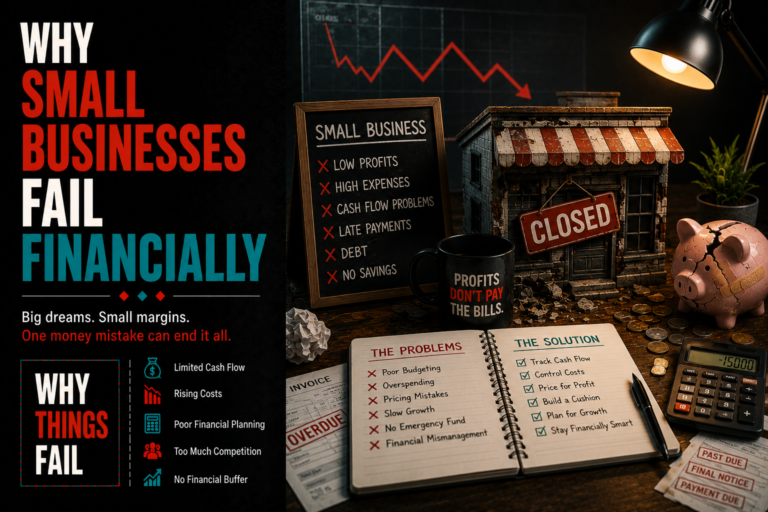
Small businesses rarely fail because of one major mistake. Financial failure usually develops through poor cash flow management, weak planning, emotional decision making, overconfidence, poor pricing, changing market conditions and delayed responses to warning signs. Understanding these hidden patterns helps explain why many businesses struggle despite having good products or services.
Introduction
Every year, thousands of small businesses close their doors despite starting with ambitious goals, passionate founders and promising ideas. Some survive only a few months, while others operate for years before financial pressure becomes impossible to manage.
The common explanation is simple.
The business did not make enough money.
Although this is technically true, it explains very little.
Revenue is often the final symptom rather than the original problem.
Behind almost every financial failure lies a chain of decisions involving leadership, customer behaviour, pricing, cash flow, operational efficiency, market competition and psychological bias. These decisions accumulate gradually until the business reaches a point where recovery becomes increasingly difficult.
This raises a more meaningful question.
Why do some small businesses remain financially resilient during difficult economic conditions while others collapse despite operating in the same industry?
The answer rarely depends on one product, one customer or one economic event.
Financial failure usually begins long before it becomes visible on financial statements.
Understanding these hidden causes provides valuable insight not only for entrepreneurs but also for investors, managers and anyone interested in how businesses succeed or fail over time.
What Is Financial Failure In A Small Business?
Financial failure does not simply mean that a business closes permanently.
A business begins experiencing financial failure when it can no longer generate sufficient cash flow to meet its financial obligations while maintaining sustainable operations.
Some businesses continue operating despite significant financial problems.
They delay supplier payments.
They increase borrowing.
They reduce product quality.
They postpone investment.
They rely on short term solutions instead of addressing deeper structural weaknesses.
Eventually these temporary solutions become permanent habits.
At this stage the business is no longer solving financial problems.
It is merely delaying their consequences.
Financial failure therefore develops gradually rather than suddenly.
The closure of a business is often the final stage of a much longer process.
The Biggest Myth
The most common belief is that small businesses fail because they have a bad product or service.
While poor products certainly contribute to failure, they explain only a small part of the story.
History provides countless examples of businesses offering excellent products that still experienced financial collapse.
Customers may appreciate a product while the business struggles with pricing, cash flow, excessive operating costs or poor financial planning.
Likewise, businesses with average products sometimes achieve remarkable financial success because they manage costs, understand customer demand and allocate resources effectively.
The market does not reward quality alone.
It rewards businesses that combine value creation with sound financial management.
The real question therefore is not whether a product is good.
It is whether the business has built a financial system capable of supporting that product over the long term.
What Usually Happens?
Financial failure in small businesses follows a surprisingly consistent pattern.
The business begins with enthusiasm and optimism.
Early customer demand creates confidence.
Owners invest more aggressively.
Operating expenses gradually increase.
Cash flow becomes unpredictable.
Unexpected costs emerge.
Profit margins begin shrinking.
Instead of adjusting the business model, many owners believe higher sales alone will solve the problem.
Borrowing increases.
Financial pressure grows.
Decision making becomes reactive rather than strategic.
Eventually the business reaches a stage where even small disruptions create significant financial strain.
Although each business operates under different circumstances, the underlying progression remains remarkably similar.
The financial collapse is often visible only at the end.
The behavioural and operational mistakes began much earlier.
Why Do Small Businesses Fail Financially?
Understanding financial failure requires looking beyond accounting figures.
Financial statements reveal what happened.
They rarely explain why it happened.
The deeper causes are found in human behaviour, leadership decisions, incentives and the systems used to manage the business.
Poor Cash Flow Management Creates Invisible Financial Pressure
Many business owners believe profit is the most important measure of success.
In reality, cash flow determines whether a business can continue operating.
A company may report healthy profits while struggling to pay employees, suppliers or rent because cash arrives too slowly while expenses require immediate payment.
This mismatch gradually creates financial pressure.
Owners begin relying on short term borrowing, delayed supplier payments or personal savings to maintain operations.
These actions temporarily reduce pressure but rarely solve the underlying problem.
Cash flow problems often remain hidden because sales continue growing.
Growth creates optimism, making financial weaknesses appear less serious than they actually are.
Eventually the business reaches a point where even one delayed customer payment can trigger a wider financial crisis.
Overconfidence Encourages Poor Business Decisions
Entrepreneurs naturally possess confidence.
Without confidence, very few businesses would ever be created.
The problem begins when confidence develops into overconfidence.
Early success often convinces business owners that future growth is guaranteed.
Expansion decisions become increasingly ambitious.
New employees are hired.
Larger premises are leased.
Inventory increases.
Marketing budgets expand.
These decisions may appear logical during periods of strong demand.
However, many are based on expectations rather than evidence.
Behavioural economists describe this as overconfidence bias, where previous success causes people to underestimate uncertainty and overestimate their ability to control future outcomes.
The business gradually becomes less flexible.
Fixed costs continue increasing while revenue remains uncertain.
When market conditions change, financial resilience disappears surprisingly quickly.
Poor Pricing Decisions Quietly Destroy Profitability
Many small businesses focus heavily on increasing sales while paying far less attention to pricing strategy.
Lower prices may attract more customers.
However, they can also reduce profit margins to unsustainable levels.
Some business owners avoid raising prices because they fear losing customers.
Others underestimate production costs, inflation, supplier price increases or labour expenses.
Over time the business sells more products but retains less profit from each transaction.
Revenue appears healthy.
Cash reserves continue shrinking.
This creates a dangerous illusion.
Owners believe the business is growing while financial strength steadily weakens beneath the surface.
Pricing is therefore not simply a marketing decision.
It is one of the most important financial decisions any business makes.
Emotional Decision Making Replaces Strategic Thinking
Business ownership is deeply personal.
Unlike large corporations, small businesses are often closely connected to the identity of the founder.
This emotional attachment influences financial decisions in subtle but significant ways.
Owners continue investing in unprofitable products because they created them personally.
They retain underperforming employees because of personal relationships.
They delay difficult decisions hoping circumstances will improve naturally.
Psychologists refer to this behaviour as loss aversion.
People generally experience the pain of accepting failure more intensely than the satisfaction of making rational decisions.
Instead of recognising financial reality early, many entrepreneurs postpone necessary changes until available options become severely limited.
The business eventually becomes trapped by decisions that once seemed temporary but gradually became permanent.
Why Do Small Businesses Fail Financially?
Poor Financial Knowledge Limits Better Decisions
Many entrepreneurs are experts in their product or service but have limited understanding of business finance.
They know how to design a product, provide a service or attract customers.
They often struggle to interpret financial statements, monitor working capital, forecast cash flow or calculate profit margins accurately.
This knowledge gap creates poor decisions.
Inventory grows faster than demand.
Operating costs increase without measuring return.
Loans are taken without understanding future repayment pressure.
Investments are made because competitors are doing the same.
Financial knowledge does not guarantee business success.
However, the absence of financial understanding makes sustainable success much harder to achieve.
Successful businesses treat financial information as a decision making tool rather than an accounting requirement.
Short Term Thinking Weakens Long Term Stability
Many small businesses become trapped by immediate financial pressures.
Owners focus on today’s sales instead of building systems that generate sustainable profitability.
Marketing budgets are reduced during slow periods.
Employee training is postponed.
Technology upgrades are delayed.
Customer relationships receive less attention.
Each decision appears reasonable in isolation.
Together they reduce the business’s ability to compete over time.
Behavioural economists describe this as present bias.
People naturally value immediate benefits more highly than future benefits.
Businesses behave similarly.
Short term survival becomes the priority while long term resilience gradually weakens.
Financial failure is therefore often the cumulative result of many small short term decisions rather than one dramatic mistake.
Weak Business Systems Create Strong Dependence On The Owner
Many small businesses depend almost entirely on one person.
The owner manages sales, purchasing, marketing, finance and customer service.
Initially this creates flexibility.
As the business grows it creates fragility.
Important decisions become delayed.
Processes remain undocumented.
Financial controls become inconsistent.
Employees lack authority to solve problems independently.
The business stops functioning as a system.
Instead it becomes an extension of the owner’s daily activity.
When unexpected challenges arise, the organisation struggles to respond efficiently because decision making has never been properly distributed.
This creates operational risk that eventually becomes financial risk.
Delayed Consequences Hide Growing Problems
Perhaps the most dangerous characteristic of business failure is delayed consequences.
Poor decisions rarely create immediate collapse.
Excessive borrowing may improve cash flow today.
Underpricing may increase sales this month.
Ignoring financial reports may have no obvious effect this quarter.
These temporary improvements encourage further poor decisions.
Behavioural economists describe this as delayed feedback.
When negative consequences arrive months later, owners often blame changing market conditions rather than recognising the behavioural patterns that created vulnerability.
The financial crisis appears sudden.
Its causes have usually been developing quietly for years.
Warning Signs
Small businesses rarely fail without warning.
One of the earliest warning signs is declining cash reserves despite increasing sales. Revenue grows while available cash becomes increasingly limited.
Another warning sign is relying on borrowing to pay ordinary operating expenses rather than funding genuine business growth.
Consistently delaying supplier payments, reducing product quality, ignoring financial reports and making important decisions without accurate data are equally concerning indicators.
Business owners also begin avoiding financial discussions because the numbers create discomfort.
Instead of analysing problems objectively, they focus exclusively on increasing sales, believing revenue alone will solve every challenge.
These warning signs are ignored because optimism often feels more comfortable than accepting financial reality.
Unfortunately, financial reality continues developing regardless of personal confidence.
What Could Have Prevented It?
Most financial failures cannot be prevented through perfect forecasting.
They can be reduced through stronger decision making systems.
Regular cash flow forecasting allows businesses to identify financial pressure before it becomes critical.
Pricing decisions should reflect actual operating costs, market conditions and sustainable profit margins rather than emotional concerns about losing customers.
Business owners also benefit from separating personal emotions from commercial decisions.
Products, employees and investments should be evaluated according to evidence rather than attachment.
Building documented systems reduces dependence on one individual and improves organisational resilience.
Perhaps most importantly, successful businesses regularly challenge their own assumptions.
They ask difficult questions before circumstances force difficult answers.
Financial resilience is rarely created by avoiding problems.
It is created by recognising them while solutions remain available.
Lessons
The reasons small businesses fail financially reveal lessons that apply across entrepreneurship, investing and leadership.
The first lesson is that revenue alone does not create financial strength. Sustainable cash flow, disciplined spending and effective resource allocation matter far more than impressive sales figures.
The second lesson is that business success depends on systems rather than constant effort from the owner. Businesses become more resilient when decision making, financial controls and operational processes function independently of one individual.
Another lesson is that confidence should always be balanced by evidence. Successful leaders remain optimistic while continually testing their assumptions against financial reality.
Perhaps the most important lesson is that financial failure develops gradually. Businesses rarely collapse because of one mistake. They decline through repeated behavioural decisions that quietly reduce resilience until recovery becomes increasingly difficult.
Failure Pattern
The dominant pattern behind financial failure is Poor Financial Discipline combined with Short Term Thinking.
Business owners often respond to immediate pressure instead of addressing underlying structural weaknesses.
Cash flow problems encourage borrowing.
Borrowing increases financial obligations.
Growing obligations reduce flexibility.
Reduced flexibility limits future choices.
The cycle continues until even small disruptions create serious financial consequences.
This pattern appears repeatedly because people naturally prioritise immediate relief over long term stability.
The same behavioural tendency influences investors, traders, families and large organisations.
Financial failure therefore reflects predictable human behaviour more than unpredictable economic events.
Hidden Lesson
The greatest threat to a small business is rarely competition.
It is the gradual acceptance of small financial compromises that eventually become normal business practice.
Every delayed decision, every ignored warning sign and every emotional judgement weakens the financial system supporting the business.
The deeper truth is that businesses usually fail financially long before they officially close.
Closure is simply the final confirmation of decisions that were made many months or even years earlier.
Failure Scorecard
| Area | Score | Explanation |
| Financial Discipline | 4/10 | Spending and financial controls often become weaker as businesses expand. |
| Decision Making | 5/10 | Decisions frequently prioritise short term survival over long term sustainability. |
| Risk Management | 4/10 | Many businesses underestimate financial uncertainty and operational risks. |
| Long Term Thinking | 4/10 | Immediate sales often receive greater attention than building resilient systems. |
| Financial Knowledge | 6/10 | Many owners understand their industry better than business finance. |
| Emotional Control | 5/10 | Personal attachment often influences commercial decisions. |
| Planning | 4/10 | Strategic planning is frequently replaced by reactive problem solving. |
| Adaptability | 6/10 | Businesses that adapt early generally survive changing market conditions more successfully. |
Key Takeaways
- Small businesses rarely fail because of one major event.
- Cash flow is often more important than reported profit.
- Emotional decisions gradually weaken financial resilience.
- Sustainable pricing is essential for long term profitability.
- Business systems are more valuable than depending entirely on the owner.
- Short term thinking often creates long term financial problems.
- Warning signs usually appear months before financial collapse.
- Strong financial discipline protects businesses during periods of uncertainty.
Frequently Asked Questions
Why do small businesses fail financially?
Most small businesses fail financially because of poor cash flow management, weak financial planning, emotional decision making, poor pricing strategies and delayed responses to financial warning signs.
Is lack of funding the main reason businesses fail?
Not always. Many businesses receive sufficient funding but fail because resources are allocated poorly or financial systems are weak. Poor financial management often causes more damage than limited capital.
Why is cash flow more important than profit?
Profit measures accounting performance, while cash flow determines whether a business can pay employees, suppliers and operating expenses. A profitable business can still fail if cash flow is inadequate.
Can a successful product prevent business failure?
No. A strong product improves commercial potential, but long term success also depends on pricing, cost control, operational efficiency, financial discipline and strategic decision making.
What is the biggest lesson from business failure?
The biggest lesson is that financial collapse is usually the result of many small behavioural and financial decisions rather than one unexpected event. Recognising these patterns early provides the greatest opportunity to protect long term business sustainability.
Conclusion
Small businesses rarely fail financially because of one recession, one competitor or one poor month of sales. They fail because behavioural decisions, financial systems and operational weaknesses gradually move further apart until the business can no longer absorb uncertainty.
Understanding this changes the conversation about business failure. Financial collapse becomes less about bad luck and more about recognising how everyday decisions shape long term resilience. By the time the numbers reveal the problem, the behaviours responsible for that outcome have often been present for much longer.