Quick Answer
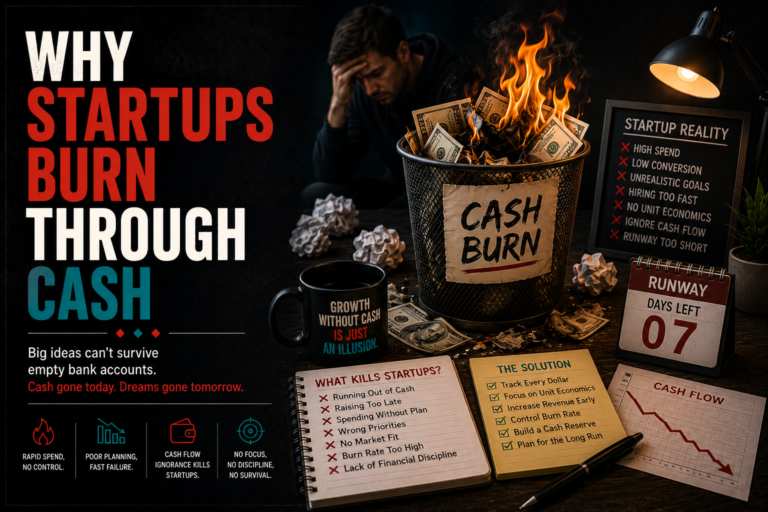
Startups rarely fail because they run out of ideas. They fail because they run out of cash. Excessive spending, unrealistic growth expectations, poor financial planning, weak decision making and behavioural biases gradually increase cash burn until the business can no longer survive. Understanding why startups burn through cash requires examining not only financial statements but also the psychology and incentives behind leadership decisions.
Introduction
Every year thousands of startups launch with ambitious founders, innovative products and millions in venture capital funding. Many receive media attention, attract talented employees and appear destined for success.
Yet a surprising number disappear within only a few years.
Their products may have solved genuine problems. Their teams may have worked tirelessly. Their investors may have believed strongly in the vision.
Despite these advantages, the business still failed.
The immediate explanation is usually simple.
The startup ran out of cash.
However, that explanation raises a more important question.
Why do businesses supported by experienced founders, talented employees and professional investors still spend money faster than they generate it?
The answer extends far beyond accounting.
Cash burn is rarely caused by one poor financial decision. It is usually the final outcome of hundreds of strategic, behavioural and psychological choices made over months or years. Each decision appears reasonable in isolation, yet together they create a business model that becomes financially unsustainable.
Understanding why startups burn through cash is therefore not simply about controlling expenses.
It is about understanding how optimism, incentives, leadership behaviour and business strategy gradually weaken financial resilience long before the bank account reaches zero.
What Is Cash Burn?
Cash burn refers to the rate at which a startup spends its available cash before generating sufficient revenue to sustain operations.
Every startup experiences some level of cash burn during its early stages.
Founders invest in product development, employee salaries, marketing, technology, research and customer acquisition before the business becomes profitable.
This is normal.
Cash burn becomes dangerous when spending consistently exceeds realistic growth while management assumes future funding or future revenue will solve present financial problems.
At that point, cash is no longer supporting growth.
It is financing uncertainty.
The business gradually becomes dependent on external investment instead of building a sustainable economic model.
The Biggest Myth
The most common belief is that startups fail because they lack funding.
In reality, many startups fail after raising significant amounts of capital.
Funding delays failure when spending habits remain unchanged.
It does not solve the underlying problem.
Easy access to investment can sometimes make financial discipline weaker rather than stronger.
When capital appears abundant, difficult decisions are postponed.
Projects continue despite weak results.
Hiring accelerates before productivity improves.
Marketing budgets expand before customer retention is proven.
Expensive offices replace practical workspaces.
Management begins optimising for growth instead of sustainability.
Money creates options.
It also removes many of the financial constraints that normally encourage disciplined decision making.
For this reason, insufficient funding is often a symptom rather than the root cause of startup failure.
Recent data backs this up directly. CB Insights’ 2026 analysis of 431 VC-backed startups that shut down found that while “ran out of capital” was cited in 70 percent of failures, it was almost always the final event rather than the underlying cause, with poor product-market fit, bad timing, and unsustainable unit economics identified as the actual root causes in most cases.
What Usually Happens?
The pattern behind startup cash burn is remarkably consistent.
A founder identifies a promising opportunity.
Investors provide funding.
The team expands rapidly.
Operating expenses increase.
Revenue grows more slowly than expected.
Management believes future growth will eventually justify current spending.
Additional funding is raised.
Instead of improving efficiency, expenses continue increasing.
Eventually investors become more cautious.
Funding slows.
Cash reserves decline.
Management begins making reactive decisions rather than strategic ones.
Hiring freezes.
Projects stop.
Suppliers remain unpaid.
The business enters survival mode.
By the time leadership recognises the seriousness of the situation, financial flexibility has largely disappeared.
Running out of cash appears sudden.
In reality, the failure began much earlier.
Why Do Startups Burn Through Cash?
This is where the investigation becomes more revealing.
Financial statements explain where money was spent.
They rarely explain why leaders consistently approved those decisions.
The deeper causes are rooted in human behaviour, organisational incentives and decision making under uncertainty.
Optimism Bias Encourages Unrealistic Growth Expectations
Every successful entrepreneur begins with optimism.
Without optimism, few people would accept the uncertainty involved in building a company from nothing.
However, optimism becomes dangerous when it prevents objective judgement.
Founders often believe revenue will arrive sooner than historical evidence suggests.
They expect customer acquisition costs to decline rapidly.
They assume competitors will respond slowly.
They forecast investment rounds closing exactly when required.
These assumptions influence hiring, expansion and spending decisions.
When reality develops more slowly than expected, expenses remain fixed while income falls behind projections.
Cash burn accelerates because financial commitments were based on expectations rather than evidence.
Optimism is essential for innovation.
Unchecked optimism can become one of the largest contributors to financial failure.
Growth Becomes More Important Than Sustainability
Many startup ecosystems reward growth above all else.
Founders celebrate rapid customer acquisition.
Investors discuss market share.
Media coverage highlights funding rounds.
Employees associate expansion with success.
Within this environment, profitability often becomes a secondary objective.
Management begins measuring success through employee numbers, office size, product launches and valuation instead of sustainable cash flow.
This changes organisational behaviour.
Departments compete for larger budgets.
Projects continue because stopping them appears negative.
Marketing expenditure increases without sufficient analysis of customer lifetime value.
The company gradually builds an expensive operating structure that depends on continuous external funding.
Growth itself is not the problem.
Growth without financial discipline creates fragile businesses that struggle when investment conditions change the same pattern behind why expansion destroys businesses more broadly, not just startups.
Overconfidence Reduces Financial Discipline
Founders frequently possess extraordinary confidence.
This characteristic helps them persuade investors, recruit talented employees and challenge established industries.
The same confidence can also weaken financial judgement.
After early success, management may assume future challenges will be solved as easily as previous ones.
Difficult conversations about reducing costs become delayed.
Risk assessments receive less attention.
Expansion plans become increasingly ambitious.
Leadership begins believing that future revenue will compensate for present inefficiency.
Behavioural economists describe this as overconfidence bias.
Previous success creates the illusion that uncertainty has become more predictable.
In reality, uncertainty remains unchanged.
The organisation simply becomes more exposed to it.
Easy Investment Can Encourage Difficult Decisions Later
Raising venture capital often creates an unintended psychological effect.
Instead of treating investment as limited business capital, some founders begin viewing it as available spending power.
Large funding rounds reduce the immediate pressure to generate positive cash flow.
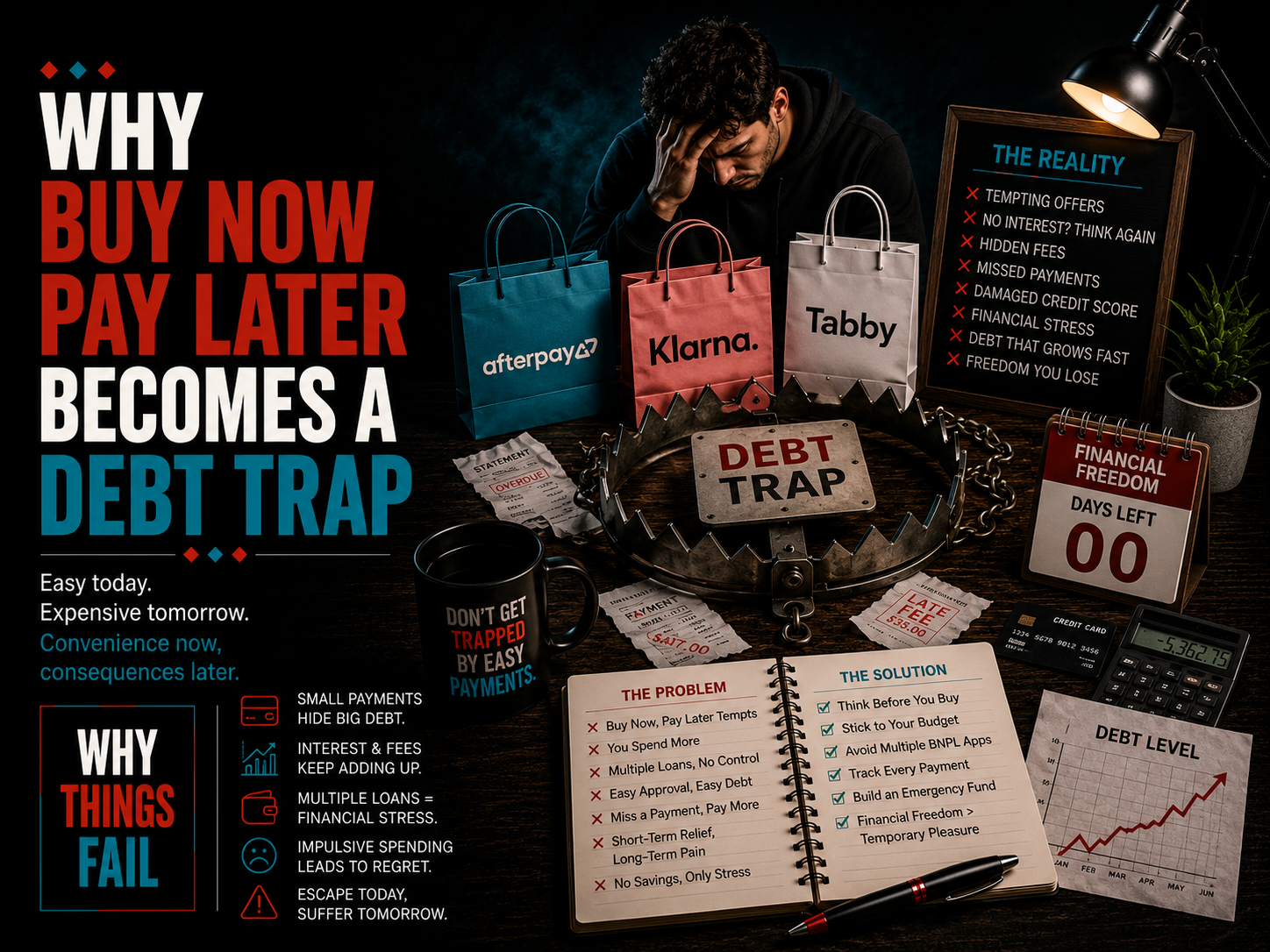
Because financial consequences are delayed, spending decisions receive less scrutiny the same delayed-consequence trap behind why Buy Now Pay Later becomes a debt trap for individual consumers
Teams expand before operational systems mature.
New offices open before existing markets become profitable.
Products multiply before core services prove sustainable.
These decisions rarely appear reckless individually.
Together they increase the monthly cash burn until the organisation depends on raising additional investment simply to continue operating.
This dependency quietly transforms growth into obligation.
The business is no longer expanding because it has achieved financial strength.
It is expanding because slowing down would expose structural weaknesses that have accumulated over time.
Why Do Startups Burn Through Cash?
Poor Product Market Fit Creates Expensive Growth
Many startups assume that more marketing will solve slow sales.
This assumption often hides a much deeper problem.
The product has not achieved strong product market fit.
Customers may show initial interest but fail to return. They may sign up but never become paying users. Businesses continue spending heavily on advertising while ignoring the underlying reason customers are leaving.
Instead of improving the product, management increases customer acquisition spending.
Revenue grows slowly while marketing costs continue rising.
Cash burn accelerates because the company is paying to acquire customers who do not create long term value.
The most successful startups usually achieve strong customer retention before dramatically increasing marketing expenditure.
Growth should amplify a working business model.
It should not compensate for a broken one.
Fear Of Missing Opportunities Encourages Overspending
Fear influences founders just as much as investors.
Many startup leaders believe slowing down means competitors will dominate the market.
This fear encourages rapid hiring, aggressive expansion and multiple product launches occurring at the same time.
Behavioural psychology explains this through loss aversion.
Founders fear losing potential opportunities more than they fear increasing financial risk a close cousin of why people spend to impress others, just at company scale instead of personal.
As a result, they pursue every promising opportunity instead of focusing on the few that create sustainable value.
The business gradually loses strategic focus.
Resources become fragmented.
Teams work harder but achieve less because attention is spread across too many priorities.
The company appears busy.
It becomes less productive.
Poor Cash Flow Management Hides The Real Problem
Profit and cash flow are often confused.
A startup may report increasing revenue while still approaching financial failure.
Revenue recorded on financial statements does not necessarily mean cash has been received.
Customers may pay months later.
Operating expenses must still be paid every month.
Salaries, software subscriptions, suppliers, office costs and marketing invoices continue regardless of delayed customer payments.
Businesses that focus only on revenue growth frequently underestimate the importance of liquidity.
Cash flow becomes the invisible risk that eventually determines survival.
Many successful businesses have experienced temporary losses while maintaining healthy cash flow.
Many failed startups reported impressive growth while quietly exhausting their available cash.
Delayed Consequences Create False Confidence
One of the most dangerous characteristics of startup failure is delayed feedback.
Poor financial decisions rarely produce immediate consequences.
Hiring additional employees initially appears positive.
Launching another product creates excitement.
Increasing advertising generates more visibility.
Expanding into new markets attracts media attention.
None of these decisions immediately signal danger.
Instead, they create future financial obligations.
Behavioural economists describe this as delayed consequences.
When poor decisions are not immediately punished, leaders assume those decisions were correct.
Months later, declining cash reserves expose weaknesses that were created long before.
Running out of cash therefore appears sudden.
In reality, financial failure has been developing quietly through hundreds of decisions that individually seemed reasonable.
Warning Signs
Cash burn rarely becomes dangerous without warning.
One of the earliest indicators is consistently rising operating expenses without proportional revenue growth.
Another warning sign is relying on future investment rounds instead of improving cash flow from customers.
Founders may begin discussing fundraising more frequently than customer retention or profitability.
Rapid hiring before operational efficiency improves is another common signal.
A growing workforce often creates the appearance of progress, but higher payroll increases monthly financial commitments that become difficult to reverse.
Leadership also begins delaying difficult financial decisions.
Projects with weak performance continue receiving funding.
Marketing campaigns remain active despite poor returns.
Expansion plans proceed even when existing markets have not achieved sustainable profitability.
Perhaps the clearest warning sign is when management cannot accurately explain the company’s cash runway, monthly burn rate or path towards financial sustainability.
When leaders lose visibility over cash, the business gradually loses control over its future.
What Could Have Prevented It?
Most startup failures cannot be prevented by raising additional investment.
They are prevented by improving financial discipline before funding becomes necessary.
Strong cash flow management provides leadership with realistic information about financial health.
Monitoring burn rate, cash runway and customer lifetime value allows founders to make evidence based decisions rather than optimistic assumptions.
A disciplined budgeting process also reduces unnecessary spending.
Every new employee, product initiative and marketing campaign should demonstrate measurable value rather than simply supporting growth ambitions.
Founders should regularly challenge their own assumptions.
Independent advisors, experienced board members and financial reviews reduce the influence of confirmation bias and overconfidence.
Most importantly, startups should pursue sustainable growth rather than rapid expansion.
Healthy businesses grow because customers create value.
Fragile businesses grow because investment temporarily finances losses.
The difference often determines long term survival.
Lessons
Startup failure reveals that business success depends on disciplined decision making rather than ambitious vision alone.
Vision creates opportunity.
Discipline transforms opportunity into sustainable growth.
Another lesson is that growth without financial foundations increases risk rather than reducing it.
Revenue, customer retention and cash flow should strengthen together.
When one develops while the others remain weak, the business becomes increasingly fragile.
Leadership also matters more than funding.
Founders establish the culture through their decisions.
If leadership rewards expansion regardless of efficiency, the organisation gradually adopts spending habits that become difficult to reverse.
The final lesson is that cash represents more than money.
It represents time.
Every pound spent reduces the time available to improve products, attract customers and adapt to changing market conditions.
Once time disappears, strategic options disappear with it.
Failure Pattern
The dominant pattern behind startup failure is Overconfidence combined with Poor Financial Discipline and Short Term Thinking.
Founders become increasingly confident after securing funding.
Growth becomes the primary measure of success.
Spending increases faster than sustainable revenue.
Leadership assumes future investment will solve present financial problems.
The same behavioural pattern appears across businesses, investors and entrepreneurs because human psychology changes very little.
Optimism reduces caution.
Success encourages confidence.
Confidence weakens discipline.
Eventually financial reality exposes weaknesses that optimism could temporarily conceal.
Hidden Lesson
The greatest threat to a startup is not limited funding.
It is unlimited confidence without financial accountability.
Cash rarely disappears because of one disastrous decision.
It disappears through hundreds of optimistic decisions that individually appear reasonable but collectively create an unsustainable business.
Financial failure therefore begins long before the company runs out of money.
It begins when disciplined decision making is replaced by the assumption that future growth will eventually solve present weaknesses.
Failure Scorecard
| Area | Score | Explanation |
| Financial Discipline | 3/10 | Spending often increases faster than sustainable revenue. |
| Decision Making | 5/10 | Optimism frequently outweighs objective financial analysis. |
| Risk Management | 4/10 | Expansion often occurs before financial resilience is established. |
| Long Term Thinking | 5/10 | Immediate growth commonly receives greater attention than sustainable profitability. |
| Financial Knowledge | 6/10 | Many founders understand business concepts but underestimate cash flow management. |
| Emotional Control | 4/10 | Optimism and fear of missing opportunities influence strategic decisions. |
| Planning | 5/10 | Growth plans are often stronger than contingency plans. |
| Adaptability | 6/10 | Successful founders adjust quickly while unsuccessful founders remain committed to unrealistic assumptions. |
Key Takeaways
- Startups usually fail because they run out of cash rather than ideas.
- Product market fit should be validated before aggressive expansion.
- Cash flow matters more than impressive revenue figures.
- Venture capital should strengthen discipline rather than weaken it.
- Overconfidence often leads to unnecessary hiring and excessive spending.
- Sustainable growth creates stronger businesses than rapid expansion.
- Every financial decision affects cash runway and future flexibility.
- Long term survival depends on disciplined leadership rather than continuous fundraising.
Frequently Asked Questions
Why do startups burn through cash so quickly?
Most startups burn through cash because operating expenses increase faster than sustainable revenue. Poor financial planning, aggressive hiring, expensive customer acquisition and weak cash flow management are common causes.
What is the biggest reason startups fail?
Running out of cash remains one of the most common reasons. However, the deeper causes usually include poor decision making, overconfidence, unrealistic growth expectations and weak financial discipline.
Can a startup grow without burning large amounts of cash?
Yes. Startups with strong product market fit, disciplined spending and healthy customer retention often achieve sustainable growth while maintaining manageable cash burn.
Why do funded startups still fail?
Funding provides resources but does not correct poor business decisions. Without financial discipline, additional capital can increase spending and delay necessary strategic changes.
How important is cash flow for startups?
Cash flow determines how long a startup can continue operating. A business may report growing revenue, but without sufficient cash to cover daily expenses, long term survival becomes increasingly difficult.
Conclusion
Startups do not burn through cash because innovation is inherently risky. They burn through cash because optimism, incentives and behavioural biases gradually replace financial discipline with assumptions about future success. Funding may delay the consequences, but it cannot eliminate them.
The deeper investigation reveals that cash is not simply a financial resource. It is a measure of strategic freedom. Once leadership loses control of cash, it also loses the ability to adapt, making financial failure the predictable outcome of decisions made long before the bank balance reached zero.