Quick Answer
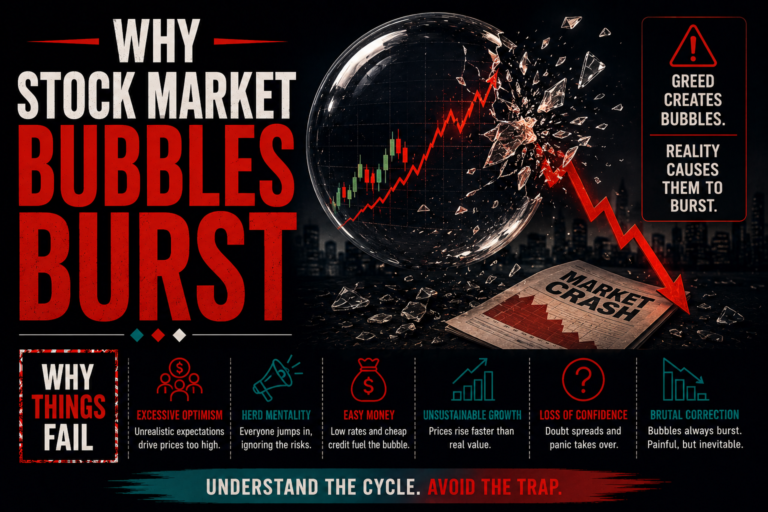
Stock market bubbles burst because prices become disconnected from fundamental value as greed, speculation and herd behaviour drive excessive buying. When confidence weakens, fear spreads quickly, causing investors to sell simultaneously and triggering a rapid market correction or crash.
Introduction
Financial history repeatedly tells the same story.
Markets rise rapidly. Investors celebrate record breaking returns. Newspapers declare a new era of prosperity. Ordinary people begin investing because everyone else appears to be making money.
Then confidence suddenly disappears.
Prices fall faster than they rose. Wealth that seemed permanent vanishes within weeks or even days. Investors who believed markets could only move higher are left asking the same question that has echoed through every major financial crisis.
Why did the bubble burst?
This question matters because stock market bubbles are not rare events. They have appeared throughout history in different countries, industries and economic conditions. Although technology, regulation and financial products have evolved, the psychological forces behind bubbles have remained remarkably consistent.
Understanding why stock market bubbles burst is not simply about explaining market crashes. It is about understanding how human behaviour gradually transforms optimism into speculation, speculation into irrational confidence and confidence into financial collapse.
Every bubble appears unique.
The underlying causes are surprisingly similar.
What Is a Stock Market Bubble?
A stock market bubble occurs when share prices rise far above their underlying economic value because investor enthusiasm becomes stronger than financial reality.
During a healthy market, stock prices generally reflect expectations about company earnings, cash flow, economic growth and business performance.
During a bubble, these relationships weaken.
Prices continue rising primarily because investors believe they can sell to someone else at an even higher price.
Speculation gradually replaces valuation.
Confidence replaces caution.
The market becomes increasingly dependent on continued optimism rather than sustainable business fundamentals.
Eventually reality catches up.
When confidence weakens, prices rapidly move back towards fundamental value.
The correction often appears sudden, but the conditions responsible for it have usually developed over many months or even years.
The Biggest Myth
The most common belief is that stock market bubbles burst because of one unexpected event.
Many people blame rising interest rates, political uncertainty, disappointing earnings or economic recessions.
These events may trigger the final decline.
They rarely create the bubble itself.
Most bubbles become fragile long before the market crashes.
The underlying problem is that investor behaviour gradually pushes prices further away from economic reality.
When valuations become increasingly dependent on optimism rather than business performance, the market becomes vulnerable.
The eventual trigger is often less important than the fragile system already created.
A bubble bursts not because one event suddenly destroys confidence.
It bursts because confidence had become the primary source of value.
What Usually Happens?
Most stock market bubbles follow a remarkably similar pattern.
A new technology, economic opportunity or financial innovation creates genuine optimism.
Early investors achieve exceptional returns.
Media coverage increases.
Public participation expands.
Speculation becomes widespread.
Valuations continue rising despite weakening business fundamentals.
Risk appears to disappear because prices keep increasing.
Eventually confidence begins to weaken.
Selling accelerates.
Fear replaces optimism.
The same investors who once believed prices would never fall begin selling as quickly as possible.
Although every bubble has unique characteristics, the behavioural sequence remains remarkably consistent.
Why Stock Market Bubbles Burst?
Understanding why bubbles burst requires looking beyond economics.
Markets are created by people.
People are influenced by psychology.
When millions of individuals make emotionally driven decisions at the same time, prices can become disconnected from reality.
The collapse therefore begins long before the first day of heavy selling.
It begins when human behaviour starts replacing rational valuation.
Greed Gradually Replaces Rational Analysis
Every major stock market bubble begins with a reasonable investment opportunity.
A growing industry attracts capital.
Businesses generate impressive profits.
Investors recognise genuine economic potential.
At this stage, rising prices often reflect improving fundamentals.
The problem begins when success changes expectations.
Strong returns convince investors that future gains will continue indefinitely.
Instead of asking whether a company is worth its current valuation, they ask how much higher the price could rise.
The objective quietly changes.
Investing becomes speculation.
Behavioural economists describe this as reward seeking behaviour.
Each profitable investment reinforces confidence.
Confidence encourages additional buying.
Additional buying pushes prices even higher.
Higher prices appear to validate previous decisions.
This positive feedback loop continues until valuation becomes secondary to momentum.
The bubble expands because investors increasingly believe future buyers will always pay more.
Herd Behaviour Creates Collective Confidence
Human beings naturally seek reassurance from other people.
Financial markets amplify this instinct.
When neighbours, colleagues, financial commentators and social media influencers all discuss extraordinary investment gains, remaining cautious becomes psychologically difficult.
Investors fear missing an opportunity that everyone else appears to recognise.
This behaviour is known as herd behaviour.
Instead of conducting independent analysis, individuals assume the crowd possesses superior knowledge.
Ironically, the growing number of buyers strengthens this belief.
Rising prices appear to confirm that the market is making the correct decision.
The crowd therefore becomes both the cause and the evidence of increasing confidence.
History repeatedly demonstrates that herd behaviour creates momentum powerful enough to separate prices from economic reality.
Overconfidence Distorts Risk Perception
One of the most dangerous psychological shifts during a market bubble is overconfidence.
After experiencing sustained gains, investors begin attributing success entirely to their own ability.
Luck becomes mistaken for skill.
Favourable market conditions become mistaken for permanent economic change.
Overconfidence reduces the perceived importance of risk.
Diversification appears unnecessary.
Valuation seems outdated.
Borrowing money to purchase additional shares feels reasonable because future gains appear almost certain.
This explains why leverage often increases during the later stages of market bubbles.
Investors become increasingly convinced that temporary declines are buying opportunities rather than warning signs.
The greater the confidence becomes, the less attention investors pay to downside risk.
Fear Of Missing Out Accelerates Speculation
One of the strongest emotional forces in financial markets is the fear of missing out.
Watching others accumulate wealth creates psychological pressure to participate regardless of valuation.
Investors who initially remained cautious gradually begin questioning their own judgement.
They worry more about missing future gains than suffering future losses.
This emotional shift transforms investing into social competition.
The decision is no longer based on company earnings, balance sheets or cash flow.
It becomes driven by comparison.
Behavioural finance research consistently shows that people dislike falling behind their peers.
During a bubble, this desire often overrides rational analysis.
Prices continue rising because investors are responding to emotional incentives rather than financial evidence.
Confirmation Bias Reinforces Irrational Optimism
Once investors become convinced that markets will continue rising, they naturally seek information supporting that belief.
Positive news receives significant attention.
Negative evidence is dismissed as temporary or irrelevant.
Economists warning about excessive valuations are described as pessimistic.
Experienced investors urging caution appear out of touch.
This psychological tendency is known as confirmation bias.
Instead of challenging assumptions, investors actively search for information that strengthens existing confidence.
The market gradually loses its ability to assess risk objectively.
Reality becomes increasingly filtered through optimism.
Easy Money Encourages Excessive Risk
Stock market bubbles often expand during periods of abundant liquidity.
Low borrowing costs encourage investors to take greater financial risks.
Businesses raise capital easily.
Speculative companies attract substantial investment despite uncertain profitability.
Cheap money does not automatically create bubbles.
It creates conditions where risk appears less expensive.
When borrowing becomes easy and asset prices continue rising, investors become more willing to leverage their positions.
This increases demand, pushing prices even higher.
The financial system gradually becomes more fragile because rising prices depend on continued access to inexpensive capital.
When financial conditions eventually tighten, confidence weakens quickly because the system was built upon increasingly aggressive assumptions rather than sustainable economic growth.
Warning Signs
Stock market bubbles rarely burst without warning. The challenge is that warning signs are easiest to ignore when confidence is at its highest.
One important warning sign is when stock prices rise much faster than company earnings. Sustainable businesses create value through revenue growth, profitability and cash flow. When valuations continue increasing despite weakening financial performance, speculation has begun replacing business fundamentals.
Another warning sign is widespread public participation. During the early stages of a bull market, experienced investors often dominate trading activity. As the bubble expands, participation spreads rapidly. People with little investment knowledge begin buying shares because friends, family members or social media personalities appear to be making easy money.
Excessive media optimism is another indicator. Headlines begin describing a new economic era where traditional valuation methods supposedly no longer apply. Every price increase is presented as evidence that markets have permanently changed.
Easy access to borrowed money also signals rising financial vulnerability. Investors increasingly use leverage to amplify returns, believing that future gains will comfortably exceed borrowing costs. This creates a fragile system where even modest price declines can trigger forced selling.
Perhaps the most dangerous warning sign is the belief that market crashes belong to the past. When investors begin claiming that this time is different, history shows that behavioural risks have usually reached extreme levels.
These warning signs are often ignored because optimism changes the way people interpret information. Rising prices create confidence, while confidence encourages investors to dismiss evidence that contradicts their expectations.
What Could Have Prevented It?
Preventing every stock market bubble is unrealistic because financial markets naturally experience cycles of optimism and pessimism.
However, the damage created by bubbles can be significantly reduced through better decision making, stronger financial systems and disciplined risk management.
One important safeguard is maintaining a clear distinction between investing and speculation. Investors who regularly evaluate company earnings, balance sheets, competitive advantages and long term business prospects are less likely to become distracted by short term price movements.
Diversification also reduces vulnerability. Concentrating wealth in one rapidly appreciating sector increases exposure to sudden market corrections. Spreading investments across industries and asset classes creates greater financial resilience when market sentiment changes.
Financial education plays an equally important role. Understanding concepts such as valuation, market cycles, liquidity and behavioural finance helps investors recognise that extraordinary returns often involve extraordinary risk.
Regulatory oversight can also reduce systemic risk by improving transparency, monitoring excessive leverage and discouraging irresponsible lending practices that amplify speculative behaviour.
Most importantly, investors should recognise that uncertainty never disappears. Markets may appear stable during a bubble, but stability created by excessive optimism is often temporary. Accepting uncertainty encourages caution long before markets demand it.
Lessons
Stock market bubbles reveal lessons that extend well beyond investing.
The first lesson is that human psychology often influences markets more powerfully than economic data. Financial decisions are rarely made through logic alone. Emotions, social influence and cognitive bias frequently shape behaviour during periods of uncertainty.
Another lesson is that success can create future vulnerability. Rising markets reward confidence, but prolonged success often reduces caution. Investors gradually become less sensitive to risk because previous decisions have consistently produced positive outcomes.
Bubbles also demonstrate that incentives matter. Financial institutions, investment promoters and media organisations often benefit from continued optimism. Their incentives do not always align with helping investors recognise growing risks.
Perhaps the most important lesson is that sustainable wealth depends more on disciplined decision making than extraordinary returns. Investors who avoid catastrophic mistakes usually outperform those who continually chase exceptional gains.
Failure Pattern
The dominant pattern behind stock market bubbles is Greed reinforced by Herd Behaviour, Overconfidence and Short Term Thinking.
The pattern begins with genuine economic opportunity. Early success attracts additional investors. Rising prices strengthen confidence. Confidence encourages speculation. Speculation pushes valuations further away from business fundamentals.
Eventually, market prices become dependent on continued optimism rather than sustainable economic performance.
When confidence weakens, the same behavioural forces reverse direction.
Greed becomes fear.
Buying becomes selling.
Confidence becomes panic.
The collapse appears sudden, but the behavioural conditions responsible for it developed gradually over an extended period.
This pattern appears repeatedly throughout financial history because human psychology changes far more slowly than financial markets.
Hidden Lesson
Stock market bubbles do not burst because investors suddenly become irrational.
They burst because rational analysis was gradually abandoned long before the crash began.
The deeper truth is that every bubble contains the seeds of its own collapse. The more confidence depends upon rising prices instead of underlying value, the more fragile the entire system becomes.
Markets rarely fail without warning.
People simply become less willing to recognise those warnings when optimism appears profitable.
Failure Scorecard
| Area | Score | Explanation |
| Financial Discipline | 4/10 | Speculative behaviour gradually replaces disciplined investing during bubble periods. |
| Decision Making | 4/10 | Emotional optimism frequently overrides objective financial analysis. |
| Risk Management | 3/10 | Diversification declines while leverage and concentration risk increase. |
| Long Term Thinking | 3/10 | Investors become focused on immediate gains rather than sustainable wealth creation. |
| Financial Knowledge | 6/10 | Information is widely available, but behavioural understanding often remains limited. |
| Emotional Control | 3/10 | Greed and fear dominate investment decisions as the bubble expands and collapses. |
| Planning | 5/10 | Many investors enter markets without predefined valuation or exit criteria. |
| Adaptability | 5/10 | Investors struggle to adjust when market conditions begin changing. |
Key Takeaways
- Stock market bubbles burst because prices become disconnected from fundamental value.
- Human psychology drives bubbles more consistently than economic events.
- Greed gradually replaces disciplined investment analysis.
- Herd behaviour encourages investors to follow the crowd instead of independent research.
- Overconfidence reduces the perceived importance of risk management.
- Easy credit and leverage make financial systems more fragile.
- Warning signs usually appear months before the eventual collapse.
- Long term investing depends on valuation, patience and disciplined decision making rather than market excitement.
Frequently Asked Questions
Why do stock market bubbles burst?
Stock market bubbles burst because investor optimism pushes prices beyond their fundamental value. Once confidence weakens, selling accelerates rapidly, causing prices to return closer to economic reality.
What causes a stock market bubble?
Bubbles are caused by a combination of strong optimism, speculation, herd behaviour, overconfidence, easy access to credit and rising investor demand that becomes disconnected from company fundamentals.
Can stock market bubbles be predicted?
The exact timing cannot be predicted consistently. However, warning signs such as excessive valuations, widespread speculation, rapid credit growth and extreme investor optimism often indicate increasing vulnerability.
Why do investors ignore warning signs?
Behavioural psychology explains that people naturally seek information supporting existing beliefs. During a bubble, rising prices reinforce confidence, making contradictory evidence easier to dismiss.
What is the biggest lesson from stock market bubbles?
The biggest lesson is that financial markets become most dangerous when widespread confidence replaces objective analysis. Sustainable investing depends on disciplined judgement rather than collective optimism.
Conclusion
Stock market bubbles are often described as financial events, yet their true origins lie in human behaviour. Every bubble begins with genuine opportunity but evolves into speculation as confidence, social influence and emotional decision making gradually replace rational valuation.
Understanding why stock market bubbles burst reveals that market crashes are rarely isolated accidents. They are the predictable outcome of behavioural patterns that repeat across generations, reminding us that the greatest risks in finance usually emerge not when fear dominates the market, but when confidence convinces everyone that risk has disappeared.