Quick Answer
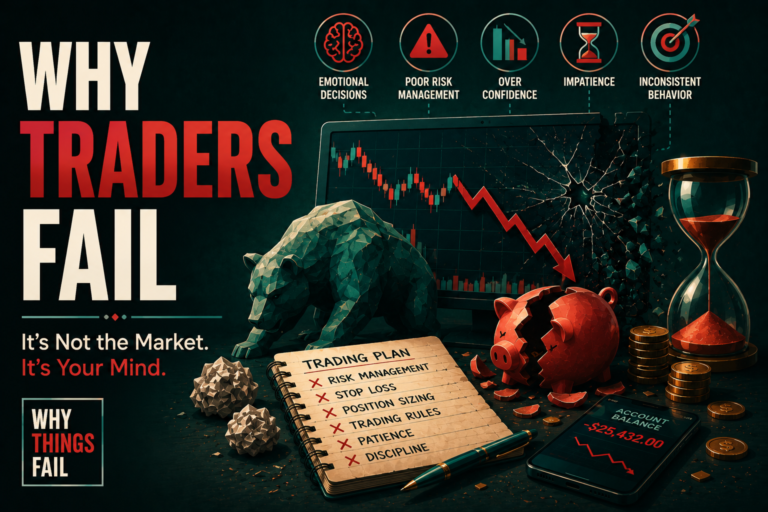
Most traders fail because they struggle to manage themselves rather than the market. Emotional decision making, poor risk management, overconfidence, impatience and inconsistent trading behaviour gradually destroy trading capital. Markets expose psychological weaknesses long before they expose weaknesses in trading strategies.
Introduction
Every year, millions of people begin trading with the same ambition.
They believe financial markets offer freedom, independence and unlimited income.
Technology has made trading more accessible than ever before. Anyone with a smartphone can buy currencies, stocks, commodities, options or cryptocurrencies within seconds. Educational videos, trading communities and social media create the impression that success is simply a matter of learning the right strategy.
Yet the reality tells a different story.
A significant number of retail traders lose money and many eventually stop trading altogether. Some exhaust their savings within months. Others spend years searching for a strategy that promises certainty but never arrives.
This raises an important question.
Why do traders continue to fail despite having greater access to information, advanced trading platforms and sophisticated analytical tools than any previous generation?
The obvious explanation is that markets are difficult.
The deeper explanation is that trading is not merely a technical challenge. It is a psychological challenge where every decision is influenced by uncertainty, emotion and human behaviour.
Understanding why traders fail requires looking beyond charts and indicators. It requires examining how the human mind responds to risk, reward and uncertainty under constant pressure.
What Is Trading Failure?
Trading failure is often misunderstood as simply losing money.
Losses alone do not define failure.
Every successful professional trader experiences losing trades because uncertainty is an unavoidable part of financial markets.
Trading failure occurs when repeated behavioural mistakes gradually erode capital and prevent consistent long term profitability.
A trader may have an excellent trading system yet fail because emotions override discipline.
Another trader may generate impressive profits for several months before giving everything back through excessive risk taking.
Others never allow profitable strategies enough time to work because they constantly change methods after short periods of disappointment.
Failure therefore reflects the quality of decision making rather than the outcome of individual trades.
The Biggest Myth
One belief dominates the trading industry.
Successful traders always predict where the market will go next.
This misconception drives thousands of new traders towards expensive courses, secret indicators and unrealistic promises.
In reality, professional trading is rarely about perfect prediction.
Markets are influenced by countless variables including economic data, central bank decisions, geopolitical events, institutional activity and changing investor sentiment.
No trader can consistently predict every market movement.
Successful traders accept uncertainty rather than attempting to eliminate it.
Their advantage comes from managing probabilities, controlling risk and maintaining discipline even when outcomes remain uncertain.
The objective is not to be correct on every trade.
The objective is to remain financially resilient across hundreds of trades.
What Usually Happens?
Most trading failures follow a remarkably similar pattern.
A new trader enters the market with enthusiasm.
Early success creates confidence.
Confidence gradually becomes overconfidence.
Position sizes increase.
Risk management becomes less important.
Losses begin to appear.
Instead of reducing risk, the trader attempts to recover previous losses more quickly.
Trading frequency increases.
Emotions replace analysis.
Capital gradually declines until continuing becomes impossible.
Although every trader experiences different market conditions, the underlying behavioural pattern changes very little.
Markets rarely destroy traders overnight.
Poor decisions repeated consistently achieve that outcome.
Why Do Traders Fail?
Understanding trading failure requires examining the interaction between psychology, incentives and decision making.
Trading presents one of the most emotionally demanding environments in finance.
Every decision carries immediate financial consequences.
Every profit reinforces confidence.
Every loss challenges confidence.
This constant emotional feedback creates conditions where rational thinking becomes increasingly difficult.
The market therefore becomes less of a financial system and more of a psychological mirror.
It reflects habits, emotional weaknesses and decision making patterns that traders often fail to recognise.
Overconfidence Creates The Illusion Of Control
One of the most common reasons traders fail is overconfidence.
A series of profitable trades convinces many traders that they have discovered a superior understanding of the market.
This confidence encourages larger positions, greater leverage and increasingly aggressive decisions.
The danger is subtle.
Success achieved during favourable market conditions is often mistaken for exceptional trading skill.
When market conditions eventually change, strategies that once appeared reliable begin producing losses.
Instead of questioning their assumptions, overconfident traders frequently believe the market is temporarily behaving irrationally.
They continue increasing risk until losses become impossible to recover.
Confidence is valuable.
False confidence is expensive.
Fear Changes Rational Decisions
Fear affects trading differently from investing.
Investors may have years to recover from temporary market declines.
Traders often evaluate results daily or even hourly.
This constant exposure to profit and loss intensifies emotional pressure.
Fear causes traders to close profitable positions too early because they worry gains will disappear.
At the same time, fear discourages them from accepting small losses.
Instead of closing losing trades according to their plan, they hope prices will reverse.
This behaviour transforms manageable losses into significant financial damage.
The paradox is striking.
Fear encourages traders to protect small profits while exposing themselves to much larger losses.
Greed Gradually Replaces Discipline
Greed rarely appears as reckless behaviour from the beginning.
It usually develops after success.
A trader doubles an account within several months.
Ordinary returns no longer feel satisfying.
The desire for faster growth encourages larger trades and greater risk.
Eventually, preserving capital becomes less important than chasing exceptional profits.
Behavioural economists describe this as reward seeking behaviour.
Each profitable trade raises expectations.
The trader begins believing that larger risks are justified because previous risks were rewarded.
This creates a dangerous cycle.
Increasing profits encourage increasing confidence.
Increasing confidence encourages increasing risk.
Eventually one poorly managed trade removes months of steady progress.
Revenge Trading Creates A Cycle Of Destruction
Few behaviours damage trading accounts more consistently than revenge trading.
After experiencing a significant loss, many traders become emotionally focused on recovering money as quickly as possible.
The objective quietly changes.
Instead of following a trading plan, the trader attempts to erase emotional discomfort.
Trade selection becomes impulsive.
Position sizes increase.
Analysis becomes superficial.
The market is no longer viewed objectively.
It becomes an opponent that must be defeated.
This mindset almost always produces additional losses because emotional urgency replaces disciplined execution.
Professional traders understand that the market has no memory.
It does not know who won or lost yesterday.
Only the trader carries emotional baggage into the next decision.
Confirmation Bias Reinforces Poor Judgement
Once traders develop an opinion about market direction, they naturally seek information supporting that belief.
Contradictory evidence receives less attention.
This behavioural tendency is known as confirmation bias.
Instead of objectively analysing changing market conditions, traders begin defending previous decisions.
Charts, news reports and economic data are interpreted selectively.
The purpose quietly shifts from understanding reality to proving existing beliefs correct.
This reduces adaptability, one of the most important characteristics of consistently successful traders.
Financial markets constantly evolve.
Traders who refuse to adapt often remain committed to strategies that no longer match current conditions.
Short Term Thinking Weakens Long Term Performance
Many traders judge their ability by the outcome of individual trades.
This creates unrealistic expectations because even excellent trading systems experience losing periods.
Professional trading is based on probabilities.
No strategy wins every time.
Short term thinking encourages traders to abandon effective methods after a small number of losses.
They begin searching for another indicator, another mentor or another strategy promising greater certainty.
The cycle repeats endlessly.
The problem is rarely the strategy itself.
It is the inability to remain consistent long enough for probability to work in their favour.
Warning Signs
Trading failure rarely happens because of one catastrophic decision. It usually begins with small behavioural changes that appear harmless at first but gradually weaken discipline.
One of the earliest warning signs is increasing position size after a series of profitable trades. Confidence begins replacing risk management. Traders convince themselves that recent success justifies greater exposure, even though market uncertainty remains unchanged.
Another warning sign is abandoning a written trading plan. Decisions that were once based on clear entry rules, exit rules and risk limits become influenced by emotion. Every trade starts to feel unique, creating excuses to ignore established rules.
Constantly changing trading strategies is another indication that psychology has begun to dominate decision making. Instead of improving execution, traders search endlessly for a perfect system that eliminates losses. They fail to recognise that uncertainty cannot be removed from financial markets.
Emotional attachment to individual trades is equally dangerous. Traders who become personally invested in being right often refuse to accept losses. Rather than closing losing positions, they continue hoping the market will eventually validate their opinion.
Perhaps the most overlooked warning sign is measuring success only by daily profits. This creates pressure to trade even when no quality opportunities exist. Activity replaces patience, leading to unnecessary transactions and increased exposure to risk.
These warning signs are often ignored because they develop during periods of optimism. The trader believes recent success proves skill, making behavioural weaknesses difficult to recognise until significant losses occur.
What Could Have Prevented It?
Most trading failures cannot be prevented by finding a better indicator or predicting market direction more accurately.
They are prevented by improving the quality of decision making.
A structured trading process is far more valuable than attempting to forecast every market movement. Traders who define clear rules for position sizing, acceptable risk, trade selection and performance reviews create systems that reduce emotional influence.
Risk management should be viewed as the foundation of trading rather than an afterthought. Limiting losses on individual trades preserves both financial capital and psychological resilience. Once emotional stability is lost, decision quality usually deteriorates.
Maintaining a trading journal can also improve behaviour. Recording the reasoning behind each trade reveals recurring psychological patterns that often remain invisible during live market conditions. Over time, traders begin recognising whether fear, greed or impatience consistently influences their decisions.
Another important safeguard is accepting uncertainty. Financial markets are probability based environments where even the strongest analysis can produce losing trades. Traders who expect certainty become frustrated by normal market behaviour. Those who accept uncertainty remain focused on executing their process rather than controlling outcomes.
Ultimately, successful trading depends less on predicting markets and more on consistently managing behaviour when outcomes remain uncertain.
Lessons
The reasons traders fail reveal broader lessons about finance, business and human behaviour.
The first lesson is that success without discipline is temporary. Early profits often create confidence, but confidence unsupported by sound risk management usually leads to excessive risk taking.
The second lesson is that emotions become strongest when money is involved. Fear, greed and impatience cannot be eliminated, but they can be managed through structured decision making and consistent processes.
Another lesson is that markets reward probability rather than certainty. Traders who continually search for perfect predictions often become disappointed because uncertainty is an inherent characteristic of financial markets.
Perhaps the most valuable lesson is that long term success depends more on avoiding destructive behaviour than discovering extraordinary opportunities. Preserving capital allows future opportunities to remain available. Losing discipline often removes that possibility.
Failure Pattern
The dominant pattern behind trading failure is Emotional Decision Making combined with Poor Risk Management.
This pattern repeats because traders naturally respond to immediate rewards and immediate losses. Profits encourage confidence, while losses create fear and frustration. Without a disciplined framework, each emotional reaction influences the next decision.
Overconfidence encourages larger positions and unnecessary risk. Fear encourages hesitation, panic and abandoning proven strategies. Greed encourages chasing unrealistic returns. Together, these behaviours create a cycle that gradually erodes trading capital.
The same pattern extends beyond trading. Entrepreneurs overexpand after periods of rapid growth. Investors chase speculative assets during market booms. Businesses ignore operational risks while conditions remain favourable. In every case, emotional judgement gradually replaces objective analysis until failure becomes increasingly likely.
Hidden Lesson
The greatest challenge in trading is not understanding the market.
It is understanding yourself.
Markets simply provide continuous feedback on the quality of your decisions. They expose impatience, overconfidence, fear and poor risk management without emotion or favour.
The deeper truth is that most traders lose money long before their accounts reach zero. Financial failure begins the moment discipline is sacrificed for the hope of faster profits. By the time capital disappears, the psychological mistakes responsible for that outcome have usually been repeated many times.
Failure Scorecard
| Area | Score | Explanation |
| Financial Discipline | 4/10 | Many traders struggle to follow consistent rules after experiencing wins or losses. |
| Decision Making | 4/10 | Emotions frequently influence trading decisions during volatile market conditions. |
| Risk Management | 3/10 | Excessive leverage and poor position sizing remain major causes of trading failure. |
| Long Term Thinking | 4/10 | Many traders focus on immediate profits instead of consistent long term performance. |
| Financial Knowledge | 6/10 | Technical knowledge is often adequate, but behavioural understanding is limited. |
| Emotional Control | 3/10 | Fear, greed and frustration regularly override disciplined execution. |
| Planning | 5/10 | Many traders begin with a plan but fail to follow it consistently. |
| Adaptability | 6/10 | Successful traders adapt to changing markets, while unsuccessful traders resist changing their assumptions. |
Key Takeaways
- Traders usually fail because of behavioural mistakes rather than market complexity.
- Overconfidence often creates more financial damage than lack of technical knowledge.
- Fear and greed distort judgement during periods of uncertainty.
- Consistent risk management is more important than finding perfect trade entries.
- Accepting small losses prevents much larger financial damage.
- A written trading process reduces emotional decision making.
- Long term success depends on consistency rather than occasional exceptional profits.
- The greatest competitive advantage in trading is psychological discipline.
Frequently Asked Questions
Why do most traders fail?
Most traders fail because emotional decision making gradually replaces disciplined execution. Poor risk management, overconfidence and inconsistent behaviour often cause greater losses than market volatility itself.
What is the biggest mistake traders make?
The biggest mistake is increasing risk after periods of success while ignoring established trading rules. This often leads to losses that erase months of steady progress.
Does having a good trading strategy guarantee success?
No. Even effective trading strategies fail when traders ignore risk management or allow emotions to influence execution. Behaviour and discipline remain just as important as technical analysis.
Why is risk management more important than prediction?
No trader can predict every market movement. Effective risk management limits the financial impact of incorrect decisions, allowing traders to survive periods of uncertainty and continue operating over the long term.
Can experienced traders still fail?
Yes. Experience does not eliminate psychological biases. Even professional traders can become overconfident, ignore warning signs or take excessive risks when favourable market conditions reinforce poor habits.
Conclusion
Traders do not consistently fail because financial markets are impossible to understand. They fail because markets continually test human behaviour through uncertainty, risk and emotional pressure. Every trade becomes a decision about discipline as much as direction.
Understanding this shifts the focus from searching for perfect strategies to recognising predictable behavioural patterns. The market rarely creates those patterns. It simply exposes them, revealing that lasting trading success depends less on mastering price movements and more on mastering the decisions made before, during and after every trade.