Introduction: Why This Failure Matters
Windows Phone did not fail because it was ugly, badly engineered, or irrelevant.
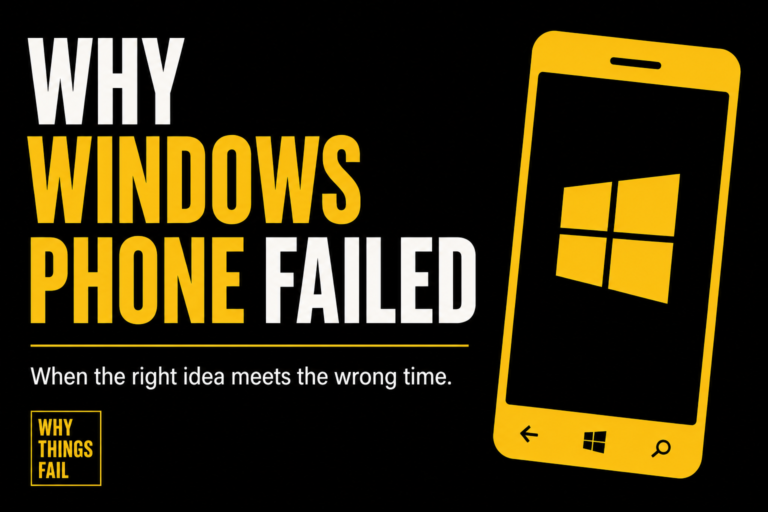
In many ways, it was the opposite. Windows Phone was visually distinctive. Its Live Tiles interface looked different from the grid of icons used by iPhone and Android. It had strong design discipline, deep Microsoft backing, Nokia hardware, Office integration, Xbox branding, and one of the most powerful software companies in the world behind it.
Yet it still failed.
That is why the Windows Phone story matters.
It shows that a good product can fail when it enters the market too late, misunderstands the ecosystem it is competing in, and cannot create enough reasons for customers, developers, manufacturers, and mobile networks to believe in it at the same time.
Windows Phone is still relevant today because many companies repeat the same mistake. They believe that brand, money, design, or technical quality can overcome weak timing and poor ecosystem momentum. They underestimate how difficult it is to change user habits once a market has already formed.
The failure of Windows Phone was not simply a mobile phone failure.
It was a failure of timing, platform strategy, developer trust, leadership assumptions, and ecosystem economics.
Who Failed?
Windows Phone was Microsoft’s attempt to compete in the modern smartphone market after the rise of Apple’s iPhone and Google’s Android.
Microsoft had already been involved in mobile through Windows Mobile, but that older system was designed for a different era: business users, stylus input, small screens, and enterprise productivity.
Windows Phone launched in 2010 as a fresh start.
It was meant to replace Windows Mobile and give Microsoft a modern smartphone platform. Later, Microsoft partnered closely with Nokia and eventually acquired Nokia’s phone business. Despite these efforts, Windows Phone never reached meaningful global scale.
By 2017, Microsoft had effectively stopped active development of Windows Phone. Windows 10 Mobile support ended later, marking the final stage of the platform’s decline.
Common Myth
Common Myth: “Windows Phone failed because it had no apps.”
Reality: The app gap was a major problem, but it was not the original cause. It was the result of deeper failures.
Windows Phone had no apps because it had too few users.
It had too few users because it arrived late, had weak carrier and manufacturer momentum, failed to offer a compelling reason to switch, and struggled to convince developers that the platform had a future.
The app gap was not just a product problem. It was an ecosystem problem.
Microsoft was not trying to sell a phone. It was trying to build a platform. And platforms fail when the different sides of the ecosystem do not grow together.
1. What Happened?
Microsoft dominated personal computing for decades. Windows was the default operating system for PCs. Office was the default productivity suite. For a long time, Microsoft’s position looked almost unbreakable.
But the smartphone changed the meaning of computing.
Apple launched the iPhone in 2007. Google’s Android grew quickly after that. Smartphones moved computing away from desks and into pockets. Apps became the new software layer. Mobile operating systems became the new strategic battlefield.
Microsoft was slow to respond.
Windows Mobile, its older mobile operating system, was not built for the touchscreen-first smartphone era. It carried the logic of desktop Windows into mobile devices. It was functional, but not emotionally compelling. It felt like a small computer, not a modern consumer product.
Windows Phone 7 launched in 2010. It was a bold redesign. It used Live Tiles, large typography, and a clean interface. It was not a copy of iOS or Android. That was one of its strengths.
But by 2010, the market had already moved.
Apple had the iPhone. Android was spreading across manufacturers. Developers were already building for iOS and Android. Consumers were learning new habits. Mobile networks were promoting devices that already had demand. Hardware makers were investing in Android because it was free, flexible, and growing.
Microsoft tried to recover through partnership and acquisition.
In 2011, Nokia chose Windows Phone as its main smartphone platform. This gave Microsoft a serious hardware partner. Nokia’s Lumia phones were well-designed and respected by many users. But the partnership also revealed the scale of the challenge. Nokia needed Windows Phone to save its smartphone business. Microsoft needed Nokia to save Windows Phone. Both companies were trying to rescue each other from decline.
In 2013, Microsoft announced it would acquire Nokia’s devices and services business. The deal was completed in 2014. Instead of solving the problem, it made Microsoft more deeply committed to a platform that had still not achieved enough momentum.
By 2015, Microsoft was shifting its strategy under Satya Nadella. Rather than forcing users into Windows Phone, Microsoft began putting its apps and services on iOS and Android. This was strategically sensible, but it also weakened the reason for Windows Phone to exist.
By 2017, Microsoft had effectively admitted that Windows Phone was no longer a focus.
The product did not collapse overnight. It faded because the ecosystem around it never became strong enough.
2. Why Did It Happen?
Microsoft Entered The Modern Smartphone Market Too Late
The first major cause was timing.
Microsoft was not late to mobile in a general sense. It had Windows Mobile years before the iPhone. But it was late to the modern smartphone category.
That distinction matters.
Being early in an old category does not mean you are early in the new one.
Windows Mobile belonged to the pre-iPhone world. It assumed phones were mainly productivity tools. The iPhone changed the category into something broader: communication, entertainment, internet, apps, identity, camera, music, and daily life.
By the time Windows Phone arrived in 2010, the rules had already changed.
Apple had built a premium consumer brand around the smartphone. Android had built a massive manufacturer ecosystem. Developers were already prioritising the two platforms that had users. Customers were already buying into app libraries, accessories, habits, and cloud services.
Microsoft was not entering an empty market. It was trying to enter a market where two powerful platforms had already created momentum.
Late entry is not always fatal. But late entry requires a much stronger reason to switch.
Windows Phone did not provide that reason.
It was different, but difference is not enough. Customers do not switch platforms just because something looks fresh. They switch when the benefit is obvious, urgent, and better than the cost of change.
For most people, Windows Phone was interesting but not necessary.
That was a dangerous position.
Microsoft Misread The Nature Of Mobile Competition
Microsoft had won in PCs through operating system dominance. The company understood licensing, enterprise relationships, developer tools, and platform control.
But mobile competition worked differently.
In PCs, Windows became dominant because manufacturers needed an operating system, businesses needed compatibility, and developers needed access to the largest user base. Microsoft sat at the centre of that system.
In mobile, the ecosystem was different.
Apple controlled hardware, software, services, retail experience, and brand perception. Android gave manufacturers a free and flexible operating system. Google used Android to expand search, maps, Gmail, YouTube, and advertising.
Microsoft tried to compete using a Windows logic in a post-Windows market.
The company assumed that its brand, developer relationships, and software history would help it win. But mobile users did not care about Windows in the same way PC users did. A phone was not just a productivity device. It was personal, emotional, social, and app-driven.
The old Microsoft advantage did not transfer cleanly.
Office helped, but it was not enough. Xbox helped, but it was not enough. Windows branding helped with recognition, but it did not create desire.
Microsoft had power in the old computing world. But in mobile, power had shifted toward app ecosystems, user experience, and developer attention.
The App Gap Became A Self-Reinforcing Trap
The app gap was one of the most visible reasons Windows Phone failed.
But the deeper issue was the feedback loop behind it.
Developers build for platforms where they can reach users. Users buy platforms where they can access the apps they want. If a platform lacks users, developers hesitate. If developers hesitate, users avoid the platform.
This creates a negative cycle.
Windows Phone became trapped in that cycle.
Major apps arrived late, had weaker versions, or were missing completely. Even when apps existed, they were often not updated as quickly as their iOS and Android versions. Users noticed. Developers noticed. Reviewers noticed.
The problem was not only the number of apps. It was confidence.
A missing app tells users, “This platform may not matter.”
A poorly maintained app tells users, “This platform is not a priority.”
A delayed app tells developers, “Others are waiting too.”
In platform markets, perception becomes reality. Once people believe a platform is weak, their behaviour makes it weaker.
Microsoft tried to solve this through developer incentives, tools, and later the idea of universal Windows apps. But the core issue remained: developers did not want to invest heavily in a platform without enough users.
The app gap was not a simple supply problem. It was a trust problem.
Windows Phone Did Not Give Users A Strong Enough Switching Reason
Windows Phone had strengths.
It looked clean. It was fast on modest hardware. Some Lumia cameras were excellent. The interface was genuinely different. For some users, it felt more organised and less cluttered than Android.
But the question was not whether Windows Phone had strengths.
The question was whether it had enough strength to overcome switching friction.
Most users already had social circles, app purchases, habits, photos, messages, accessories, and expectations tied to iOS or Android. Moving to Windows Phone meant accepting uncertainty.
Would my bank app work?
Would Instagram work properly?
Would WhatsApp be updated?
Would my favourite games be available?
Would this platform still exist in three years?
For many customers, the answer was unclear.
Windows Phone asked users to take a risk without giving them a reward big enough to justify it.
This is a common failure pattern. Companies often assume that a better or more elegant product will win. But users do not evaluate products in isolation. They evaluate risk, convenience, familiarity, social proof, and future safety.
Windows Phone may have been good. But iPhone and Android felt safer.
In consumer technology, safe often beats interesting.
Nokia Became Both An Asset And A Warning Sign
The Nokia partnership gave Windows Phone credibility. Lumia devices were often well-built, colourful, and distinctive. Nokia added mapping, cameras, hardware quality, and global distribution.
But the partnership also had a hidden weakness.
Windows Phone became too dependent on Nokia.
Other manufacturers had little incentive to commit deeply. Android offered scale, flexibility, and a growing ecosystem. Samsung, HTC, LG, and others could customise Android, sell across price ranges, and benefit from Google’s momentum.
With Windows Phone, they faced uncertainty. They would be supporting a smaller platform where Microsoft controlled the software direction and Nokia appeared to be the preferred partner.
This created a strategic tension.
Microsoft needed hardware partners. But its close Nokia relationship made other partners less motivated. Then Microsoft acquired Nokia’s phone business, making the conflict even clearer. Why would other manufacturers heavily support a platform where the platform owner also competed against them directly?
The Nokia deal looked like commitment. But it also signalled that the broader ecosystem had failed to form naturally.
Healthy platforms attract many participants. Struggling platforms become dependent on one major participant.
Windows Phone was the second case.
Microsoft’s Strategy Kept Shifting
Another problem was strategic instability.
Windows Phone was a fresh start after Windows Mobile. Then Windows Phone 8 changed the technical foundation. Then Microsoft moved toward Windows 10 Mobile and universal apps. Then it shifted toward putting Microsoft services on iOS and Android.
Each move had logic. But together, they created uncertainty.
Users wondered whether their devices would receive updates. Developers wondered which framework to support. Manufacturers wondered whether Microsoft was fully committed. Customers wondered whether the platform had a future.
Platform trust requires consistency.
Microsoft needed to send a clear message: this platform will be supported, improved, and worth investing in for the long term.
Instead, the market received mixed signals.
The company wanted to build a mobile platform, protect Windows, integrate with PCs, support Nokia, attract developers, please enterprise users, compete with iPhone, compete with Android, and later become a cross-platform services company.
Those goals were not always aligned.
Under Satya Nadella, Microsoft’s cross-platform strategy was smart. It helped Microsoft succeed in cloud and services. But it also reduced Windows Phone’s strategic importance. Once Microsoft Office, Outlook, OneDrive, Teams, and other services worked well on iPhone and Android, the average user had less reason to buy a Windows Phone.
Microsoft saved its services by sacrificing the platform.
That was probably the right business decision. But it confirmed that Windows Phone had lost.
Microsoft Underestimated Ecosystem Momentum
One of the deepest causes of failure was underestimating momentum.
Markets do not reset just because a large company launches a good product.
By 2010, Apple and Android were not just products. They were ecosystems with developers, accessories, media coverage, retail presence, social proof, and user habits.
Windows Phone entered as a third option. But third platforms face a brutal problem. They need to be much better in at least one important way, or they need to dominate a specific niche.
Windows Phone did neither strongly enough.
It was not cheaper enough to beat Android. It was not premium enough to beat iPhone. It was not business-critical enough to dominate enterprise. It was not app-rich enough to attract young consumers. It was not flexible enough to attract manufacturers.
It occupied an uncomfortable middle position.
A platform cannot survive by being the third choice for everyone. It needs to be the first choice for someone.
Windows Phone never clearly answered: “Who is this absolutely perfect for?”
Leadership Was Fighting The Last War
Microsoft’s leadership had spent years protecting Windows. That shaped its instincts.
The company saw mobile partly through the lens of Windows relevance. It wanted phones to connect to the Windows ecosystem, strengthen Microsoft services, and extend the Windows platform.
But mobile was not simply an extension of the PC. It was a new centre of gravity.
This is where successful companies often struggle. Their past success teaches them lessons that become dangerous in a new market.
Microsoft had learned that operating system dominance mattered. It had learned that developer ecosystems mattered. It had learned that enterprise relationships mattered.
Those lessons were not wrong. But they were incomplete.
In smartphones, consumer desire mattered more. App culture mattered more. Speed mattered more. Hardware-software integration mattered more. Carrier promotion mattered more. Social proof mattered more.
Microsoft was not unintelligent. It was experienced in the wrong way.
The company understood platforms. But it underestimated how fast a new platform could make the old one less central.
3. What Warning Signs Existed?
The iPhone Changed User Expectations Immediately
The first warning sign appeared in 2007.
The iPhone showed that users wanted touch-first devices with full web browsing, simple interfaces, and strong consumer appeal. It changed what people expected from a phone.
Microsoft’s early reaction underestimated this shift.
The warning sign was not simply that Apple had launched a successful product. The warning sign was that the definition of a phone had changed.
When a category changes, old advantages lose value.
Microsoft did not respond with enough urgency.
Android’s Growth Showed That Scale Was Moving Elsewhere
Android was another warning sign.
Google’s strategy was powerful because it gave manufacturers an alternative to Apple. It allowed Samsung, HTC, Motorola, LG, and many others to compete in smartphones without building their own operating systems from scratch.
This created enormous distribution.
Every Android phone sold made Android more attractive to developers. Every developer made Android more attractive to users. Every user made Android more attractive to manufacturers.
Microsoft could see this happening.
The warning sign was clear: Android was becoming the default non-Apple smartphone platform.
Once that happened, Windows Phone had to fight not just Apple, but the entire Android manufacturing ecosystem.
Developers Were Not Prioritising Windows Phone
Developers were an early signal of platform health.
When developers hesitated, it showed that they did not believe Windows Phone would produce enough return. This was more than a technical issue. It was a confidence issue.
Microsoft had strong developer relationships in the PC world, but mobile developers followed users. The smartphone market rewarded speed and reach. Developers could not afford to build for every platform equally.
If Windows Phone was third in user attention, it would also be third in developer effort.
That was a major warning sign.
Consumers Liked The Design But Still Did Not Switch
Another warning sign was the gap between adoption and admiration.
Many reviewers and users praised aspects of Windows Phone. The design was respected. Lumia hardware had fans. The platform was not hated.
But liking a product is not the same as buying into it.
The market was saying: “This is good, but not enough.”
That is one of the most dangerous forms of feedback. Companies often interpret praise as progress. But praise without adoption is a warning.
Windows Phone had interest, but not commitment.
Nokia’s Dependence Revealed Weak Ecosystem Health
The more Windows Phone depended on Nokia, the more obvious the ecosystem weakness became.
If many manufacturers had been excited, Microsoft would not have needed to rely so heavily on one partner. Nokia gave the platform visibility, but it also exposed the lack of broader support.
When a platform depends too much on one company, it becomes fragile.
Windows Phone was not growing like a self-sustaining ecosystem. It was being pushed.
That difference matters.
4. What Could Have Prevented It?
Microsoft Needed To Move Earlier
The most realistic prevention was earlier action.
If Microsoft had responded more aggressively to the iPhone in 2007 and Android in 2008, it may have had a better chance. It needed a modern smartphone platform before iOS and Android became deeply entrenched.
Timing was the largest issue.
Once users, developers, and manufacturers committed elsewhere, Microsoft had to overcome massive switching costs.
Earlier entry would not have guaranteed success. But late entry made success much harder.
Microsoft Needed A Clearer Niche
Windows Phone tried to be a broad consumer platform.
That was difficult because iPhone and Android already owned the broad market.
A better approach may have been to dominate a specific segment first.
For example:
- Enterprise security and productivity
- Affordable high-quality smartphones in emerging markets
- Best camera phones through Nokia
- Deep Xbox and entertainment integration
- Business users who wanted Microsoft services
The problem was not that Windows Phone had no strengths. The problem was that it did not focus those strengths into one unavoidable position.
A platform needs a beachhead.
Windows Phone tried to win the whole war before it had secured a beachhead.
Microsoft Needed Stronger Developer Economics
Microsoft could not simply ask developers to build for Windows Phone. It needed to make the economics irresistible.
That could have meant stronger financial incentives, easier porting tools much earlier, guaranteed promotion, revenue support, or direct partnerships with essential app categories.
The goal should not have been “more apps” in general.
The goal should have been: no user should reject Windows Phone because of missing daily-use apps.
Banking, messaging, transport, social media, maps, music, video, work tools, and local services mattered more than raw app count.
Microsoft needed to solve the essential-app problem before it became part of the platform’s identity.
Microsoft Needed More Consistent Commitment
The platform suffered from uncertainty.
Microsoft needed a long-term commitment that users, developers, manufacturers, and carriers could believe. That meant fewer resets, clearer upgrade paths, and less confusion about the future of Windows Phone.
A platform is not just software. It is a promise.
If the promise feels unstable, people hesitate.
That hesitation becomes fatal.
Microsoft Needed To Accept That Mobile Was Not A Windows Extension
The deepest alternative was philosophical.
Microsoft needed to treat mobile not as a way to protect Windows, but as a new computing world with its own rules.
That required different thinking:
- Consumer emotion over enterprise familiarity
- App ecosystems over desktop compatibility
- Hardware experience over licensing control
- Developer speed over platform purity
- Market momentum over internal strategy
Microsoft eventually learned this lesson. Its later success in cloud, subscriptions, and cross-platform services showed a more flexible company.
But Windows Phone arrived during the transition between old Microsoft and new Microsoft.
It was caught between two eras.
5. What Can Readers Learn?
1. Good Products Still Fail Without Ecosystems
Windows Phone proves that product quality is not enough.
A platform needs users, developers, partners, distribution, trust, and momentum. If one side is weak, the whole system suffers.
This applies beyond technology. Marketplaces, agencies, communities, apps, media brands, and service businesses all depend on ecosystems.
You can build something good and still fail if the surrounding system does not support it.
2. Timing Can Be More Important Than Resources
Microsoft had money, talent, brand recognition, and technical ability.
But it was late.
Resources help, but they do not erase timing disadvantages. Once customer habits form, competitors gain data, developers commit, and partners align, the cost of catching up rises sharply.
Late movers need extraordinary differentiation.
Windows Phone had differentiation, but not enough.
3. The Third Option Must Be Clearly Better For Someone
Being the third choice is dangerous.
If customers already have two strong options, a third option must have a very clear reason to exist. It must be the best choice for a specific group, use case, price point, or emotional need.
Windows Phone was different, but not essential.
That is a critical lesson.
Different is not the same as necessary.
4. Developer Trust Is Strategic Capital
Developers did not ignore Windows Phone because they disliked Microsoft. They ignored it because the opportunity was uncertain.
Trust matters.
When people build on your platform, they are investing time, money, and reputation. They need to believe the platform will grow.
If they doubt that, they wait.
If they wait, the platform weakens.
5. Past Success Can Make Leaders Slow To See New Reality
Microsoft’s PC dominance shaped how it saw mobile.
That is normal. Leaders interpret new markets through old experience. But old experience can become a filter that blocks reality.
The danger is not ignorance. The danger is experienced intelligence applied to the wrong environment.
6. Failure Pattern
Primary Failure Pattern: Failure To Adapt
Windows Phone’s primary failure pattern was failure to adapt quickly enough to a changed market.
Microsoft did adapt eventually, but too slowly.
It understood software. It understood platforms. It understood developers. But it underestimated how quickly smartphones would shift power away from PCs and toward mobile ecosystems.
The company was not destroyed. Microsoft survived and later became stronger under a different strategy. But Windows Phone failed because the organisation could not move fast enough from the logic of the PC era to the logic of the mobile era.
This pattern appears repeatedly.
Successful companies often fail not because they are weak, but because they are strong in a way the new market no longer rewards.
They keep using the mental model that made them successful.
By the time they realise the model has expired, the market has moved.
7. The Hidden Lesson
The hidden lesson of Windows Phone is this: A company can understand technology and still misunderstand timing.
Microsoft knew how to build software. It knew how to support developers. It knew how to create operating systems. It knew how to work with manufacturers.
But the smartphone market was not waiting for another operating system.
By the time Windows Phone became good enough, the ecosystem question had already become more important than the product question.
That is the deeper truth.
Many failures happen after the product improves.
This feels unfair, but markets are not fair. A late product must not only be good. It must be good enough to overcome habit, risk, switching cost, developer hesitation, partner doubt, and competitor momentum.
Windows Phone was good.
But it was not good enough to reverse the direction of the market.
Failure Scorecard
- Leadership: 5/10 Microsoft’s leadership recognised the importance of mobile, but too late. The company eventually made bold moves, including redesigning the platform and acquiring Nokia’s phone business. However, the earlier delay was costly. Leadership also struggled to provide a stable long-term story for users and developers.
- Strategy: 4/10 The strategy lacked a clear winning position. Windows Phone tried to compete broadly against iPhone and Android without owning a specific category. The Nokia partnership gave focus, but also narrowed the ecosystem. Microsoft never fully answered why users should switch.
- Adaptability: 5/10 Microsoft did adapt from Windows Mobile to Windows Phone, and later from Windows Phone to cross-platform services. But the adaptation came in stages and often after the market had already moved. The company changed, but not fast enough to save the platform.
- Innovation: 7/10 Windows Phone was genuinely innovative in design. Live Tiles, typography, and the interface language were distinctive. The problem was not lack of creativity. The problem was that innovation in interface design did not solve the deeper ecosystem challenge.
- Financial Management: 4/10 Microsoft had the financial power to sustain the platform, but the Nokia acquisition became expensive and did not generate the strategic turnaround expected. Money was used to buy commitment, but it could not buy ecosystem momentum.
- Customer Understanding: 5/10 Microsoft understood some user needs, especially productivity and simplicity. But it underestimated how much consumers cared about apps, social proof, familiarity, and future confidence. Customers did not just want a good phone. They wanted a safe platform.
- Long-Term Thinking: 6/10 Microsoft eventually made the right long-term move by focusing on services across iOS and Android. But for Windows Phone itself, long-term thinking was weakened by late timing, platform resets, and unclear commitment.
Key Takeaways
- A good product can fail if the ecosystem around it is weak.
- Late entry requires a powerful reason for customers to switch.
- Developers follow users, and users follow apps.
- Platform trust is built through consistency, not just announcements.
- Being different is not enough; a product must be necessary.
- Strong companies can fail when old assumptions shape new decisions.
- Money can extend a failing strategy, but it cannot always fix it.
- Praise from reviewers does not equal market adoption.
- A third platform must dominate a niche before it can challenge leaders.
- Success in one era can create blindness in the next.
Failure Timeline
- 2007 → Apple launches the iPhone, changing smartphone expectations.
- 2008 → Android begins gaining momentum as the open alternative to iPhone.
- 2010 → Microsoft launches Windows Phone 7 as a modern replacement for Windows Mobile.
- 2011 → Nokia chooses Windows Phone as its main smartphone platform.
- 2012 → Windows Phone 8 launches with a new technical foundation.
- 2013 → Microsoft announces acquisition of Nokia’s devices and services business.
- 2014 → Microsoft completes the Nokia acquisition.
- 2015 → Microsoft shifts increasingly toward services across iOS and Android.
- 2017 → Microsoft effectively confirms Windows Phone is no longer a major focus.
- 2019–2020 → Windows 10 Mobile reaches end of support.
Conclusion
Windows Phone failed because Microsoft entered the modern smartphone market too late, misread the new rules of mobile competition, and never created enough ecosystem momentum to become a serious third platform.
It was not a simple failure of design. It was not only a failure of apps. It was not because Microsoft lacked money or technical ability.
It failed because smartphones had become more than devices. They had become ecosystems.
Apple had desire. Android had scale. Windows Phone had potential.
Potential is not enough.
The deeper lesson is that markets do not reward companies for arriving with a good answer after customers have already chosen another system.
Windows Phone was a reminder that in platform battles, the best product does not always win.
The product that wins is the one that becomes too useful, too familiar, and too deeply embedded to leave.